
I am writing this from Japan. My family and I are here for a few weeks, moving between Osaka, Kyoto and Nara, and the weak yen is impossible to ignore. I was here more than a decade ago, and the difference this time shows up within the first day. Meals that would feel properly expensive back in Ontario come out costing a fraction of that once I convert. Local trains barely register as an expense. Even convenience store snacks, the onigiri and canned coffee that quietly add up on any trip, feel almost free.
I have already looked at Japan from the other direction in Living in Japan as a Canadian: what it costs to live here, how residency works, and where the country fits as an expat destination. This is a different question entirely.
Anyone who has glanced at CAD/JPY over the last couple of years already knows the yen has been weak. But standing in a train station doing currency math in my head, a different question kept nagging at me. If my Canadian dollar buys an unusual amount of Japan at the restaurant, the convenience store and the ticket machine, does it also buy an unusual amount of value on the Tokyo Stock Exchange?
The answer, after spending real time on this, is not necessarily.
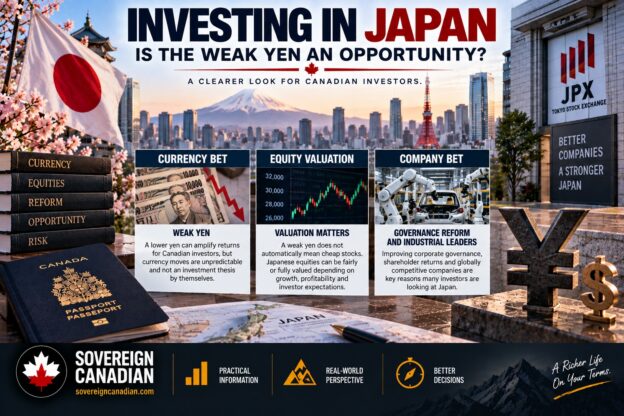
A cheap currency does not automatically mean a cheap stock market, and that distinction turns out to be most of the story. There are at least three separate bets hiding inside the sentence “Japan looks cheap.”
There is the currency bet: whether the yen itself is unusually weak and might eventually strengthen.
There is the equity valuation bet: whether Japanese stocks are actually cheap once you look past the currency.
And there is the company bet: whether specific Japanese businesses or sectors are positioned to do well because Japan itself is changing.
These three things are related, but they are not the same trade, and conflating them is how a reasonable observation on the street turns into a sloppy investment thesis.
Is the yen actually cheap?
Start with what is real. As of late September 2026, USD/JPY has been trading around 157, and CAD/JPY has been sitting close to 112. Ten years ago, USD/JPY was closer to 120. Twenty years ago it was closer to 115. The yen has weakened meaningfully against most major currencies over that stretch, and the move accelerated hard after 2022.
The most useful way to think about this is not the spot rate but the real effective exchange rate, or REER. A REER adjusts a currency for inflation differences and weights it against the currencies of a country’s actual trading partners, rather than comparing today’s exchange rate to some arbitrary date in the past.
On that measure, the yen is sitting near extraordinary multi-decade lows. This is not a currency that looks a little soft. It looks unusually weak in a way that shows up clearly once you strip out inflation and look at trade-weighted purchasing power.
Why?
The most important driver is the interest-rate gap. The Bank of Japan raised its policy rate again on September 18, 2026, taking it to 1.25 percent, the highest level since 1995. Under normal logic, a rate hike should support a currency. This one did not. The vote split seven to two, Governor Kazuo Ueda made no commitment to a fixed schedule of further hikes, and the yen weakened after the decision.
The market read a cautious, data-dependent central bank rather than the beginning of an aggressive hiking cycle, while the rate gap against the United States remains large enough to support carry trades, where investors borrow cheaply in yen and invest the proceeds in higher-yielding assets elsewhere.
Layer on top of that Japan’s energy dependence. Japan’s energy self-sufficiency rate was only about 16.4 percent in fiscal 2024, according to the country’s Agency for Natural Resources and Energy, leaving it heavily dependent on imported oil, coal and liquefied natural gas. There is also the steady outbound flow of Japanese capital from pension funds, insurers and households investing abroad.
Those persistent outbound flows can add to selling pressure on the yen, particularly when Japanese interest rates remain below rates available abroad, though exchange rates ultimately reflect several interacting trade, capital and expectations channels rather than any single cause.
What would change this?
A narrowing of the interest-rate gap between the United States and Japan could support the yen. A genuine risk-off shock, the kind that forces leveraged carry trades to unwind quickly, can push it stronger in a hurry. Japan’s Ministry of Finance has also demonstrated that it is willing to intervene when currency moves become sufficiently disorderly.
On the other side, a more dovish Bank of Japan, continued fiscal expansion, persistent interest-rate differentials or another energy-price shock could push the yen weaker still.
I want to be careful here, because it is tempting to treat “historically weak” as though it means “must eventually snap back.”
It does not.
Some of what is driving the yen lower may be structural rather than purely cyclical, tied to Japan’s demographics, energy dependence and international capital flows. A currency can stay historically cheap for a long time if the underlying reasons for cheapness remain in place.
So the honest position is that yen weakness creates potential upside for an unhedged Canadian investor if it eventually strengthens, and additional downside if it weakens further. I am not going to pretend I know which of those outcomes is more likely.
Cheap yen does not mean cheap stocks
Here is where the trip changed my thinking.
I went in assuming that if the currency was this cheap, the stock market was probably cheap too.
It is not, at least not in the way the currency is.
The Nikkei 225 broke above 68,000 for the first time on June 3, 2026, closing at 68,402. That is not a market sitting at fire-sale prices.
Broader Japanese equities, measured by the TOPIX rather than the price-weighted Nikkei, still trade at a meaningful valuation discount to the US market. Forward earnings multiples are in the mid-teens rather than the considerably higher multiples attached to the S&P 500, while Japanese price-to-book ratios also remain substantially lower.
But a discount is not the same thing as a bargain, and two things temper that discount considerably.
First, the market has already rerated hard. Japanese equities are trading around record territory, and a meaningful part of the “cheap Japan” trade that value investors were making five years ago has already played out.
Second, Japanese companies as a group still generate lower returns on equity than their American counterparts, and a market with structurally lower profitability arguably deserves to trade at a structurally lower multiple. Some of the gap between Japan and the US is a currency and sentiment story. Some of it reflects genuine differences in profitability and capital efficiency.
So the honest version is that Japan still trades below the United States on several valuation measures, which is true and worth knowing.
But that is a very different statement from saying the Japanese market is sitting there at fire-sale prices because the yen happens to be weak.
Those are not the same claim, and the second one is not well supported by the numbers.
Show the FX math
This is the part that actually matters if you are deciding whether to put money into Japan, and it is simpler than it looks.
When you buy a Japanese asset with Canadian dollars, your eventual return in CAD is not just the return on that asset in yen. It is the combination of the local return and the change in the exchange rate, and the combination is multiplicative rather than additive.
In plain terms:
CAD return = (1 + Japanese asset return) × (1 + yen return versus CAD) − 1
A few examples make this concrete.
Say you put CAD $100,000 into a Japanese investment.
Scenario one. The Japanese investment gains 20 percent, but the yen weakens 15 percent against the Canadian dollar over the same period.
CAD $100,000 × 1.20 × 0.85 = roughly CAD $102,000.
The Japanese investor made 20 percent. The unhedged Canadian investor made about 2 percent. Almost the entire local gain was erased by the currency.
Scenario two. The Japanese investment gains a more modest 10 percent, but the yen strengthens 20 percent against the Canadian dollar.
CAD $100,000 × 1.10 × 1.20 = roughly CAD $132,000.
That is a 32 percent return. The currency did most of the work.
Scenario three. The Japanese investment is flat, but the yen appreciates 25 percent.
CAD $100,000 × 1.00 × 1.25 = CAD $125,000.
That is a 25 percent return from currency alone, with the underlying business contributing nothing.
Scenario four. The Japanese investment falls 10 percent and the yen weakens another 20 percent.
CAD $100,000 × 0.90 × 0.80 = roughly CAD $72,000.
That is a 28 percent loss driven by both legs moving against you at once.
| Japanese asset return | Yen vs. CAD | CAD $100,000 becomes |
|---|---|---|
| +20% | -15% | ~$102,000 |
| +10% | +20% | ~$132,000 |
| 0% | +25% | ~$125,000 |
| -10% | -20% | ~$72,000 |
The point of laying this out is not to scare anyone off Japan. It is to make clear that buying Japanese assets without hedging the currency means owning two separate moving pieces, and either one can dominate the outcome in a given year.
This is also where currency-hedged Japan exchange-traded funds come in.
A currency-hedged fund attempts to strip out most of the yen’s movement, leaving you closer to the local return on the underlying companies. If your actual thesis is specifically that the yen is unusually weak and likely to recover, buying a hedged fund removes the very exposure you were trying to capture.
You would be making the equity bet while deliberately switching off most of the currency bet.
On the other hand, if your thesis has nothing to do with the currency, if you simply believe Japanese companies will do well and would rather not take a view on where the yen goes, hedging can make sense.
It is not that hedged is universally better or unhedged is universally better.
It depends on which bet you actually intend to make.
Something has really changed in corporate Japan
If there is a Japan story with more substance to it than the currency, this is probably it.
For decades, Japanese companies were notorious for sitting on enormous cash piles, holding shares in each other for reasons that had more to do with business relationships than investment logic, generating low returns on equity, and facing relatively little pressure from shareholders to change any of it.
Starting in 2023, the Tokyo Stock Exchange began explicitly pushing listed companies to focus on their cost of capital and share valuations, particularly companies trading below book value.
The scale of the problem was substantial. When the reform push began, the TSE noted that roughly half of Prime Market companies and around 60 percent of Standard Market companies had both returns on equity below 8 percent and price-to-book ratios below one.
Since then, Japanese companies have increased buybacks and dividends, cross-shareholdings have continued to unwind, and shareholder activism has become a much more visible part of the market.
The improvement has not been a perfectly clean one-way march. Different company universes produce different below-book statistics, and those numbers move with market prices as well as management decisions. But the direction of the reform itself is real.
It helps to split this into two phases.
The easy phase is paying out excess cash, buying back stock and selling cross-shareholdings. These are relatively straightforward decisions once management commits to them, and Japan has made real progress here.
The hard phase is closing mediocre businesses, selling non-core assets, improving return on invested capital and allocating capital rationally across sprawling corporate groups.
That work is much less complete.
If I had to pick the more durable Japan thesis between the weak yen and this governance shift, I would lean toward the governance shift.
A currency can and does reverse.
A structural change in how companies are expected to behave, once it takes hold, tends to be much harder to undo.
Is Japan becoming a normal economy again?
For roughly three decades, Japan operated under conditions that were genuinely unusual by global standards.
Prices barely moved or fell outright. Interest rates sat at zero or below zero. Wage negotiations produced modest, grinding increases at best.
That has started to change.
Core inflation, excluding fresh food, was 1.7 percent year over year in August 2026. Spring wage negotiations have also produced increases around 5 percent in recent years, levels Japan had not seen for decades.
That sounds like the return of a more normal inflationary economy.
The complication is that real wages, meaning pay adjusted for inflation, have not kept pace consistently. Headline wage settlements also do not map perfectly onto the entire Japanese workforce, particularly employees of smaller firms.
I do not think this question is settled.
Whether Japan has genuinely escaped its deflationary mindset, with a durable cycle of rising wages feeding rising consumption feeding further wage growth, or whether the country is still somewhere in the transition, remains an open question.
It matters for almost everything else in this article, because it sets up the case for the banks.
The banks
For most of the last thirty years, Japanese banks operated in an environment that was actively hostile to how banks normally make money.
Near-zero interest rates crush the spread a bank earns between what it pays depositors and what it charges borrowers.
Positive, rising rates change that math directly.
Mitsubishi UFJ Financial Group, or MUFG, is the largest of Japan’s three megabanks and a reasonable stand-in for the group.
The bank has experienced a substantial improvement in profitability as Japanese rates have normalized, while its valuation has rerated along with it. MUFG’s current medium-term plan targets an ROE of approximately 12 percent for fiscal 2026, a level that would have looked distinctly ambitious during Japan’s long zero-rate era.
That illustrates a pattern that shows up repeatedly in this research.
The investment case has improved in real, measurable ways: wider margins, higher profitability, stronger capital returns.
At the same time, the valuation has moved substantially higher.
So a large share of the easy money has already been made.
Buying MUFG today is not the same trade as discovering an overlooked Japanese bank before rate normalization began. Sumitomo Mitsui and Mizuho have followed broadly similar paths.
The thesis may be improving at exactly the same time that the price becomes less attractive.
Japan’s closest thing to a Berkshire
If you have followed Japanese stocks at all in the last few years, you have probably heard of the sogo shosha, the handful of enormous diversified trading houses that Warren Buffett and Berkshire Hathaway began buying years ago.
It is worth understanding what these companies actually are before deciding whether Berkshire’s involvement means anything for your own decision.
A sogo shosha is not quite a normal trading company and not quite a holding company.
Itochu, Mitsubishi Corporation, Mitsui & Co., Marubeni and Sumitomo Corporation, the five major houses Berkshire owns, run sprawling businesses spanning energy, metals, food, agriculture, infrastructure, machinery, chemicals and logistics. They also own direct stakes in operating businesses around the world, from mines to supermarkets to power projects.
Calling them Japan’s Berkshire Hathaway is useful shorthand.
It also hides some important differences.
The trading houses are generally much more exposed to commodities and global economic cycles than Berkshire, and they have nothing resembling Berkshire’s enormous insurance float, the pool of relatively low-cost capital that has historically given Buffett so much flexibility.
Berkshire began building its positions around 2019 and disclosed stakes above 5 percent in all five in August 2020. By 2026, its holdings in each had risen above 10 percent, and Berkshire’s new CEO Greg Abel has reiterated that the company views them as very long-term investments.
Berkshire has also issued substantial amounts of yen-denominated debt. That matters because yen investment income can be matched against yen financing costs, reducing the currency mismatch Berkshire would otherwise carry.
This is the part worth sitting with.
Buffett’s Japan trade is not the same trade available to a Canadian buying these stocks today.
Berkshire bought years earlier at substantially lower valuations, has access to enormous amounts of capital, can fund itself directly in yen, and can hold the investments essentially indefinitely.
A Canadian buying today pays today’s valuation, funds the position in Canadian dollars unless they deliberately do otherwise, and carries the resulting currency exposure.
None of that means the trading houses are uninteresting on their own merits.
Itochu in particular stands out for capital discipline and lower dependence on volatile commodity earnings than some peers, which makes it an interesting company to study.
I am not recommending it.
The conclusion is simply that the sogo shosha are probably the closest thing Japan has to diversified Berkshire- or Brookfield-style capital allocators, but the analogy only goes so far, and the reasons Berkshire likes them do not automatically transfer to an individual Canadian investor.
Japan’s world-class industrial companies
Set aside the household names for a moment and look at the companies most Canadians have never heard of but that quietly dominate specific industrial niches worldwide.
For a Canadian portfolio already heavily exposed to financials and resources, and often relying on US mega-cap technology for much of its technology exposure, this kind of industrial and automation exposure is genuinely different, not just geographically but structurally.
Keyence makes sensors and machine-vision systems used in factory automation and has extraordinary margins, a substantial net-cash position and an unusually strong balance sheet.
Fanuc is a leader in industrial robotics and CNC controllers and sits directly in the path of the global trend toward automating factories that are struggling to find workers, a trend Japan’s own shrinking labour force makes especially relevant at home.
Komatsu, in construction and mining equipment, is more cyclical and tied to global capital spending.
Hitachi is worth mentioning separately as an example of successful corporate transformation, having reshaped itself over the past decade from a sprawling conglomerate into a more coherent business focused on areas including power grids, rail systems and industrial digital technology.
The theme across all of these is that Japan remains exceptionally strong in industrial segments that rarely show up in a typical consumer’s daily life.
And the country’s demographic problem, a shrinking working-age population, is itself becoming a source of demand for the automation these companies sell.
The catch is one that repeats throughout this article:
Being an excellent company does not automatically make a stock attractively priced.
Several of Japan’s highest-quality industrial companies already trade at valuations that assume a great deal of continued success.
Semiconductors: Japan never really left
Japan is no longer the dominant force in leading-edge chip manufacturing that it was in the 1980s.
What it retained, and in some cases strengthened, is an unusually strong position in the equipment, materials and testing that the global semiconductor industry depends on regardless of where the chips themselves are fabricated.
Tokyo Electron is a major global supplier of deposition and etching equipment.
Advantest is one of the dominant companies in semiconductor testing, including equipment used on increasingly complex AI-related chips.
Disco dominates highly specialized cutting, grinding and processing equipment used in semiconductor manufacturing and advanced packaging.
Shin-Etsu Chemical is one of the world’s largest suppliers of silicon wafers.
These are not marginal Japanese companies trying to catch up. They hold important positions in categories most people never think about.
The problem is price.
Tokyo Electron and Advantest have both traded at very high earnings multiples during the AI capital-spending boom, well above the levels that would normally be associated with a cheap market.
Japan is also investing heavily in rebuilding domestic semiconductor capacity through the government-backed Rapidus project and Taiwan Semiconductor Manufacturing Company’s expanding presence in Kumamoto. Both support the broader Japanese supply chain, even if Rapidus itself remains an ambitious and unproven project.
Japan may have a genuinely excellent semiconductor equipment and materials industry and a mediocre entry price at the same time.
Both things can be true.
What about Japanese real estate?
Japan also has a substantial listed real estate investment trust market.
J-REITs trade on the Tokyo Stock Exchange much like Canadian and American REITs, and parts of the sector offer relatively high income yields while trading below estimates of underlying property value. Tourism has also provided a meaningful tailwind for hotel-focused assets.
But here is the contradiction worth understanding.
The same rise in Japanese interest rates that helps the banks is a direct headwind for REITs.
Higher rates raise refinancing costs and can push capitalization rates higher, putting downward pressure on property valuations.
This is a good example of why there is no single unified Japan trade.
What helps one sector can hurt another at exactly the same time.
Prime central Tokyo and Osaka property is also a fundamentally different asset from property in shrinking regional towns. Major listed developers such as Mitsui Fudosan and Mitsubishi Estate have attracted investor attention partly because the market value of some prime property holdings may exceed their carrying values, while governance reform is increasing pressure to use assets and capital more efficiently.
For Canadians interested in the property side rather than listed securities, I have covered that separately in Japan Real Estate for Canadians.
The less obvious Japan opportunity
There is a case, separate from everything above, that Japan’s smaller and mid-sized listed companies represent a more genuinely inefficient corner of the market than the large, closely followed names most investors default to.
The characteristics supporting that argument are real.
Many smaller Japanese companies receive limited analyst coverage. A significant number continue to trade below book value. Some sit on unusually large net-cash positions. Family and insider ownership remains common, and the same governance pressure reshaping large companies is gradually working its way through smaller firms where more inefficiency may remain.
This may be one of the parts of the Tokyo Stock Exchange reform story with the most runway left.
The caveats matter just as much.
Liquidity in individual small-cap names can be thin. Meaningful research requires real effort. Governance at family-controlled companies does not necessarily improve on the timeline outside shareholders hope for. And direct access for Canadian retail investors is less convenient than buying North American-listed securities.
This is not a call to start stock-picking illiquid Japanese small caps.
It is simply worth knowing that this layer of the market exists and may behave very differently from the large companies dominating most Japan ETFs.
How a Canadian can actually invest in Japan
Assuming any of this has convinced you Japan is worth a closer look, the practical access question comes down to a handful of routes.
Broad exchange-traded funds are the simplest entry point.
EWJ is the longstanding heavyweight among US-listed Japan ETFs, while lower-cost alternatives such as FLJP and BBJP offer broad Japanese equity exposure through different index methodologies.
Currency-hedged funds are a different animal.
DXJ, for example, is not simply “Japan with the currency removed.” WisdomTree describes DXJ as exposure to Japanese dividend-paying companies with an exporter tilt, while hedging yen fluctuations against the US dollar.
That distinction matters.
DXJ’s performance can differ from a plain broad-market Japan index because both its currency treatment and its stock-selection methodology are different.
ADRs provide another route.
Toyota, Sony and Japan’s major banks have exchange-listed American depositary receipts that allow North American investors to buy exposure through ordinary brokerage accounts without trading directly in Tokyo.
Other Japanese companies trade over the counter in North America instead, generally with less liquidity and potentially wider spreads.
Then there is direct ownership.
Interactive Brokers Canada provides access to the Tokyo Stock Exchange, while RBC Direct Investing also publishes an international-trading schedule covering Japanese exchanges, although its pricing is dramatically different from a low-cost online global broker.
The broader point is that direct Tokyo access exists for Canadians, but it is less universal than access to Canadian and US markets.
For anyone interested in international diversification more broadly, this also fits naturally into the Asset Haven side of my Flag Theory framework: the objective is not secrecy or moving everything offshore, but understanding what additional markets, currencies and institutions are actually available to you.
One more point is worth making clearly.
If you already own a broad developed-market or global equity fund such as XEF, ZEA, XAW or VXC, you almost certainly already own Japan.
Japan is one of the largest country weights in developed international indexes and represents a meaningful slice of broad global indexes.
A dedicated Japan position, for most diversified Canadian investors, therefore isn’t first-time exposure.
It is a deliberate overweight on top of exposure you already have.
The tax question
This is where the structure of what you own matters almost as much as the investment itself.
Japan generally withholds tax on dividends paid to foreign investors. Under the Canada-Japan tax treaty, Japanese tax on an ordinary portfolio dividend paid to a Canadian beneficial owner is generally capped at 15 percent.
What happens after that depends on both the account and the investment wrapper.
If you hold Japanese securities directly in a taxable Canadian account, Japanese withholding applies, but the foreign tax may generally be included in calculating Canada’s foreign tax credit, subject to the normal Canadian rules.
Inside an RRSP or TFSA, the situation is different. CRA does not allow foreign taxes paid on income earned inside those accounts to be included in the foreign-tax-credit calculation. And unlike the special Canada-US treaty treatment available for certain US-source investments held directly inside an RRSP or RRIF, Japanese dividend withholding does not simply disappear because a Japanese investment sits inside a Canadian registered account.
ETF structure adds another layer of complexity.
A Canadian-listed ETF that owns Japanese shares directly will generally incur Japanese withholding inside the fund.
A US-listed Japan ETF that owns Japanese shares directly also incurs Japanese withholding at the fund level. But whether an additional layer of US withholding applies when the US ETF distributes income to a Canadian depends on the Canadian account holding it.
According to BlackRock Canada’s current foreign-withholding-tax guide, a US-listed international equity ETF held directly inside an RRSP or RRIF is generally exempt from that second US withholding layer, although the underlying Japanese withholding remains a cost.
Hold the same US-listed international ETF in a TFSA, and the picture changes: the underlying foreign withholding remains and US withholding can also apply to the ETF distribution, with neither generally producing a usable Canadian foreign tax credit inside the TFSA.
In a taxable account, the structure changes again because some withholding may be creditable while withholding suffered internally by a foreign fund may not flow through to you in the same way.
That sounds annoyingly complicated because it is.
The important point is not that one wrapper is always best. It is that direct Japanese shares, a Canadian-listed Japan ETF and a US-listed Japan ETF are not necessarily tax-equivalent simply because they ultimately own the same Japanese companies.
For a small position, the difference may not justify redesigning your portfolio around withholding-tax efficiency. For a meaningful allocation, it is worth understanding the actual fund structure and account treatment before choosing the vehicle.
The case against Japan
None of the above means Japan is an easy or obvious buy, and the bear case deserves real weight rather than a token paragraph.
Japan’s population has been shrinking since the mid-2000s, its population is among the oldest in the world, and the working-age population is expected to decline substantially over the coming decades.
That matters for domestic consumer demand, labour availability and the fiscal cost of an increasingly elderly population. It also weighs heavily on regional property outside the major cities.
But it is also part of what makes the automation companies discussed earlier structurally interesting.
A shrinking workforce is exactly what creates sustained demand for robots and productivity-enhancing equipment, areas where Japan happens to be exceptionally strong.
Government debt is genuinely enormous by global standards, with gross debt well above 200 percent of GDP.
That is not a claim that Japan is heading toward default.
A large share of Japanese government debt is held domestically, including by the Bank of Japan, and Japan simultaneously holds enormous external assets.
It does mean that as interest rates rise from the extraordinary levels of the past few decades, debt-service costs become a more meaningful fiscal constraint.
Japan’s energy dependence is another structural vulnerability. The country remains heavily dependent on imported fossil fuels, so a weak yen combined with expensive oil or LNG can be painful for the trade balance and for companies that consume large amounts of imported energy.
Japan also carries meaningful economic and geopolitical exposure to China and to tensions around Taiwan. The sharp decline in Chinese tourism during 2026 following diplomatic friction was a useful reminder that these risks can migrate from foreign-policy headlines into the real economy.
Set against all of that, though, the most immediate practical risk for an investor looking at Japan today may simply be valuation.
The market has already rerated substantially from where it traded five years ago.
A genuinely good story bought at the wrong price can still turn into a disappointing investment.
And a fair amount of what makes Japan interesting has already shown up in the price of the most obvious ways to access it.
So what are you actually betting on?
By this point it should be clear that “I want to invest in Japan” is not, by itself, a real investment thesis.
It is a starting point that needs to be sharpened into something more specific before it translates into an actual decision.
| If your thesis is | What you are actually seeking |
|---|---|
| The yen is unusually weak and may eventually recover | Unhedged Japan exposure |
| Japanese companies can do well but I do not want to speculate on the currency | Currency-hedged Japanese equities |
| Corporate governance reform still has real runway left | Value, cash-rich and restructuring situations, potentially including small caps |
| Interest-rate normalization continues | Japanese banks and insurers |
| Japan retains genuine industrial advantages | Automation, precision machinery and advanced materials |
| AI-related capital spending stays strong | Semiconductor equipment and materials |
| Japanese markets still contain overlooked value | Small caps and special situations |
This is not a list of recommendations, and it is not meant to be exhaustive.
It is a map from belief to exposure.
The useful exercise is figuring out honestly which row, or rows, actually describes what you believe rather than defaulting to the first Japan ETF that comes up in a search.
Where this leaves me
For what it is worth, here is how this changed my thinking.
I came into this expecting the weak yen itself to be the investment story.
I do not think that anymore.
The yen genuinely looks historically weak on a real, trade-weighted basis, and that observation was not wrong. It just turned out to be a smaller part of the answer than I expected, because it does not make Japanese equities broadly cheap, and the currency bet is a separate decision from the equity bet no matter how naturally the two get talked about together.
What surprised me more was the corporate governance story.
I went in treating it as background context and came out thinking it might be the more durable of the two theses, precisely because it does not depend on anyone correctly predicting an exchange rate.
The bank-normalization story is real as well, though enough of it has already shown up in prices that my enthusiasm is tempered without being erased.
Japan’s industrial franchises are as impressive as advertised, and the semiconductor equipment businesses are genuinely dominant in their niches, but current valuations in several areas make me cautious about paying up simply because the underlying business is excellent.
The small- and mid-cap governance story is the one I would want to keep watching rather than act on yet, mostly because it is the hardest part of this market to research and access properly from Canada.
I am not claiming to know yet whether, or how much, Japan I personally should own.
What I can say is that the question changed shape over the course of writing this.
It stopped being about a weak currency and started being about which of several separate, more specific ideas actually holds up.
Coming back to the convenience store
I can walk outside right now, into a convenience store or onto a train platform, and directly feel what roughly 112 yen per Canadian dollar means.
The stock market does not work that way.
It does not hand you an obvious physical signal the way a cheap meal or train ride does.
I started this because Japan felt cheap.
After actually looking at the market, that sentence needs an important qualifier.
The yen looks cheap. Japan as a whole does not look uniformly cheap.
A large part of the stock market has already rerated to reflect a genuinely different corporate Japan from the one that existed a decade ago.
Some Japanese assets are still worth serious attention. But the most compelling reasons to look at Japan right now are not simply “the currency is on sale.”
They are a historically weak currency that may or may not reverse, an unfinished governance transformation, the normalization of interest rates after decades near zero, genuinely dominant global industrial and materials businesses, and pockets of the market where inefficient capital allocation may still be changing.
Several of the most obvious ways to access those themes have already rerated to reflect them.
Japan deserves real attention from a Canadian investor building a globally diversified portfolio.
But buying Japan today means deciding, specifically, whether you want the currency, the broad market, a particular structural change inside corporate Japan, or some combination, and what price you are willing to pay for it.
Those are different decisions wearing one name.
And the country you visit and the market you invest in are not always telling you the same story.
A future piece on this site will walk through the mechanics of buying foreign stocks directly from Canada, covering ETFs, ADRs, over-the-counter shares and direct foreign listings side by side.
This article set out to answer a narrower question: whether the weak yen itself is the opportunity.
The answer, as best I can tell, is that it is one piece of a larger puzzle, not the whole thing.
This article reflects my own research and personal views as of September 2026 and is not financial or tax advice. Market data, valuations and currency levels change quickly and should be independently verified before you act on anything here. I am not a licensed financial advisor or tax professional, and specific tax outcomes depend on your own investments, fund structures and account types. Speak with a qualified professional before making investment decisions.