
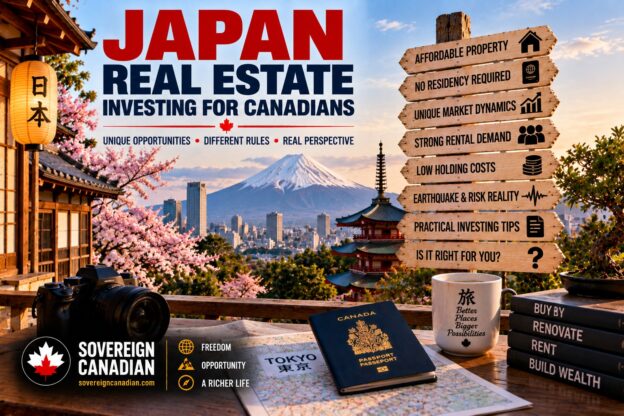
I started looking at Japanese property the way most Canadians probably do, which is by accident. I was reading about the weak yen, wandered onto a listing site, and found myself staring at a detached house an hour outside a major city priced at less than the annual property tax bill on some Toronto homes. Then I found an apartment in a real city, on a real train line, for the price of a parking space in Yorkville. My first reaction was the one the internet wants you to have: this has to be a mistake, or an opportunity, and either way I should keep scrolling.
The more I looked, the more I realized the cheap-property story was simultaneously true and misleading. Japan is not a poor country hiding a fire sale. It is one of the richest, safest, most functional places on earth. The trains run to the second. The rule of law is real. Foreigners can buy property with no residency or nationality requirement. Tourists arrive in record numbers. And yet large parts of the residential market behave in a way that would look like a malfunction to anyone raised on Canadian real estate, where the assumption that a house is a savings account that always goes up is baked so deep we forget it is an assumption at all.
So this is not a pitch. It is an investigation into a single uncomfortable question. How can property be this inexpensive in a country this wealthy, and does the answer describe an opportunity or explain why the property is cheap in the first place? Cheap real estate can mean genuine undervaluation. It can also mean lower expected returns, demographic decline, structural depreciation, poor liquidity, location risk, or some combination of all of them. The whole game is figuring out which of those explanations fits which part of Japan, because Japan is not one property market. It is dozens.
Can a Canadian actually buy property in Japan?
Yes, and this is the part that genuinely surprises people. Japan is one of the most open real-estate markets in the developed world. A Canadian can buy freehold land and buildings on essentially the same legal footing as a Japanese citizen. There is no nationality test, no residency requirement, no minimum spend, no government approval board, and no reciprocity condition. You do not need to live in Japan, hold a visa, or ever have set foot in the country. Freehold ownership does not expire, and you can sell, rent, or pass the property to your heirs. Condominiums, which the Japanese call manshon, come with a proportional and permanent share of the underlying land, which is very different from the leasehold arrangements common across much of Southeast Asia. Always confirm whether a specific property sits on freehold or leasehold land, because both exist.
Here is the crucial thing to be clear about, because a lot of marketing muddies it deliberately. Buying property in Japan gives you no residency rights whatsoever. There is no investment visa, no golden visa, no path to a Japanese passport hiding inside a real-estate transaction. Ownership and the right to live in Japan are entirely separate legal systems. If anyone implies that a house is a back door to living in Japan, stop reading whatever they are selling.
There is also a live regulatory dimension, and it is moving. Foreign purchases have hit record levels recently, helped by the weak yen, and that has drawn political attention. The response so far is disclosure rather than restriction. A non-resident who acquires Japanese real estate must file a report with the Ministry of Finance, through the Bank of Japan, within twenty days of the purchase. That filing requirement is long-standing, but an exemption that used to cover a buyer’s own-residence purchase was removed in April 2026, so it now applies to every non-resident acquisition regardless of purpose. A separate step requiring buyers to disclose their nationality at ownership registration is being phased in through 2026. Land near military bases and other sensitive sites carries its own notification rules under a dedicated security law, and agricultural and forest land carry extra requirements. None of this restricts foreign ownership or adds a surcharge today. What is worth watching is that the governing coalition committed in late 2025 to draft legislation strengthening the rules on foreign land acquisition for the 2026 parliamentary session, so a tightening from today’s unusually open baseline is a real policy risk rather than a certainty. This is the fastest-moving part of the whole picture, so verify the current state of these rules before you act.
Why Japanese real estate does not behave like Canadian real estate
To understand why so much Japanese property looks cheap, you have to unlearn a Canadian instinct. In Canada we treat the house and the land as a single appreciating blob. Japan values them separately, and structures depreciate far faster than Canadians expect. The National Tax Agency assigns each building a statutory useful life for tax-depreciation purposes: roughly twenty-two years for a wooden house, the most common type, and forty-seven years for reinforced concrete. That is a tax-accounting schedule, not an official declaration that the house has no value once the clock runs out, but it shapes how buyers, banks, and appraisers behave. Land is the more durable half of the value, and in a desirable urban location it can represent seventy to eighty percent of the total, while the building is the part quietly written down on the books. Even land is not a guaranteed store of value: in shrinking rural markets it has fallen for decades. The insight is the separation of land and structure, not a promise that either one always holds.
This is where the famous claim that Japanese houses become worthless after thirty years needs care, because it is partly true, partly an accounting convention, and partly internet exaggeration. The statutory useful life is a tax rule, not a statement about when a house falls down. A well-built, well-maintained wooden house can last sixty to seventy years. The thirty-year figure has two roots. First, the postwar boom produced a great deal of cheap, seismically weak housing that genuinely did not age well. Second, government statistics historically recorded buildings mainly when they were demolished, so the many older houses still standing never showed up in the averages.
What is real is how these conventions feed on themselves. Rapid structural depreciation and a market preference for newer stock reduce the collateral value of older houses and make lenders more cautious about them, which pushes buyers toward demolition and rebuilding rather than renovation, and a preference for new construction hardens into a market fact. A newly built home commonly loses a meaningful share of its value the moment the first owner takes possession, much like a new car. A tax quirk even keeps empty houses standing: land with a residential building on it gets a large property-tax reduction versus vacant land, so owners leave the old structure up.
This cuts both ways for a buyer. A structurally sound twenty-five-year-old house can trade at a discount that reflects its age and the cultural preference for new construction rather than any physical problem, which a patient foreign buyer may sometimes be able to use, though I would want real transaction evidence before calling it a reliable inefficiency. But if you are counting on the building itself to appreciate the way a Canadian house does, you are fighting the entire structure of the market.
The demographic question is the enormous caveat
Now the part that should make any investor cautious. Japan’s population is shrinking, and not gently. The country peaked near 128 million around 2008 and sits close to 123 million now, losing something like half a million people a year. Medium-variant projections put it around 105 million by 2050 and near 75 million by the end of the century. The working-age population, the people who actually rent and buy, peaked in the mid-1990s and is on a long decline that steepens from here. The median age is around fifty, fertility has been below replacement for half a century, and marriage rates, which drive most Japanese births, have collapsed.
When you buy an asset whose local buyer pool may shrink for decades, you should want a very good reason. That is the honest bear case, and it is not one to wave away in a sentence.
But the simple version of the demographic argument is also wrong, and this is the single most important thing I learned. National decline does not fall evenly. Japan is depopulating and urbanizing at once, so people and economic activity are consolidating into a handful of major metros even as the country as a whole empties out. Greater Tokyo and its surrounding prefectures, Nagoya’s region, Fukuoka, and Sendai are holding or gaining share of a shrinking total, while rural towns hollow out at a frightening pace, some with vacancy rates above one in five homes.
The implication reframes the entire exercise. Japanese real estate is not really a bet on Japan. It is a bet on a specific city, a specific train station, and a specific neighbourhood. A prime node inside Tokyo or Fukuoka can stay desirable, or even appreciate, while the national headline number falls for thirty years. A house in a depopulating town can lose its buyer pool entirely. The country-level statistic tells you almost nothing about the block you are actually buying on. Any serious analysis has to zoom in.
The markets that might actually work
Because location is everything, it is worth walking through the markets a foreign buyer might realistically consider, and being honest that they are not interchangeable.
Tokyo is the anchor. It accounts for a huge share of national transaction value and offers the deepest liquidity, strong transparency, and consistently low vacancy in its popular wards. Occupancy there is high enough that landlords have, for the first time in a generation, regained real pricing power, and rents that were flat for decades are now rising at renewal. New condominium prices in the twenty-three wards have pushed to record levels, with the used market posting some of its strongest gains in years. The catch is yield. Using Global Property Guide’s cross-city series, which compares median rents with median prices on a consistent basis, the average Tokyo gross yield sits near three and a quarter percent, and prime central wards run lower still, often in the two to three and a half percent range. You are buying stability and liquidity, not cash flow, and buying at or near record prices.
Osaka is the more interesting income story. Entry prices are lower, and on the same Global Property Guide basis its gross yields run closer to four and a half percent, comfortably above central Tokyo, and the city has genuine commercial weight. Two cautions. The 2025 World Expo has already come and gone, so treat any lingering Expo hype as a spent catalyst rather than a reason to buy. The integrated resort and casino development targeted for later this decade is more durable, but do not underwrite a purchase on a single project. Separate the temporary from the structural.
Kyoto is a trap disguised as a postcard. The tourism is real, heritage protections and height limits genuinely constrain supply, and that scarcity supports land values. But those same protections, plus some of the strictest short-term-rental rules in the country, make it far harder to turn tourist fame into rental returns than newcomers expect. Fukuoka is the city the demographic optimists point to, and with reason: it is young, growing, attracting internal migration, and offering higher yields than Tokyo, even as the wider Kyushu region shrinks around it. Sapporo offers affordability, winter tourism, and gross yields around five percent on that same series, the highest among the major cities it tracks, with slower underlying demographics and the separate, foreigner-heavy Niseko resort market nearby.
Then there is everywhere else. Regional cities and rural towns advertise gross yields of seven to ten percent, and on a spreadsheet that looks irresistible. The yield is compensation for risk: thinner tenant demand, faster depreciation, weaker liquidity, and a buyer pool that may not exist when you want to sell. A five-million-yen rural house and a fifty-million-yen Tokyo apartment are both Japanese real estate in the way a lottery ticket and a bond are both financial assets.
The truth about akiya
No English-language discussion of Japanese property survives contact with the akiya, the abandoned house, so it deserves its own section. The headline is genuinely striking. Japan’s most recent national survey counted roughly nine million vacant homes, about fourteen percent of the entire housing stock. Some are listed for a few hundred thousand yen. A handful are effectively free, handed over in exchange for a commitment to renovate and move in.
Before you book a flight, two rounds of cold water. First, that nine-million figure is widely misused. It includes rentals sitting between tenants, second homes, and units on the market. The number of genuinely abandoned, nobody-is-coming-back houses is closer to four million, and they are concentrated exactly where you would least want to own: depopulating rural prefectures far from the demand driving city prices. Second, the purchase price is the smallest number in the transaction. A conservative renovation of a structurally sound old house commonly runs three to eight million yen, and a full restoration five to fifteen million or more, routinely exceeding the purchase price several times over. Add closing costs of six to eight percent, ongoing property tax, and, if the place has sat empty, a real risk of an unfavourable seismic profile.
The complications compound. Many akiya carry tangled title, with fractional ownership spread across dozens of distant relatives, though a 2024 reform now makes inheritance registration mandatory and is slowly cleaning this up. Many rural houses sit on agricultural land, which is tightly restricted for every buyer regardless of nationality, typically requiring approval from the local agricultural committee and often farmer status. Municipalities can designate a neglected property a specified vacant house, stripping its tax break and sometimes billing the owner for demolition. And the listings live mostly on Japanese-only municipal akiya banks run for regional revitalization, not for foreign investors.
The investor’s question cuts through all of it. If nobody local wants this house at two million yen, what do I know that the local market does not? Sometimes there is a real answer: a specific town on the upswing, a personal willingness to do the work, a lifestyle payoff that does not need to pencil out financially. But a two-million-yen house that needs fifteen million in work and is nearly impossible to resell is not cheap. It is expensive and illiquid wearing a cheap price tag. A cheap lifestyle asset and a good investment are two different things, and English-language coverage of the akiya market routinely blurs the distinction.
The weak yen: opportunity or optical illusion?
For a Canadian, the weak yen is doing a lot of the emotional work in the cheap-property story, and it deserves cold scrutiny. As a rough illustration, at recent rates near one hundred fifteen yen to the Canadian dollar, a ten-million-yen house is about eighty-seven thousand dollars, a thirty-million-yen apartment about two hundred sixty-one thousand, and a fifty-million-yen unit about four hundred thirty-five thousand. Those numbers will have moved by the time you read this, which is exactly the point. Treat every conversion here as an example, not a quote.
A weak yen genuinely does lower your Canadian-dollar cost of entry, and that is real. But currency is a two-way street that most cheerful analyses only walk down one side of. Buy when the yen is historically weak and you have taken on an open currency position. Your rent arrives in yen. Your eventual sale proceeds arrive in yen. If the yen strengthens, your Canadian-dollar returns get a tailwind on top of any property gain. If it stays weak or weakens further, that same currency can quietly erase a perfectly good yen-denominated return when you convert back. There is no law that says the yen must revert to some remembered level, and betting on mean reversion is a speculation, not a plan.
The blunt way to put it is that a property earning four percent in yen is not earning four percent in Canadian dollars. It is earning four percent plus or minus a currency move you do not control. If your thesis for buying in Japan is mostly that the yen is cheap, you are not making a real-estate investment. You are making a currency bet with a building attached, and there are cleaner ways to bet on a currency.
What the investment math actually looks like
Vague promises of attractive Japanese yields fall apart the moment you build an actual pro forma, so let me build one. These figures are illustrative and clearly labelled as assumptions, not a forecast for any specific unit.
Take a thirty-million-yen apartment in an Osaka-type market, roughly two hundred sixty-one thousand Canadian dollars at the illustrative rate. Assume rent of one hundred ten thousand yen a month, which is one million three hundred twenty thousand yen a year, a gross yield of four point four percent. That gross figure is the number the listings and the agents will quote you. Now start subtracting the real costs of ownership. Acquisition friction of about eight percent adds roughly two point four million yen up front, taking the all-in cost to about thirty-two point four million yen before you collect a single yen of rent.
Then the annual costs, and to be useful the arithmetic has to be shown in full. A vacancy allowance of five percent takes about sixty-six thousand yen off the top. Condominium management fees and the mandatory repair-reserve contribution come to perhaps two hundred sixteen thousand yen a year. A property manager taking five percent of the collected rent, since you are not in the country, is about sixty-three thousand yen. Fixed asset and city planning taxes run around one hundred fifty thousand yen. Earthquake and fire insurance is roughly thirty thousand yen, and a maintenance allowance another fifty thousand. Those costs total about five hundred seventy-five thousand yen, so the net operating income lands near seven hundred forty-five thousand yen. That is a net yield of about two and a half percent on the purchase price, and closer to two point three percent once the acquisition costs are included. Treat every figure here as a clearly labelled assumption for one illustrative unit, not a market average for Osaka.
Sit with that number. The headline four point four percent gross became roughly two point three to two point five percent net, and that is before any Japanese tax, any Canadian tax, financing, or a single yen of currency movement. A central Tokyo unit at a three point four percent gross yield lands closer to two percent net on the same logic. The question is not whether Japanese property can produce a positive net yield. It usually can. The question is whether two to two and a half percent, net of the currency risk, distance, administration, and weaker appreciation outlook, adequately compensates a Canadian who could instead hold a diversified portfolio or, frankly, a Canadian bond. Sometimes the honest answer is no, and the number says so.
Financing and transaction costs
Here is where the famous Japanese low interest rates meet reality. Japan does have cheap mortgages, but access depends far more on your residency than your nationality, and a non-resident Canadian is close to the back of the queue. Lenders want Japanese-sourced, taxed income; even a Japanese citizen earning entirely overseas hits the same wall. Permanent residents and long-term residents can borrow on close to local terms, with low rates and high loan-to-value ratios. Non-residents mostly cannot. For someone living in Canada, ordinary Japanese mortgage financing is largely out of reach. What exists is a specialist product rather than a mainstream one, offered by a small number of lenders on materially lower leverage and higher pricing than a resident would see, with shorter amortizations and often a requirement that the property sit in central Tokyo or another defined prime market. Specific terms vary by lender and change quickly, so treat any advertised figure as a starting point to confirm directly. The practical result is that most non-resident foreign buyers pay cash.
It is worth killing a stale talking point too. The Bank of Japan has been raising rates, so the era of nearly free money is fading even for locals, and a non-resident was never getting the headline rate anyway. The realistic alternative is Canadian capital, cash or a home-equity line of credit. But borrowing against Canadian real estate to buy Japanese real estate means your true hurdle rate is your Canadian borrowing cost, not Japan’s, and that changes the entire calculation.
Transaction costs, at least, are reasonable by global standards. Budget six to ten percent of the price for total acquisition friction, higher if you finance, covering a legally capped brokerage commission, registration and one-time acquisition taxes on the assessed value, stamp duty, and the judicial scrivener who handles registration. Ongoing, you owe annual fixed asset and city planning taxes plus condominium and repair-reserve fees. The process runs sixty to ninety days, can be done remotely through a power of attorney, and requires a way to move yen, usually via your agent or a Japanese account.
Earthquakes and physical due diligence
You cannot evaluate a Japanese building the way you would a Canadian condo, because the ground moves. Japan sits on the convergence of four tectonic plates, experiences on the order of fifteen hundred perceptible earthquakes a year, and accounts for roughly a fifth of the world’s larger quakes. Two dates matter enormously, and both are governed by the date on the construction confirmation certificate rather than the completion date or the seller’s word.
The first is June 1981, when the new seismic standard, shin-taishin, took effect. The second is June 2000, when the rules for wood-frame houses were tightened again with better foundations and joint connectors. The difference is not academic. In the Architectural Institute of Japan’s survey of Mashiki, the town at the epicentre of the 2016 Kumamoto earthquake, the collapse rate for wooden houses built under the old pre-1981 standard was about twenty-eight percent, against roughly nine percent for those built under the 1981 standard and about two percent for post-2000 construction, and not a single house rated to the top seismic grade collapsed. The same pattern showed up in the 1995 Kobe earthquake, where the great majority of collapsed houses, and of the deaths, were in pre-1981 buildings. A building’s relationship to those two dates can materially affect its collapse risk, whether banks will finance it, and how easily you resell it.
In practice the rule is simple. For anything built before 2000, and absolutely for anything pre-1981, budget for an independent seismic diagnosis by a licensed engineer before you commit, and treat a missing construction certificate as a red flag rather than a paperwork nuisance. Earthquake insurance is a separate, government-backed add-on to fire coverage and is typically capped at a fraction of the insured sum, so it mitigates rather than eliminates the risk. Finally, pull the local hazard maps for flooding, tsunami, landslide, and liquefaction, because a cheap price sometimes reflects a location the maps already flagged.
Short-term rentals and the minpaku problem
Record tourism makes the Airbnb fantasy almost irresistible: buy a small apartment, list it, let visitors pay your mortgage. The regulatory reality is far less accommodating. Japan’s 2018 Private Lodging Business Act, universally called the minpaku law, created a legal path for short-term rentals but capped ordinary registered minpaku at one hundred eighty nights a year. That single number breaks most naive projections, because your unit sits idle for half the year unless you convert it to medium-term letting.
On top of the national cap sit local rules that are actively tightening. Many condominium associations ban short-term rentals outright through their bylaws, separate from any government rule, and industry surveys suggest the large majority of buildings do exactly that. Kyoto imposes particularly restrictive local rules, limiting minpaku in many residential zones to a narrow window that quietly makes it non-viable in exactly the neighbourhoods tourists want. Osaka was long the friendliest, thanks to a special zone that allowed year-round operation and at one point hosted the large majority of such properties nationwide, but the city stopped accepting new special-zone applications in May 2026, closing that door to newcomers while letting existing operators continue. And as of mid-2026 the national tourism agency allows municipalities to cut the permitted operating days to zero in sensitive areas, a local ban in all but name. Running a legal minpaku means registration, a posted licence number, fire-safety equipment, twenty-four-hour guest contact, passport verification, and neighbour notification, with real enforcement behind it.
The economics then finish the job. Cleaning, platform fees, furnishing, higher turnover, and active management take a large bite out of gross short-term revenue, and a non-resident owner faces withholding on the income on top of that. The idea that a Canadian can buy an apartment from nine thousand kilometres away and quietly run it on Airbnb does not survive contact with the rules or the workload. Short-term rental in Japan is a genuine business that rewards experienced local operators. For an overseas passive investor it is mostly a regulatory and operational headache wearing a tourism halo.
Taxation, on both sides of the Pacific
Tax is where a mediocre Japanese investment can become a genuinely poor one, and it has two sides.
The Japanese side
Japan taxes the income and gains from Japanese property regardless of where the owner lives. For a non-resident, a business or corporate tenant withholds about twenty percent of the rent, though rent paid by an individual for their own or a relative’s home is exempt. That withholding is not the final tax: a non-resident still files an annual Japanese return, deducts expenses and depreciation, and has the withholding credited against the final bill, so the effective rate on net income is often well below the headline. You must appoint a Japanese tax representative. Annual holding taxes run around one point seven percent of the assessed value, and assessed values sit meaningfully below market.
On sale, capital gains are taxed separately and the holding period matters a great deal. Property held for more than five years as of the first of January in the year of sale is taxed at roughly twenty percent, while property held for five years or less is taxed at nearly forty percent. There is also a collection mechanism where the buyer withholds about ten percent of the sale price from a non-resident seller, credited later. The primary-residence exemptions available to residents generally do not apply to you.
The Canadian side
Because this is where Canadian owners get tripped up, read it twice. As a Canadian tax resident you are taxed on worldwide income, so your Japanese rental income must be reported in Canada on the standard rental form, in Canadian dollars, whether or not you leave a single yen in Japan. To avoid being taxed twice on the same income, you claim a foreign tax credit for the Japanese tax you paid. That credit comes from Canadian domestic law and the associated form, not from the treaty itself; the Canada-Japan tax treaty helps allocate taxing rights and adds predictability, but it mitigates double taxation rather than eliminating it, and differences in timing, classification, and tax base can still leave you with mismatches.
Then there is the reporting trap. If the total cost of your specified foreign property exceeds one hundred thousand Canadian dollars at any point in the year, you must file the foreign-asset information return, and the penalties for missing it are steep even when no tax is owed. The nuance that catches people is that the test is primary use, not whether rent was ever collected. A property used primarily, meaning more than half the time, for your own personal enjoyment stays exempt as personal-use property even if it is rented out occasionally to help cover costs, while a property held mainly to earn income is specified foreign property that counts. A place rented eight months of the year for profit and used by you for four does not qualify for the exemption. On sale, the Canadian gain is calculated in Canadian dollars using the exchange rates on your purchase and sale dates, so a currency move can create or erase a taxable gain independent of the yen price. That gain is then subject to the capital-gains inclusion rate in force in the year of disposition, which should be confirmed against the enacted rules at the time rather than assumed. Verify every threshold and rate before you file, because these details move.
Estate and inheritance risk
This one is easy to overlook and unpleasant to discover late. Japan has an inheritance and gift tax regime with some of the highest rates in the developed world, reaching well past fifty percent at the top, and Japanese-situs property can remain within the Japanese inheritance-tax net even where the owner and the heirs are non-residents. A Canadian who owns a Japanese apartment has created a Japanese-situs asset that can draw Japanese inheritance tax on death, with a filing obligation and a valuation exercise landing on heirs who may not speak the language or know the system. Whether anything beyond the Japanese property itself gets pulled in depends on a web of residency, domicile, and look-back rules that are genuinely fact-specific. I am not going to pretend to resolve that here, and neither should any blog. If you get far enough to be serious about a purchase, this is a question for a cross-border tax and estate specialist before you buy, not after someone dies.
Owning it from nine thousand kilometres away
Strip away the theory and ownership comes down to mundane logistics performed across a twelve-hour time difference and a language barrier. Someone has to collect the rent, vet tenants, attend the condominium association meetings, pay the taxes, arrange repairs, and check on an empty house after the next typhoon or earthquake. You will not be doing any of that from Ontario. A property manager will, for a fee that eats into the already thin net yields, and the good ones earn it. Language is a real cost, not a footnote: contracts, tax notices, and contractor conversations happen in Japanese, and a non-resident must maintain a Japanese contact and tax representative. None of this is prohibitive. It is simply the unglamorous reality that separates a property that looks easy in a listing from one that is manageable from Canada.
Who Japanese real estate actually makes sense for
The frustrating and useful answer is that it depends entirely on what kind of buyer you are, and three buyers make the point.
Investor A wants a relatively liquid, professionally managed long-term rental in a major global city, and buys a central Tokyo apartment. She accepts a net yield around two percent because what she is really buying is a developed-world asset with real rule of law and currency exposure that diversifies away from Canada. Judged as pure income against equities or bonds, it is mediocre. The harder question, and the one she should force herself to answer, is why a two percent net Tokyo condo is a better store of value than the alternatives that give her almost the same yen and Japan exposure with far less friction: a Japanese REIT, Japanese equities, yen-denominated bonds, or simply holding yen. The honest answers are narrow. She wants direct, titled property rather than a security, she may use it herself, and she wants a physical foreign asset she holds directly rather than a brokerage security. Those can be sufficient reasons, and they point at the one thing property offers over the paper alternatives, a flag that plants slowly. Diversification on its own is not, because she can buy that far more cheaply. As long as she does not tell herself she is buying cash flow, and can say why she wants the building rather than the paper, she is not fooling herself.
Investor B wants rental income but expects to spend a few weeks a year in Japan. He buys an Osaka apartment, rents it most of the year, and uses it himself when he visits. His financial return is unremarkable, but he is also buying a foothold, a personal-use benefit, and optionality. For him the mediocre yield is subsidized by genuine lifestyle value, and that can be a perfectly rational trade, the same yield-and-lifestyle calculus that draws Canadians toward markets like Mexico. He should just be clear that the personal use, not the return, is carrying the decision, and that using it himself changes how it is treated for tax.
Investor C sees a three-million-yen rural house online and assumes there must be an arbitrage. There usually is not. He is looking at a lifestyle project priced like a bargain, one that will demand many times its price in renovation, sit in a depopulating town, and be very hard to sell. If he wants the project and the rural life, wonderful. If he thinks he has found free money the local market missed, he has misread the situation entirely.
Scoring Japan
Pulling it together, here is how Japan grades on the factors that actually matter to a Canadian buyer, the same factors I weigh for any market in the wider offshore framework. These are qualitative judgments, not false-precision scores.
| Factor | Assessment |
|---|---|
| Foreign ownership rights | Strong. Freehold, few restrictions, though transparency rules are tightening |
| Entry price | Strong in rural and regional areas, stretched at the prime urban top end |
| Rental yield | Weak in central Tokyo, moderate in Osaka and regional cities |
| Appreciation potential | Weak nationally, moderate in select consolidating urban nodes |
| Demographics | Weak nationally, but sharply divergent by city and neighbourhood |
| Rule of law | Strong. A genuine developed-world advantage |
| Political and property-rights risk | Low. Stable institutions and secure title, a genuine strength |
| Foreign-buyer regulatory risk | Moderate and rising from a very low base, as disclosure rules tighten and further legislation is under discussion |
| Currency risk | Moderate to high, and a double-edged sword for a Canadian |
| Financing availability | Weak for non-residents. Cash is the realistic route |
| Tax complexity | High, on both the Japanese and Canadian sides |
| Management from Canada | Weak. Feasible but genuinely demanding across the distance and language |
| Personal-use value | Strong for the right buyer, negligible for a pure investor |
| Residency optionality | None. Property confers no visa or residency |
| Resale liquidity | Strong in prime Tokyo, moderate in major cities, weak to nil in rural areas |
The pattern is hard to miss. Japan scores well on the things that make a market safe and open, and poorly on the things that drive appreciation and cash flow. It looks stronger as a jurisdictional-diversification and lifestyle market than as a high-return real-estate market. Preserving capital is not guaranteed either, because a rural house, an aging condo in the wrong location, or an unhedged yen position can all erode it. What Japan offers is diversification and optionality in a functioning system, not aggressive compounding and not a promise of preservation.
What I would actually do
If I were seriously investigating a Japanese purchase, here is the sequence I would follow.
- Decide honestly which buyer I am. Pure investment, hybrid, or lifestyle. Each is judged by a different standard, and pretending a lifestyle asset is an investment is the most common way to get hurt.
- Refuse to treat “Japan” as the unit of analysis. I would pick a specific city, then a specific station, then a specific neighbourhood, and evaluate that block on its own demographics and demand.
- Concentrate a pure-investment search on highly liquid Tokyo nodes or genuinely growing major-city markets such as Fukuoka and selected parts of Osaka, where liquidity and demand are most durable, and ignore headline rural yields.
- Build the full net pro forma, not the gross yield, and stress-test it against a further ten percent move in the yen in the direction that hurts.
- Pay for an independent seismic diagnosis on anything built before 2000, and walk away from a missing construction certificate.
- Assume a cash purchase, and price the opportunity cost of that cash honestly against a diversified Canadian portfolio.
- Engage a cross-border tax and estate specialist before making an offer, specifically on foreign-asset reporting, the foreign tax credit, and Japanese inheritance exposure.
- Only then, and only if the numbers survive all of that, would I fly out to see the actual property and the actual neighbourhood before committing a dollar.
The verdict
So does Japan’s unusual combination of wealthy-country institutions, weak demographics, cheap-looking housing, and a weak yen make its real estate attractive to a Canadian, or merely make it look cheap? After all of it, my honest answer is that both are true at once, and the whole skill is telling them apart.
Japan offers something genuinely rare: developed-world assets, with real rule of law and real infrastructure, at prices Canadians associate with emerging markets, the mirror image of the trade-off in a frontier European market. But the discount is not a mistake the market has failed to notice. It is the market pricing in weak demographics, structural building depreciation, thin appreciation, and, in the countryside, disappearing demand. Where the cheapness is real value is narrow and specific: prime, consolidating urban locations, and hybrid or lifestyle purchases where a modest financial return is topped up by personal use and diversification. Where the cheapness is a warning sits everywhere the yield looks too good, the price looks too low, and the buyer pool is quietly vanishing.
Part of what makes Japan look cheap to us is simply that we are Canadians, conditioned by an unusually appreciation-driven housing market to assume property always compounds. Japan is a useful corrective to that reflex. It deserves serious consideration precisely because it is so different from home, not because a ten-million-yen house is automatically a bargain. For the right buyer, on the right block, with clear eyes about the yen, the tax, and the distance, it can make sense. For everyone else, it is a fascinating market to understand and a poor one to buy on impulse.
This article is general information for Canadian readers and reflects conditions as of its research date. It is not investment, tax, legal, or immigration advice, and I am not a lawyer, an accountant, or a licensed advisor. Foreign real estate involves currency, tax, legal, and liquidity risks that are specific to your situation. Rules, rates, thresholds, and exchange rates referenced here change frequently. Before acting, verify current figures with primary sources and consult qualified Canadian and Japanese cross-border professionals.