
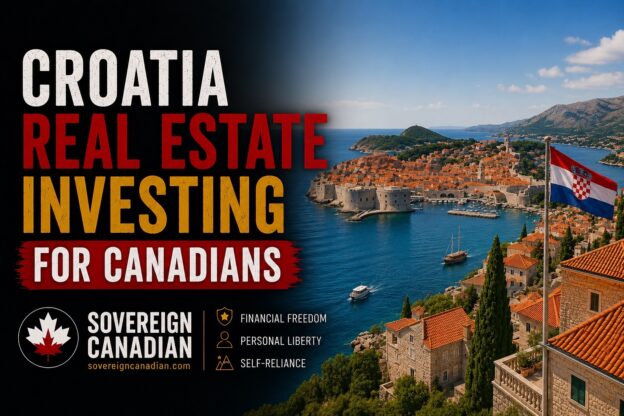
Mexico sells yield. Portugal sells lifestyle and a legal system you recognize. Croatia sells something neither of them can: full EU membership, the euro already in your wallet, and a coastline that’s still catching up to its own tourism numbers.
If you’ve read the Mexico intro post or the Portugal intro post, you know how I open these — with the honest version of “why here, and why not somewhere cheaper or closer.” For Croatia, the honest version is this: it’s the only market in this series where you’re buying into a country that finished its integration story. EU accession happened in 2013. It adopted the euro in January 2023. It joined the Schengen zone the same year. There’s no currency conversion drama, no “will this country still be in the EU in ten years” question, and no separate visa-free travel calculus once you’re in. You’re buying property in a fully normalized European jurisdiction that also happens to have 1,700+ islands and some of the clearest water in the Mediterranean.
That normalization comes at a cost — literally. Croatian house prices rose over 13% in 2025 alone, the eighth straight year of gains, and the easy-money era of “cheap Adriatic villa” is mostly gone except in the interior. This is the primer for a new arm of the series, sitting under the foreign real estate investing pillar post that maps the whole international strategy. Individual regions — Istria, Split and the Dalmatian coast, Dubrovnik — get their own deep dives later. This post is the map before the itinerary.
Popular Areas: Rental Income vs. Retirement Life
These are not the same list, and treating them as interchangeable is the single most common mistake I see Canadians make when they start browsing Croatian listings.
For rental income:
- Split and the central Dalmatian coast — the busiest short-term rental market in the country by volume, strong ferry and flight connectivity to the islands (Hvar, Brač, Vis), and a 12-month base of demand rather than a pure July-August spike.
- Zadar — cheaper entry point than Split with similar tourist draw, plus a fast-growing digital nomad and remote-work crowd extending the season into shoulder months.
- Istria (Rovinj, Poreč, Pula) — the peninsula closest to Italy and Slovenia, with a long-established German and Austrian repeat-tourist base that predates Croatia’s EU membership. More predictable, less flashy, consistently rented.
- Zagreb — the outlier on this list because it’s not a beach play at all. It’s a long-term-rental city: professionals, students, and a stable capital-city tenant base. If STR regulation on the coast keeps tightening, Zagreb’s LTR market is the quiet hedge.
For retirement and lifestyle:
- Istria — mild winters, proximity to Italy for day trips, decent healthcare infrastructure, and the most mature expat community in the country. This is the closest thing Croatia has to Portugal’s Algarve.
- Opatija and the Kvarner Riviera — an old Austro-Hungarian resort town with a genuine year-round community, not just a summer shell.
- Hvar, Korčula, smaller islands — beautiful, but be honest with yourself about winter. Ferry schedules thin out, some businesses close for the season, and liquidity if you ever need to sell is thinner than on the mainland.
Dubrovnik belongs on neither list for most Canadians. It’s spectacular, it commands premium prices, and the old town specifically has been actively restricting new short-term rental permits to manage overtourism. If Dubrovnik is the draw, buy for love, not yield.
Legal Structure for Foreign Ownership
Here’s the mechanic that trips up more North Americans than anything else in this post: Croatian property law runs on reciprocity, not blanket foreign-ownership rights.
EU, EEA, and Swiss citizens buy under the same conditions as Croatian nationals — no extra approval, no waiting period. Canadians are not EU citizens, so you fall into the “third country” category, which means two things:
- Canada needs a reciprocity arrangement with Croatia (it does, broadly, though the arrangement is assessed at the province level for Canadian buyers — confirm your specific situation against the Croatian Ministry of Justice reciprocity information and with a Croatian property lawyer before you get attached to a listing).
- You need Ministry of Justice approval before your purchase can be registered. Budget two to six months for this. Your signed purchase contract is legally void without it, so don’t let anyone rush you into skipping the step.
A few structural things worth knowing going in:
- Agricultural and forest land are restricted for non-EU buyers regardless of reciprocity status, unless you’re operating through a registered Croatian business tied to agricultural use.
- The maritime domain — roughly the first six metres of land from the coastline — is public property everywhere in Croatia. Nobody privately owns true beachfront; adjust your mental image accordingly.
- The land registry and cadastre are separate systems, and a meaningful share of properties show discrepancies between the two. This is not optional due diligence — hire your own lawyer, not the seller’s agent’s preferred lawyer, and have them verify the title independently before you put down a deposit.
- Where reciprocity or approval gets complicated, the common workaround is buying through a Croatian company (d.o.o.). This is also the standard structure for non-EU owners who want to run rental activity as a business rather than as an individual — more on that below.
Every foreign buyer, EU or not, needs an OIB (Croatian personal tax number) before completing a purchase. It’s a straightforward application at a Tax Administration office or Croatian embassy, and it’s required for everything downstream — the purchase contract, the bank account, the taxes.
Financing Options for Canadians
Short version: Croatian mortgages exist for foreigners, but they’re not designed for someone earning Canadian-dollar income with no Croatian residency.
Banks like Zagrebačka banka, PBZ, and Erste Bank do lend to non-residents, but expect meaningfully stricter terms than a Croatian resident would get:
- Down payments in the 30–50% range for non-EU, non-resident buyers, versus 10–20% for residents or EU citizens with local income.
- Rates currently in the mid-3% to 4.5% range, tracking the ECB curve since Croatia is fully euroized.
- A Croatian bank account is mandatory, which usually means an in-person visit or a well-organized remote onboarding process.
- Some lenders want a local co-borrower with Croatian employment if your income is foreign-sourced and the file is borderline.
For most Canadians in this series, the realistic paths are: pay cash, tap a HELOC against Canadian property before you go, or arrange private financing — the same playbook that shows up in the Mexico and Portugal posts, because it’s the same underlying problem. Foreign income doesn’t map cleanly onto any country’s domestic mortgage underwriting.
One genuine advantage Croatia has over Mexico: there’s no currency conversion risk once your money lands. Croatia adopted the euro at a fixed rate from the old kuna in 2023, so pricing, financing, and notary costs are all quoted natively in EUR. Your only currency exposure is CAD-to-EUR at the time you move money — which is exactly the kind of transfer where a service with a genuine mid-market rate matters more than your bank’s “no fee” wire that quietly marks up the exchange.
STR vs. LTR Mechanics
This is the section that’s changed the most in the last year, and it’s worth reading closely if yield is your goal.
Short-term rental (under 30 days):
- Owners choose between a flat-rate tax per bed (paušalni porez) or taxation on actual costs. The flat-rate model is the popular choice precisely because it’s predictable — you know your annual liability regardless of occupancy.
- Before you list anything, the property needs categorization (a star rating and inspection through the local tourist board) and registration in the eVisitor system for guest reporting.
- Tourist tax is charged per guest per overnight stay, roughly €1.30–€2.00 depending on season and municipality.
- If you own in a multi-unit building, two-thirds of co-owners by ownership share now have to consent to short-term rental use — a 2024 change that’s already caused friction in some apartment blocks along the coast.
- Starting June 2026, every accommodation unit needs its own unique registration number under new EU-wide rules, without which listing on Airbnb or Booking.com becomes illegal. If you’re planning to run more than one unit, that’s one registration number per door, not per building.
- Non-EU owners who want to run rental as an ongoing activity rather than occasional hosting often route it through a Croatian company, partly for legal clarity and partly because it simplifies the categorization paperwork.
Long-term rental (30+ days):
- Materially simpler tax treatment: your taxable base is 70% of gross rental income, taxed at a flat 10%, plus a small municipal surtax. Effective tax rate typically lands around 7% of gross.
- No categorization, no eVisitor, no tourist tax collection.
- The trade-off is obvious — coastal LTR yields don’t come close to peak-season STR yields. This is the Zagreb argument from the areas section above: less upside, less regulatory exposure, less seasonal labour.
Current Regulatory Landscape
Croatia’s short-term rental market is genuinely one of the most active in Europe — Split and Zadar are near the top of the entire EU for apartments-per-capita listed for tourist rental — and the regulatory response has caught up fast. A new Hospitality Industry Act is in draft form and expected to take effect January 2027, layering on top of the EU registration-number requirement that lands mid-2026. The direction of travel is consistent: more registration, more digitization, less tolerance for informal or unregistered listings. Penalties for operating without proper registration currently run €1,000 to €15,000 for individuals.
Separately, 2025 brought a full property tax reform, replacing the old “holiday home tax” with a single unified annual property tax that applies whether the place is occupied, rented, or sitting empty — €0.60 to €8.00 per square metre, set by each municipality within that national band. If you were picturing a Croatian property sitting vacant with no carrying cost, that loophole is closed.
On the ownership side, Croatia doesn’t have a golden visa program tied to real estate — buying property doesn’t fast-track residency the way it does in some other EU countries. What it can support is a temporary stay permit for “other purposes” (enjoying your own property), renewed annually and capped around nine months a year. Most Canadians who want to actually live there long-term end up looking at the digital nomad visa or another residency pathway alongside the purchase, not instead of it.
Taxes
Layer these on top of whatever you already know from the foreign real estate pillar post, which covers the Canadian side (T776, T1135, T2209, and the foreign tax credit mechanics) in full — I won’t repeat that here.
On the Croatian side:
- Transfer tax: 3% of purchase price on resale property, paid by the buyer.
- VAT instead of transfer tax: new builds sold by a developer typically carry 25% VAT rather than the 3% transfer tax — a much bigger number, so factor it into any new-construction comparison.
- Annual property tax: €0.60–€8.00/m², municipality-set, under the 2025 reform.
- Rental income tax: flat-rate per bed (STR) or 10% on 70% of gross income (LTR/simplified STR), plus local surtax. The Croatian Tax Administration (Porezna uprava) publishes the current rules for renters, including the VAT registration wrinkle that hits anyone dealing with foreign booking platforms.
- Capital gains: property held more than two years and used as a primary residence is generally exempt on sale. Investment property sold within two years, or without primary-residence status, falls under standard capital gains treatment — this is a narrower exemption than it first appears, so don’t assume it applies to a pure rental purchase.
- No inheritance tax for spouses and children, which matters if this property is part of a longer-horizon family plan rather than a pure trade.
Safety
Croatia is consistently ranked among the safer countries in Europe on standard peace and crime indices — low violent crime, stable EU-member governance, and a legal system that treats foreign owners the same as citizens once a title is registered, with equal court access if a dispute arises. That last point matters more than people expect; it’s not universal in this series. The Government of Canada travel advisory for Croatia sits at “take normal security precautions” — its lowest level — with the main flagged risks being petty theft and pickpocketing in tourist-heavy areas, plus poorly maintained rural and coastal roads.
Two practical risk notes rather than headline ones: the Dalmatian coast has some wildfire exposure in peak summer, and Croatia sits in a moderate seismic zone — the 2020 earthquake near Zagreb and Petrinja is the reference point most people bring up. Neither is a reason to avoid the market, but both are reasons to check building age, construction standards, and insurance coverage as part of due diligence rather than as an afterthought.
What I’d Actually Do
If I were deploying capital into Croatia today, ranked:
- Split or Zadar, for a rental play with a fallback. Strong STR demand now, but structured so it still works as an LTR if the regulatory tightening keeps going the way it’s going.
- Istria, for a genuine retirement or long-stay purchase. Established expat infrastructure, proximity to Italy, and a climate that doesn’t punish you for showing up in November.
- Zagreb, only if the coast’s regulatory direction makes you nervous. Lower yield, lower drama, and the one Croatian market that isn’t fundamentally a tourism bet.
- Dubrovnik and the smaller islands, for lifestyle — not yield. Buy these because you want to be there, not because the spreadsheet told you to.
None of these are “buy this week” calls. Croatia rewards patience through the Ministry of Justice approval timeline more than any other market in this series, and rushing that step is how foreign buyers end up with a void contract and a wasted deposit.
Not financial advice. These are my real research notes as I evaluate this market for myself. Run your own numbers and talk to a Croatian property lawyer and a cross-border tax advisor before acting on anything here.