
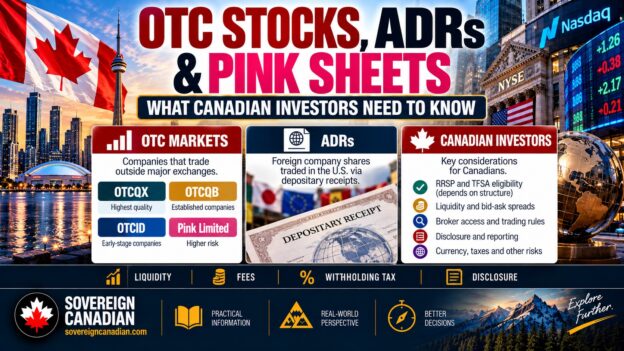
Most Canadians who own foreign stocks never think about where the shares actually trade. The ticker shows up in the app, the price looks fine and the order goes through. Then the spread is wider than expected, or a TFSA purchase gets flagged, or a dividend arrives smaller than announced. In each case the problem wasn’t the business. It was the security, and how it trades.
Not Every Stock Trades on a Major Exchange
Not every stock worth owning trades on the NYSE, Nasdaq or TSX. Nestlé, one of the world’s largest food companies, is listed in Switzerland, and its US line is quoted over the counter. Plenty of speculative microcaps trade in the same general market. Those are very different situations.
I separate four things: the company, the security (an ordinary share, a depositary receipt or something else), the venue where it trades and the ownership structure, meaning what you legally hold. I covered where stocks trade in TSX vs NYSE vs Nasdaq, and S&P 500 vs Nasdaq vs Dow Jones vs TSX covered what index numbers measure. This article covers what lies off that familiar map.
What Does Over-the-Counter Trading Mean?
Over-the-counter (OTC) describes a way of trading, not a type of company. FINRA describes OTC trading as trading that generally takes place off an exchange. Exchange-listed stocks can trade OTC, and unlisted stocks trade only OTC.
An exchange is a centralized marketplace with listing standards. In the OTC world, broker-dealers quote and trade securities with each other and with clients. Market makers are the broker-dealers that post a bid (the price they’ll pay) and an ask (the price they’ll sell at), and in quiet names they’re often why you can trade at all.
OTC Markets Group is a private company that runs the best-known OTC marketplaces and sorts securities into tiers. It isn’t a regulator, and the OTCQB rulebook says that market is not a registered stock exchange. OTCQX and OTCQB are tiers, not exchanges. The NYSE and Nasdaq are SEC-registered national securities exchanges, a different kind of institution.
OTCQX, OTCQB, OTCID and Pink Sheets
The “Pink Sheets” name is a holdover from the paper quotation sheets that preceded electronic trading, and OTC Markets Group traces its roots to the National Quotation Bureau. “Pink” is now loose shorthand for the lower-disclosure end of the market. On July 1, 2025, OTC Markets retired the Pink Current category and launched OTCID, so some older articles and broker help pages describe a structure that no longer exists.
| Tier | What it signals | Notable requirements |
|---|---|---|
| OTCQX | Top tier | Meets OTC Markets’ financial and disclosure standards and stays current on reporting |
| OTCQB | Venture stage | Minimum bid price, audited financials for most issuers, current reporting, no bankruptcy |
| OTCID | Basic market | Current information, a verified profile and an annual management certification |
| Pink Limited | Warning flag | Doesn’t meet OTCID standards, so information gaps may exist |
| Expert Market | Restricted | No current public information, and quotes aren’t shown to the public |
OTC Markets Group says Pink Limited “will serve as a warning” and that the Expert Market is for companies that fail to provide even minimal disclosure. Below those sits the Grey Market, with no public quotations.
A higher tier isn’t a guarantee of financial strength or liquidity. A Pink Limited quotation doesn’t make a company fraudulent or sound. It says the issuer isn’t meeting OTC Markets’ information standard. Keep three things apart: limited disclosure, no verifiable information and a formal finding of fraud by a regulator or court. Large non-US companies also appear in the lower tiers, since strong home-market disclosure doesn’t require a relationship with OTC Markets. And not every Pink security is a penny stock, which is a separate legal definition based on price and size.
What Is an American Depositary Receipt?
An American Depositary Receipt (ADR) is a certificate issued by a US depositary bank that represents shares of a non-US company. Technically it evidences American Depositary Shares (ADS), each representing a set number of the foreign company’s shares held by a custodian in the home market. The SEC’s investor bulletin notes that ADRs trade in US dollars and settle through US systems.
The ratio is the number of underlying shares per ADS. If an ordinary share trades at EUR 50 and an ADS represents four shares, the ADS is worth about EUR 200, or roughly USD 220 at 1.10. It isn’t four times as expensive. It holds four shares. The ratio is a packaging choice, not a discount or a premium.
A sponsored ADR is set up by agreement with the foreign company. An unsponsored ADR is created without the company’s cooperation, often by a broker-dealer. Programs also come in levels:
| Level | US venue | Raises capital? | Reporting in the US |
|---|---|---|---|
| Level I | OTC only | No | Form F-6; no issuer financial disclosure in that filing |
| Level II | National exchange | No | Annual Form 20-F |
| Level III | National exchange, typically | Yes | Annual Form 20-F, plus full registration to offer ADRs |
Form F-6 contains no information about the foreign company, and Level I programs can be unsponsored. That’s why ADR and OTC aren’t synonyms: some ADRs trade on the NYSE or Nasdaq and some trade OTC. Some foreign companies skip ADRs and list ordinary shares in the US instead. Spotify, a Luxembourg company, lists ordinary shares, not ADSs, on the NYSE as SPOT, according to its Form 20-F.
ADRs vs Ordinary Shares: What Do You Actually Own?
What you own is an economic interest in the ordinary shares through a chain. The foreign company’s shares sit with a custodian in the home market, a depositary bank issues ADRs against them and your Canadian broker holds the ADR for you. You aren’t registered on the foreign company’s share register. Owning the receipt and being the registered shareholder are legally different things.
The deposit agreement sets the rest, so I’m describing patterns, not rules. One recent JPMorgan form of ADR shows typical terms. Dividends arrive in the home currency and are converted to US dollars after fees, and that form allows up to USD 0.05 per ADS on a cash distribution and up to USD 0.05 per ADS a year for administration. Voting is indirect: holders instruct the depositary, which handles voting under the deposit agreement, and notices are distributed according to that agreement’s terms. Rights offerings and mergers also run through the depositary and can be handled differently than at home.
Holders can generally surrender ADSs to withdraw the underlying shares, subject to fees. Programs can also end. In that form the depositary gives at least 30 days’ notice and can sell the shares and hold the net proceeds for holders. Voting, conversion and termination rights depend on the program documents and applicable law, so no description fits every ADR.
Real Companies, Four Structures
Four companies show four setups, as of October 2026.
| Company | US ticker | What it is | US venue | Home listing |
|---|---|---|---|---|
| Nestlé | NSRGY | Sponsored ADR | Over the counter | SIX Swiss Exchange (NESN) |
| Tencent | TCEHY | Unsponsored ADR | Over the counter | Hong Kong (0700) |
| Toyota | TM | ADS, each representing ten common shares | NYSE | Tokyo (7203) |
| Spotify | SPOT | Ordinary shares | NYSE | NYSE (Luxembourg-incorporated company) |
Nestlé is a large, reputable company whose US line is OTC. Its investor relations page calls its ADRs its only sponsored secondary trading program and says they trade over the counter in the US, while its shares trade on the SIX Swiss Exchange. The OTC line is a convenient wrapper, not a warning sign.
Tencent is the unsponsored case. BNY’s depositary receipt directory lists TCEHY as an unsponsored, OTC-quoted program with BNY as first filer and other depositary banks also named, and a 2018 SEC exhibit describes unsponsored ADSs for Tencent shares with The Bank of New York Mellon as depositary, so Tencent didn’t set the program up. Status can change, so confirm it.
Toyota’s ADSs are NYSE-listed as TM, each representing ten common shares, according to its Form 20-F, and its stock overview lists the common stock in Tokyo and Nagoya. I look at Japan more broadly in investing in Japan.
Spotify has no depositary and no receipt, just ordinary shares listed in New York. None of these is a recommendation.
Liquidity, Spreads and the Hidden Cost of Trading
A large, sound company can have a thinly traded OTC line. The OTC quote is a secondary market for a company whose main trading happens elsewhere, so there are fewer market makers, wider spreads and prices that can lag or go stale when the home market is closed. An OTC quotation can be less liquid than the primary foreign listing, though OTC liquidity varies widely, and volume and spread are things you can check.
Here’s what a wide spread costs. Say an ADR is quoted at USD 24.00 bid and USD 24.60 ask. You buy 400 at the ask for USD 9,840. Selling immediately at the bid returns USD 9,600. The round trip costs USD 240, about 2.4%, before commissions and currency conversion. At a quote of USD 24.29 bid and USD 24.31 ask, the same round trip costs about USD 8, or 0.08%. Same company, different market.
Order type matters too. A market order takes whatever price is available, which in a thin market can be far from the last price you saw. A limit order caps what you’ll pay. Some brokers decide for you: RBC Direct Investing doesn’t accept market orders on OTC markets, and Wealthsimple supports only limit orders for OTC securities. A price that looks attractive but won’t fill is common.
Buying OTC Stocks and ADRs Through a Canadian Brokerage
I ask five questions: can I view a quote, can I enter an online order, does it need a phone call, can I hold an existing position, and can I buy it in a registered account? A broker can say yes to some and no to others. The examples below come from broker help pages as of October 2026, and they change.
Wealthsimple supports a limited list of US OTC stocks, only in non-registered accounts. Questrade says OTC symbols can be rejected by automated routing, and securities that lose electronic eligibility can only be traded manually through its Trade Desk, with extra fees. RBC Direct Investing says a security that trades only on OTC markets is non-qualified, while one that also trades on a designated stock exchange may qualify. Scotia iTRADE doesn’t accept securities trading only on the OTC Bulletin Board or Pink Sheets in TFSA, RIF or RRSP accounts, and it also excludes “foreign listed certificates”, which its page doesn’t define, so ask how it treats ADRs. Interactive Brokers Canada’s registered-account page lists stocks on designated US and Canadian exchanges and doesn’t mention OTC securities, ADRs or other foreign exchanges.
Broker policy can be narrower than the tax rules, so ask yours.
Can You Hold OTC Stocks and ADRs in a TFSA or RRSP?
A broker letting you click Buy doesn’t tell you a security is a qualified investment. Broker trading permissions and qualified-investment status are separate questions, and the tax consequences of holding a non-qualified investment can fall on the account holder.
For a TFSA, the CRA says any investment not listed as qualified is non-qualified and taxable. The tax is 50% of fair market value when acquired, the plan is taxed on income and gains from the investment, certain further income earned on income already taxed can attract a separate 100% advantage tax if it isn’t withdrawn when the CRA asks, and the 50% can be refunded if you dispose of the investment by the end of the calendar year after the year the tax arose, unless you knew or ought to have known it was non-qualified. See the CRA’s page on non-permitted TFSA investments. RRSPs and RRIFs have their own rules, so the same caution applies.
The main route to qualifying is a listing. Securities listed on a designated stock exchange are generally qualified, and Finance Canada’s list of designated stock exchanges names 5 in Canada and 43 abroad as of March 27, 2026, including the NYSE, Nasdaq, Tokyo, London, Hong Kong and SIX Swiss. Nestlé’s shares on SIX and Toyota’s in Tokyo are therefore listed on designated exchanges. A US OTC quotation alone isn’t a designated-exchange listing, so an OTC-only security generally doesn’t qualify that way, though an OTC quotation doesn’t erase a designated listing elsewhere.
ADRs need more care. An NYSE- or Nasdaq-listed ADR is itself listed on a designated exchange. For other ADRs, section 4900 of the Income Tax Regulations prescribes as qualified “an American Depositary Receipt where the property represented by the receipt is listed on a designated stock exchange.” That wording applies to TFSAs and RRSPs alike, and the CRA’s qualified investments folio reads it the same way (paragraph 1.22). So an OTC ADR whose underlying shares are on a designated exchange can qualify, but the folio doesn’t address individual programs and brokers may be stricter than the law, so confirm with your broker and a tax professional first.
This is educational, not tax advice. My TFSA deep dive covers the wider rules, and RRSP vs TFSA covers account choice.
Dividends, Withholding Taxes and Depositary Fees
An ADR dividend passes through more hands than a Canadian one. The depositary receives it in the home currency, converts it to US dollars, deducts fees and pays your broker. The SEC notes the fees are usually deducted from gross dividends, so you may receive less than the headline figure before tax.
A foreign dividend is still foreign when the ADR trades in the US. Foreign withholding depends on the source country’s tax rules and any applicable treaty relief. My dividend tax guide covers US dividends, including the 15% treaty rate and why a TFSA loses it. Those rules are about US-source dividends. A Swiss or Japanese company’s dividend isn’t US-source because its ADR trades in New York, and I wouldn’t assume the US-Canada treaty rate applies. In a non-registered account, foreign tax withheld can generally support a foreign tax credit. In a TFSA there’s no Canadian tax to offset, and whether an RRSP gets relief depends on the source country and its treaty with Canada.
OTC Stocks and Fraud Risk
OTC status alone doesn’t prove misconduct. The same marketplace holds large foreign companies and shell companies. But FINRA says fraudsters have historically targeted low-priced microcap stocks on OTC markets, because little public information makes them easier to manipulate. In a pump-and-dump, promoters build a position, hype the stock online and sell into the demand they created. FINRA’s red flags include unsolicited advice from strangers, pressure to act now and volatility that “can stem from sudden interest in a normally illiquid stock”.
Other risks are quieter: late or weak disclosure that makes valuation guesswork, dilution, reverse splits, delistings, trading halts and, for some issuers, Canadian cease trade orders after which brokers may block trades. None of it means avoiding the whole category. It means verification falls to you.
When Does an OTC Security Make Sense?
An OTC security or ADR can make sense when it gives convenient access to a substantial foreign company, spreads and liquidity are acceptable, the ownership structure is clear, disclosure is adequate, my broker handles it in the account type I want, and the total cost is lower than going direct.
Other routes can be better. The primary foreign listing may have a tighter market, though it brings currency and custody questions for the next article in this series. An exchange-listed ADR often trades more actively and has clearer registered-account treatment. And for exposure to a country rather than one company, a diversified fund avoids single-security structure risk, as I compared in ETFs vs mutual funds vs individual stocks.
What I’d Actually Do Before Buying an OTC Stock or ADR
- Confirm what the ticker is: an ADR, an ordinary share or something else.
- Find the primary listing and compare how it trades.
- Confirm the venue and, if it’s OTC, the tier and disclosure status.
- Check average volume and the current bid-ask spread.
- Find the ratio, depositary, fees and how dividends are taxed at source.
- Check whether the program is sponsored and how voting works.
- Ask your broker about online orders, order types and support for the position.
- Confirm registered-account eligibility before buying in a TFSA or RRSP.
- Look for conversion, custody or termination issues.
Understanding What You Own
The company, the security, the venue and the ownership structure are four different things. Nestlé’s OTC line is a convenience around a Swiss-listed company, and a speculative microcap quoted in the same general market is a different animal. An ADR can offer convenient exposure without being identical to owning the ordinary share. For Canadians, registered-account eligibility, currency, withholding tax, broker access and liquidity can matter as much as the business. The fourth article in this series covers investing directly in global stock markets, including foreign-currency trading, broker access and custody.
Disclaimer: This article is for general informational and educational purposes only and does not constitute personalized financial, investment, tax or legal advice. Investors should conduct their own research and consult qualified professionals where appropriate.