
If my family spends $15,000 a year on groceries and grocery prices rise 3% a year, the bill in twenty years is about $27,000. That is roughly $12,000 a year more than we pay now, and about $115,000 of extra grocery spending along the way.
Canadians have an obvious thing to say about this, and we say it constantly. Grocery prices are too high. The industry is concentrated. Loblaw, Sobeys and Metro make billions of dollars.
So here is a tidy Canadian idea. If Loblaw, Metro and Empire, the parent of Sobeys, really are earning more as grocery prices rise, why not own them? Collect the dividends, let the shares compound, and get a little of the money back from the checkout counter.
I wanted to know whether that actually works.
The answer is yes, but not for the reason I expected.
A plain broad-market ETF works too.
Once that idea is stripped away, a more interesting investment question is left standing: if I want a defensive Canadian equity position anyway, are any of the grocers attractive enough at today’s prices to deserve a bigger slice of my portfolio?
The answer turns out to be different for each company.
All prices, multiples and yields in this article are based on market data available through October 2, 2026.
Are Canadian grocers actually making too much money?
This is where most discussions of grocery stocks either start or end, so it needs to be dealt with first.
The best source I found is the Competition Bureau’s Canada Needs More Grocery Competition report. I think the original is considerably more useful than the headlines built around it.
The Bureau found that the reported profits of Canada’s three largest grocers—Loblaw, Empire/Sobeys and Metro—rose from about $2.4 billion in 2019 to $3.6 billion in 2022. That is roughly 50%.
But four details matter.
These are whole-company profits, not food-only profits. Loblaw and Metro have substantial pharmacy businesses, and the companies do not publish food-only profits. Their fiscal years also differ. Separately, when the Bureau examined food gross margins, it was working with information voluntarily provided by the grocers and explicitly cautioned that the available data limited the conclusions it could draw.
What it found was that food gross margins had generally increased by about one to two percentage points since 2017. The Bureau called that increase “modest yet meaningful.” (Competition Bureau Canada)
Then comes the part I think matters most for an investor.
The Bureau itself explains that dollar profits can increase even when margins do not. If a grocer buys something for $1.00 and sells it for $1.20, its gross profit is 20 cents. If inflation pushes the cost to $1.10 and the same 20% markup produces a $1.32 selling price, gross profit rises to 22 cents even though the margin did not change.
Across billions of dollars of sales, that effect becomes enormous.
That does not mean nothing happened to margins. A one-percentage-point increase across tens of billions of dollars of grocery sales is real money, and the Bureau’s conclusion was that Canada needs more grocery competition. It specifically pointed to barriers to entry, property controls, the scale advantages of the established companies and the difficulty independents face trying to compete. (Competition Bureau Canada)
But the evidence supports something narrower than either side of the political argument tends to claim.
The three largest grocers’ reported profits rose about 50% between 2019 and 2022. Food gross margins increased by roughly one to two percentage points from 2017. The Bureau also said grocers do not disclose food-only profits, its margin data were limited, and profit dollars can rise substantially during inflation even without wider margins.
That does not prove profiteering.
It does not clear the grocers either.
What grocery inflation actually did
The inflation was certainly real.
According to Statistics Canada, food purchased from stores rose 7.8% on an annual-average basis in 2023, another 2.2% in 2024 and 3.5% in 2025. By August 2026, grocery prices were another 2.8% higher than a year earlier. (Statistics Canada)
The cumulative increase is what households feel. By August 2026, grocery prices were roughly 29% higher than they had been five years earlier.
But higher food prices do not flow mechanically into grocer revenue, let alone profit.
From 2021 through 2025, Loblaw and Metro each increased total revenue by roughly 20%. Grocery prices rose by more than that over the same broad period. And those corporate revenue figures include businesses beyond the grocery aisle, particularly pharmacy.
That alone makes the simple “food went up 25%, therefore grocers pocketed 25% more” story difficult to sustain.
Loblaw is the company where profitability really did improve.
Its reported operating margin was around 4% to 5% before 2021. In fiscal 2025, operating income was $4.42 billion on $63.9 billion of revenue, or roughly 6.9%. Loblaw’s own 2025 annual report shows gross margin at 31.3%, unchanged from 2024 on the reported basis. Loblaw’s 2025 annual report and financial reporting (aem-loblawinc)
That operating-margin improvement is economically significant. I would not wave it away.
But Loblaw is not simply a supermarket. It owns Shoppers Drug Mart, health businesses and T&T. It has pushed further into discount banners, expanded private label, invested in distribution and automation, and spent heavily buying back its own shares.
In the second quarter of 2026, Loblaw reported revenue growth of 4.1%, adjusted EPS growth of 11.9% and retail adjusted EBITDA growth of 5.3%. It also confirmed that it expected to repurchase about $2.1 billion of its shares during 2026. Loblaw Q2 2026 results (Loblaw)
Metro tells a different story. Its margins have been much steadier in recent years. Empire’s adjusted EBITDA margin was also essentially unchanged between fiscal 2025 and 2026.
Those relatively flat margins are difficult to reconcile with a simple story in which higher grocery prices mechanically became wider corporate margins.
Canada can simultaneously have an overly concentrated grocery industry and grocery companies that remain fundamentally low-margin retailers. Those ideas are not contradictory.
Defensive demand is not the same as an inflation hedge
Three ideas tend to get blurred together.
The first is that grocery demand is defensive. People still need to eat during recessions. That is obviously useful to a business.
The second is that grocery stocks hedge food inflation. That would require some reliable relationship between higher grocery prices and higher earnings or stock returns.
I could not establish one.
Food inflation can lift nominal sales, but it also affects wages, freight, energy, inventory, supplier costs and consumer behaviour. Customers trade down. Promotions change. Volumes change. Discount banners gain share.
The third idea is that grocery stocks themselves must therefore be defensive in the stock market.
That does not automatically follow either.
A predictable business can still be a bad investment if I pay too much for it. A company earning steadily growing profits can produce a disappointing shareholder return if its valuation multiple falls from 25 times earnings to 17 times.
The business and the stock are two different things.
That distinction becomes important with Loblaw.
The $15,000 grocery-bill experiment
Suppose my family spends $15,000 a year on groceries today and that bill rises by 3% annually.
After ten years it is about $20,200. After twenty years it is about $27,100.
The additional annual cost in year twenty is roughly $12,100, and the cumulative additional spending over the twenty years is about $115,000.
Now suppose I put $25,000 into a basket of Canadian grocery stocks today and it compounds at 9% a year.
After twenty years, the portfolio is worth about $140,000.
A 4% withdrawal from it would provide about $5,600 a year, covering roughly 46% of the additional year-twenty grocery bill.
That sounds like a reasonably good hedge.
Until I give the exact same $25,000 to a broad ETF and assume the exact same 9% return.
It also becomes about $140,000.
A 4% withdrawal is still about $5,600.
The grocery stocks did not create a special hedge. They compounded.
The hedge wasn’t Loblaw. The hedge was owning productive assets.
That distinction matters.
A household’s grocery bill is exposure to a rising price level. A portfolio of businesses that compounds faster than that price level can offset some of the damage. It does not particularly matter whether those businesses sell groceries, software, rail transportation or industrial equipment.
For a grocery stock to be a genuinely superior grocery-inflation hedge, I would want evidence that its earnings or shareholder returns respond more reliably to food inflation than corporate earnings generally do.
I did not find that evidence.
This is the same broader principle I keep coming back to when comparing investing with other uses of capital. In my article on mortgage prepayment versus non-registered investing, the important question was not whether equities “beat” a mortgage in some abstract sense. It was what kind of return I was actually receiving, after tax and after accounting for risk.
The same discipline applies here.
If the grocery hedge does not actually exist, a grocery stock has to earn its place in my portfolio on its merits as an investment.
So why own grocery stocks at all?
Because the businesses can still be attractive.
They sell necessities. Demand is comparatively predictable. They generate substantial cash. Several have long records of dividend growth and steadily shrinking share counts. And they operate in a Canadian market where building a competing national distribution and store network is extremely difficult.
The Competition Bureau’s 2026 follow-up continues to describe grocery competition as an issue despite progress since its original study. (Competition Bureau Canada)
None of that makes the stocks automatic buys.
It makes them worth valuing.
Loblaw Companies: the best business at the hardest price
Loblaw Companies is no longer just a grocery chain.
Its food businesses include conventional grocery, No Frills, Maxi and T&T. Shoppers Drug Mart gives it a major pharmacy and health presence, while PC Optimum connects much of the ecosystem.
The financial-services structure changed materially in 2026. Loblaw completed the sale of PC Financial to EQB after the second quarter and owned approximately 19.9% of EQB at closing. Starting in the third quarter, Loblaw no longer reports PC Financial as before and instead recognizes its share of EQB’s earnings. (Loblaw)
There is plenty to like.
Scale matters. The discount banners are well positioned when consumers trade down. Pharmacy provides a second growth engine. The company has been expanding its store base, and management is targeting continued per-share earnings growth while returning enormous amounts of capital through repurchases.
What bothers me is the valuation.
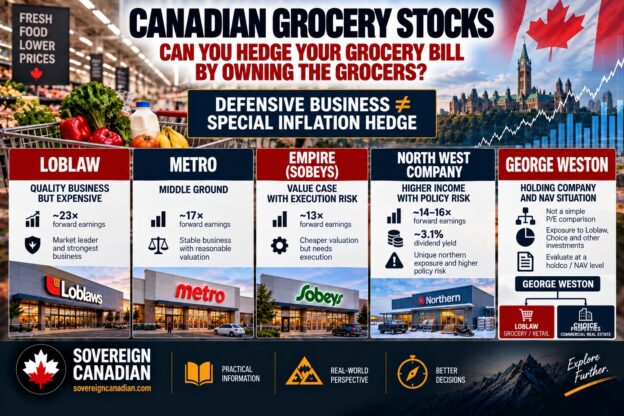
Loblaw closed October 2 at about C$62.16, giving it a market capitalization around C$71.5 billion. Current consensus data put the shares around 23 times forward earnings, with a dividend yield of roughly 1%. (Investing.com Canada)
That is not an obviously cheap price for a grocer.
The historical return is also more interesting than the headline suggests.
Using adjusted historical prices with dividends reinvested, C$10,000 invested in Loblaw at the end of September 2016 would have grown to roughly C$53,000 by October 2, 2026. That is an annualized total return of about 18.2%. (StockVS)
That is exceptional.
But look at when it happened.
Loblaw’s dividend-reinvested calendar returns were roughly -2% in 2017, 13% in 2018, 12% in 2019 and -4% in 2020. Then came approximately 68% in 2021, 17% in 2022, 9% in 2023, 49% in 2024 and 33% in 2025. (StockVS)
Loblaw’s extraordinary decade was overwhelmingly created after 2020.
I do not think that was simply luck. The business improved. Margins expanded. Earnings grew. Buybacks reduced the share count.
But investors also became willing to pay considerably more for those earnings.
That matters because I cannot earn the historical re-rating again unless the valuation rises still further.
At around 23 times forward earnings, I am paying today for a lot of the quality that the market discovered over the last five years.
Loblaw is the business in this group I like most.
It is also the price I like least.
Metro: boring can be useful
Metro operates Metro, Super C and Food Basics along with Jean Coutu, Brunet and other pharmacy banners. It is concentrated in Ontario and Quebec and has annual sales above $22 billion. (Metro)
Its 2026 results were distorted by a strike at its Laval produce distribution centre.
Metro estimated the labour dispute reduced third-quarter profit by C$66 million after tax, or C$0.32 per share. Adjusted EPS fell 18.4% in the quarter. The dispute began March 30 and ended after employees ratified a new five-and-a-half-year collective agreement on September 24. Metro’s Q3 2026 reporting (Newswire)
That episode exposes one of Metro’s less obvious risks. A steady company can still have operational concentration. One important distribution centre caused a visible earnings hit.
At October 2, Metro traded around C$89.09 with a market capitalization of about C$18.7 billion. The shares were around 17.3 times forward earnings and yielded roughly 1.8%. (StockAnalysis.com)
That is a much less demanding valuation than Loblaw’s.
Metro is not exciting, and I mean that as something close to a compliment.
It has a mature food business, a valuable pharmacy operation, reasonably predictable margins and a habit of returning capital to shareholders. Its share count has continued to decline.
Its recent stock performance has been less impressive than Loblaw’s, but that does not make the underlying company poor.
For me, Metro is the middle ground: a good business at a fairly ordinary valuation.
Empire: the cheaper stock with something to prove
Empire Company owns Sobeys, Safeway, IGA, FreshCo, Farm Boy, Longo’s, Foodland and Voilà.
This is the value and recovery case.
Empire closed October 2 at C$48.25, with a market capitalization around C$10.8 billion. Because its reported trailing earnings are distorted by the Voilà impairment, the more useful number is the forward multiple: roughly 13.2 times consensus earnings. (StockAnalysis.com)
That is materially cheaper than Loblaw or Metro.
There is a reason.
In fiscal 2026, Empire recognized C$746 million of impairment charges as it restructured its e-commerce operations, including closing its Alberta Voilà customer-fulfilment facilities. Management expects the changes to improve annualized operating income by approximately C$95 million once fully reflected. Empire’s fiscal 2026 e-commerce restructuring(EmpireCo)
Empire has also been pushing further into discount grocery and continuing to repurchase shares.
But its history contains enough execution mistakes that I would not describe the stock as “Loblaw, only cheaper.”
It is cheaper partly because investors have less reason to give management the benefit of the doubt.
That can create opportunity. It can also create a value trap.
If valuation were my main criterion, Empire is the large Canadian grocer I would investigate first. But it is also the one where I would want the largest margin of safety.
At around 13 times forward earnings, the valuation is already much more interesting than Loblaw’s. What I would want now is evidence that the Voilà reset, discount-store expansion and capital spending actually translate into sustained per-share growth.
North West Company: a different grocery stock
The North West Company does not really belong in the same bucket as the big three.
It operates food and general-merchandise stores in northern and remote Canada as well as Alaska, the Caribbean and the South Pacific. It is much smaller, with a market capitalization around C$2.6 billion.
At October 2, North West traded at C$54.11. Its trailing P/E was about 18.5 times. Forward estimates vary depending on the data provider, but roughly 14 to 16 times is a more defensible range than the 13 times I initially had in the research. Its annual dividend is C$1.68, giving it a yield of about 3.1%. (StockAnalysis.com)
That makes it the only company here that I would really describe as an income stock.
Its latest quarter was strong. Consolidated same-store sales rose 6.7%, including 7.4% in Canadian operations, although the comparison benefited from wildfire disruption in the previous year and current northern spending has also been influenced by settlement payments. North West quarterly reports (FinancialFilings)
The unusual issue is public policy.
Nutrition North Canada subsidizes eligible food shipped to isolated communities. Retailers are required to pass the subsidy through to consumers. The effectiveness of that pass-through has been disputed, and North West has faced scrutiny and litigation around northern food pricing.
I would not casually describe North West as a monopoly. Some communities have extremely limited competition, which is economically important, but it is also exactly why pricing attracts political attention.
The investment case therefore has two sides. North West has attractive returns on capital, a materially higher dividend than the other grocers and a business serving markets where entry is difficult.
Those same characteristics create unusual regulatory and reputational risk.
Interestingly, the dividend has made a large difference to its actual shareholder result. Using adjusted historical prices with distributions reinvested, C$10,000 invested ten years ago would have grown to roughly C$31,400 by October 2, 2026, equivalent to about 12.1% annually. (StockVS)
That is much better than the price-only return suggested in my initial research.
North West deserves more credit as a long-term investment than a simple share-price chart gives it.
George Weston: a cheaper way to get Loblaw exposure?
George Weston Limited is essentially a holding company built around Loblaw and Choice Properties.
At the end of 2025, George Weston owned 52.6% of Loblaw and 61.7% of Choice Properties. (Weston)
At June 20, 2026, the company calculated net asset value of C$45.25 billion, or C$120.89 per George Weston share. That calculation included 609.4 million Loblaw shares worth C$39.1 billion, 446.4 million Choice units worth C$7.29 billion, C$499 million of corporate debt, C$835 million of preferred shares and C$236 million of corporate cash and short-term investments. (MarketScreener)
By October 2, George Weston itself traded around C$100.95. (StockAnalysis.com)
There is clearly a discount.
But I would be careful about calling it free money.
The headline NAV marks Loblaw and Choice at market value. Actually liquidating those holdings could have tax consequences. George Weston also introduces holding-company complexity and gives me Choice exposure whether I want it or not. And a holding-company discount can remain in place for decades.
History provides a useful warning.
Using dividend-reinvested adjusted prices, C$10,000 invested in George Weston ten years ago would have grown to about C$32,800, or roughly 12.6% annually. The equivalent Loblaw investment grew to about C$53,000, or roughly 18.2% annually. (StockVS)
The discount was not a free arbitrage.
There is still something attractive about George Weston buying back its own shares below the value of the underlying assets. That should create some NAV-per-share accretion over time.
But my conclusion is narrower than “buy Loblaw at a discount.”
If I specifically wanted Loblaw exposure and also liked Choice Properties, I would compare George Weston with Loblaw before buying either.
I would not buy George Weston merely because NAV is higher than the share price.
These are mostly not income stocks
It is easy to see “grocery stock” and assume “dividend stock.”
The current yields say otherwise.
Loblaw yields roughly 1%. Metro is around 1.8%. Empire is about 2%. George Weston is around 1.3%. North West is the outlier at approximately 3.1%.
The more important shareholder-return mechanism at Loblaw, Metro and Empire has been a combination of earnings growth, dividend growth and buybacks.
Buybacks matter because they turn corporate earnings growth into faster per-share earnings growth. If the company earns the same amount but has fewer shares outstanding, each remaining share owns more of the business.
They are not automatically valuable, though.
Buying back an undervalued stock can be excellent capital allocation. Buying it back at an inflated valuation is much less compelling.
That is one reason Loblaw’s current multiple matters. The company is still repurchasing billions of dollars of stock, but those repurchases are occurring at a much higher earnings multiple than they did several years ago.
For a deeper look at why the tax character of dividends, capital gains and other investment returns matters, I have a separate guide to dividend taxation in Canada.
What are we paying today?
The relative valuation is clearer after refreshing the numbers.
| Company | Approx. Oct. 2 price | Forward P/E | Dividend yield |
|---|---|---|---|
| Loblaw | C$62.16 | ~23× | ~1.0% |
| Metro | C$89.09 | ~17× | ~1.8% |
| Empire | C$48.25 | ~13× | ~2.0% |
| North West | C$54.11 | ~14–16× | ~3.1% |
| George Weston | C$100.95 | ~19×* | ~1.3% |
*I find NAV more useful than P/E for George Weston because reported earnings are affected by its holding-company structure.
These multiples are not perfectly comparable. Loblaw and Metro have substantial pharmacy businesses. Empire’s trailing earnings contain the Voilà impairment. George Weston is a holding company. North West operates in very different markets.
Still, the spread is large enough to matter.
Loblaw is priced as the premium company.
Empire is priced as the company investors trust least.
Metro sits between them.
North West offers the most income but brings a very different risk profile.
George Weston requires an NAV framework rather than a simple earnings comparison.
That is more useful to me than declaring one of them “the best grocery stock.”
Is there a Canadian grocery ETF?
There is no clean one.
The closest established option is iShares S&P/TSX Capped Consumer Staples Index ETF (XST). Its MER is 0.61%, and it had roughly C$397 million of assets around the end of September. Recent holdings were approximately 25% Loblaw, 24% Alimentation Couche-Tard, 16% Metro and 13% George Weston, followed by Saputo, Empire and North West. (BlackRock)
That is not a grocery portfolio.
Couche-Tard is a convenience-store and fuel business. George Weston creates additional indirect Loblaw exposure. Saputo is a dairy processor.
There is also Global X MART. As of August 31, it was essentially equal-weight Empire, Metro, Loblaw, Dollarama and Couche-Tard. But it had only about C$11 million of assets and is again not a pure grocery fund. (Global X Investments Canada Inc.)
Broad Canadian ETFs already own these companies without requiring me to make a sector bet.
That leads me to a fairly simple conclusion.
If I wanted a deliberate overweight to Canadian grocers, I would rather choose the companies myself than pay a 0.61% MER for XST when a large part of the fund is exposure I did not ask for.
That is especially true when XIC’s MER is only 0.06%.
Which account should hold them?
I would not let asset location determine whether I buy a stock in the first place.
But once I decide to own it, taxes matter.
Canadian eligible dividends receive preferential treatment in a taxable account. CRA’s current guidance confirms that an eligible dividend is grossed up by 38%, with a federal dividend tax credit equal to 15.0198% of the grossed-up taxable dividend. Provincial treatment sits on top of that. CRA’s eligible-dividend rules (Canada)
Capital gains remain subject to the one-half inclusion rate. The federal government abandoned the proposed increase in 2025, and CRA reverted to administering the enacted 50% inclusion rate. CRA capital-gains guidance (Canada)
Inside a TFSA, Canadian dividends and capital gains can compound without Canadian tax. Inside an RRSP, investment income can compound tax-deferred, but eventual withdrawals are generally taxable as ordinary income.
That does not mean “high yield goes in the TFSA” or “low yield goes taxable” is a universal rule. Registered room has an opportunity cost. Expected return, tax rate, withdrawal timing and what else I own all matter.
I go into that broader capital-allocation problem in RRSP vs TFSA: The Decision Changes as Your Income Rises.
US-listed investments add another wrinkle. Under Article XXI of the Canada-US tax treaty, qualifying pension and retirement arrangements receive special treatment for US-source dividends and interest. Canada-US Tax Convention(Canada)
A TFSA or FHSA does not receive the same blanket treatment; CRA explicitly notes, for example, that foreign dividends paid into an FHSA may be subject to foreign withholding tax. (Canada)
That matters if I decide to buy Kroger, Walmart, Costco or a US-listed consumer-staples ETF instead of a Canadian grocer.
For this article, though, I would keep the tax decision subordinate to the investment decision.
First decide whether I want the company.
Then decide where it belongs.
Regulation is real, but I would not build the bear case around it
The regulatory environment has changed.
The Canada Grocery Code became fully operational January 1, 2026. Costco, Empire, Loblaw, Metro and Walmart all registered with it. It is an industry-led code intended to improve predictability and fairness between retailers and suppliers rather than a system of government grocery price controls. (Canada Grocery Code)
Property controls have also become a genuine competition issue.
Manitoba passed legislation restricting grocery property controls, and in 2026 the province began taking remaining controls to its Municipal Board. Manitoba’s property-control legislation (Province of Manitoba)
On September 22, 2026, the Competition Bureau reached a legally enforceable agreement with Empire under which it agreed to stop enforcing restrictive covenants and limit its use of exclusivity clauses. The Bureau’s work on other grocers continues. Competition Bureau–Empire agreement (Canada)
The Bureau also launched a broader examination of competition across Canada’s food supply chain in June 2026. (Competition Bureau Canada)
Those are real developments.
What I have not found is an enacted Canadian grocery windfall-profit tax or government grocery price-control regime as of this article’s October 2026 cutoff.
I therefore see regulation as a persistent risk rather than the core reason not to own the stocks.
For Loblaw, valuation bothers me more.
For Empire, execution bothers me more.
For Metro, growth and operational concentration matter more.
For North West, policy risk is much more directly connected to the business model.
Where I would look for value
This is where the exercise becomes useful to me.
I do not need to decide that Loblaw is a “buy” or Empire is a “sell.” I need to know what price compensates me for what I am getting.
With Loblaw, I struggle at roughly 23 times forward earnings. Around 19 or 20 times I would be considerably more interested. Around the high teens, assuming the operating story remained intact, I would start looking very closely.
That is not a price target. Earnings will move. The multiple is the point.
Metro is easier for me at roughly 17 times forward earnings. I am not getting Loblaw’s recent growth, but I am also not paying Loblaw’s valuation. A weaker share price after the strike, combined with evidence that earnings have normalized, would make the setup more interesting.
Empire is already the cheapest of the big three. At roughly 13 times forward earnings, I do not need another enormous valuation decline to become interested. What I need is more confidence that the operating improvements are durable.
That is an important distinction.
Sometimes the catalyst for buying a stock is a lower price.
Sometimes it is the same price with better evidence.
For Empire, I lean toward the second.
North West is around C$54 with a 3.1% yield. Its five-year average yield has been closer to the high-3% range, so something around a 3.8% yield—roughly the mid-C$40s at the current dividend—would give me a more interesting income entry point. (StockAnalysis.com)
George Weston is different again. I would watch the discount to NAV rather than invent a P/E trigger. If the discount became clearly wider than normal while Loblaw and Choice remained fundamentally sound, the wrapper would become more attractive.
This is why “best business” and “best stock” are not the same question.
Loblaw is the best business of the group in my view.
At today’s prices, it is not the one I find easiest to buy.
Metro and Empire give me more valuation room. North West gives me more income but introduces a very different set of risks. George Weston gives me an alternative way to express a Loblaw thesis, but with Choice and holding-company baggage attached.
I do not see a screaming bargain among them.
If I wanted to put money into the group today, I would be more comfortable starting my work on Metro or Empire than chasing Loblaw after its extraordinary post-2020 run.
And if Loblaw’s multiple eventually came back toward the high teens without the business deteriorating, my answer could change quickly.
So, can I hedge my grocery bill by owning the grocers?
Not in the way I originally meant.
If I invest $25,000 and it compounds successfully for twenty years, the resulting portfolio can absolutely offset part of a grocery bill that has risen with inflation.
But it does not matter whether that $25,000 owns grocery stores.
A broad equity portfolio producing the same return does exactly the same job.
The useful discovery was somewhere else.
Canadian grocery stocks are not one trade.
Loblaw is a high-quality business carrying a premium valuation after an extraordinary five-year run.
Metro is the steadier operator at a much less demanding price.
Empire is the cheaper recovery and execution story.
North West is a smaller, higher-yield business with unusual geography and policy exposure.
George Weston is a discounted wrapper around Loblaw and Choice whose discount may persist indefinitely.
Would I buy one specifically to hedge my grocery bill?
No.
Would I own one because the business was good and the valuation made sense?
Absolutely.
The grocery bill was the reason to ask the question.
Valuation is what ultimately decides whether the stock belongs in my portfolio.