
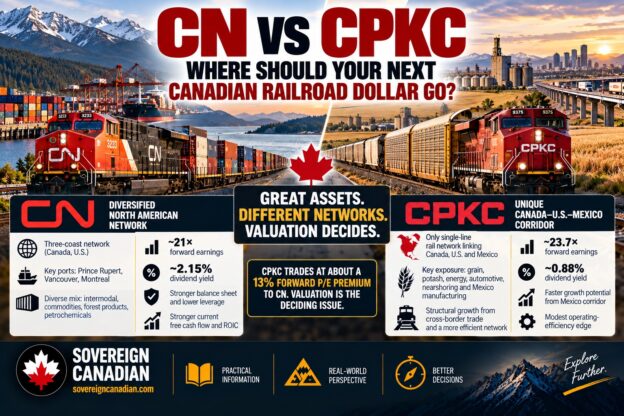
I own both CN and CPKC. I also own them a third way, through the Canadian index funds and mutual funds that hold both almost by default. So when I ask which railroad I would buy next, I am really asking about the margin: what an extra C$10,000 should do in a portfolio that already has a fair amount of both.
Part of what I like about railroads is that they are infrastructure whose physical replacement value is enormous. Canada is not going to wake up one morning and decide that railways are obsolete. The economic cycle will keep turning, commodity prices will swing, governments will change and trade routes will shift, but the country still has to move grain, potash, crude and chemicals, automobiles, containers, lumber, metals and consumer goods across a very large piece of geography, and trains are still the cheapest way to do much of it. Nobody is going to build another CN or another CPKC from scratch. The rights-of-way, the urban corridors, the bridges and tunnels, the yards and terminals, the port connections and the signalling systems took more than a century to assemble, and the political and environmental approvals required to repeat the exercise today would take longer than most investment horizons. Inflation makes the theoretical bill higher every year.
That is an attractive place to begin an investment thesis. It is not the thesis. A wonderful asset bought at too high a price can produce mediocre returns for a very long time, and CPKC’s acquisition of Kansas City Southern happens to be a useful illustration of that principle, as we will see. Scarcity tells you the business is durable. It says nothing about whether the stock, at C$170.66 for CN or C$122.51 for CPKC, is priced to give you a good outcome. Those are the October 2, 2026 closing prices I will use throughout, and the comparison only works if both companies are measured on the same day.
So the question is concrete. If I had another C$10,000 to put into a Canadian railroad today, would it go into CN or CPKC? Answering it required looking at what each company physically is, what actually moves on its tracks, how well the Kansas City Southern bet is working, what the balance sheets and cash flows really look like, and finally how much of a valuation premium CPKC deserves over CN. The last part turned out to decide everything.
Two railroads with different shapes
CN runs roughly 18,900 route miles across Canada and the United States. Draw it as a T. The crossbar is a Canadian east-west backbone running from Vancouver and Prince Rupert on the Pacific coast through the Prairies and Southern Ontario to Montreal and the St. Lawrence, and on to Halifax. The stem drops out of Chicago through Memphis to New Orleans and the Gulf Coast. That gives CN access to three coasts and several competing ports, which matters when a port is congested or a mountain line is cut. Prince Rupert is the standout asset in that list: it offers one of the shortest sailing times from North Asia to North America and moves containers inland on a single railroad. The Gulf leg gives CN a position in U.S. petrochemicals that CPKC only partly matches. And it all runs on track CN owns in Canada and the United States, not on a government concession.
CPKC runs about 20,000 miles across three countries, and its shape is closer to a Y. Two arms reach from Vancouver and the Prairies and from Montreal and Saint John toward the Midwest, converging at Chicago and Kansas City. The stem then runs south through Texas, crosses at Laredo, and reaches Monterrey, Mexico City and the Mexican ports of Lázaro Cárdenas on the Pacific and Veracruz and Altamira on the Gulf. CPKC markets this as the only single-line railroad connecting Canada, the United States and Mexico, and that is accurate. One feature is easy to skip past: the Mexican portion is operated under a government concession, not owned outright the way the Canadian and U.S. track is. I will come back to what that means in practice.
If I could own one physical network for thirty years and valuation did not exist, I would choose CN, narrowly. It has the denser two-coast Canadian system, Prince Rupert, owned right-of-way throughout, and a business that does not lean on the trade policy of three governments. But the choice is closer than it looks, and I can construct the argument for CPKC without much effort. If North American manufacturing continues to migrate toward Mexico, and if the single-line product keeps taking freight that used to move by truck or by two railroads and a handoff, CPKC could eventually prove to be the more valuable network. A railroad’s value depends on where the economy is growing, not only on what it already carries, and CPKC owns the corridor that points toward the growth.
The moat is replacement cost, and the price is a separate question
The replacement-value argument is real, and worth being specific about. Consider what you would have to assemble: continuous rights-of-way through Vancouver, Toronto, Montreal, Chicago and Kansas City; the canyons and passes of the BC mountains; bridges and tunnels; hundreds of yards and terminals; port access; a signalling and dispatch system; locomotives and rolling stock; environmental assessments and Indigenous consultation across thousands of kilometres; and a political environment in which a new freight line through any urban corridor would face years of opposition. The urban corridors alone are effectively unbuildable at any price. There is no credible published estimate of what it would cost to recreate either network, and I will not manufacture one. If you want a rough sense of scale, assume, purely as an illustration and not as a valuation method, that new heavy-haul mainline with structures and signalling costs C$5–15 million per route-mile before urban land, terminals, equipment and time. That gives a range of C$100–300 billion for a network of this size, which brackets the roughly C$125–130 billion enterprise values the market already assigns to each company. The market is not ignoring replacement cost.
That is the distinction I want to hold onto. Replacement value creates the moat: it explains why competitors do not appear and why both companies can raise prices over time. It does not tell you what multiple to pay for the earnings the moat protects. For shareholders, scarcity only matters if it turns into pricing power, returns on the capital invested, free cash flow and earnings growth, and those are measured against the price you pay. Both stocks trade above 20 times forward earnings, so the market has already capitalized the “you could never build another one” argument. It is a reason to be willing to own these businesses for a long time. It is a poor reason to ignore valuation.
What actually moves on these railroads
The freight mix for the first half of 2026 shows how differently the two companies are exposed. These are shares of freight revenue, rounded.
| CN | CPKC | |
|---|---|---|
| Grain, potash and fertilizer | 23% | 31% |
| Petroleum, chemicals, energy and plastics | 21% | 19% |
| Intermodal | 23% | 18% |
| Metals, minerals (and consumer products at CPKC) | 11% | 13% |
| Forest products | 11% | 5% |
| Coal | 5% | 6% |
| Automotive | 6% | 9% |
The categories are not perfectly comparable. CN reports potash inside grain and fertilizers, CPKC breaks potash and fertilizer out separately, and CPKC’s metals line includes some consumer products. Neither reports “Mexico freight” as a commodity, only by geography. But the pattern holds up. CN is more exposed to forest products, to intermodal and to Asian container traffic through Vancouver and Prince Rupert, and its chemicals business runs along the Gulf. CPKC is proportionally more of a Prairie agriculture and potash railroad, with a larger automotive franchise and a larger share of its volume tied to U.S.-Mexico industrial trade.
Grain shows the difference clearly. CPKC’s grain revenue rose 24% in the second quarter of 2026, CN’s grain and fertilizer revenue rose 18%, and both set records for the 2025–26 crop year. A strong harvest helps both, but it helps CPKC more in proportion to its size. Regulated Canadian grain revenue is capped each crop year by a formula the Canadian Transportation Agency applies, so grain is volume-driven, not price-driven, for both railroads. The 2026–27 cap rose by roughly two-thirds of a percent for each company.
A short guide to how each company behaves in different environments, keeping to cases where the difference is real:
| Environment | Who benefits more | Why |
|---|---|---|
| Canadian grain boom | CPKC, modestly | Larger grain and potash share, plus grain moving to Mexico |
| Oil and energy boom | CN, slightly | More petrochemical, NGL and Prince Rupert export exposure; fuel surcharges help both |
| Canadian mining boom | CN, modestly | Northern reach and Pacific export terminals |
| Asian import boom | CN | Intermodal is 23% of freight, with Prince Rupert and Vancouver |
| Mexico manufacturing boom | CPKC, clearly | Owned Mexican network and the Laredo crossing |
| U.S. recession | CN, mainly on balance sheet | CPKC has more automotive and cross-border exposure and more debt |
| Canadian recession | Neither | Both are roughly half Canadian-originated |
| North American trade conflict | CN | A fifth or more of CPKC freight touches Mexico |
| High inflation | Roughly even | Both price above inflation; CN’s lower leverage helps |
| Autonomous trucking | No clear winner | Discussed below |
If you buy CN, you are buying a diversified Canadian trade and port story with a Gulf petrochemical leg. If you buy CPKC, you are buying Prairie agriculture plus a bet that U.S.-Mexico-Canada integration keeps deepening. Neither is a pure commodity bet, because bulk freight is a bit under two-thirds of revenue at each company and the rest is merchandise, automotive and intermodal.
The Mexico bet
The case for Kansas City Southern was obvious when CP made it. Mexico had become the United States’ largest trading partner, manufacturers were moving production closer to the American market, and automotive supply chains already crossed the border several times before a vehicle was finished. A railroad that could carry a Canadian canola cargo or a Saskatchewan potash train all the way to a Mexican customer, or an Ontario-built part to a Monterrey plant, without a handoff at the border, would have something no competitor could replicate. By buying KCS and its Mexican concession, CP created that railroad, and the acquisition also gave it the Laredo gateway, which is where most of the U.S.-Mexico rail freight crosses.
The early evidence that the single-line product works is genuinely good. CPKC’s Canada-Mexico land-bridge business was roughly C$100 million in revenue in 2023. Management now expects it to exceed C$600 million by the end of 2026 and talks about a path toward C$1 billion. New services such as the Mexico Midwest Express, cold-chain hubs and an interline service with CSX into the U.S. Southeast have followed, grain shipments to Mexico set records, and automotive revenue is up sharply this year.
I want to keep that in proportion, because it is easy to let a good growth rate stand in for a large business. Traffic that moves directly between Canada and Mexico is only about 3% of CPKC’s freight revenue. If you add U.S.-to-Mexico, Mexico-to-U.S. and intra-Mexico traffic, the share of revenue that touches Mexico in some way is about 22–23%. That is a large number, and it explains why investors care about Mexico, but it does not mean 22–23% of the company is on the line if trade rules change. Most of that traffic moves because Mexican plants, farms and consumers need goods, and because a railroad is the cheapest way to move them. Even a damaging change in tariff treatment would reduce volumes at the margin, not wipe out the traffic, which is a point I return to in the section on USMCA. Even at C$1 billion, the Canada-Mexico land bridge would be roughly 6% of revenue. The economically important Mexican business is U.S.-Mexico, where CPKC competes against Union Pacific, not the land bridge that gets the headlines.
A very good railroad at a very full price
Given a strategic purchase of this size, the obvious question is whether CPKC has delivered the synergies it promised. The answer requires comparing the right numbers, because the original promise and the current claim are not the same kind of figure.
When CP announced the deal in March 2021 it talked about US$780 million of annualized synergies. By the time it signed the revised agreement in September 2021, the figure had become about US$1 billion within three years: roughly US$820 million of EBITDA growth from market opportunities, which meant new revenue won from the combined network, and roughly US$180 million from cost and efficiency improvements. CP’s own investor presentation labels the whole figure EBITDA. What CPKC reports now is different. On the second-quarter call its chief marketing officer said the company sees a run-rate of about C$1.4–1.5 billion of synergy revenue by the end of 2026. That is revenue, not EBITDA, and it is in Canadian dollars. At the 2026 exchange rate it is about US$1.0–1.1 billion.
To compare them you have to translate revenue into profit, and CPKC does not publish the incremental margin. If incremental margins on synergy revenue are somewhere between 45% and 65%, which is reasonable for a railroad adding volume to an existing network, then the revenue synergies correspond to roughly 55–85% of the US$820 million the market-opportunity half of the case was supposed to deliver, with a central estimate around 70%. The cost half is not disclosed in comparable form. My reconstruction is therefore that CPKC has delivered something like 55–85% of the original EBITDA synergy case, most likely around 70%, and that it is arriving roughly six months after the three-year mark, measured from the date CPKC took control in April 2023. Because the key inputs are not disclosed, I would not defend any of those numbers to the decimal.
That is behind the original case but it is not a failure. The land-bridge business is real and still growing, and the pipeline keeps expanding. One expected pillar, though, has not appeared: heavy Canadian crude moving to Mexico was supposed to be a meaningful part of the merger-related growth, and CEO Keith Creel acknowledged in September that it has not materialized.
That brings us to return on capital, where the comparison looks worse for CPKC than it should. CPKC’s core adjusted return on invested capital was about 6.9% in 2025, on roughly C$70 billion of average invested capital, against about 12.9% for CN. Taken at face value that suggests CPKC’s railroad is less than half as profitable on the money invested in it. But the denominator includes the price CPKC paid to assemble the network. The balance sheet carries about C$18–19 billion of goodwill, which is the premium over the book value of KCS’s assets. Take goodwill out and CPKC’s return rises to approximately 9.4%. Take out goodwill and intangibles and it is about 10%. The remaining gap to CN is real, and it comes from some mix of purchase-accounting step-ups to the value of KCS’s physical assets, Mexican and Meridian Speedway build-out capital that is not yet earning, and the nature of the traffic. CPKC does not disclose enough for me to split it cleanly.
I do not read that as a bad acquisition. I read it as a very good railroad bought at a very full price. KCS brought the Laredo gateway and the Mexican network that CPKC’s strategy now depends on, and the operating business is growing. But the price, about US$31 billion of enterprise value including roughly US$3.8 billion of assumed debt, means the combined company’s 6.9% core adjusted return is not yet an obviously attractive return on the enormous capital committed to the transaction. The stock has done well since the announcement, but a good part of that came from the market paying a higher multiple for the growth story, not from per-share earnings, which have grown slowly on a share count that rose by roughly 40% to fund the deal. The operating economics have to catch up. That requires synergies to keep arriving, Mexican volumes to keep compounding and returns on the enlarged capital base to improve, and that is plausible but not yet demonstrated. It is also a useful lesson that applies well beyond railroads: buying an extraordinary strategic asset does not create shareholder value automatically if you pay too much for it.
CN’s quieter case
CN does not have a story as easy to tell. It does not have a Mexican network, and its growth narrative is roughly “carry Canadian trade, keep improving productivity and compound.” I find that part of the attraction. Its diversification is real: no single commodity group is more than about 23% of freight, it has Pacific access through both Vancouver and Prince Rupert and Atlantic access through Montreal and Halifax, and it reaches the Gulf through Chicago and Memphis. When a wildfire or a flood closes a mountain line in British Columbia, or a port is congested, it has more places to send freight, though both railroads share some of the same BC canyons. Its Gulf network gives it a petrochemical franchise that CPKC lacks in the same form. And the whole network runs on track it owns.
In July 2026 CN also moved to narrow CPKC’s advantage in Mexico, and the details are worth getting right because early coverage was loose with them. Under a binding agreement with Union Pacific, CN receives haulage rights between Memphis and Eagle Pass, Texas, for Canada-Mexico traffic. Union Pacific operates the trains over that stretch, and the freight is handed to Ferromex, the large Mexican railroad, at the border. The arrangement applies only to traffic moving between Canada and Mexico, it does not depend on the proposed Union Pacific–Norfolk Southern merger, and the rights can be converted to trackage rights, under which CN would run its own trains, if volumes justify it. In exchange, UP gets rights over CN’s former Elgin, Joliet & Eastern bypass around Chicago. A second, separate agreement, which does depend on the merger being approved, gives CN a Kansas City foothold through UP’s Neff Yard and other Midwest rights.
This does not give CN a Mexican network. It gives CN a partnership-based route in which another railroad runs the trains and a third company takes the freight at the border. It is a useful competitive response, and it modestly reduces what is unique about CPKC’s product, but CPKC still owns a Mexican network, the Laredo crossing and the only true single-line service. If CN captured 10–25% of the roughly C$600 million land-bridge business over time, it would cost CPKC something like 0.6–1.4% of earnings per share. That is worth watching and not worth worrying about.
Trade policy, the concession and the trucks
The most important political question for CPKC is the future of USMCA, and the facts here are easy to get wrong. On July 1, 2026, the three countries held the agreement’s scheduled six-year joint review. The U.S. Trade Representative then issued a statement saying the United States did not agree to renew the agreement in its current form and that it is therefore “not renewed,” while also saying it remains in force. That is the accurate reading: the agreement did not terminate and it did not expire. It continues to operate, and tariff treatment did not change on July 1. What the failure to extend triggers is a cycle of annual joint reviews, the first beginning in July 2027, which continue until the three countries agree to a new 16-year term or the agreement reaches its scheduled expiry in July 2036. The agreement also contains a separate withdrawal provision that lets any party leave on six months’ written notice, and that, more than the annual reviews, is the tail risk.
This matters more to CPKC than to CN because of the roughly 22–23% of CPKC revenue that touches Mexico. But the direct earnings effect is smaller than many investors assume. I ran rough sensitivities using CPKC’s 2026 revenue, a high decremental margin on lost volume and the current share count. If Mexico-touching volumes fell 5–10% for a year or two, that would reduce earnings per share by something like 2–3.5%. If they fell 25%, which is a severe outcome, the hit would be roughly 9%. Those are meaningful numbers, but they are smaller than the damage from a change in how investors value the stock. If the market stopped paying a premium for CPKC’s Mexican growth and the multiple fell by three turns, that alone would cost about 13%. The larger risk to the stock is valuation, not the immediate earnings decline.
The Mexican concession gets mentioned in every CPKC risk-factor list, so it deserves a plain description. Kansas City Southern de México holds a 50-year concession that took effect in June 1997 and runs to June 2047. It is renewable for up to another 50 years under conditions. Its original exclusivity period did not simply lapse in 2027: a 2022 agreement tied to the Celaya bypass extended CPKC Mexico’s exclusivity by ten years, to 2037, though exclusivity is not complete protection from trackage rights, haulage rights, regulation or government policy. It carries normal obligations: a five-year business plan with required investment, rate rules and regulatory compliance. It can be revoked under certain circumstances, such as failing to make required capital expenditures or violating rate rules, and if that happened the government could lease the railroad’s service-related assets for at least a year and up to five. I do not read this as an imminent threat. I found no precedent of a Mexican Class I concession being revoked, though I did not research that exhaustively, and the more realistic questions are renewal terms in the 2040s and policy pressure on rates and investment. CN’s owned right-of-way deserves a modest durability advantage. Concession risk is not a reason to reject CPKC.
Autonomous trucks are the long-term disruption argument most investors raise, and it should be treated as a margin question, not an existential one. Rail is several times more fuel-efficient than trucking on a ton-mile basis, and the structural advantages are largest for bulk and long-haul freight. One crew runs a train carrying more than 9,000 tons. Autonomous trucks would mainly attack the weaknesses of trucking, driver cost and hours-of-service limits, and so the pressure would land first on shorter and medium-distance intermodal lanes. They are not a plausible replacement for grain trains, potash, coal, chemicals or other bulk freight, which is most of what both railroads carry. CN has more intermodal in its mix, but its intermodal is long-haul port traffic such as Prince Rupert to Chicago, which is where rail is strongest. CPKC’s domestic and cross-border intermodal covers more distances that trucks can contest. I would not treat either company as clearly more exposed.
Who runs the better railroad, and who earns more on the money
On operating efficiency CPKC has a modest edge. In the second quarter of 2026 its core adjusted operating ratio was about 61.6% and CN’s adjusted ratio was about 62.2%, both worse than a year earlier because of fuel. CPKC’s reported operating ratio was 64.6%, but that figure includes KCS purchase accounting and acquisition costs that have nothing to do with how trains run, so the core number is the fairer comparison. CPKC has been the more aggressive operator for years, and I think it is probably the better railroad operator.
But operating ratio and return on invested capital answer different questions. The operating ratio tells you how much of each revenue dollar is left after running the railroad. ROIC tells you how much profit the company earns on all the capital investors have put into assembling it. A railroad can run extremely efficiently and still earn a mediocre return on the amount of capital, including acquisition premiums, that went into building the system. That is exactly the KCS story. CPKC is the better operator and CN currently produces the better return on invested capital, and both statements are true at once.
Cash flow, where CN looks better
CN does look better on cash flow, but I should be careful because the headline gap overstates it. The two companies define free cash flow differently. CN takes operating cash flow minus net investing cash flow. CPKC’s adjusted free cash starts from the same place and then adds back certain items, including the effect of exchange rates on cash balances and some KCS acquisition and advisory costs. To compare them, I used one definition for both: operating cash flow minus property additions, over the twelve months to June 30, 2026.
On that basis CN generated roughly C$3.55 billion and CPKC roughly C$2.40 billion. At the October 2 market capitalizations, that is a free cash flow yield of about 3.4% for CN and 2.2% for CPKC, which would suggest CN delivers about 50% more cash per dollar of equity. That is the trailing number, and it needs a qualification, because 2026 flatters both companies. CN plans to spend about C$2.8 billion on capital this year, net of customer reimbursements, and CPKC about C$2.65 billion, each down roughly 15% from 2025. CN’s reported free cash flow growth in the first half was also helped by about C$84 million from selling part of a rail subdivision. On a more normalized capital program, CN’s yield is closer to 3.1–3.3% and CPKC’s closer to 2.7–2.8%.
The advantage is therefore real, but it is closer to 15–25% on normalized spending than the 50% suggested by the trailing figures. CPKC’s operating cash flow is also growing faster, up about 7.6% in the first half against a small decline at CN. This is a good example of why investors should not mechanically screen on one year’s free cash flow yield. When both companies are cutting capital spending at the same time, a single year can say as much about the timing of projects as about the strength of the business.
Balance sheets, buybacks and dividends
CN carries adjusted debt of about 2.6 times EBITDA and CPKC about 3.2–3.3 times, depending on whether cash is netted. CN has the stronger credit profile and is rated higher. CPKC is rated BBB+ by S&P with a positive outlook, Baa1 by Moody’s with a stable outlook, and BBB (high) by Morningstar DBRS with a positive trend. CN’s DBRS rating is A with a stable trend. DBRS has said CPKC’s long-term leverage target is 2.75 times and that its trend could revert to stable if buybacks pushed leverage toward 3.5 times. I would describe CPKC’s leverage as elevated but manageable. It is not dangerous and not a constraint on the business today, but it does limit how fast CPKC can return capital, and it leaves less cushion if freight weakens.
The more interesting finding is that both companies are returning more to shareholders than they generate. In the first half of 2026, CPKC paid out about 177% of its adjusted free cash flow through dividends and buybacks, and CN about 132%. In both cases, dividends and repurchases exceeded free cash flow, while borrowing and leverage also increased. That does not let us trace a particular borrowed dollar to a particular buyback, but it does mean the shareholder distributions were not fully funded by internally generated free cash flow. CPKC bought its shares at an average of about C$117, an earnings yield around 4.4% on 2026 estimates against an after-tax cost of new debt of roughly 3–4%, which is a thin but positive spread, and CN’s repurchases carry a better one. The repurchases are not obviously irrational at those prices, but with shareholder distributions running above free cash flow, neither railroad should get unlimited credit for shrinking its share count. I would not single out CPKC as the aggressive one. CN’s lower leverage simply gives it more room if freight weakens.
On dividends the comparison is lopsided. CN pays C$3.66 a year (C$0.915 a quarter), a yield of about 2.15% and roughly 45% of expected 2026 earnings, after a 3% increase this year that CN describes as its thirtieth consecutive annual increase. CPKC pays C$1.072, a yield of about 0.88% and roughly 21% of expected earnings, though it raised the dividend 20% last year and 17.5% this year. CN clearly wins for current income. But a dividend is not inherently better than a buyback or reinvestment, and CPKC’s low payout is not evidence that it has found higher-return uses for the cash. Its return on reported capital is lower than CN’s, and its total payout to shareholders, once buybacks are included, is the larger of the two. CN simply returns more of its cash in the form of dividends. For a Canadian investor who wants income, that matters, particularly because CN’s dividends are generally eligible Canadian dividends, but total return remains the objective.
How much faster does CPKC really grow?
Current consensus estimates for the two companies, after the second-quarter results, are:
| CN | CPKC | |
|---|---|---|
| 2026 revenue | ~C$18.5B | ~C$16.4B |
| 2027 revenue | ~C$19.3B | ~C$17.35B |
| 2028 revenue | ~C$19.7–19.9B | ~C$18.1B |
| 2026 EPS | ~C$8.14 | ~C$5.18 |
| 2027 EPS | ~C$9.00 | ~C$6.00 |
| 2028 EPS | ~C$9.85–9.90 | ~C$6.39 (looks stale) |
Over 2026–2028 that is revenue growth of roughly 3.7% a year at CN and 5.2% at CPKC, a difference of 1.5 to 2 percentage points that I find credible. Earnings per share look closer: about 10% a year at CN and about 11% at CPKC, although the 2028 CPKC figure appears out of date, so the true gap could be wider. But the headline EPS numbers include buybacks, and CPKC is shrinking its share count by about 4% a year against roughly 2.4% for CN. Strip out the buybacks and the evidence supports roughly one to one and a half percentage points of additional organic EPS growth for CPKC as a central estimate. That is a real advantage, not the 2-point-plus advantage a quick look at the headline numbers suggests, and the difference matters because it feeds directly into how much of a valuation premium CPKC can justify.
The immediate question for CPKC is whether it can reach its 2026 estimate. It earned C$2.30 of core adjusted EPS in the first half. To reach the consensus C$5.18 it needs about C$2.88 in the second half, roughly 18.5% growth over the second half of 2025, which the quarterly estimates (C$1.34 in the third quarter, C$1.55 in the fourth) confirm. CN needs about 9% growth in the second half to reach its consensus. The acceleration at CPKC is plausible. Volumes picked up to nearly 7% quarter to date, grain and automotive are strong, synergy revenue is still building, the third-quarter comparison is soft, and the share count is falling. But C$5.18 is not a conservative number. CPKC has missed analyst estimates by one to three cents in three of the last four quarters, management’s guidance of low double-digit growth brackets the consensus but sits at the top of the range, and fuel and interest costs are headwinds. I would use a range of C$5.00 to C$5.20 for 2026, with about C$5.10 as a sensible central estimate.
That matters for valuation, because the apparent premium moves with the estimate. At C$122.51, CPKC trades at 25.0 times earnings if it earns C$4.90, 24.5 times at C$5.00, 24.0 times at C$5.10, 23.65 times at C$5.18 and 23.1 times at C$5.30. A realistic miss pushes the premium to CN up by two or three percentage points. CPKC reports on October 28 and CN on October 30, and the third-quarter results will be the first real test.
Valuation, which decides the answer
At the October 2 close CN traded at C$170.66, about 21.0 times 2026 consensus earnings of C$8.14, with a dividend yield of roughly 2.15%. CPKC traded at C$122.51, about 23.65 times consensus earnings of C$5.18, with a yield of roughly 0.88%. CPKC therefore trades at a premium of about 13% to CN on forward earnings.
The first question is whether that is a lot. Before the KCS transaction, mature CP and CN traded much closer to parity. On year-end trailing earnings from 2016 to 2019, CP’s premium averaged only a few percentage points, and in 2020 and 2021 it was roughly zero or slightly negative. The premium appeared after the deal. On year-end forward earnings, which I took from financial data sites and therefore treat as approximate, CPKC traded at about a 13% premium to CN in 2022, 14% in 2023, 19% in 2024 and 15% in 2025. Those series are not perfectly comparable, since trailing figures are distorted by one-time items and, after 2023, by KCS purchase accounting that depresses CPKC’s reported earnings, but they tell a consistent story. Today’s premium of about 13% is expensive compared with pre-KCS CP, and sits around the low end of the post-KCS range.
The second question matters more: what premium does CPKC deserve? History does not answer it. The market has paid about 15% for four years because it believed in the Mexican growth story, and that does not make 15% fair. A premium should reflect what you get for it. CPKC offers perhaps one to one and a half points of additional organic earnings growth, a unique Mexican franchise and a better operating ratio. In return you accept higher leverage, the USMCA uncertainty, the concession structure, synergies that are arriving behind the original schedule and an unusually back-half-loaded 2026. When I solved for the premium that would make the two stocks equally attractive, assuming that eventually both trade at the same multiple, the growth advantage alone justified roughly 5%. Giving some credit for the three-country network, but discounting it for the risks above, gets to about 10%. That is the key number in this article: a reasonable central premium for CPKC is approximately 10% over CN, versus about 13% today.
What C$10,000 buys
Here is what C$10,000 buys in each stock at the October 2 prices. These are claims on the underlying economics, not cash you receive, since a company retains or spends most of what it earns.
| CN | CPKC | |
|---|---|---|
| Shares purchased | ~58.6 | ~81.6 |
| Annual dividend income | ~C$215 | ~C$88 |
| 2026E earnings attributable | ~C$477 | ~C$423 |
| Normalized free cash flow attributable | ~C$310–330 | ~C$270–280 |
CN produces more than twice the current dividend income and somewhat more cash flow behind each dollar invested. CPKC offers a faster expected growth rate, which is the reason the stock costs more per dollar of current earnings.
Five-year scenarios
I used one simple framework for both companies: start from 2026 earnings, add organic growth and the effect of buybacks, apply an exit multiple five years out, and add the dividends received along the way. I started CN at C$8.10 and CPKC at C$5.12, slightly below consensus, so neither forecast begins from the most optimistic figure. In the base case CN’s earnings grow 8.7% a year, 6.3% organic plus 2.4% from buybacks, and CPKC’s grow 10.8%, 7.8% organic plus 3.0% from buybacks. CPKC’s exit multiple carries a premium to CN’s that varies by scenario. I weighted bear, base and bull outcomes 25%, 50% and 25% for both stocks and did not adjust the weights to favour either one.
| CN bear | CN base | CN bull | CPKC bear | CPKC base | CPKC bull | |
|---|---|---|---|---|---|---|
| EPS growth a year | ~5% | ~8.7% | ~10.9% | ~5% | ~10.8% | ~13.5% |
| Exit P/E | 16.5x | 19.5x | 22x | ~16x | ~20.9x | ~24.9x |
| Year-5 share price | ~C$171 | ~C$240 | ~C$299 | ~C$105 | ~C$178 | ~C$240 |
| Dividends over five years, per share | ~C$19 | ~C$21 | ~C$22 | ~C$6 | ~C$6.50 | ~C$7 |
| Annualized return | ~2.2% | ~8.9% | ~13.5% | ~−2.1% | ~8.6% | ~15.0% |
The exit multiples are anchored in history. CN’s forward P/E was around 17 at the end of 2025, near 21.5 in 2023 and nearly 24 in 2021, so 16.5, 19.5 and 22 span what it has actually done. Weighted by probability, CN comes out at about 8.6% a year and CPKC at about 8.2%.
I would not read anything into the 0.4-point difference. The correct interpretation is that expected returns are effectively tied, with CN offering the better downside and CPKC the better upside. CN’s bear case still earns a small positive return, while CPKC’s loses about 2% a year, and CPKC’s bull case beats CN’s by a point and a half. How much you value that asymmetry is a question about your own risk tolerance. What decides the outcome is the premium CPKC holds when you sell. If CPKC permanently deserved no premium, its expected return at today’s price falls to about 6.9%. If it keeps the 15% premium the market has paid since the deal, it rises to about 9.6%. The entire debate between these two stocks is a debate about that premium.
The switching price
That leads to a practical rule, and I would rather state it as a rule than a price target. With CN at C$170.66, I would switch the marginal purchase to CPKC at around C$119. With CPKC at C$122.51, I would stop adding CN at around C$176. Both prices correspond to CPKC trading at roughly a 10% forward-P/E premium to CN on consensus earnings, which is the premium I think is defensible. Above roughly a 10% premium, I prefer CN, and below that I prefer CPKC.
I would not defend C$119 as scientifically superior to C$118 or C$120. It comes out of a model with uncertain inputs, and the sensible range across the premium assumptions I tested runs from about C$113 if CPKC deserves little or no permanent premium to about C$128 if the full post-KCS premium persists. These are valuation guideposts, not intrinsic values. Notice also that both triggers are only 2–4% from today’s prices, which tells you how close the call is.
What I would actually do
If I had another C$10,000 to invest on October 5, 2026, I would buy CN. This is not a strong conclusion that CN is the better company. Expected returns are essentially tied. CN has the higher free cash flow yield, the stronger balance sheet, the larger dividend and a downside case I would rather live through. It needs less heroic execution in the second half of the year, and it depends less on the outcome of USMCA reviews and on Mexican growth continuing at its recent pace.
CPKC offers a lot in return for its price: faster growth, a unique Mexican franchise, a modestly better operating ratio, a stronger bull case and potentially the better very-long-term growth opportunity if North American production keeps moving south. If CPKC fell toward C$119 without CN moving, or if it reported a strong third quarter that made its second-half ramp look secure, I would likely choose differently. CN gets the tie-break, not a landslide.
The 20-year question
It is tempting to say that a railroad with a Mexican growth option must be the better compounder over twenty years, and I do not think the evidence supports saying it with confidence. I can separate two questions. As a twenty-year growth opportunity, CPKC has the edge, because of Mexico and the higher potential organic growth rate. A one to one-and-a-half point growth advantage compounded over twenty years is meaningful: it would leave CPKC with substantially more earnings at the end. As a twenty-year investment from today’s valuation, though, I think it is too close to call. Against that growth edge you have to set the starting valuation, a return on invested capital that has to rise from the current level before the KCS purchase pays off, higher leverage, the future quality of capital allocation, regulatory change, and whether CPKC permanently earns a premium multiple or loses it. Each of those could wipe out a point of annual growth, and nobody knows which way they will break.
Index funds, and taxes
Many readers will already own more of both railroads than they realize. Recent holdings data put CN and CPKC at roughly 5% combined in XIU and around 4% combined in XIC, VCN and ZCN, although weights move with market prices and should be checked against the current fund holdings, and CPKC is the larger of the two in each fund. Buying an individual railroad on top of a Canadian index ETF is therefore an active overweight, not a way of gaining exposure you otherwise lack. That is not an argument against doing it, and it is the position I am in myself. It is context for how large the bet really is.
For the tax treatment, both companies are Canadian corporations. In a non-registered account, their dividends are generally eligible Canadian dividends for Canadian residents and qualify for the dividend tax credit, which is why CN’s higher yield is especially efficient outside a registered account. Canada’s capital-gains inclusion rate remains one-half in 2026, because the proposed increase was cancelled in 2025, so half of a realized gain is added to your taxable income. In a TFSA, dividends and gains are generally tax-free. In an RRSP or RRIF, growth is tax-deferred and withdrawals are included in taxable income, with no separate dividend tax credit on what you take out. For a Canadian investor there is generally no fundamental tax advantage to buying the U.S.-listed shares of either company because they trade in U.S. dollars. Both are the same securities, and the currency exposure in the underlying businesses, which earn a large share of their income in U.S. dollars and, for CPKC, Mexican pesos, is the same whichever listing you buy. The trading currency only matters if you already hold U.S. dollars and want to avoid converting.
For a deeper look at the account decision itself, I cover that separately in RRSP vs TFSA: The Decision Changes as Your Income Rises.
The comparison
| Category | Winner | Note |
|---|---|---|
| Physical network | CN | Owned right-of-way, Prince Rupert, two-coast density |
| Operating efficiency | CPKC | Core operating ratio about 0.6 points better |
| Growth runway | CPKC | 1.5–2 points faster revenue growth, Mexico |
| Balance sheet | CN | About 2.6x vs 3.2–3.3x leverage; higher ratings |
| Current income | CN | 2.15% vs 0.88% yield |
| ROIC | CN | 12.9% vs 6.9% (about 9.4% for CPKC excluding goodwill) |
| Mexico opportunity | CPKC | Owned Mexican network and single-line service |
| Current valuation | CN | About 21.0x vs 23.65x forward earnings |
| Bull-case upside | CPKC | Larger bull case if the premium holds |
| Downside protection | CN | Positive bear-case return and lower leverage |
| Five-year expected return | Tie, CN narrowly | About 8.6% vs 8.2%, within model error |
| 20-year growth opportunity | CPKC | Mexico and a higher organic growth rate |
| Next C$10,000 today | CN | Tie-break on risk, income and execution |
Conclusion
Both companies own assets that would be extraordinarily hard to recreate, and in some places politically and economically impossible. That makes them attractive businesses to own, and it is why I own both. But the analysis also shows why the replacement-cost argument cannot be the whole thesis: an irreplaceable railroad is not an irreplaceable stock price.
CPKC may eventually prove to be the better growth company. It has the better operating ratio, the Mexican franchise and the larger upside if the premium holds. CN is, for now, the better-priced claim on an extraordinary network, with the stronger balance sheet, the higher income and the safer path to its numbers. At today’s prices I choose CN. At approximately C$119 for CPKC, with CN unchanged, I would likely choose differently.