
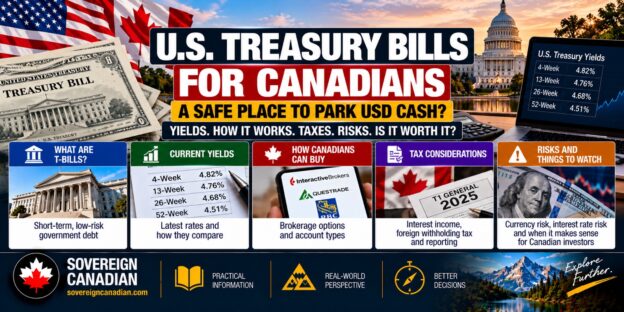
Updated October 23, 2026. Market yields are based on October 22, 2026 data unless otherwise indicated. Rates change daily and are not forecasts or guarantees.
Picture a Canadian investor with USD 25,000 sitting in an RRSP, waiting for an attractive opportunity to buy U.S. equities. The cash earns little or nothing meanwhile. Could a three- or six-month U.S. Treasury bill put that money to work?
On October 22, 2026, the U.S. Treasury reported a 13-week bill yielding 4.14% and a 26-week bill yielding 4.31%, using its investment-yield measure.
On USD 25,000, those rates would generate approximately USD 257 over 91 days or USD 530 over 182 days, assuming a purchase at the quoted yield and a hold to maturity.
That is meaningful income from a short-term government security.
But Canadians face questions that American investors do not.
Can you buy individual U.S. Treasuries through a Canadian brokerage? Can you hold them in an RRSP or TFSA? Is the interest subject to U.S. withholding tax? What happens when the Canadian dollar strengthens? And are Treasury ETFs such as SGOV or UBIL.U better alternatives?
The answers depend on your account, your brokerage, and especially the currency you already hold.
U.S. Treasuries can be excellent investments for Canadians who already hold USD. But converting Canadian dollars solely to capture a higher American interest rate is a very different proposition.
What Are U.S. Treasury Securities?
The U.S. government issues several types of marketable debt securities.
Treasury bills, or T-bills, mature in one year or less. They do not pay regular interest coupons. Instead, investors purchase them at a discount and receive their face value at maturity.
Treasury notes mature in two to ten years, while Treasury bonds mature in twenty or thirty years. Both generally pay interest every six months.
Treasury Inflation-Protected Securities, or TIPS, adjust their principal according to U.S. inflation. That distinction matters because American inflation is not necessarily the same as Canadian inflation.
Floating-rate notes pay interest that resets periodically with short-term Treasury rates.
For Canadians looking to earn interest on USD cash, short-term Treasury bills are usually the most relevant starting point.
Understanding Treasury yields
Treasury bills are commonly quoted using two different yield measures.
The discount yield calculates the annualized discount using the bill’s face value and a 360-day year.
The investment yield, also called the bond-equivalent or coupon-equivalent yield, uses the purchase price and a 365-day or 366-day convention.
The investment yield is generally more useful when comparing Treasury bills with GICs or other fixed-income investments.
For example, on October 22, 2026, the U.S. Treasury reported:
| Treasury bill | Discount yield | Investment yield |
|---|---|---|
| 4 weeks | 3.94% | 4.01% |
| 8 weeks | 4.01% | 4.09% |
| 13 weeks | 4.04% | 4.14% |
| 17 weeks | 4.11% | 4.22% |
| 26 weeks | 4.16% | 4.31% |
| 52 weeks | 4.20% | 4.39% |
Source: U.S. Treasury Daily Bill Rates, October 22, 2026.
These are secondary-market quotations, not guaranteed prices available to every retail investor. Your actual return depends on the security purchased, its remaining maturity, the dealer’s price and transaction costs.
Why duration matters
Duration measures a bond’s sensitivity to interest-rate changes.
A bond with a duration of five years would generally lose approximately 5% of its market value if yields increased by one percentage point, before accounting for convexity and other factors.
A three-month Treasury bill has very little duration.
A long-term Treasury bond ETF can have a duration exceeding fourteen years.
This creates an important distinction.
An individual Treasury bill held to maturity returns its stated face value, assuming the U.S. government meets its obligations.
A Treasury ETF continuously replaces maturing securities. It has no fixed maturity date, and its market value can fluctuate.
Short-term Treasury ETFs are relatively stable. Long-term Treasury ETFs are not cash equivalents.
How Can Canadians Buy U.S. Treasury Bills?
TreasuryDirect is not a practical option
TreasuryDirect is the U.S. government’s platform for purchasing Treasury securities directly.
Its account requirements include a Social Security number, a U.S. address of record and an account at a U.S. depository institution.
Most Canadian residents who do not already meet those requirements cannot open an account.
That leaves two practical routes: buying individual Treasuries through a brokerage or purchasing a Treasury ETF.
Which Canadian brokerages sell individual Treasuries?
Canadian brokerages frequently advertise fixed-income products, but that does not necessarily mean they offer individual U.S. Treasury bills.
Some sell Canadian government bonds and T-bills. Others offer U.S. corporate bonds without clearly advertising U.S. government debt.
The distinction matters.
| Brokerage | Individual U.S. Treasury access | Status |
|---|---|---|
| Interactive Brokers Canada | U.S. Treasury bills, notes and bonds | Confirmed |
| Questrade | Individual U.S. Treasuries | Not confirmed |
| RBC Direct Investing | Individual U.S. Treasuries | Not confirmed |
| TD Direct Investing | Individual U.S. Treasuries | Not confirmed |
| BMO InvestorLine | Historical references to U.S. T-bills | Current access unconfirmed |
| Scotia iTRADE | U.S. fixed-income products advertised | Specific Treasury access unconfirmed |
| CIBC Investor’s Edge | Individual U.S. Treasuries | Not confirmed |
| National Bank Direct Brokerage | Individual U.S. Treasuries | Not confirmed |
| Wealthsimple | Individual U.S. Treasuries | Not confirmed |
Interactive Brokers Canada provides the clearest documented access.
Its published commission schedule charges 0.002% of face value on the first USD 1 million of U.S. Treasury securities, subject to a USD 5 minimum.
On a USD 25,000 bill, the percentage commission is only USD 0.50, so the USD 5 minimum applies.
Interactive Brokers also states that it does not add a markup to bond prices. Investors should nevertheless consider the market bid-ask spread and any applicable external fees.
Source: Interactive Brokers Canada Fixed-Income Commissions.
Interactive Brokers publishes information about holding USD and U.S. bonds in registered accounts. However, investors should confirm that their particular account permits purchases of the specific Treasury security.
For other brokerages, ask a direct question:
Can I purchase individual U.S. Treasury bills in USD in my RRSP, TFSA or non-registered account, and what is the all-in execution cost?
Do not assume that access to U.S. stocks or ETFs automatically means access to individual Treasuries.
Can Canadians Hold Treasuries in an RRSP or TFSA?
Canadian registered accounts can hold only qualified investments under the Income Tax Act and related regulations.
Certain foreign government debt obligations can qualify, including U.S. Treasury securities that satisfy the applicable requirements.
These requirements can involve credit ratings, issue size and other statutory conditions.
U.S.-listed ETFs traded on designated stock exchanges can also qualify under the listed-security rules.
However, legal eligibility and brokerage availability are different questions.
A security might qualify under Canadian tax law but still be unavailable through a particular brokerage or account type.
Account-by-account comparison
| Account | Canadian tax treatment | Main consideration |
|---|---|---|
| RRSP | Investment income grows tax-deferred; withdrawals generally taxable | Confirm Treasury access and USD support |
| Spousal RRSP | Same general investment treatment as an RRSP | Withdrawal attribution rules may apply |
| RRIF | Investment income grows tax-deferred; withdrawals taxable | Annual minimum withdrawals |
| TFSA | Investment income and qualifying withdrawals tax-free | U.S. ETF withholding practices matter |
| FHSA | Tax-sheltered growth; qualifying withdrawals tax-free | Short-term bills may suit a defined purchase horizon |
| RESP | Investment income grows tax-deferred; educational assistance payments generally taxable to the student | Confirm brokerage support |
| Non-registered | Interest taxable under applicable Canadian rules | Track income and foreign-exchange transactions in CAD |
For most Canadians, the RRSP-versus-TFSA decision is not determined by the Treasury investment itself.
RRSP contributions can generate tax deductions, while withdrawals are generally taxable.
TFSA contributions do not generate deductions, but qualifying withdrawals are tax-free.
The right choice depends on current and future tax rates, available contribution room and the broader investment portfolio.
Our RRSP vs TFSA guide explores that decision, while the TFSA deep dive examines foreign investment taxation.
For education savings, see our RESP deep dive.
Taxation of U.S. Treasuries for Canadians
U.S. withholding tax on Treasury interest
Qualifying U.S. Treasury interest paid to Canadian residents is generally exempt from U.S. withholding tax.
The U.S. portfolio interest exemption provides an important statutory basis for this treatment.
The Canada-U.S. tax treaty also generally assigns taxing rights over qualifying cross-border interest to the recipient’s country of residence, subject to its provisions and exceptions.
Canadian investors ordinarily establish their foreign status through Form W-8BEN or equivalent documentation maintained by the intermediary.
This is different from the familiar 15% withholding tax commonly applied to U.S. corporate dividends.
Treasury ETFs are more complicated
A U.S.-listed Treasury ETF receives interest from its underlying Treasury securities and distributes income to shareholders.
For U.S. tax purposes, those distributions can be classified as dividends.
However, U.S. tax law permits qualifying regulated investment companies to designate certain distributions as interest-related dividends that may be exempt from withholding for eligible foreign investors.
ETF issuers publish information about these designations.
The complication is how Canadian brokerages process them.
A brokerage may apply the exemption at source. Alternatively, withholding may occur because of documentation or intermediary processing.
This matters particularly inside a TFSA, where foreign withholding tax generally cannot be recovered through a Canadian foreign tax credit.
RRSPs and RRIFs may benefit from additional treaty protection for qualifying income, but investors should not assume that every Treasury ETF distribution receives identical treatment.
Before purchasing a U.S.-listed Treasury ETF in a TFSA, ask your brokerage how it handles interest-related dividend designations.
Canadian income tax on Treasury bills
In a non-registered account, Treasury interest is taxable in Canada.
CRA explicitly addresses the treatment of Treasury bills.
When a T-bill is purchased at a discount and held until maturity, the difference between the purchase price and redemption amount is considered interest.
If the investor sells before maturity, CRA requires a calculation of accrued interest. The investor may also realize a capital gain or loss.
For an early sale, CRA’s general calculation is:
- Calculate interest accrued to the disposition date using the effective yield, purchase price and holding period.
- Subtract that interest from the disposition proceeds.
- Compare the remaining proceeds with the adjusted cost base to determine any capital gain or loss.
This distinction is important.
A Treasury bill does not automatically generate capital gains simply because it trades at a discount.
The discount ordinarily represents interest income.
CRA provides a worked example in its Treasury Bills and Stripped Bonds guidance.
When is the interest taxable?
For an individual holding a short-term Treasury bill until maturity, the discount is generally reported as interest in the year the bill matures.
CRA’s guidance on interest income specifically addresses Treasury bills that mature during the tax year.
Longer holding periods, early sales and other circumstances can introduce additional rules.
Investors should not build a tax-deferral strategy around Treasury-bill purchase dates without confirming the applicable treatment.
Foreign-exchange gains and losses
Currency introduces another layer of Canadian taxation.
A Canadian investor must calculate the Canadian-dollar cost of a Treasury security and the Canadian-dollar value of its maturity or sale proceeds.
Exchange-rate movements can therefore affect the Canadian taxable result even when the USD amount received is predictable.
The tax treatment depends on the nature of the transaction and the applicable income or capital rules.
Currency gains and losses on USD cash held separately from a Treasury security may require separate calculations.
The CAD 200 exemption applicable to certain foreign-currency capital gains and losses should not be assumed to exempt exchange-rate changes embedded in a debt security.
For non-registered Treasury investments, retain records of purchase dates, USD prices, exchange rates, interest calculations and disposition proceeds.
Our Canadian capital gains guide explains why capital gains, capital losses and interest income receive different tax treatment.
T1135 foreign-property reporting
Canadian residents may need to file Form T1135 when the total cost of specified foreign property exceeds CAD 100,000 at any time during the year.
Foreign government debt obligations can count toward this threshold.
Units of U.S.-listed ETFs can also be specified foreign property.
Holdings inside qualifying registered accounts are generally excluded.
Units of Canadian-resident mutual fund trusts are also generally excluded, even when the fund owns foreign securities.
The threshold applies to the aggregate cost of specified foreign property, not simply one Treasury position.
A Canadian investor who already owns U.S. stocks, foreign bank accounts or foreign real estate should consider the combined reporting obligation.
Our foreign real estate investing guide discusses the same reporting regime.
Individual Treasury Bills Versus Treasury ETFs
For most Canadians, this is the practical investment decision.
| Factor | Individual Treasury bill | Treasury ETF |
|---|---|---|
| Maturity date | Known | No fixed maturity |
| USD redemption amount | Known if held to maturity, subject to issuer performance | Market value fluctuates |
| Yield | Determined at purchase | Changes as holdings roll |
| Management fee | None | Annual expense ratio |
| Trading costs | Dealer spread and possible commission | Bid-ask spread and possible commission |
| Reinvestment | Manual | Managed by the fund |
| Liquidity | Secondary market through participating broker | Exchange trading |
| Cash distributions | Normally none before maturity | Often monthly |
| Interest-rate sensitivity | Declines as maturity approaches | Depends on continuing portfolio duration |
| Estate-tax considerations | Qualifying direct Treasury debt generally receives favourable treatment | Depends on fund domicile and legal structure |
Individual Treasury bills are particularly attractive when an investor has a known future date for using the money.
A six-month bill provides a predictable USD maturity amount.
An ETF offers greater convenience.
It can be bought or sold during market hours, and the manager automatically replaces maturing securities.
For investors waiting indefinitely for equity opportunities, an ETF may be easier.
For investors who need USD on a known date, individual bills deserve serious consideration.
The Main U.S.-Listed Treasury ETFs
Several U.S.-listed ETFs provide exposure to Treasury securities.
| ETF | Investment exposure | Reported expense ratio | Approximate duration |
|---|---|---|---|
| SGOV | 0-3 month U.S. Treasuries | 0.09% | 0.10 years |
| BIL | 1-3 month U.S. Treasuries | Approximately 0.14% gross | 0.11 years |
| SHV | 0-1 year U.S. Treasuries | 0.15% | 0.27 years |
| USFR | Floating-rate Treasury notes | 0.15% | 0.02 years |
| TFLO | Floating-rate Treasury notes | 0.15% | 0.01 years |
| SHY | 1-3 year U.S. Treasuries | 0.15% | 1.80 years |
| IEF | 7-10 year U.S. Treasuries | 0.15% | 6.84 years |
| TLT | 20+ year U.S. Treasuries | 0.15% | 14.84 years |
Expense ratios and durations are from the October 2026 research snapshot and should be checked against current issuer disclosures before trading.
The most important distinction is not a few basis points of management fees.
It is duration.
SGOV and BIL provide very short-term Treasury exposure.
SHV extends somewhat further along the maturity curve.
USFR and TFLO hold floating-rate Treasury notes whose coupons reset periodically.
SHY, IEF and TLT introduce progressively greater interest-rate sensitivity.
A one-percentage-point increase in yields could reduce TLT’s price by approximately 14.8%, before convexity and other effects.
The same change would have only a small immediate price effect on SGOV.
This does not make long-term Treasury ETFs inherently bad investments.
It makes them fundamentally different investments.
TLT is a long-duration bond investment, not a substitute for cash.
Investors expecting interest rates to fall may find long-duration funds attractive. But those funds can suffer substantial losses when yields rise.
For USD cash management, SGOV, BIL, USFR and TFLO are generally more relevant starting points.
Canadian-Listed Treasury ETFs
Canadian investors can also obtain U.S. Treasury exposure through ETFs listed in Canada.
One particularly relevant option is the Global X 0-3 Month U.S. T-Bill ETF, trading as UBIL.U.
UBIL.U invests in short-term U.S. Treasury bills and trades in USD on the Toronto Stock Exchange.
Global X reports:
- Management fee: 0.12%, plus applicable sales tax.
- MER: 0.13%, based on the December 31, 2025 reporting period.
- Currency: USD.
- Currency hedging: None.
- Distribution frequency: Monthly.
- Registered-account eligibility: Yes.
The fund’s objective is to provide interest income through exposure to U.S. Treasury bills with remaining maturities generally below three months.
Source: Global X UBIL.U Fund Information.
UBIL.U is especially relevant for Canadians who already hold USD but prefer a Canadian-domiciled investment fund.
Other Canadian-listed products provide exposure to longer Treasury maturities.
| ETF | General exposure | Currency treatment |
|---|---|---|
| UBIL.U | 0-3 month U.S. Treasury bills | USD, unhedged |
| ZTS / ZTS.U | 1-5 year U.S. Treasuries | Series-dependent |
| HTH | 7-10 year U.S. Treasuries | CAD-hedged |
| HTB | 7-10 year U.S. Treasuries | Unhedged |
| XTLH | Long-duration U.S. Treasuries | CAD-hedged |
The longer-duration Canadian ETF descriptions are based on the research dossier. Current ticker availability, fees and fund structures should be confirmed with issuers before trading.
A Canadian-listed ETF trading in USD does not eliminate currency risk.
If the underlying assets are denominated in USD, the Canadian-dollar value of the investment still changes with USD/CAD.
Trading in USD simply avoids the need to convert currency solely to purchase the fund.
A CAD-hedged ETF has a different objective: reducing the effect of exchange-rate movements on returns.
That brings us to the most important issue in this entire investment decision.
Currency: Where a Higher Yield Can Disappear
Suppose a Canadian investor has CAD 10,000 and is considering a six-month U.S. Treasury bill.
On October 22, 2026, the 26-week bill had a discount yield of 4.16%, equivalent to an investment yield of approximately 4.31%.
Using a 182-day illustration, the approximate purchase price is 97.8969% of face value.
That produces a six-month USD return of approximately 2.15%.
But the Canadian-dollar result depends on the exchange rate at maturity.
To isolate currency risk, assume the investor converts CAD 10,000 into USD without fees, purchases the bill, and converts the maturity proceeds back into CAD.
| USD/CAD movement | Approximate ending value | CAD return |
|---|---|---|
| USD falls 10% against CAD | CAD 9,194 | -8.06% |
| Exchange rate unchanged | CAD 10,215 | +2.15% |
| USD rises 10% against CAD | CAD 11,237 | +12.37% |
Illustration assumes a 10% change in the USD/CAD quotation and excludes transaction costs and taxes. Figures are rounded.
The result is striking.
The investor earns approximately 2.15% in USD over six months.
But a 10% decline in USD/CAD turns that into a Canadian-dollar loss of approximately 8%.
A 10% increase in USD/CAD produces a gain exceeding 12%.
The Treasury bill performed as expected in USD.
The exchange rate determined the Canadian-dollar result.
Comparing U.S. and Canadian Treasury bills
Now compare the U.S. bill with a six-month Government of Canada Treasury bill.
The original research used a Canadian six-month yield of approximately 2.60% on October 14, 2026.
That represents approximately 1.30% over six months.
The U.S. bill’s updated yield produces approximately 2.15% over the same illustrative period.
The apparent advantage is therefore only about 0.85 percentage points over six months.
A relatively small appreciation of the Canadian dollar can eliminate that advantage.
And this comparison excludes the cost of converting CAD into USD and back.
For Canadians starting with CAD, the yield difference alone is not a sufficient investment thesis.
Currency-conversion costs
Many Canadian brokerages charge foreign-exchange spreads when converting between CAD and USD.
At an illustrative 1.5% conversion cost, exchanging CAD 50,000 into USD costs approximately CAD 750.
Converting back later can generate another charge.
Those costs can consume much of the interest earned on a short-term Treasury bill.
Norbert’s Gambit is one alternative.
It involves purchasing an eligible interlisted security in one currency, journalling it to the other currency and selling it.
The technique can reduce conversion costs, particularly for larger amounts.
However, brokerage commissions, journalling procedures, settlement delays and execution risk still matter.
Historical estimates of Norbert’s Gambit costs should not be treated as current brokerage quotations.
Our TSX versus U.S. exchanges guide discusses the broader considerations of investing across currencies.
Does currency hedging solve the problem?
An investor can hedge USD exposure through forward contracts or a currency-hedged ETF.
But hedging does not allow investors to collect the higher U.S. interest rate while eliminating currency risk for free.
Under covered interest parity, forward exchange rates reflect the interest-rate differential between the two currencies.
A fully hedged U.S. Treasury investment should therefore produce a return broadly comparable to a Canadian-dollar investment of similar maturity and credit characteristics, before differences in credit risk, transaction costs and market conditions.
This does not mean the interest-rate differential is a separate management fee.
It is reflected in the pricing of the currency hedge.
The practical conclusion is that hedging can reduce currency volatility, but it generally removes much of the apparent yield advantage.
Two very different Canadian investors
Consider two investors.
The first already holds USD 25,000 in an RRSP and intends to use that money to buy U.S. equities.
Purchasing a short-term Treasury bill does not require an additional currency conversion.
The investor already has USD exposure and can earn Treasury interest while waiting.
The second investor has CAD 25,000 and plans to use the money for Canadian expenses.
Converting that money into USD to buy a Treasury bill creates a currency mismatch between the investment and its intended use.
Both investors buy the same security.
But the investment serves different purposes.
The first is managing existing USD liquidity.
The second is combining a short-term fixed-income investment with an exchange-rate position.
U.S. Treasuries Versus Canadian Alternatives
| Investment | Illustrative yield | Reference date | Main consideration |
|---|---|---|---|
| U.S. 13-week Treasury bill | 4.14% investment yield | Oct. 22, 2026 | USD exposure |
| U.S. 26-week Treasury bill | 4.31% investment yield | Oct. 22, 2026 | USD exposure |
| U.S. 52-week Treasury bill | 4.39% investment yield | Oct. 22, 2026 | USD exposure |
| Government of Canada 6-month T-bill | 2.60% | Oct. 14, 2026 | CAD-denominated |
| Government of Canada 1-year T-bill | 2.93% | Oct. 14, 2026 | CAD-denominated |
| Government of Canada 2-year bond | 3.20% | Oct. 15, 2026 | Interest-rate sensitivity |
| Government of Canada 5-year bond | 3.53% | Oct. 15, 2026 | Longer duration |
| Government of Canada 10-year bond | 3.83% | Oct. 15, 2026 | Longer duration |
| Competitive 1-year GIC | Approximately 3.65% | September 2026 | Liquidity restrictions |
| Competitive 5-year GIC | Approximately 4.10% | September 2026 | Five-year commitment |
The Canadian yields and GIC rates are historical research snapshots, not current offers. GIC rates vary by institution, deposit amount and product conditions.
The appropriate comparison depends on the intended use of the money.
A six-month Treasury bill should generally be compared with a Canadian security of similar maturity.
A five-year GIC is not an equivalent substitute for cash that may be needed in three months.
Canadian GICs and eligible savings deposits can benefit from CDIC insurance, subject to coverage limits and eligibility rules.
Government of Canada securities do not carry CDIC insurance, but they are obligations of the federal government.
U.S. Treasuries are obligations of the U.S. government.
All three involve different combinations of liquidity, credit risk, currency exposure and return.
For Canadians managing everyday cash reserves, simplicity and currency matching often matter more than obtaining the highest quoted yield.
Our premium bank accounts guide discusses additional ways to manage Canadian cash.
U.S. Estate Tax: An Important Distinction
Canadian investors should distinguish direct ownership of U.S. Treasury securities from ownership of U.S.-domiciled investment funds.
Under U.S. tax law, qualifying debt obligations whose interest falls within the portfolio interest exemption can be excluded from U.S.-situs property for estate-tax purposes.
Direct U.S. Treasury securities can therefore receive favourable treatment.
U.S.-domiciled ETF interests require a separate analysis.
The treatment depends on the fund’s legal structure, applicable situs rules and the investor’s ownership arrangement.
Investors should not automatically assume that an ETF holding Treasury bills receives the same estate-tax treatment as direct Treasury debt.
The IRS generally requires Form 706-NA when a deceased nonresident noncitizen’s U.S.-situs assets exceed USD 60,000, subject to the applicable rules.
That is a filing threshold, not an automatic tax bill.
The Canada-U.S. tax treaty can provide substantial relief, including a proportional unified credit.
The amount of relief depends on the circumstances and estate calculations.
For Canadians with larger estates, the practical tax exposure may be substantially different from what the USD 60,000 threshold suggests.
One particularly important unresolved issue is the treatment of U.S.-domiciled ETF holdings inside Canadian RRSPs and RRIFs.
A registered account’s Canadian tax treatment does not, by itself, settle the U.S. estate-tax question.
For material holdings, the investor should obtain advice based on the specific fund, account structure and total estate.
Canadian-domiciled Treasury ETFs can simplify the analysis by avoiding direct ownership of a U.S.-domiciled fund interest, although the fund’s legal structure should still be verified.
Source: IRS Estate Tax Guidance for Nonresident Noncitizens.
Putting U.S. Treasuries to Work
Scenario 1: USD 25,000 waiting for equities
Suppose an investor has USD 25,000 in an RRSP.
The investor expects to deploy the money into U.S. stocks within three to six months but does not want it sitting idle.
A 13-week Treasury bill purchased at an investment yield of approximately 4.14% could earn roughly USD 257 over 91 days.
A 26-week bill purchased at approximately 4.31% could earn roughly USD 530 over 182 days.
The investor knows the maturity date and expected USD redemption amount.
If the money might be needed earlier, SGOV or BIL provides more flexibility.
The ETF can be sold during market hours, subject to market conditions and trading costs.
Its yield will change as its underlying holdings mature and are replaced.
For this investor, both choices are reasonable.
The decision depends on the expected deployment date and whether the brokerage offers individual Treasury bills.
Scenario 2: CAD 30,000 in emergency reserves
Now consider a Canadian household holding CAD 30,000 for unexpected expenses.
The money might be needed to repair a vehicle, replace a furnace or cover a temporary income disruption.
A six-month Canadian Treasury bill yielding 2.60% would earn approximately CAD 389 over 182 days.
A U.S. Treasury bill yielding 4.31% would earn approximately CAD 645 over the same period if the exchange rate remained unchanged and conversion costs were ignored.
The difference is about CAD 256.
A 10% exchange-rate movement on CAD 30,000 represents roughly CAD 3,000 before accounting for the investment return.
That is more than eleven times the apparent yield advantage.
For emergency reserves intended to meet Canadian-dollar obligations, the additional currency risk is difficult to justify.
A Canadian high-interest savings account, cashable GIC or short-term Government of Canada security is generally a better match.
Scenario 3: Building a USD Treasury ladder
A Treasury ladder divides money among securities with different maturity dates.
Suppose an investor wants to allocate approximately USD 50,000 across five Treasury bills.
The investor could target roughly USD 10,000 of face value in each of the following maturities:
| Rung | Maturity |
|---|---|
| 1 | 4 weeks |
| 2 | 8 weeks |
| 3 | 13 weeks |
| 4 | 17 weeks |
| 5 | 26 weeks |
Because Treasury bills are purchased at discounts, the total purchase cost would be less than USD 50,000.
The exact amount depends on each bill’s quoted yield, remaining maturity and execution price.
As each bill matures, the investor can use the proceeds or reinvest in another bill.
A ladder can provide regular access to maturing principal without requiring sales on the secondary market.
However, it also requires more administration than a short-term Treasury ETF.
For an investor who simply wants a place to hold USD while waiting for equity opportunities, SGOV or UBIL.U may be more convenient.
Scenario 4: Expecting interest rates to fall
Investors who expect interest rates to decline may consider longer-duration Treasuries.
A decline in market yields generally raises the prices of existing fixed-rate bonds.
Using duration as a rough approximation, a one-percentage-point decline in yields could increase IEF’s price by approximately 6.8% and TLT’s by approximately 14.8%, before convexity and other effects.
The reverse also applies.
A comparable increase in yields could produce substantial capital losses.
An investor buying TLT is taking a meaningful position on long-term interest rates.
That is different from holding Treasury bills as a cash-management tool.
Long-term Treasury ETFs can be appropriate portfolio investments.
They should not be confused with cash reserves.
The Verdict: Which Treasury Investment Makes Sense?
Canadians who already hold USD
Best fit: individual short-term Treasury bills or a short-term Treasury ETF.
Investors who already hold USD can earn interest without converting additional Canadian dollars.
Individual Treasury bills are attractive when the money is needed on a known date.
SGOV and BIL are attractive when liquidity and convenience matter more.
UBIL.U offers a Canadian-domiciled alternative.
The investor still has USD exposure when measuring total wealth in CAD, but the Treasury purchase does not introduce a new currency conversion.
For Canadians holding USD inside an RRSP while waiting to buy equities, this is the clearest use case.
Canadians holding CAD for Canadian expenses
Best fit: Canadian-dollar fixed-income products.
Government of Canada Treasury bills, high-interest savings accounts and suitable GICs generally match Canadian-dollar liabilities better than unhedged U.S. Treasuries.
A higher U.S. yield is not sufficient justification for taking exchange-rate risk.
Converting CAD into USD and back can also consume a meaningful portion of the interest earned.
For short holding periods, those costs matter.
Canadians seeking longer-term fixed-income diversification
Best fit: Treasury exposure selected according to duration and currency objectives.
Short-term Treasury funds offer liquidity and relatively low interest-rate sensitivity.
Intermediate-duration funds provide greater sensitivity to changing bond yields.
Long-duration funds can perform strongly when yields fall but can also experience substantial losses when yields rise.
Canadian-listed funds can simplify some account and estate-planning considerations.
Currency-hedged funds can reduce USD/CAD volatility, but investors should understand how forward exchange rates affect hedged returns.
Individual bills or an ETF?
Choose individual Treasury bills when a known maturity date matters, the brokerage provides access and the investor values certainty of the USD redemption amount.
Choose a Treasury ETF when simplicity, liquidity and automatic reinvestment matter more.
Neither is universally superior.
The decision depends on the investor’s account, currency, time horizon and purpose for holding the money.
Final Thoughts
U.S. Treasuries deserve consideration in a Canadian investor’s toolkit.
They offer exposure to one of the world’s deepest government securities markets, with maturities ranging from a few weeks to thirty years.
Short-term Treasury bills can be particularly useful for managing existing USD balances.
But Canadians should resist the temptation to compare a U.S. Treasury yield directly with a Canadian GIC or Treasury bill yield without considering currency.
A 4.31% U.S. yield is not automatically better than a 2.60% Canadian yield.
For a Canadian investor who needs CAD at maturity, exchange-rate movements and conversion costs can easily overwhelm the difference.
For an investor who already holds USD and intends to keep it in USD, the calculation is different.
That investor can use Treasury bills or ETFs to earn income while preserving the flexibility to deploy the money later.
The best reason for a Canadian to own U.S. Treasuries is not simply that U.S. interest rates are higher. It is that the investment fits the currency, time horizon and purpose of the money.
This article is general information, not individualized investment, tax or legal advice. Securities, tax rules and brokerage practices should be verified before investing.