Everyone in this series so far has been chasing something familiar. Mexico is proximity. Portugal is EU access and a legal system you half-recognize. Albania is neither of those things, and that’s exactly why it’s worth a post.
If you’ve read the foreign real estate pillar post, the Mexico introduction, or the Portugal guide, you know my bias: I want yield, I want a clear path to ownership, and I want a country that isn’t going to change the rules on me three years after I wire the deposit. Albania checks the first two boxes better than almost anywhere else in Europe right now — genuinely double-digit gross yields on the coast, land you can own outright as a foreigner in most cases, entry prices that make Portugal look expensive by comparison. The third box is the interesting one, because Albania is mid-transformation. It’s an EU candidate country with all 33 negotiation chapters open, a tourism sector that tripled in visitor numbers in a decade, and a property market still priced like nobody’s noticed. That combination — improving fundamentals plus a market that hasn’t repriced yet — is usually where the money gets made. It’s also usually where the due diligence has to work harder, because the legal and regulatory scaffolding is still being built while you’re standing on it.
This is the primer. Submarket deep dives — the Riviera towns, Tirana specifically, whether Durrës is a real opportunity or just the cheap seats — get their own posts. Here, we cover the fundamentals: where Canadians are actually buying, how ownership works, what financing looks like, the STR-versus-LTR math, where the regulatory landscape stands today, what the Canadian tax side actually looks like (this one has a real wrinkle), and how seriously to take the safety headlines.
Where Canadians Are Buying: Rental Markets vs. Retirement Markets
Albania splits cleanly into two investor profiles, and conflating them is the fastest way to buy the wrong property.
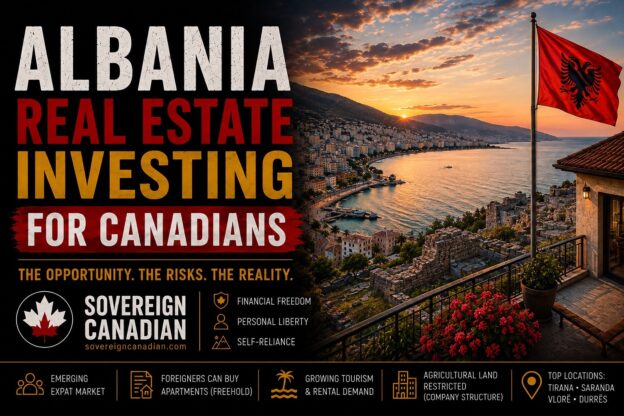
For rental yield, the Albanian Riviera is the story. This is the stretch of Ionian coastline running from Vlorë down through Himarë, Dhërmi, and Ksamil to Saranda — 360 kilometres of coast that’s been getting compared to Croatia twenty years ago, and not without reason. Saranda’s central promenade is producing 6–10% gross on short-term rentals, with the broader Riviera running 9–12% gross during peak season and occupancy north of 80% between May and October. Prices are still low by Mediterranean standards: central Saranda runs roughly €1,600–1,800/m², sea-view stock €2,200–3,000/m². Ksamil — nicknamed the “Maldives of Europe” for its turquoise coves — commands a premium and gets the most foreign attention, though locals will tell you it’s also the most overhyped pocket on the coast, packed in summer and dead by November. Vlorë is the value play right now: €1,000–1,800/m², yields around 5.5–8.5% gross, and a new international airport (opened 2025, ten kilometres from the city) that’s expected to be the single biggest catalyst for the southern Riviera over the next few years. If I were underwriting a rental purchase today, Vlorë and the Orikum/Radhimë stretch just south of it are where I’d be looking — the “second ring” that hasn’t been repriced yet but sits directly in the airport’s growth radius.
For retirement and lifestyle, Tirana and the Riviera towns split the vote. Tirana offers city infrastructure, the best healthcare access in the country, an actual expat community (Blloku and Pazari i Ri are the walkable, café-dense neighbourhoods foreigners gravitate to), and long-term rental yields around 5–7% if you want the property to earn while you’re not using it. The Riviera towns offer the lifestyle case — sea, mountains, a slower pace — but come with the seasonality problem: full and buzzing from June through September, quiet the rest of the year, with pharmacy and specialist medical access that thins out fast once you’re outside Tirana. Saranda’s central promenade is the one Riviera location that holds a year-round population and expat presence in real numbers, largely because of the Corfu ferry link and a growing digital nomad scene.
The pattern across both profiles: this is not a diversified market yet. Everyone’s underwriting the same handful of zip codes. That’s fine for now, but it’s the first thing that changes as EU accession gets closer.
Legal Structure for Foreign Ownership
This is the part that surprises people, because it’s simpler than Mexico or Portugal.
Buildings: no restrictions, full ownership, no local partner required. Albanian law (rooted in Law No. 7850 and reinforced by the 2021 Foreigners Law) gives foreign individuals the same property rights as Albanian citizens when it comes to apartments, houses, villas, and commercial buildings. You buy in your own name, you get the same title deed, and you’re registered directly with the State Cadastre Agency (ASHK). No fideicomiso, no Sh.p.k. requirement, no restricted zone to navigate — a meaningfully lighter structure than what Mexican coastal buyers deal with.
Land is where the restrictions live. Agricultural land can’t be purchased directly by foreign individuals — you need a locally registered company (which can be 100% foreign-owned) to hold it, or you can lease it for up to 99 years without forming one. Urban construction land is generally purchasable when tied to a building investment, under what’s informally called the “3x rule” — the value of what you build has to exceed three times the value of the land. Land within an existing residential development is normally bundled into the apartment or house purchase and doesn’t trigger separate restrictions. And here’s the detail that trips people up: land within 200 metres of the coastline can fall under restricted classification even when the property looks like a standard villa. Always pull the cadastral certificate (kartela) and confirm the classification before you get emotionally attached to a listing — Albania’s post-communist title history means overlapping claims and informal construction still show up, and the physical appearance of a property tells you nothing about its legal classification.
The mechanics: sign before a licensed notary, register with ASHK (typically 5–15 working days for cadastral processing), and budget 3–7% of the purchase price for total closing costs — transfer tax (roughly 2–4%), notary fees (0.5–1%), and legal fees. You’ll need an Albanian tax ID (NIPT), which is straightforward to obtain and can usually be arranged remotely via power of attorney if you can’t attend in person.
Financing Options for Canadians
Short version: bring cash, or bring financing from home.
Albanian banks do lend to non-residents, but it’s a small slice of their book — foreign borrowers represent roughly 4% of outstanding mortgage lending — and the terms reflect that. Expect 60–70% loan-to-value, meaning a 30–40% down payment, rates in the 4–7% range, and underwriting that wants provable income (ideally Albanian-sourced), a local bank account, and often a guarantor with ties to the country. That’s a meaningfully tighter box than what Mexican or Portuguese banks offer Canadian buyers, and it’s why the overwhelming majority of foreign purchases in Albania are cash deals.
For most readers of this series, that points back to the same conclusion I keep landing on: the capital for an Albania purchase is more likely to come from a Canadian HELOC than from an Albanian mortgage. If you’ve been through the second real estate investment post, you already know my view on leveraging home equity against Canadian rates to deploy into a higher-yield foreign market — the arbitrage only works if the yield gap covers your borrowing cost with room to spare, and at 9–12% gross on the Riviera against a Canadian HELOC in the 6–7% range, there’s real room. Just don’t confuse gross yield with your actual spread; property management, vacancy, and Albania’s rental tax all eat into that gap before it hits your pocket.
STR vs. LTR: The Actual Mechanics
Unlike Mexico’s patchwork of state-by-state STR licensing, Albania’s system is refreshingly uniform: there is no separate tax rate for short-term versus long-term rental income — both are taxed at a flat 15% on gross rent. That simplicity is the good news. The operational side has more moving parts:
Short-term (Airbnb, Booking.com): You need to register the property with the local municipality as short-term accommodation before listing it. This is administrative rather than restrictive — there’s no cap on foreign-owned STR units and no licensing quota like Quintana Roo’s RETUR-Q regime — but skipping registration is the kind of thing that gets expensive if a municipality decides to enforce it retroactively. Coastal towns (Saranda, Vlorë, the Riviera villages) are the natural STR markets: 80–90% peak-season occupancy, €100–200/night achievable on well-positioned seafront units, and a hard drop-off outside May–October unless you’re in Tirana or Saranda’s year-round zone.
Long-term (12-month contracts): The lease has to be registered with the tax authority, and the 15% applies to the same gross-rent base. Deductions exist — maintenance, insurance, property management fees — but they’re narrower than what you’d see in Western Europe, so don’t model this as a net-of-everything calculation the way you might with a Canadian rental.
The honest trade-off: STR on the Riviera can post gross yields double what Tirana LTR delivers, but it demands active management, marketing, and a tolerance for six months of the year producing a fraction of the other six. Without professional management, owners commonly lose 20–40% of the property’s realistic income potential to vacancy and inefficiency. If you’re not planning to be hands-on or hire a local manager, Tirana’s steadier long-term rental market is the less exciting and more defensible choice.
Current Regulatory Landscape
Three things are moving at once, and all three matter to a buyer’s timeline.
EU accession is the macro tailwind. All 33 negotiation chapters were open as of late 2025, with integration targeted for 2030–2032. Comparable accession stories — Croatia and Romania in particular — saw real estate appreciate 30–60% in the five years leading into membership. That’s the bet underlying most of the “buy now” enthusiasm you’ll read elsewhere, and it’s not an unreasonable one, but accession timelines slip, and pricing that in too aggressively is how people overpay for a story that takes longer than expected.
The Foreigners Law (79/2021) governs residency, and property ownership is a real pathway. Owning residential property of at least 20 square metres per family member can support a Type D long-stay visa and residence permit application under Article 84 — you submit the ownership certificate instead of a rental contract, which Albanian authorities treat as the stronger evidence. Ownership doesn’t automatically grant residency; it supports an application you still have to file. Permanent residence follows five years of continuous legal residence, and citizenship by naturalization follows seven.
The land classification system is still catching up to the market. Albania doesn’t have the kind of centralized MLS or standardized zoning transparency that Canadian buyers take for granted, and the cadastral system, while dramatically improved over the past decade, still carries the occasional legacy dispute from the post-communist restitution era. This isn’t a reason to avoid the market — it’s a reason to spend real money on a local lawyer who pulls the kartela before you sign anything, not after.
The Canadian Tax Layer — And the Wrinkle
This is the section where Albania actually differs from everywhere else we’ve covered in this series, so pay attention here even if you skim the rest.
Albania taxes rental income at a flat 15% on gross rent for residents and non-residents alike, and capital gains on sale generally at 15% as well, with some exemptions depending on holding period. As a Canadian resident, you still owe Canadian tax on that same income and gain — Canada taxes its residents on worldwide income regardless of where it was earned — and the property itself is very likely a specified foreign property triggering T1135 reporting once your total foreign property cost base crosses $100,000 CAD.
Here’s the wrinkle: unlike Mexico (where T2209 foreign tax credit relief operates cleanly under a functioning bilateral framework), Canada does not currently have a bilateral tax treaty with Albania. Checking Canada’s official in-force treaty list confirms Albania isn’t on it — the alphabetical list runs straight from Algeria and Argentina onward with no Albania entry. That doesn’t mean you’re double-taxed with no relief — Canada’s domestic foreign tax credit rules under the Income Tax Act still let you claim a credit for tax paid to Albania against your Canadian liability on the same income, using the same T2209 mechanism you’d use for any non-treaty country. But without a treaty, there’s no tie-breaker residency article, no negotiated withholding rate ceiling, and no mutual agreement procedure if the two tax authorities disagree on how something should be characterized. In practice, for a straightforward rental property held personally, this rarely causes a real problem — the unilateral credit generally does its job. Where it matters more is if you’re structuring through an Albanian company, financing cross-border, or eventually selling: get a cross-border accountant who’s actually looked at a non-treaty jurisdiction before, not one who’s going to assume treaty mechanics apply by default.
Safety: Separating Headlines from Reality
Albania’s reputation still lags its reality by about fifteen years, and it’s worth addressing directly because it’s the first objection every Canadian friend will raise.
Global Affairs Canada’s current guidance for Albania is “take normal security precautions” — its lowest advisory tier, the same level assigned to Germany and Austria. The intentional homicide rate (1.1 per 100,000, per UNODC data) sits below France and comparable to the UK, and Numbeo’s crime index ranks Albania safer than more than half the European countries it surveys, including France, Belgium, and Italy. Violent crime against tourists and foreign residents is genuinely rare. What actually shows up in the advisories: petty theft and pickpocketing in crowded tourist areas, aggressive and occasionally reckless driving (this is the real risk — treat rural roads and mountain driving with real caution), and organized-crime activity that exists but operates in its own lane, disconnected from tourists and foreign buyers. There’s also a standing note about unexploded ordnance in remote areas near the Kosovo border — not a coastal or Tirana concern, but worth knowing if a deal ever takes you into the northeast.
None of this is a reason to avoid the market. It is a reason to use a reputable local lawyer and notary rather than cutting corners on the one country in this series where you can’t yet lean on decades of established foreign-buyer infrastructure the way you can in Mexico or Portugal.
Bottom Line
Albania is the highest-risk, highest-upside country I’ve covered in this series so far, and I mean that as a description, not a warning label. The yields are real, the ownership structure for buildings is genuinely simpler than Mexico’s fideicomiso or Portugal’s non-resident surcharge regime, and the EU-accession tailwind is a legitimate catalyst rather than marketing copy. What you’re actually underwriting is jurisdictional immaturity — a legal and tax framework that’s still firming up, a title system still working through its history, and a Canada-Albania relationship that hasn’t yet produced a tax treaty. If that’s a trade-off you’re comfortable pricing in, the Riviera’s yield-to-entry-price ratio is hard to find anywhere else on the Mediterranean right now. If you want a European coastal market where the legal furniture is fully assembled, Portugal is still the safer starting point — read that post before this one if you haven’t.
For those moving forward: Vlorë and the airport-adjacent stretch of the Riviera for yield, Tirana for a steadier retirement base with real infrastructure, cash or Canadian-sourced financing over an Albanian mortgage, and a lawyer who pulls the kartela before you fall in love with the view.
This post is for informational purposes only and does not constitute legal, tax, or investment advice. Cross-border property purchases involve jurisdiction-specific legal and tax obligations that change over time — consult a qualified cross-border accountant and a locally licensed lawyer before acting on anything here.