
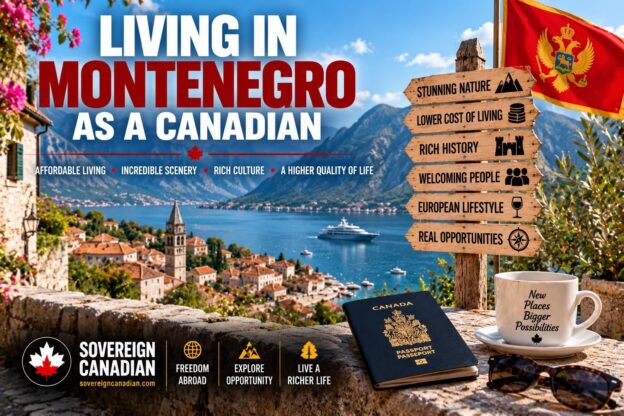
Montenegro is the most European-feeling country in Europe that is not yet in Europe. You pay for your coffee in euros the country adopted unilaterally in 2002. You sit under a NATO umbrella it joined in 2017. And you live in the clear frontrunner of the European Union’s enlargement queue, a country that has opened all thirty-three negotiating chapters and provisionally closed eighteen of them, with a government openly targeting membership in 2028. From a Canadian’s chair, Montenegro can feel like arrival. The airport signs, the euro, the Porto Montenegro yachts, the accession headlines: all of it says a mature European state.
The evidence says something more careful. Montenegro is selling a present that already looks increasingly European while the legal, tax and institutional architecture of permanence still has important gaps. The lifestyle premium, the security premium, the convergence premium: those are already in the price. The deeper things a Canadian would rely on to actually put down roots, a treaty, a residence flag that builds toward something, a passport you can hold alongside Canada’s, a hospital that can carry you into your eighties, are the things Montenegro cannot yet sell you. That is the country’s defining tension, and it is the series identity I will use throughout: convergence without completion.
The short version, which the rest of this article earns rather than asserts: Montenegro sells you the arrival and rents you the future. It is a superb country in which to spend a chapter, and a country you should be slow to assume a future in. The question is not whether Montenegro is pleasant. It plainly is. The question is which kind of Canadian it actually serves, for how long, in which town, under what legal and tax structure, and what would eventually make them leave.
The two Montenegros: postcard and resident
The internet sells you Kotor Bay at golden hour and Budva’s old town at midnight. The resident decision is made somewhere else entirely, so start by separating the postcard from the address.
Podgorica, the capital, wins no beauty contests. It is a flat, hot, functional inland city, and it is where the country’s administration, its main hospital, its year-round airport and its most stable rental market actually sit. It is Montenegro’s Tirana: the place nobody dreams about and many residents quietly need.
Tivat is anchored by the Porto Montenegro marina, the country’s cluster of English-medium schools, and the highest concentration of English-speaking services on the coast. It increasingly functions as an international enclave layered onto a traditional Montenegrin town.
Kotor and its ribbon of Dobrota are the UNESCO showpiece: stunning, stair-ridden, cruise-choked in summer, damp and quiet in winter, and awkward for anyone who values flat ground and year-round services. Budva is the tourism-and-nightlife capital, heavily built, congested in season, thin out of it. Herceg Novi sits at the mouth of the bay near the Croatian border, steep and mild. And Bar, further south, is the flat, working, year-round port city that the postcards ignore and that this article will argue is the most underrated address in the country.
The north – Kolasin, Zabljak and, more broadly, inland centres such as Niksic – is real Montenegro but a different proposition: mountains, winters, and thin services. Worth knowing exists; rarely the answer for a Canadian.
Getting in: the ninety-day clock and the registration slip
For a visit, Montenegro is easy. Canadian passport holders enter visa-free for up to ninety days within any one-hundred-and-eighty-day period, with a passport valid at least three months beyond departure. There is no visa to apply for and no online authorisation: Montenegro is not in the Schengen Area, so the EU’s forthcoming ETIAS system does not apply here.
The genuinely useful structural fact is that Montenegro’s ninety-day clock runs independently of the Schengen clock. Days you spend in Montenegro do not consume your Schengen allowance, and vice versa. That makes Montenegro a legitimate non-Schengen base for a Canadian working through a long European stint, in exactly the same way Albania is. It is worth correcting a common myth here: Montenegro is not a weaker version of that trade than Albania. Canadians receive the same ninety-in-one-hundred-and-eighty allowance in both countries. Albania’s celebrated one-year visa-free stay is a United States citizen arrangement; it does not extend to Canadians. On the tourist clock, the two neighbours are equivalent for a Canadian.
One administrative catch trips people up. Montenegro requires foreigners to be registered with the tourist police within twenty-four hours of arrival, the so-called white card. Hotels do this automatically. Private landlords and short-let hosts must do it manually, and failing to register can bring a fine and complicate a later residence application. Keep the slip. If you are rotating in and out on the ninety-day allowance, treat registration as a discipline, not an afterthought.
Residence: the routes that ladder, and the two that do not
This is where convergence without completion becomes concrete. Montenegro offers several temporary-residence routes: property ownership, employment, company ownership or directorship, family reunification, study, and a digital-nomad permit. There is no dedicated passive-income or retirement visa of the Portuguese type. And renting a home is not itself an independent ground for residence, though an employee, company owner, digital nomad or family member obviously rents like anyone else.
The property route is the one Montenegro is marketed on, and it changed materially in January 2026. Under amendments to the Law on Foreigners published in Official Gazette number 003/2026 and in force from 17 January 2026, a third-country national seeking residence through real estate must now own property with a tax-assessed value of at least EUR 150,000, measured by the Tax Authority’s transfer-tax assessment rather than the contract price. The figure is worth explaining because the internet still conflicts on it: the government first proposed EUR 200,000 in November 2025, withdrew that draft in mid-December after investor pushback, and enacted EUR 150,000 on the last day of the year. Holders of pre-existing property-based permits are grandfathered, and EU, Icelandic, Norwegian, Liechtenstein and Swiss nationals are exempt.
Here is the load-bearing fact. The Government of Montenegro’s own permanent-residence guidance states that the five-year clock toward permanent residence does not include time spent on temporary residence held for owning real estate, nor time on a study permit, and study, where it counts at all, is generally credited at half rate. Employment, company directorship and family reunification, by contrast, count in full. The digital-nomad permit sits in a greyer zone: the official exclusion list does not name it, and Montenegrin lawyers disagree on whether its years count, but the argument is largely academic, because the nomad permit caps at four years and then forces a six-month departure, so it cannot on its own reach the five continuous years permanent residence demands. The practical upshot is stark. The route a mobile, affluent Canadian would most naturally reach for, buy a flat, is the one Montenegro expressly refuses to count toward permanence, and the nomad route cannot get there alone either. The flags that are easy to obtain are not the flags that build.
The digital-nomad permit, described accurately
Montenegro does have a real digital-nomad residence permit, and it is worth describing precisely because the internet has muddied it. The permit is a statutory category under the Law on Foreigners, available to non-Montenegrin nationals who work remotely for employers or clients registered outside Montenegro. It runs for two years and can be extended once for a further two, to a maximum of four, after which a six-month departure is required. The income threshold is three times the Montenegrin minimum wage. Because that minimum wage is itself set in two tiers by education level in 2026, EUR 600 for vocational qualifications and EUR 800 for a bachelor’s degree or higher, the nomad income floor inherits the same split: roughly EUR 1,800 per month for applicants without a degree and EUR 2,400 for those with one, plus health insurance and a clean record.
The tax feature is the draw. Qualifying digital-nomad income from a foreign employer or foreign self-employment is exempt from Montenegrin personal income tax, and a parallel statutory exemption relieves social-security contributions on that income. You will still pay Montenegro’s twenty-one percent VAT on what you consume locally, and the exemption attaches to the nomad status, not to your global life.
You will also find breathless claims that the whole thing expires on 31 December 2026. Treat those with care. What carries that date is the government’s promotional Programme for Attracting Digital Nomads, a policy-and-marketing initiative, not the statutory residence permit or the tax exemption, which live in the Law on Foreigners and the tax laws respectively and have no published repeal. The terms could well be revised as Montenegro aligns with EU norms, and anyone building a multi-year plan should watch for that. But as the law stands, the nomad permit and its exemption are real and current. The genuine limitations are structural: the permit caps at four years and then forces a six-month departure, so it cannot by itself build the five continuous years permanent residence requires; it does not permit local work; it does not grant Schengen mobility; and it does not open the public-healthcare door.
Tax: low-rate, not low-tax, and why the missing treaty matters
Montenegro is marketed as a low-tax jurisdiction, and by European standards the headline rates are indeed low. Salary is taxed on a monthly basis at zero up to EUR 700, nine percent from EUR 700 to EUR 1,000, and fifteen percent above EUR 1,000. Entrepreneurial income runs on an annual version of the same idea. Investment income, dividends, interest, capital gains, rent and royalties, is taxed at a flat fifteen percent. The corporate rate is nine percent up to EUR 100,000 of profit, then twelve, then fifteen. VAT is twenty-one percent standard. Social contributions were cut sharply in the October 2024 reform: the employee now bears ten percent pension and disability plus a half-percent unemployment share, the mandatory health contribution was abolished, and employers were largely relieved. Sources still quoting a combined burden above twenty percent are describing the pre-reform world.
Low rates are not the same as low tax for a Canadian, and here is the distinction that matters. Montenegro taxes its residents on worldwide income once they cross the 183-day line or establish their centre of vital interests in the country. There is no Canada-Montenegro income tax treaty. That absence is real and it is load-bearing, but it must be described correctly. It does not mean your income is simply taxed twice. Montenegro’s domestic law grants residents an ordinary foreign tax credit for foreign tax paid, capped at the Montenegrin tax attributable to that income. The exact interaction still depends on the source and character of the income, so actual double taxation is usually mitigated rather than eliminated by formula.
What the missing treaty actually costs you is subtler and still significant: there is no treaty to allocate taxing rights between the two countries, no treaty to reduce Canadian withholding, no residency tie-breaker to resolve a dual-residence dispute cleanly, and no specific pension or investment protections. For a Canadian with Canadian-source retirement income, that combination bites, as the next section shows. The honest verdict: Montenegro is low-rate by European standards, but for a Canadian it is frequently not tax-saving at all, and can add a layer rather than remove one. See Flag Theory for Canadians for where a low-rate residence actually helps and where it does not.
Leaving Canada, briefly
Emigrating for tax purposes is a Canadian event before it is a Montenegrin one, and it deserves its own treatment in Departure Tax Canada and Canadian Tax Residency. The short version for Montenegro follows.
Ceasing Canadian residency turns on facts, not on a form: severing significant residential ties, home, spouse, dependants, and the secondary ties Canada Revenue Agency weighs. Because there is no treaty, there is no tie-breaker to lean on if your ties are ambiguous, so a Montenegro departure needs to be clean rather than half-made. On departure, Canada levies its deemed-disposition departure tax on most non-registered holdings, a capital-gains event you should model before you move.
Canadian-source income you keep is then exposed to Part XIII non-resident withholding, and the no-treaty status shows up here. Absent a treaty, the default twenty-five percent withholding on periodic pension and registered-plan payments is not reduced, where many treaties would cut the rate on periodic Registered Retirement Income Fund payments to fifteen. Canada Pension Plan and Old Age Security are payable abroad, but Old Age Security has a hard condition: to be paid indefinitely outside Canada you generally need twenty years of Canadian residence after age eighteen. And this is where Montenegro differs unexpectedly from Albania. Canada has a social-security agreement with Albania, in force since 1 August 2022, that helps with pension qualification and the residence count. Montenegro appears on no such Canadian list. There is no Canada-Montenegro social-security agreement to totalise contributions or to help satisfy the twenty-year rule. For a pension-funded retiree, that gap is one of the quiet costs of choosing Montenegro over its southern neighbour.
Registered accounts add uncertainty rather than clarity. Montenegro publishes no recognition of the Tax-Free Savings Account, the Registered Retirement Savings Plan wrapper or the others, so a resident cannot assume the shelter survives the border. That uncertainty is itself a planning cost, and you should price it rather than wish it away.
Healthcare: one hospital, and the road to it
Do not assume a country of roughly 620,000 has weak medicine simply because it is small. The more precise finding is about concentration. Montenegro has exactly one tertiary hospital, the Clinical Centre of Montenegro in Podgorica. It is the only institution in the country providing tertiary care, and the national tertiary-care system gravitates to it for cardiac surgery, interventional cardiology, oncology with radiotherapy, neurology and major trauma. The general hospitals in Kotor, Herceg Novi, Bar, Niksic and the northern towns handle stabilisation, emergencies, basic surgery and obstetrics. They are not tertiary centres.
For the hardest cases, complex oncology, advanced cardiac surgery, neurosurgery, Montenegro refers patients abroad, principally to Serbia, Croatia and Italy, under bilateral arrangements. So the country’s real medical map has two features a Canadian must weigh: a single national centre in the capital, and an export route for anything that centre cannot handle.
Now run the coast test the series always runs. Picture a seventy-five-year-old Canadian in Kotor, Budva or Tivat who suffers a serious cardiac event. They are stabilised at a coastal hospital and then moved to Podgorica, roughly ninety minutes to two hours from the bay by road under normal conditions, and potentially much longer when summer traffic clots the coast and the approaches inland. The most complex diagnoses then travel onward, across a border, to Belgrade or beyond. The limitation is not primarily quality. It is concentration, capacity and distance. That distinction is the hinge of the retirement decision, because the beach map and the hospital map are not the same map, and only one of them matters at eighty.
Families and schooling: the collapse into Tivat
A Canadian family’s Montenegro decision is quietly made by its schools. English-medium international education is not spread across the coast; it is concentrated, and overwhelmingly in Tivat and the Bay of Kotor. The country’s original International Baccalaureate school, Knightsbridge Schools International, sits in Tivat beside Porto Montenegro, with fees running from roughly EUR 7,600 to EUR 17,600 a year plus registration. Arcadia Academy, a British school offering Cambridge IGCSE and A-Levels, is also in the Tivat area, at roughly EUR 7,000 to EUR 14,000. Podgorica offers a subsidised French school and a few smaller options; Budva and Bar skew toward Russian-curriculum schools.
The practical consequence is a collapse of choice. A Canadian family that wants serious English-medium education does not get to choose freely among Montenegro’s towns; it effectively chooses Tivat. That has a knock-on cost. Two children in the upper years can run somewhere between EUR 25,000 and EUR 35,000 a year in tuition alone, which erodes a large part of the cost arbitrage that drew the family to Montenegro in the first place. Price two real children before you fall for the headline rents.
There is a deeper tension worth naming, because Montenegro’s own geography creates it. The best place in the country to educate your children is not the best place to get seriously ill. The English-school cluster is on the bay; the tertiary hospital is over the mountains in Podgorica. A one-year family stay can live comfortably with that gap. A multi-decade one cannot ignore it.
Cost of living: cheaper than it looks, dearer than the brochure
Montenegro is genuinely cheaper than Western Europe, on the order of forty to fifty percent, and modestly cheaper than Croatia now that Croatia uses the euro and has drifted upward. But it is no longer the ultra-cheap Balkan secret, and the single biggest variable is not the country but the town.
Off-season long-term rents tell the story. A one-bedroom runs roughly EUR 400 to EUR 750 in Podgorica, EUR 450 to EUR 700 in Kotor, EUR 500 to EUR 1,200 in Budva or Tivat, and, tellingly, EUR 300 to EUR 450 in Bar, the cheapest of the notable towns. Coastal rents then spike twenty to forty percent in the summer, when tourism and foreign demand collide with a thin supply of good year-round stock. A comfortable single budget lands around EUR 1,200 to EUR 1,500 a month all in; a couple, EUR 1,800 to EUR 2,500. Utilities run EUR 135 to EUR 280, with air-conditioning in summer and heating in winter the wild card, and internet a predictable EUR 20 to EUR 30.
There is a real question of whether Montenegro carries a small-state property premium, with coastal land finite and foreign demand disproportionate to a tiny domestic economy. The evidence supports a qualified yes. Montenegro hosts a large foreign-resident and second-home population relative to its size, and that presence concentrates on the coast. There, whole segments of the market move on the budgets and expectations of outsiders rather than on local wages, and towns like Budva and the Bay of Kotor are shaped more by foreign and investor demand than by local incomes. So the honest cost picture is two markets: an affordable inland-and-southern one built on local incomes, and a coastal one priced for outsiders. Buy the second and much of the arbitrage disappears; the headline figure was never the coastal figure.
Housing reality
Housing depth belongs to Montenegro Real Estate Investing for Canadians, but resident reality matters here. Foreigners can broadly own apartments and buildings, with restrictions on agricultural land and some border-zone parcels that usually push buyers toward a company structure. The risk areas to verify rather than assume are familiar to the region: unpermitted or illegally extended construction, unfinished developments sold off-plan, cadastre and title verification, coastal overdevelopment, seasonal damp in poorly built coastal stock, and seismic exposure along the Adriatic.
The one line to carry into any purchase is that a EUR 300,000 Adriatic apartment is not automatically a EUR 300,000 European institution. The building may be beautiful and the paperwork thin. Verify the title, the occupancy permit and the tax-assessed value, the same value that now governs your residence eligibility, before you sign because you liked the view.
Infrastructure and the seasonal-airport problem
Daily life in Montenegro is convenient in the small-country way and constraining in the same breath. Roads are decent but the coast clogs in summer, and the Sozina tunnel shortens the inland run to Podgorica from Bar and the southern coast far more than from the Bay of Kotor, which reaches the capital by the slower Cetinje road. What deserves a Canadian’s attention is air access, because it shapes both family logistics and the retirement calculus.
Montenegro has two airports and a Croatian one it half-depends on. Podgorica is the only reliable year-round international airport, with roughly fifty destinations and steady service to Belgrade, Istanbul, Vienna, Ljubljana, Zagreb and Warsaw, plus a Wizz Air base and a daily Turkish Airlines link to Istanbul that opens the wider world. Tivat, closest to the bay and its schools, is structurally a summer-leisure airport: something like eighty percent of its traffic falls between May and September, and its winter timetable shrinks to a handful of Belgrade, Vienna and Istanbul routes. Dubrovnik, across the Croatian border, is often cheaper via budget carriers but adds an international crossing that can stack one to three unpredictable hours in peak season.
There are no direct flights to Canada. The realistic routing to Toronto or Montreal is a single stop through Istanbul, Vienna, Frankfurt, Rome or Belgrade, a twelve-to-sixteen-hour door-to-door day. The structural point for residents is that the coast’s air convenience is seasonal, while Podgorica’s is not. For anyone who will fly regularly in winter, for family, for medical care, proximity to Podgorica is a year-round asset that the bay does not offer.
Safe streets, thinner institutions
Montenegro is personally safe. The Government of Canada places it at its lowest advisory tier, take normal security precautions, with low crime and mainly seasonal petty theft in tourist areas. Organised-crime violence exists but rarely touches foreigners.
Institutional strength is a separate question, and here the picture is more mixed. Freedom House rates Montenegro only partly free, and its rule-of-law and corruption-control indicators sit well below Canadian or Croatian norms. Contract enforcement, judicial reform, municipal planning and property-dispute resolution are all live weaknesses that the EU’s own accession monitoring keeps flagging. So the honest formulation is that Montenegro can be very safe to live in and still materially weaker institutionally than the country you left. Personal safety and institutional reliability are different goods, and Montenegro delivers the first more fully than the second. That gap is not a reason to stay away; it is a reason to keep your important legal and financial architecture outside a system you would not yet fully trust to adjudicate it.
Language, integration and the expat layer
Montenegrin, effectively mutually intelligible with Serbian, Croatian and Bosnian, is the language of administration, written in both Latin and Cyrillic scripts. English is widely usable on the coast and among the young, less so in offices and the north. Russian and, increasingly, Ukrainian are audible everywhere along the coast, alongside a substantial Western-European contingent.
That expat layer is a double-edged asset. It makes the coast unusually easy to live in without Montenegrin: services, schooling and social life in English or Russian are all available. But it also makes Montenegro easy to live beside rather than inside. The Russian, Ukrainian and Western-European enclaves can become a parallel society, comfortable and self-sufficient, that never quite requires you to join the country itself. For a chapter, that is a feature. For a decade, it is worth asking whether you are integrating into Montenegro or merely importing your own world onto a prettier coast. Functioning, integration and belonging are three different things, and the coast makes the first easy while quietly leaving the third to you.
Climate: scout the season that would make you leave
The series rule is to scout the season most likely to make you leave, not the one most likely to make you buy. In Montenegro that means ignoring July on the bay and testing the hard seasons.
On the coast, the punishing season is high summer, when heat, humidity, crowds and traffic converge, and the shoulder truth is that Kotor’s bowl can feel airless and damp. Podgorica’s own summer is a continental furnace, regularly among the hottest spots in the region, which is the capital’s real liability. The northern mountains flip the problem: genuine winters with snow and thin services. Across the coastal housing stock, winter damp and mould in poorly built or poorly heated flats is a recurring resident complaint, and the bora wind can be fierce. Wildfire and seismic risk sit in the background along the Adriatic. Before committing to any town, spend time in Kotor in February, in Podgorica in August, and in whichever coastal flat you fancy during a wet, windy week. The bay in June sells itself. The question is whether you can live there in the months that do not.
Remote work, graded honestly
Montenegro divides sharply by which clock your income runs on. For a Europe-facing remote worker, it is a strong base: the time zone aligns with clients, internet in the main towns is fast, coworking exists in Podgorica, Tivat and Budva, and the digital-nomad permit can deliver a zero-percent Montenegrin tax on foreign income if you qualify and become resident. The caveats are the ones already noted: the permit caps at four years and does not by itself build toward permanent residence, and Montenegro’s 183-day rule is hard, so a genuinely footloose worker who anchors nowhere may simply stay tax-resident back home, making Montenegro’s rates irrelevant.
For a North-America-facing worker, the calculus is worse, and it is the time zone, not the tax, that does the damage. Montenegro sits six hours ahead of Toronto, so a Canadian-market schedule means working late into the Montenegrin evening every day, indefinitely. Fast internet does not fix a calendar. The euro-Adriatic lifestyle is real, but a worker who must keep Eastern-time hours will feel the misalignment far more than the savings.
Entrepreneurship: a base for external income, not a local market
Company formation in Montenegro is cheap and light: minimum share capital of a few hundred euros, a nine-percent headline corporate rate at the bottom band, and comparatively little bureaucracy. For a Canadian earning externally who wants a low-cost European operating base, that is attractive, and company directorship has the added virtue, unlike property or the nomad permit, of counting in full toward permanent residence.
The constraint is the domestic market. Montenegro is a country of roughly 620,000 people with a tourism-and-construction-heavy economy and a thin professional-services bench. A business that depends on selling into Montenegro is selling into a very small pond with limited competition and limited depth. The 2026 reforms also tightened the company route: an owner-director now generally needs the company to have paid at least EUR 5,000 in taxes and contributions in the prior year to renew the integrated residence-and-work permit, which quietly ends the era of the empty shell company used only for a residence card. So the honest framing is that Montenegro is a decent base for externally earned income and a difficult place to build a locally dependent business.
EU accession: the upside that is already in the price
Montenegro is the enlargement frontrunner, and the numbers are worth stating precisely as of September 2026. All thirty-three chapters are open, and eighteen have been provisionally closed, with the government aiming to close the rest by the end of 2026 and to join in 2028. Brussels treats Montenegro as its best-performing candidate; an accession-treaty drafting body is already at work, and the Commission has proposed a multi-billion-euro financial package. Serious observers still caution that the timeline is ambitious and hostage to rule-of-law reform, so a Canadian should treat 2028 as a target, not a fact.
Now the insight that matters for a buyer. Much of the accession upside is already priced into Montenegro, especially on the coast, where property and living costs already carry near-EU levels. You are, in effect, paying today for a membership that arrives later, if it arrives on schedule at all. And here the convergence-without-completion thesis turns sharp for a Canadian. The EU institutions may arrive: deeper regulation, better infrastructure, stronger courts, possible Schengen integration, system-level improvements a resident would genuinely enjoy. EU citizenship rights do not arrive for you merely because Montenegro joins. Free movement and political rights attach to citizens, and under current Montenegrin naturalisation law a Canadian would face the renunciation problem described below. You can buy the country’s improving present. You cannot buy its future passport simply by being there when the flag changes.
Permanent residence and citizenship
Permanent residence requires five continuous years of qualifying temporary residence. Continuity is fragile: absences totalling more than ten months over the period, or six months at a stretch, break it and reset the counter. And, as established, property-based residence is expressly excluded from those five years, while the nomad permit caps at four years and cannot reach them on its own. The ladder to permanence runs through employment, company directorship or family, not through a flat or a nomad card.
Citizenship is where a Canadian’s passport ambitions usually end. Standard naturalisation requires roughly ten years of lawful continuous residence, commonly framed as five on a temporary permit followed by five as a permanent resident, plus an elementary Montenegrin language test and a clean record. Crucially, Montenegro generally requires renunciation of prior citizenship and does not permit dual citizenship except by bilateral treaty or rare exception. There is no Canada-Montenegro dual-citizenship arrangement. An ordinary Canadian naturalising in Montenegro would therefore generally have to give up Canadian citizenship. The old citizenship-by-investment programme, which some outdated sites still tout, closed to new applicants at the end of 2022. The conclusion is blunt: Montenegro is a residence story for Canadians, not a second-passport story, and it does not become one even after EU accession.
Montenegro versus Albania: what the premium buys
This is the comparison the series has been building toward, and it should be precise rather than sentimental. Montenegro costs more than Albania. The question is what the premium buys.
It buys real things. Euro stability instead of the lek. A visibly stronger present-day institutional feel and a more advanced EU trajectory, Montenegro is chapters ahead of Albania in the queue. A genuine high-end coast, Porto Montenegro, Tivat, that Albania does not match. Reliable year-round air access at Podgorica. Those are worth paying for if you value them.
But be clear about what the premium does not buy. It does not buy better Canadian tax treatment: neither country has an income tax treaty with Canada, and the analysis is broadly the same on both sides of the border. And on property-based permanence Montenegro may actually be weaker: Albania’s general five-year permanent-residence framework does not expressly exclude property-owner residence, while Montenegro explicitly does. On another axis too Albania is ahead: Canada has a social-security agreement with Albania and none with Montenegro, which matters for a pension-funded retiree’s Canada Pension Plan and Old Age Security position. So the Montenegro premium buys a better present, euro, institutions, coast, air, not a stronger root or a cleaner exit. Whether that is worth the extra cost depends entirely on whether you are buying a lifestyle or a foundation. The companion piece, Living in Albania as a Canadian, makes the other side of that trade.
Montenegro versus Croatia: the unfinished versus the finished
Croatia is the completed version of the same Adriatic idea: in the EU, in Schengen, on the euro, with mature institutions, and more expensive for it. The question for a Canadian is whether Montenegro is sufficiently cheaper, easier or more flexible to justify choosing a country that has not yet finished its European transition.
The answer is a qualified sometimes. Montenegro is modestly cheaper on everyday costs and lighter on business setup, and its residence routes are more accessible to a non-EU national than Croatia’s. But Croatia gives a Canadian resident life inside an EU and Schengen state, with the mobility, regulatory integration and institutional depth that brings, even though EU-citizen free-movement rights still attach to citizenship rather than to ordinary Canadian residence. So Montenegro’s honest position is a middle ground between Albania’s reversibility and Croatia’s maturity. It suits a Canadian who wants euro-Adriatic life at below-Croatia prices and does not need EU rights. If you need the institutions and the mobility, buy the finished country and pay for it; see Living in Croatia as a Canadian. If you want to sample cheaply and keep the exit wide open, Albania. Montenegro is the compromise, and a compromise is only worth it at the right price.
Montenegro versus Cyprus and Malta
Against the island jurisdictions, the trade is easy to summarise. Montenegro offers compactness, a real coast and foreigner-friendly access without literal island isolation; you can drive out to Croatia, Bosnia, Serbia, Kosovo or Albania. But it has much thinner tertiary healthcare than Cyprus or Malta, a genuinely seasonal second airport, and a shallower bench of international services and institutions. Montenegro does not trade away island dependence for nothing; it trades it for mountain-and-border dependence and a single national hospital. For the tax-and-lifestyle comparison that draws Canadians to the islands, see Living in Cyprus as a Canadian and Living in Malta as a Canadian.
The real ceiling: small-country capacity
Step back and the pattern resolves. Montenegro’s constraints are not, for the most part, Albania-style institutional unreliability. They are the arithmetic of a country of roughly 620,000 people. A population that size can support one tertiary hospital, not a network. It can support a narrow cluster of international schools, not a choice in every city. It can fill a summer airport and one year-round one, not several. It sustains a thin professional-services market, a tiny domestic business market, and a shallow specialist-healthcare bench, all of which a Canadian will eventually bump into, most painfully while aging. This is the article’s strongest secondary theme, and it is worth stating plainly: Montenegro’s real ceiling is capacity, not corruption. It is small before it is anything else, and smallness is a structural fact that no amount of EU convergence quickly fixes.
Five Canadian models
Seasonal Montenegro. A Canadian spending two or three months a year fits inside the ninety-day allowance and pays no Montenegrin tax as a non-resident. Base on the coast in the shoulder seasons, Herceg Novi or Tivat, use Tivat’s summer flights, and keep it a visit rather than a residence. This is Montenegro at its best: low friction, easy exit, real Adriatic reward. Verdict: strong, and genuinely reversible.
One-Year Family Montenegro. A family with two school-aged children will route through Tivat for schooling, take a residence permit, and accept that serious healthcare means a Podgorica transfer. The tuition arithmetic is the surprise, and it eats much of the arbitrage. Verdict: workable and rewarding for a single school year; the gap between school geography and hospital geography is tolerable over twelve months.
Remote Montenegro. A Canadian earning abroad should split by market. Europe-facing, with the nomad permit and its zero-percent foreign-income exemption, Montenegro is a strong base. North-America-facing, the six-hour time gap is a daily tax the euro coast cannot offset. Verdict: excellent for European-facing work, poor for Canadian-hours work.
Retirement Montenegro. A healthy couple arriving at sixty and intending to stay past eighty faces the no-treaty pension exposure, the missing social-security agreement, the Old Age Security twenty-year rule, and a single tertiary hospital. Location must be chosen on the hospital map. Verdict: possible but demanding, and only in the right town.
Second-Base Montenegro. An affluent, mobile Canadian can use Montenegro as a European presence flag: a property, a residence card, a legal foothold, a euro base with continental exits, held with minimal time on the ground. It works as optionality. It does not deepen into permanence, and the tax-residence trap must be actively avoided. Verdict: useful as a flag, limited as a foundation. This is the Flag Theory for Canadians use case.
One family decision: Tivat
Asked to place a Canadian couple with two primary-school children in Montenegro for exactly one school year, and forced to choose a single town, the answer is Tivat. No menu.
The reason is the schooling geography that this article has already established. The country’s best English-medium schools, Knightsbridge and Arcadia, are in and around Tivat, not in the capital. For a single year, the child’s classroom outranks almost every other variable, and Tivat is where the credible International Baccalaureate and British options actually are. Tivat also offers the highest concentration of English-language services on the coast, a walkable core around Porto Montenegro, and the country’s most convenient airport during the non-winter months that bracket a school year. Podgorica has a French school and thinner English options, but it cannot match Tivat for an English-speaking Canadian family, and its continental summer is punishing.
The honest caveat travels with the choice: Tivat is on the bay, and serious illness still means the road to Podgorica. For twelve months with healthy children, that is an acceptable trade. Tivat wins the year.
One retirement decision: Bar
Asked to place a healthy Canadian couple who move at sixty and expect to remain past eighty, and again forced to choose, the answer is Bar. Podgorica is what the hospital map alone would choose; Bar is what wins once you weigh everything a person actually lives.
At sixty the beach map is tempting. Past eighty the road to the hospital is the map that matters, and that single line disqualifies the obvious postcard answer. Kotor is beautiful and wrong for aging: stairs, congestion, mountain transfers, seasonal thinning. What Bar offers instead is a rare combination for Montenegro: flat, walkable terrain; a genuine year-round city rather than a resort that empties in October; the coast without resort dependence; the lowest housing costs among the notable towns; rail and road connectivity; and, decisively, proximity to Podgorica through the Sozina tunnel, roughly an hour by road in normal conditions to the country’s only tertiary hospital.
Test that against the emergency-transfer weighting the series insists on, and Bar still holds. A cardiac event in Bar reaches the Clinical Centre in Podgorica far faster than the same event on the bay, without the summer coastal traffic that turns a Kotor transfer into a gamble. Podgorica itself would win a pure hospital-map contest, but its continental heat and lack of coast make it a hard place to actually retire to. Bar is the decision: coastal life you can age inside, close enough to the one hospital that counts. Podgorica is the answer only if healthcare is the sole variable.
What money solves, and what it does not
For an affluent Canadian, a great deal of Montenegro’s friction is purchasable. Money buys private clinics and English-speaking doctors for everyday care, a well-built and well-heated home instead of a damp one, lawyers and drivers and airport transfers, private schooling, comprehensive insurance and medical evacuation, generators and backup systems, and treatment abroad when the local system runs out of depth. Wealth genuinely smooths the daily experience here, arguably more than it does in Albania, because the high-end coastal ecosystem already exists to spend into.
What money cannot buy is structural. It cannot conjure a second tertiary hospital or deepen a specialist bench that a country of 620,000 cannot staff. It cannot make Tivat’s airport run full winter schedules or dissolve the Croatian border queue. It cannot flatten Kotor’s mountains or unclog the summer coast. It cannot rewrite the rule of law, enlarge the domestic market, or change a citizenship statute that demands you renounce Canada. And it cannot manufacture belonging. Money solves comfort; it does not solve capacity, and Montenegro’s binding constraints are capacity constraints. That is the line to keep: wealth buys you a better experience of Montenegro’s limits, not an exemption from them.
The sovereignty question
Does Montenegro increase a Canadian’s sovereignty, or merely swap dependence on Canada for dependence on a much smaller state? The answer is that it can add optionality without adding foundation, and confusing the two is the mistake to avoid.
As a second base, Montenegro is real: a legal European foothold, a non-Schengen clock, a euro address, continental exits by road, and a low-cost place to hold optionality. That is a genuine sovereignty gain for a mobile Canadian who keeps Canada as the anchor. But as a replacement for Canada, Montenegro substitutes a large, treaty-networked, institutionally deep state for a small one with a single hospital, no Canadian tax or social-security treaty, an easy property-residence flag that does not ladder, and a passport you can only earn by surrendering your own. The hypothesis worth holding is that Montenegro is strongest not as the cheapest place to live but as a relatively low-cost piece of European optionality sitting between Albania’s reversibility and Croatia’s maturity. Take it as a flag and it strengthens your position. Mistake it for a foundation and you have traded a large dependence for a smaller, thinner one.
Scorecard
Grades run A to F and are deliberately spread. They describe fit for a Canadian, not the country’s charm.
| Use case | Grade | One-line reason |
|---|---|---|
| Reconnaissance trip | A- | Easy, safe, euro, beautiful, low friction |
| Seasonal or snowbird base | B+ | No visitor tax; ninety-day cap limits a long winter |
| One-year family sabbatical | B+ | Works well through Tivat; tuition erodes arbitrage |
| One-to-five-year family relocation | C+ | School and hospital depth thin over time |
| Retirement on Canadian pensions | C | No treaty, no social-security pact, single tertiary centre |
| Retirement on investment income | B- | Portfolio funding softens the pension gaps |
| North-America-facing remote work | C+ | Six-hour time gap is a daily cost |
| Europe-facing remote work | A- | Aligned hours; zero-percent nomad exemption on foreign income |
| Ordinary entrepreneur | C+ | Low rates, tiny domestic market |
| Mobile investor or second base | B | Real presence flag, limited depth |
| Tax residence as a saving | C- | Worldwide taxation at fifteen percent; often no net saving |
| Property-based residence flag | C | Renewable permit that never ladders to permanence |
| Permanent residence | C- | Five years, easy routes excluded, fragile continuity |
| Citizenship | D | Ten years and renunciation of Canada |
| Aging in place past seventy-five | D+ | One hospital, coast transfers, thin depth |
| Permanent relocation | C | A good present resting on an incomplete foundation |
The shape says the thesis out loud. Montenegro grades high for sampling, chapters, European-facing remote work and second-base optionality, and low for permanence, citizenship, aging and tax saving. Chapter yes, root no.
Verdict
- Who should seriously consider Montenegro? Europe-facing remote workers, seasonal and snowbird Canadians, mobile investors wanting a euro presence flag, and families planning a defined chapter rather than a permanent move.
- Who should choose elsewhere? Anyone whose case rests on permanence, on Canadian-pension retirement, on a keepable second passport, or on serious healthcare depth in old age.
- Season, chapter or permanent home? Chapter, most convincingly. Season, easily. Permanent home, only with clear eyes and the right town.
- Is meaningful cost arbitrage still available? Yes inland and in the south; much less on the coast once good housing, private healthcare and international schooling are bought.
- Is it actually cheap once those are bought? No. The coastal, well-serviced, family version of Montenegro is a mid-cost European life, not a bargain.
- Is it a good Canadian retirement destination? Only conditionally, and only in a Podgorica-adjacent town like Bar. The pension mechanics and single hospital weigh against it.
- Better for pension-funded or portfolio-funded retirees? Portfolio-funded. The no-treaty and no-social-security-agreement gaps hit pension income hardest.
- Attractive for affluent Canadians? Yes for lifestyle and optionality; wealth buys comfort but not capacity.
- Attractive for families? For a chapter, yes, through Tivat, with tuition priced honestly. For the long haul, the depth is thin.
- Attractive for remote workers? Strongly for European-facing work; weakly for Canadian-hours work.
- Best family base? Tivat.
- Best retirement base? Bar, with Podgorica as the pure hospital-map alternative.
- Is property-based residence actually useful? As a presence flag, yes. As a path to permanence, no; it ladders to nothing.
- Does EU accession strengthen the case? It strengthens the country’s institutions and is largely priced in already. It does not deliver EU citizenship rights to a Canadian resident.
- Sovereignty gain or dependence on a smaller system? A gain as a flag held alongside Canada; a downgrade if taken as a replacement for it.
What I’d Actually Do
- Decide first whether you want a season, a chapter or a permanence attempt. Montenegro rewards the first two and punishes casual assumptions about the third.
- Confirm your ninety-in-one-hundred-and-eighty Canadian allowance and treat Montenegro’s non-Schengen clock as a deliberate tool, not an accident.
- Register the white card within twenty-four hours on every stay, and keep the slips.
- Scout the bad seasons before buying anything: Kotor in February, Podgorica in August, and any coastal flat during a wet, windy week.
- Even if the coast is the draw, scout Podgorica, because the hospital and the year-round airport live there.
- Model your Canadian departure properly: factual residency, departure tax, and Part XIII withholding at the unreduced twenty-five percent, before you move.
- Model your specific pension and investment taxation, including the missing social-security agreement and the Old Age Security twenty-year rule.
- Treat property-based residence and the nomad permit as renewable presence flags, not as steps toward permanent residence or citizenship.
- If permanence is the goal, structure residence through employment, a genuinely active company, or family, the routes that actually count toward the five years.
- Price private healthcare and medical evacuation, and map your serious-care referral path to Podgorica and onward to Serbia, Croatia or Italy.
- Price two real children through Knightsbridge or Arcadia before believing the cost arbitrage.
- Rent for a full year in your chosen town before buying anything, and never buy on a summer visit.
- Verify cadastre, title, occupancy permit and tax-assessed value on any property, and remember that value now also governs your residence eligibility.
- Understand, in writing, that citizenship would require roughly a decade and renouncing Canada, and plan Montenegro as a residence, not a passport.
- Design the exit before you need it: keep your core financial and legal architecture in a system you trust, and hold Montenegro as optionality rather than as the foundation.
For the wider framework behind these steps, see Expat Living for Canadians, and for how Montenegro sits alongside its neighbours, Living in Greece as a Canadian.
This article is general information for Canadians, not legal, tax, immigration or financial advice. Rates, thresholds, residence rules and treaty positions change, and several Montenegrin figures cited here were current in 2026 and should be reverified before you act. Confirm your own situation with qualified Canadian and Montenegrin professionals before making any relocation, tax or investment decision.