
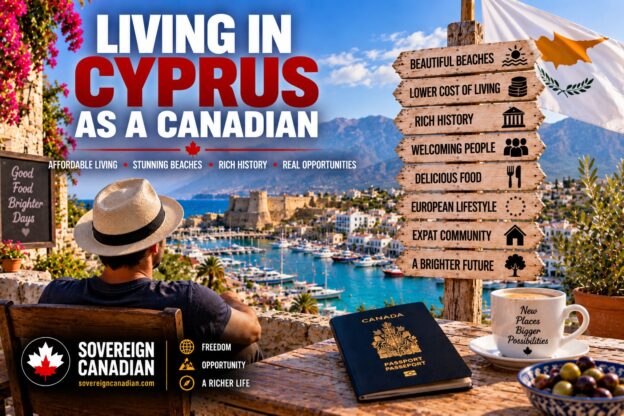
I went into Cyprus expecting to write “Greece with lower taxes.” That framing is wrong, and the way it’s wrong turned out to be the most interesting thing about the island.
Cyprus is the rare Mediterranean country where the tax system and the lifestyle finally point the same direction. In Italy the incentive and the geography fight each other. In Spain the life is easy to love and hard to structure. In Croatia you get a superb chapter country wrapped around a weak permanent home. Cyprus does something none of those do: it hands an English-speaking Canadian a warm winter, a euro economy, an English-influenced common-law legal tradition, and a genuinely favourable tax regime, all in the same place, without asking you to move to a microstate.
Then it quietly presents the bill. The bill is not money. Cyprus is an island at the far southeast corner of Europe, closer to Beirut than to Athens, with no road out, a summer that is becoming physically hostile, a water supply that leans on desalination, and a medical system that ships its hardest cases abroad. Every serious problem in Cyprus is a plane problem.
So the real question is not whether Cyprus is a good place to live. For the right Canadian it is very good. The question is which version of a Canadian life Cyprus improves, which version it complicates, and whether the options it opens are worth the dependencies the island introduces. I worked through the residence rules, the 2026 tax reform, the actual Canada-Cyprus treaty text, the healthcare geography and the flight map, and I came out with clear answers. Some of them surprised me.
One sentence to hold onto before we start, because it governs almost everything that follows: Cyprus taxes pensions like everyone else and taxes capital like almost no one else. That single asymmetry decides who should look hard at this island and who should look at Greece instead.
The scorecard
I grade destinations by use case, because the same country can be an A for one Canadian and a C for another. The spread is the analysis. With Cyprus the spread is wide, and it clusters around one axis: how mobile you are, and whether your money is in a portfolio or a pension.
| Use case | Grade | Why |
|---|---|---|
| Tax residence for a mobile, ties-severed Canadian | A | 60-day rule plus non-dom plus zero Cyprus tax on most securities gains makes this one of the strongest capital-focused residence structures in the EU |
| Optional second-base residence flag | A | Lifetime residence on a property investment, one visit every two years, English, euro |
| Retirement living on investment income | A minus | Non-dom plus zero securities CGT plus warm winter; medical depth the only real drag |
| Remote-work base for EU or Middle East clients | A minus | English by default, plus seven hours from Toronto suits async and eastern-facing work |
| Seasonal or snowbird base | A | Cyprus sits outside Schengen, so its 90 days don’t burn your Schengen 90 days, and the winter is genuinely warm |
| Retirement living on Canadian pensions | B plus | The tax is near-even with Greece (Greece marginally ahead); you’re buying lifestyle, not arbitrage |
| One-year family sabbatical | B plus | Deep English and British-curriculum schooling is the genuine standout |
| Business base for an ordinary entrepreneur | B | Fifteen per cent corporate tax and English law are real; but it adds structure more than reach |
| Reconnaissance trip (2-8 weeks) | A | Compact, English-friendly and easy to test; one visit won’t expose both winter appeal and summer heat |
| Remote-work base for a North American employer | C plus | The seven-hour gap eats your Mediterranean evening whole |
| EU citizenship with no ancestry | C plus | A clean seven-year path, but it is seven years of real residence, not a shortcut |
| Permanent home for aging past 75, inland | C | Nicosia heat plus off-island tertiary care is the cost nobody quotes you |
Read the top and bottom of that table together and the thesis writes itself. Cyprus rewards capital and mobility. It penalizes rootedness in the wrong microclimate and dependence on the hardest tiers of medicine. Now let’s earn each of those grades.
What “Cyprus” actually means before you rent anything
You cannot make a single sensible decision about Cyprus until you understand that the word refers to at least three different things, and that a Canadian expat should treat only one of them as home.
The Republic of Cyprus is the internationally recognized state, an EU member since 2004, using the euro. It controls roughly the southern two-thirds of the island. This is the Cyprus this article is about. When I say Cyprus, I mean the Republic.
The northern third is administered by the Turkish Republic of Northern Cyprus, recognized only by Turkey. Between them runs the Green Line, a UN-patrolled buffer zone that cuts through the middle of the capital, Nicosia, making it the last divided capital in Europe. There are also two British Sovereign Base Areas, Akrotiri and Dhekelia, which remain UK territory and mostly do not intrude on civilian life.
The practical translation for a Canadian is short. You can cross the Green Line at official checkpoints as a tourist with a passport, and day trips north are common and unremarkable. But you should treat the north as a fundamentally separate legal proposition, not as a discounted version of the south. That is not a political statement. It is a property-title statement, and I’ll come back to it hard in the housing section, because it is the single place where a Canadian can lose real money by being casual. Entering the island through a northern airport or port is treated by the Republic as an unauthorized entry point, which can create friction; arrive through Larnaca or Paphos in the south and none of this touches you.
The one genuinely useful quirk of this arrangement, and it’s a real one, is that the Republic of Cyprus is not in the Schengen Area. That has consequences for how long you can stay, and they run in your favour.
Short stays: the snowbird math is better than it looks
Cyprus is one of only two EU countries, along with Ireland, that remain outside the Schengen Area, and as of publication it was not part of the Schengen Entry/Exit System that began rolling out across the bloc in 2026. The EU-wide ETIAS travel authorization is not yet live; the EU’s stated expectation is a launch in the last quarter of 2026, with the exact date not yet announced, and it will apply to Cyprus as well as to Schengen once it starts.
For a Canadian, the headline is this: a Canadian passport gets you up to 90 days in any 180 in Cyprus visa-free, and that clock is separate from the Schengen 90/180 clock. Time in Cyprus does not count against your Schengen days, and vice versa.
That separation is worth planning around. A Canadian who wants a long European winter without a long-stay visa can, if the trips are sequenced properly, string roughly 90 days in Cyprus together with roughly 90 days in Schengen and legally cover close to half a year. No other warm EU destination hands you a clean second allowance like that, because the warm EU destinations are almost all inside Schengen. Cyprus is the exception, and the exception is the strategy.
Two cautions keep this honest. First, this is a moving target. As of publication, Cyprus remains outside Schengen, so its visitor allowance is separate from the Schengen 90/180 calculation, but Cyprus has been working toward Schengen accession, and when it joins, and when ETIAS starts, this separate allowance narrows or disappears. So verify the Schengen and ETIAS status at the time you travel; do not build a multi-month plan on today’s arithmetic without rechecking it. Second, visa-free days are visitor days. They do not let you work locally, they do not build toward residence or citizenship, and they do not make you a tax resident. For anything longer or deeper, you need an actual residence route.
Residence routes a Canadian would actually use
Cyprus has a thick immigration-law catalogue. Most of it is noise for our purposes. Here are the routes a Sovereign Canadian reader would realistically use, in rough order of commitment.
The visitor / temporary residence permit, known locally as the “Pink Slip.” This is the workhorse for a non-EU national who wants to live in Cyprus without buying property or working locally. You show a lease or owned home, private health cover, and evidence of stable income from outside Cyprus sufficient to support yourself without local work, then renew annually. It permits residence, not local employment, and the time generally does not count toward the fast-track investment residence. The exact income figure attached to the Pink Slip has drifted over the years and varies by family size, so treat the specific number as a verify-at-publish item and confirm the current threshold with the Civil Registry and Migration Department before you rely on it. Conceptually, though, the Pink Slip is the “I have foreign income and want to live here quietly” permit.
The Digital Nomad Visa. This one is open again, after applications reopened, with the total number of permits capped at 500 as of the Migration Department’s latest published rules. It is for non-EU nationals working remotely for employers or clients outside Cyprus, requires stable net monthly income of at least EUR 3,500 (increased by 20 per cent for a spouse and 15 per cent per child), and comes with private health insurance. It runs one year, renewable for a further two, three years in total, and it explicitly forbids serving Cypriot clients. Note the structural limit: it is a temporary residence permit that runs a maximum of three years and does not, by itself, lead to permanent residence. Whether the time on it counts toward longer-term residence or a naturalization clock is not something to assume from the fact that it’s temporary, and not something to assume the other way either; confirm it with the Migration Department if a passport is your eventual goal, because a temporary permit is not automatically a settlement path.
Ordinary employment. Possible but rarely the point for our readers. Cyprus wages are low by Canadian standards, work permits for third-country nationals involve employer sponsorship, and the EU Blue Card route exists but is aimed at high-skill hires, not lifestyle movers.
The company / entrepreneur route. A Canadian can incorporate and run a Cyprus company, and this is where the tax structure gets interesting, but simply owning a company does not automatically grant you residence. What owning and directing a Cyprus company does do is satisfy the employment-or-directorship limb of the 60-day tax residence test, which is a different and more valuable thing. More on that shortly.
Permanent residence by investment, Regulation 6(2), the fast track. This is, in my read, Cyprus’s most important structural advantage over Croatia. You invest at least EUR 300,000 (before VAT) in new-build residential property purchased directly from a development company (resale does not qualify for the fast track; note VAT applies on top, and the reduced 5 per cent rate on the first 130 square metres is reserved for a genuine primary residence, with a ten-year occupancy commitment, value and size caps and a formal application, conditions a once-every-two-years investor usually will not meet, so budget for the standard 19 per cent), and you demonstrate secured annual income from abroad of at least EUR 50,000, rising by EUR 15,000 for a spouse and EUR 10,000 per child. At least EUR 200,000 must be paid before you apply, with funds transferred from outside Cyprus. Processing typically runs two to three months. The permit is granted for life, covers the whole family, and does not authorize local employment (you may still own shares and receive dividends and investment income). To keep it, you maintain the qualifying investment (retain the property, or replace it with another that qualifies) and visit Cyprus at least once every two years.
Here is the distinction that this section exists to make, and that half the marketing around it blurs. Regulation 6(2) gives you permanence of status, not accrued time toward a passport. The permit is lifelong and needs only a visit every two years; naturalization, by contrast, counts actual physical presence, and a PR holder who merely flies in every other year builds no citizenship clock at all. Investment PR is an excellent EU foothold and a genuine option on eventual citizenship, but the option only converts if you go and live there. Treat the residence and the citizenship as two separate projects. One more flag: the framework for third-country property ownership was under review during 2026, so confirm the current rules before committing a purchase.
Retirement. There is no separate “retirement visa” with that name. Retirees use either the Pink Slip (if they are not buying) or, more commonly among affluent movers, the Regulation 6(2) investment route. Do not let a relocation website invent a retirement visa that the law does not contain.
Two different residences, and why confusing them is expensive
The single most common mistake I see in Cyprus write-ups, and the one most likely to hurt a Canadian, is treating immigration residence and tax residence as the same thing. They are separate systems with separate rules, and a citizenship clock is a third system again. You can hold any one without the others.
Immigration residence is about your legal right to live in Cyprus: the Pink Slip, the nomad visa, the Regulation 6(2) permit. Tax residence is about which country gets to tax your worldwide income. Citizenship residence is about the clock toward a passport. Cyprus lets you mix and match these deliberately, which is exactly what makes it interesting to a Flag Theory reader, and exactly what makes it dangerous to someone who assumes that getting one gets them the others.
Cyprus has two tests for individual tax residence. The first is the ordinary 183-day rule: spend more than 183 days in Cyprus in a calendar year and you are tax resident, no other conditions. The second is the one people travel across the world to use.
The 60-day rule, and the sentence you must not skip
Cyprus is one of very few countries that will treat you as a full tax resident on only 60 days of physical presence. To qualify in a given year you must satisfy all of the following at once: spend at least 60 days in Cyprus; not spend more than 183 days in any single other country; carry on business in Cyprus, be employed in Cyprus, or hold a directorship in a Cyprus tax-resident company, with that role not terminated during the year; and maintain a permanent home in Cyprus that you own or rent.
One point of reconciliation, because older guidance and newer guidance disagree and it matters. Until the end of 2025, the 60-day test carried a fifth condition: you also had to not be tax resident in any other state. The 2026 reform removed that condition for individuals, effective 1 January 2026, which is why you may still see it listed on older Tax Department pages and omitted from newer summaries; confirm against the current statute, but the amended position is that dual residence is now permitted under Cyprus domestic law. That change is not the reassurance it looks like for a Canadian, and here’s why.
For an internationally mobile person this is genuinely powerful. It gives you a defensible, certificate-backed EU tax residence without anchoring you to any one country for half the year. Pair it with a Cyprus company (which supplies the directorship limb) and with non-dom status (below), and you have the structure that draws entrepreneurs and investors to the island.
Now the sentence you must not skip, because it inverts the naive pitch. The 60-day rule lowers the Cyprus bar. It does nothing to the Canadian bar.
In fact, removing the old fifth condition makes the trap easier to walk into, not harder. Cyprus used to have a gate, “not tax resident anywhere else,” that would have stopped a still-Canadian-resident from qualifying at all. That gate is gone. So Cyprus will now happily certify you as a tax resident on 60 days even while Canada still considers you one of its own, which lulls you into thinking the structure works. It doesn’t, because becoming a Cyprus tax resident on 60 days does not make the Canada Revenue Agency accept that you have ceased to be a Canadian tax resident. Canada decides your Canadian residence by looking at your residential ties: a home available to you in Canada, a spouse or dependants there, and secondary ties like vehicles, memberships and health cards. If you keep meaningful ties, CRA can still treat you as a factual resident of Canada, and now you are tax resident in both countries at once. When that happens, the Canada-Cyprus treaty tie-breaker decides, and I read the actual treaty text to be sure how. Article 4 resolves dual residence in a fixed order: first to the country where you have a permanent home available; if both, to your centre of vital interests; then habitual abode; then nationality. A Canadian spending 60 days in Cyprus while keeping a home and family in Canada does not win that test. The centre of vital interests points home, and the whole structure collapses.
So the 60-day rule is a tool for the Canadian who has already genuinely severed Canadian residential ties and lives a mobile life. For that person it is excellent. For the person hoping to keep one foot in Canada and one low-tax foot in Cyprus, it manufactures dual residence and, most likely, a tie-break straight back to Canada. This is the crux of the sovereignty question, and it’s why I keep the immigration, tax and citizenship systems strictly separate. See Canadian tax residency and flag theory for Canadians for how a clean break is actually built.
Cyprus non-dom: the load-bearing feature, described carefully
If the 60-day rule is the door, non-dom status is the room. It is the reason affluent, mobile people choose Cyprus over other warm EU countries, and it survived the 2026 reform intact. But it is routinely oversold, so I’m going to separate the layers, because “Cyprus has no tax on dividends” is not true once you count everything.
Cyprus, like the pre-2025 UK, distinguishes between being tax resident and being domiciled. A person who was not domiciled in Cyprus in the 20 years before arriving is treated as a non-domiciled tax resident, automatically, confirmed when you register with the Tax Department. Non-dom status lasts 17 years, after which you become deemed domiciled if you’ve been Cyprus tax resident for 17 of the prior 20 years.
Here is what non-dom actually does, layer by layer, on 2026 rules:
The Special Defence Contribution is the tax that would otherwise bite passive income. For a domiciled resident, the 2026 reform cut SDC on dividends from 17 per cent to 5 per cent, and left interest at 17 per cent. A non-dom is exempt from SDC entirely, on dividends and on interest, for the full 17 years. SDC on rental income was abolished for everyone in 2026.
Income tax does not apply to dividends at all in Cyprus, for anyone. Capital gains on securities – shares, bonds, fund units, whether Cypriot or foreign – are not taxed in Cyprus at all; the capital gains tax reaches only Cyprus-situated real estate and shares in companies that mainly own Cyprus real estate. There is no wealth tax, and no inheritance or estate tax.
So what does a non-dom living off dividends and investments actually pay? One thing: the General Healthcare System contribution, GESY (also written GHS), levied at 2.65 per cent on dividends and interest (and on rents), and owed by Cyprus tax residents including a newly-arrived non-dom, on worldwide passive income. And even that is capped, because GESY applies to a total income base of at most EUR 180,000 a year, so the maximum GESY on your entire passive income tops out at EUR 4,770 a year, no matter how large the portfolio. Once your passive income passes that ceiling, additional dividends, interest and securities gains carry no further Cyprus tax or health contribution at all. That capped 2.65 per cent, not zero, is the honest floor, and it is confirmed in current Cyprus professional tax guidance rather than inferred.
That is the honest version of the headline. Not “zero tax on dividends,” but: zero income tax, zero SDC as a non-dom, zero capital gains tax on securities, and a flat 2.65 per cent health levy that tops out at EUR 4,770 a year. For someone living from capital, that is close to as good as it gets inside the EU, and unlike Greece’s flat 7 per cent it does not scale with your income.
Now, who actually benefits? The answer differs dramatically by profile, and this is where most articles wave their hands.
A Canadian living off a large taxable investment portfolio is the biggest winner. Global dividends and interest face the capped GESY contribution, while securities capital gains generally face neither Cyprus income tax nor capital gains tax at all. This is the profile Cyprus was built for.
A Canadian business owner who genuinely relocates the business structure and management to Cyprus and earns profits through a substantive Cyprus company is the second winner, subject to the corporate-residence traps in the next section.
A remote salaried employee benefits partly: employment income is still taxed under the normal bands (zero up to EUR 22,000, then rising to a 35 per cent top rate), though a 50 per cent exemption applies to employment income above EUR 55,000 for new residents, for 17 years. Salary is where Cyprus looks ordinary.
A Canadian retiree living mainly on CPP, OAS and RRIF income benefits the least from non-dom, because, as the treaty section will show, Canada gets first crack at those pensions and the Cyprus advantage barely engages. Non-dom is a capital regime wearing a retirement brochure.
An ordinary family earning employment income sees the smallest gain of all, and pays full social insurance and health contributions on the gross. Non-dom is not for wage earners.
Corporate Cyprus, and the trap a Canadian must not walk into
Cyprus has a long reputation as an international business jurisdiction, and part of that reputation is still deserved. The 2026 reform raised the corporate income-tax rate from the famous 12.5 per cent to 15 per cent, aligning with the OECD global minimum, which means the number you may have in your head is now stale. Fifteen per cent is still among the lowest headline corporate rates in the EU. The reform also abolished the deemed dividend distribution rules on post-2026 profits and extended loss carry-forward from five to seven years.
For a Canadian, though, the corporate story is mostly a warning. You cannot sit in Cyprus, run a Canadian corporation from your laptop, pay yourself dividends, and assume non-dom has solved everything. Two doctrines get in the way.
The first is corporate residence and management and control. A corporation is generally resident where its central management and control actually sits, which is usually where the directors make real decisions. A Canadian who moves to Cyprus and keeps running a Canadian company from a Cyprus kitchen table risks making that company a dual-resident or Cyprus-managed entity, with tax consequences on both sides. The second is permanent establishment: the treaty (Article 5, which I read in full) deems a fixed place of business, or a dependent agent habitually concluding contracts, to be a taxable presence. Working from Cyprus can create a Cyprus permanent establishment of a foreign company.
The clean version most advisors build is a genuine Cyprus company with real substance in Cyprus, of which you are director, extracting dividends into your non-dom hands. The messy version is a Canadian company operated from Cyprus by habit, which invites both countries to tax it. This is not a do-it-yourself area. Model it with a cross-border advisor who understands both the Income Tax Act and Cyprus law before you move a single invoice.
The Canada-Cyprus treaty: what it actually does to your retirement
This is where I want to be exact, because the retirement pitch for Cyprus depends on it and most sources are vague. I read the Convention text itself, so these are the real allocations, not a summary of a summary.
Start with the disappointing part, because it decides the retiree case. Under Article 18, Canadian pensions paid to a Cyprus resident may be taxed in Cyprus, but may also be taxed in Canada, and for periodic pension payments the Canadian tax is capped at the lesser of 15 per cent of the gross and the rate you’d otherwise pay as a Canadian resident. There is a modest carve-out: Canada only taxes to the extent your total Canadian pension payments in the year exceed CAD 10,000, and you claim that exemption by filing Form NR5. In practice the Canada Revenue Agency and Service Canada apply the 15 per cent rate to periodic CPP, QPP and OAS payments at source, and the NR5 route is how you recover the effect of the CAD 10,000 slice.
Put the two sides together. Canada withholds up to 15 per cent on your periodic CPP, OAS and eligible employer-pension and RRIF payments, but that 15 per cent bites only on the amount above the first CAD 10,000 of total Canadian pension income once you file the NR5 to claim it. So the effective Canadian rate is not a flat 15 per cent; it’s below 15 per cent for a modest pension and climbs toward 15 per cent as the pension grows. A retiree drawing CAD 10,000 of Canadian pension can pay nothing to Canada; one drawing CAD 40,000 pays 15 per cent on CAD 30,000, an effective rate a little over 11 per cent; one drawing CAD 100,000 sits close to the full 15. Cyprus, as your residence country, can also tax that pension, but it offers either its flat 5 per cent foreign-pension rate (on amounts over EUR 5,000, by annual election) or the normal bands, and it credits the Canadian tax you already paid. Because Canada’s rate generally exceeds Cyprus’s 5 per cent, the Cyprus tax is wiped out by the credit and the Canadian withholding is the number you actually live with. The celebrated Cyprus 5 per cent pension rate never gets to bite on your Canadian pensions, because Canada is standing in front of it.
That is the crucial, unglamorous finding: for Canadian government and registered pension income, Cyprus is not a tax haven. You pay the Canadian withholding, up to 15 per cent and less on a modest pension, much the same as you would resident in Greece or most treaty countries.
Now the part that redeems Cyprus. Under Article 13, gains on the sale of securities and most other property are taxable only in your country of residence, and Cyprus does not tax securities gains at all. So a Canadian who has properly ceased Canadian residence and lives off a taxable portfolio sees capital gains taxed at zero. Dividends sourced outside Canada, and interest, fall to the non-dom treatment and the capped health levy. One important nuance I want to flag rather than gloss: Article 13 also preserves Canada’s right to tax gains realized by someone who was a Canadian resident at any point in the six years before the sale, which dovetails with Canada’s departure-tax mechanics and means the clean-portfolio benefit is a post-departure benefit, not a same-year one.
Dividends and interest from Canadian sources carry treaty caps of 15 per cent, though Canada’s domestic law already exempts most arm’s-length interest paid to non-residents, so Canadian-source interest is often nil. RRSP lump-sum withdrawals are not “periodic” and attract the full 25 per cent Canadian withholding; a RRIF drawn within the periodic-payment limits can qualify for the 15 per cent rate. The lump-sum-versus-periodic distinction is exactly the kind of decision worth modelling before you draw a dollar as a non-resident.
The comparison this sets up, Cyprus versus Greece for a Canadian retiree, is important enough that I give it its own section below. Hold the thought: on pensions the two are close, with Greece marginally ahead; on portfolios they are not close at all, and Cyprus is far ahead.
Your Canadian accounts, honestly
Do not assume any of your Canadian registered wrappers keep their magic abroad. They mostly don’t, and Cyprus doesn’t recognize them as anything special.
The TFSA is the clearest casualty. Its tax-free character is a creature of Canadian law; a Cyprus tax resident is taxed by Cyprus on worldwide income under Cyprus rules, and there is no treaty provision or Cypriot exemption that preserves the account’s tax-free status, so Cyprus does not care that Canada calls the account a TFSA. The saving grace is indirect: because a non-dom pays no SDC and no capital gains tax on securities, the investment income inside what used to be your TFSA is lightly taxed in Cyprus anyway, not because the wrapper survived but because Cyprus taxes that kind of income lightly regardless of wrapper. Note separately that the United States treats the TFSA harshly if you’re a US person, but that’s a different problem.
RRSPs and RRIFs are on firmer ground, but be careful about why. The treaty clearly governs the distributions: a RRIF drawn within the periodic limits is a pension for treaty purposes and taxed as one, as set out above. What the treaty does not do is what the Canada-US treaty does explicitly, namely spell out that the plan’s internal growth is left untaxed while it accumulates. The Canada-Cyprus treaty contains no equivalent provision, so do not assume Cyprus recognizes an RRSP or RRIF as a tax-deferred trust during accumulation the way Canada does. It may in practice tax only distributions, but the treatment of income and gains accumulating inside a Canadian registered plan for a Cyprus resident is not something I can prove from the treaty text, and it is exactly the kind of point on which you want a written Cyprus tax ruling, which the Tax Department will issue in advance for high-value or complex pensions. Get the ruling; don’t guess.
RESPs and FHSAs are the clearest casualties after the TFSA. An RESP loses its Canadian grant-and-shelter logic abroad and, again, has no special Cyprus recognition to assume; the FHSA is too Canadian-specific to travel usefully. Plan both before you go, not after, and treat their Cyprus tax treatment as a question for a Cyprus advisor rather than a settled fact.
Leaving Canada
This is covered in depth elsewhere, so I’ll keep it to the shape of the problem. Ceasing Canadian residence means severing residential ties in fact, not just buying a plane ticket, and the treaty tie-breaker is your backstop, not your first move. Departure creates a deemed disposition of most of your property, the departure tax, on the day you leave; retained Canadian real estate and registered accounts have their own continuing rules; Canadian-source income keeps facing non-resident withholding; and you lose provincial health coverage on departure. Cyprus does not change any of that. It’s the destination, not the exit. Work the exit with Canadian tax residency, departure tax and flag theory for Canadians before you fixate on Cyprus.
Healthcare, which is really a geography question
Cyprus runs a universal public system, GESY, rolled out in 2019 and completed in 2020. It is genuinely good for what most people need most of the time: you register a personal doctor, pay tiny co-payments (a specialist visit on referral costs a couple of euros), and prescriptions are cheap. Non-EU residents with an alien registration certificate and a valid residence permit are eligible, funded through income contributions. Doctors frequently trained in the UK or Greece and speak excellent English, which removes the language barrier that complicates healthcare in Greece, Italy or Spain.
Eligibility is not automatic with residence, so don’t let “resident” become shorthand for “covered.” GESY access depends on your status and on contributions: it covers Cypriot and EU nationals, and third-country nationals who hold the right status, such as long-term or permanent residents contributing through income, but the category of your permit and your contribution record matter, and a newly arrived permit-holder should confirm eligibility rather than assume it. Confirm your own position with the Health Insurance Organisation before you cancel private cover.
The catch, once you are in, is not quality of routine care; it’s depth and waiting. Non-emergency specialist procedures can carry waits of weeks or months, which is why most expats who can afford it carry supplementary private insurance, typically EUR 100 to 200 a month for an individual, and run a hybrid: GESY for routine care, private for speed and for hospitalization.
And then there is the constraint that abstract cost-of-living articles never mention, and that matters more than any of them for a Canadian planning to age here. Cyprus is an island, and it does not have the full tertiary depth of a large mainland country. The government itself acknowledges this: the Health Insurance Organisation runs a formal scheme to send patients abroad when specialization, equipment or timely access is lacking, and it streamlined the reimbursement process for exactly that in late 2025. That scheme exists because some complex cases, in areas like advanced cardiac surgery, certain cancers and rare diseases, are referred off-island for treatment, typically to Greece, Israel or the UK. It is not that every serious diagnosis means a flight; it is that the option of a flight is built into the system by design. Unlike Croatia, where a hard case can drive to Vienna or Ljubljana, in Cyprus the fallback is always a flight.
One thing genuinely softens it, and one thing that looks like a comfort should not be mistaken for one. The genuine mitigant: Limassol has real private tertiary capacity, including a modern dedicated cancer centre, so off-island is not the answer for every serious case. The false comfort: Israel’s world-class hospitals are roughly a short flight away, which helps in a planned referral, but a neighbouring country’s hospital is not a substitute for domestic tertiary capacity, it depends on the referral scheme, private means or insurance, and, in a region where airspace can close, on flights actually operating. Treat proximity to strong hospitals as convenience, not as home capacity. If you are a healthy 60-year-old choosing where to be at 80, make the strength of the medicine you can reach without a boarding pass a primary filter, not a footnote. It reshapes the where-to-live answer, and I’ll let it. See medical tourism for Canadians for how Canadians already use nearby systems deliberately.
Families and schooling: the quiet Cyprus advantage
This is where Cyprus’s British legacy pays off in a way that genuinely surprised me. English-language, British-curriculum and IB schooling is deeper and more established here than in Greece, Croatia or Italy, because the island has run English-medium private schools for generations. Nicosia and Limassol have the most options; Paphos and Larnaca have solid ones. Tuition runs roughly EUR 5,000 to 15,000 per year per child depending on the school and city, which is the largest hidden cost for a relocating family and needs to be in your budget from day one.
Public schools teach in Greek, which works well for young children who will absorb the language and integrate, and works badly for a 14-year-old parachuted in for one year who then has to slot back into a Canadian curriculum. The practical rule mirrors what I’ve written for other countries: young children can go local and thrive; older children who need continuity should go English-curriculum. For a one-year sabbatical the English-schooling depth is the deciding factor, and it tilts the family answer toward the cities with the best English schools rather than the prettiest coastline.
I make the actual one-year family decision further down. No menu.
Cost of living, and the two economies underneath it
Do not call Cyprus cheap without qualifying it. On Eurostat’s price levels the island sits somewhat below the EU average overall, groceries roughly at the EU norm with dairy notably expensive, and that “below average” picture is real for Nicosia, Larnaca and Paphos. Limassol breaks it. Limassol rents have climbed 25 to 40 per cent since 2020 on the back of technology-sector relocation and an influx of Russian and Ukrainian residents and capital, and central Limassol now prices like a mid-tier Western European city.
Underneath that sits a genuine two-economy problem, the Cyprus version of Croatia’s domestic-versus-Adriatic split, and it’s sharper here because it’s concentrated in one city. The average Cypriot gross salary was about EUR 2,450 a month in late 2025, which nets to roughly EUR 2,000 a month after income tax, social insurance and the health contribution; the median sits lower than that average, and the national minimum wage is around EUR 1,000. A foreign-income household spending EUR 3,000-plus a month is simply not living in the same economy as the Cypriot family next door, and in Limassol specifically it is bidding for the same apartments against international money that has detached local rents from local wages. This matters for how welcome you’ll feel, how integrated you can become, and how sustainable the current pricing is.
The one line item that turns a cheap-looking rent into an expensive household is electricity. Cyprus power runs well above the EU average per kilowatt-hour, and in a climate where air conditioning runs close to around the clock through July and August, summer electricity bills routinely run two to three times winter ones; EUR 200 a month for a one-bedroom in high summer is unremarkable. Budget for cooling the way a Canadian budgets for heating, because on this island it’s the same size of problem pointed the other way.
Here are realistic 2026 monthly household budgets, in euros, rent included, as ranges rather than false precision. Treat the top of each range as Limassol and the bottom as Larnaca or the cheaper districts of Nicosia and Paphos.
| Household | Nicosia | Limassol | Larnaca | Paphos |
|---|---|---|---|---|
| Seasonal couple (renting, 2-3 months) | 2,600-3,400 | 3,400-4,800 | 2,400-3,200 | 2,300-3,100 |
| Retired couple (year-round) | 2,600-3,600 | 3,400-5,000 | 2,400-3,300 | 2,300-3,200 |
| Remote-working couple | 3,000-4,000 | 3,800-5,500 | 2,800-3,700 | 2,700-3,600 |
| Family of four, local school | 3,400-4,600 | 4,400-6,200 | 3,200-4,300 | 3,100-4,200 |
| Family of four, international school | 4,400-6,400 | 5,600-8,500 | 4,000-5,800 | 3,900-5,700 |
Compared with Ontario, a retired couple or portfolio-funded household generally stretches its money further in Larnaca, Paphos or Nicosia than in the GTA, roughly comparable in Limassol once you add the summer power bills and international-school fees. The purchasing-power gain is real outside Limassol and marginal inside it.
Housing, and the one place a Canadian can lose money badly
For an expat-life article the mechanics of buying matter less than the mechanics of renting and one hard legal warning, so I’ll keep the investment detail subordinate.
Renting is the sane way to start. Furnished apartments are widely available in all four cities; leases commonly run a year with one to two months’ deposit; the furnished coastal market carries a premium, sharpest in Limassol. Non-EU Canadians can buy property in the Republic, subject to a Council of Ministers permission that is largely a formality for a home, with historic limits on the number and size of holdings; the title-deed system in the south, run by the Department of Lands and Surveys, is reliable and searchable, though there is a long-standing backlog of title-deed issuance on some developments that your lawyer must check.
Now the warning, in plain terms. Buy in the Republic. Do not buy in the north. Property in Northern Cyprus is not a discounted version of southern property; it is a different and legally hazardous asset. Much of the land in the north was owned by Greek Cypriots displaced in 1974, and the Republic’s courts, backed by EU law, can entertain their claims. The landmark case, Apostolides v Orams, ended with EU-wide enforcement of a Republic court judgment against British buyers who had built on disputed northern land, including orders to demolish and return it. Some northern titles carry far less risk than others, but sorting them requires specialist legal work, the Republic does not recognize northern title, and the political situation can change the analysis overnight. For a Canadian who wants a home rather than a lawsuit, the north is simply off the table. The full mechanics of buying, title deeds, VAT and the north-south split get their proper treatment in Cyprus real estate investing for Canadians; for this expat-life article, treat this paragraph as the whole of my property advice: south only, lawyer first, title verified.
Where a Canadian should actually live
Four places are worth serious consideration, and they are genuinely different propositions. I’ll assess them as places to live, not to holiday.
Nicosia is the capital and the real year-round city: government, business, the island’s main hospitals and referral capacity, the deepest job and school markets, and a normal urban life that doesn’t empty out in winter. Its costs are more reasonable than Limassol’s. Its liabilities are that it has no sea, it sits on an inland plain that turns brutally hot in summer, and it is the divided city, with the Green Line running through its heart. For a working family or anyone who prioritizes healthcare depth, Nicosia is stronger than its low tourist profile suggests.
Limassol is the international and business hub, with the most expat depth, the best restaurants, strong private healthcare including tertiary cancer care, good international schools, and a coastal life. It is also the most expensive place on the island by a wide margin, reshaped by Russian, Ukrainian and tech money, and for many the value has slipped: you pay Western-European coastal prices for a mid-sized city. If money is not the binding constraint and you want the fullest international life with the best private medicine, Limassol earns it. If you’re rate-sensitive, it will punish you.
Paphos is the retirement and British-expat capital: an established English-speaking ecosystem, its own airport, a mild winter, and lower prices than Limassol. It is also the most seasonal and the most car-dependent, thinner on specialist medicine, and furthest from Nicosia’s tertiary hospital. For a certain retiree, the ready-made English community is the whole point; for aging with serious medical needs, its distance from the strongest hospitals is a mark against it.
Larnaca is the underrated compromise, and the more I looked the more I liked it. It has the main international airport on its doorstep (the shortest hop to the plane that everything on this island eventually requires), a genuine year-round town rather than a resort, coastal life, value well below Limassol, and a wave of new development. Its ceiling is lower than Limassol’s for high-end international life and its specialist medicine is thinner than Nicosia’s, but as an all-round base that balances cost, coast, connectivity and normal life, it’s the one I’d point most people at first.
Smaller options exist and mostly serve narrow tastes. Polis and the Akamas fringe for quiet coastal living, Peyia for a village-with-expats feel near Paphos, the Troodos foothills for cooler summers and a rural life at the cost of isolation and driving. Useful for some; not a first base for most.
Climate: scout the worst season, not the pretty one
Cyprus has one of the warmest climates in the EU, and that cuts two ways that a single visit will not show you.
Winter is Cyprus at its best and its most persuasive. Coastal daytime highs sit around 17 to 18C in January, the island is green, and the sea is still swimmable at the shoulders of the cold season. As a Canadian winter base it beats the Algarve and the Costa del Sol on temperature, ties Malta, and loses only to the Canary Islands, which remain the true winter-warmth champion of the wider region. If you scout Cyprus in January you will fall in love and you will be seeing its friendliest face.
Summer is the face you need to see before you commit. Inland, around Nicosia and the central plain, July and August routinely push past 40C, with readings near 46 to 47C recorded in recent heatwaves; the coast is milder at 30 to 32C thanks to the sea breeze but still demands constant air conditioning. Add deadly wildfires in recent summers, dust events blown in from the Middle East and North Africa, and a water-stressed island leaning heavily on desalination amid a broader drought, and the summer is not a minor caveat. It is becoming a structural constraint on comfortable year-round living, worst inland, and worsening with climate change.
So the counterintuitive rule for Cyprus specifically: the worst time to scout is August, not January. Anyone can enjoy a Cypriot winter. The real question is whether you can live through a 40C week in Nicosia with the power meter spinning, and you can only answer that by being there when it happens.
Water, power and the dependencies you don’t see on arrival
This is a sovereignty publication, so island dependence gets its own section. Moving to Cyprus introduces a set of quiet reliances a Canadian doesn’t notice on a sunny viewing trip.
Water is the first. Cyprus is chronically water-stressed and depends significantly on desalination, which ties fresh water to electricity and to functioning infrastructure; drought years bring restrictions. Electricity is the second: generation is expensive and historically fossil-heavy, prices sit above the EU average, and the grid carries a heavy summer cooling load, though renewable penetration is rising. Connectivity is a genuine bright spot, fibre is widely available in the cities at reasonable prices and mobile coverage is good, so remote work is well served. Roads are decent and distances short, but public transit is thin and life is car-dependent almost everywhere outside central Nicosia and Limassol. And the airport is the master dependency: everything off-island, medical, family, business, runs through Larnaca or Paphos, and there is no overland alternative.
None of these is disqualifying. All of them are real. The honest way to hold it: Cyprus trades the continental optionality of a Croatia or a Spain for the self-contained convenience of an island, and an island’s conveniences come bundled with an island’s fragilities.
Safety and geopolitics: the map looks scarier than the Tuesday
Separate two very different things here, because they get conflated and shouldn’t be.
Ordinary personal safety in Cyprus is high. Violent crime is low, the main day-to-day risks are road safety (drive defensively) and petty tourist scams in the resort strips. Earthquakes are a background risk and summer wildfire is a real seasonal one. On the ordinary measures, this is a safe place to live.
Geopolitically, the map is genuinely busy: a divided island with a UN buffer zone, Turkish forces in the north, British military bases, and proximity to Israel, Lebanon and Syria. It is fair to ask whether that changes the risk profile for a resident. My read, informed by Government of Canada travel advice, is that the geopolitics loom much larger from abroad than they do in daily life in the Republic’s cities. The Green Line is quiet and heavily managed; the bases are unobtrusive; the regional conflicts are near in kilometres but have not made ordinary life in Limassol or Larnaca unsafe. The one caveat worth keeping is that regional flare-ups can disrupt flights and airspace, which, on an island where the airport is the only exit, is a practical inconvenience more than a safety threat. The map is more alarming than the Tuesday, but the map is not nothing.
Language and integration: easy to live in, easy to stay foreign
English is the reason Cyprus functions so smoothly for a Canadian, and possibly the reason it’s hard to integrate deeply. The British colonial legacy left English widely used in business, professional services and much of government, and doctors, lawyers and accountants routinely operate in it. You can run an entire competent life here in English, which you cannot really do in Greece or Italy.
That ease is double-edged, and it’s a tension worth naming rather than assuming. Because you never have to learn Greek to function, most anglophone expats don’t, and a large, comfortable English-speaking bubble exists to absorb you, especially around Paphos. Cypriot society itself is warm, family-centred and social, but it runs in Greek and through long-standing local networks, and the path in is real learning and real time. Cyprus is unusually easy to live in and, precisely because of that, unusually easy to remain socially foreign in. Which of those you experience is a choice, not a default, and the default is the bubble.
Daily life: three different Cypruses
The texture of Cyprus depends entirely on which Cyprus you’re in, and there are at least three.
Cyprus on holiday is beaches, tavernas, long lunches, sea and sun, the version every visit sells you. Cyprus on a Tuesday in February is quieter and genuinely pleasant: mild, walkable in the cities, cafe culture year-round, cheap and easy groceries, a relaxed pace, some bureaucracy that moves slowly but increasingly online, and coastal towns that thin out but don’t close. Cyprus during a 40C week in August is a third place entirely: life retreats indoors and to the water’s edge, the air conditioning never stops, the power bill climbs, and the middle of the day belongs to the sun. Older Cypriot buildings are often poorly insulated for both heat and the surprisingly cool damp of winter nights, so apartment quality and cooling matter more than a viewing trip reveals.
Around all of that: driving is the default and parking is easy by European standards, smoking is more prevalent than in Canada, pets are manageable, the food is excellent and Mediterranean, outdoor life and hiking are superb in spring and autumn, and children have more everyday independence than in most Canadian cities. It’s a good daily life. Just make sure you’ve met all three versions before you sign a lease.
Remote work: the time zone is the whole story
For remote work, Cyprus gets the fundamentals right, fibre internet, coworking in the cities, cheap and reliable connectivity, a workable non-dom tax position, and then hands you one structural fact that decides everything: it sits roughly seven hours ahead of Eastern Canada.
Translate that into an actual day. A Toronto nine-to-five becomes, in Cyprus, roughly 4 p.m. to midnight. That consumes the entire Mediterranean evening, the exact thing you moved for. If your work is tied to a North American employer’s synchronous hours, Cyprus is a poor fit and you’ll live nocturnally. If your work is asynchronous, or you’re a founder setting your own hours, or your clients are European or Middle Eastern, the same seven hours becomes an asset: you’re perfectly placed for a European workday and well-positioned for the Gulf. Compared with Greece and Croatia, Cyprus is marginally worse for North American overlap (it’s the furthest east) and marginally better for Middle East work. The rule is simple: Cyprus rewards remote workers who face east and punishes those who face west.
Business and entrepreneurship: more structure than reach
Cyprus’s international-business reputation is real but often misread for what it gives an ordinary Canadian entrepreneur. What’s genuinely useful: an English-language, common-law business environment, EU market access, a 15 per cent corporate rate, a deep professional-services sector, and established strengths in shipping, tourism, funds and a growing technology scene. Company formation is straightforward and the legal system is familiar to anyone used to common law.
What it doesn’t automatically give you is reach. For most location-independent Canadian businesses, incorporating in Cyprus adds a layer of international structure rather than opening new markets, and the value depends entirely on whether you genuinely relocate substance and management there. Done properly, with real Cyprus substance and you as a resident director, it can be efficient and clean. Done as a paper arrangement while you live your real life elsewhere, it’s the corporate-residence trap from earlier wearing a nicer suit. Cyprus expands optionality for the entrepreneur who actually moves; it just adds complexity for the one who doesn’t. Avoid the offshore-brochure framing; think substance.
Getting back to Canada
Connectivity is where the island tax bites hardest, and it’s the clearest contrast with Croatia. There are no nonstop flights between Canada and Cyprus. A Toronto-to-Larnaca trip is a minimum of roughly 12 to 13 and a half hours in the air with at least one connection, realistically a full travel day door to door, typically routed through London, Frankfurt, Athens, Vienna, Warsaw or a Middle East hub; seasonal one-stop options via European carriers come and go. Larnaca is the main airport with the widest schedule; Paphos is the secondary one, stronger on seasonal and budget European routes.
Set that against Croatia, which offers continental road optionality and short hops to major European hubs, and against Greece, whose Athens hub is far larger and better connected than Larnaca. Cyprus is the most isolated of the three by a clear margin. Is that connectivity adequate for permanent Canadian life? For most people, yes, it’s tiring rather than prohibitive. But if you have aging parents in Canada, or any reason to expect frequent, urgent round trips, price in that every one of them is a long-haul connection, and factor it into where you base yourself: this is a real point in Larnaca’s favour and against Paphos or a Troodos village.
Permanence and citizenship: separate the clocks
Here again, keep the systems apart. Immigration permanence and citizenship are their own tracks, unrelated to the 60-day tax rule.
Permanent residence, via the Regulation 6(2) route above, is genuinely strong: a lifetime permit on a EUR 300,000 property investment plus EUR 50,000 of foreign income, granted in a couple of months, maintained by a single visit every two years. That is a real EU foothold with almost no presence requirement, which is exactly what makes it valuable as a flag.
Citizenship is a longer, more demanding track. The investment-citizenship “golden passport” programme was abolished in 2020, and the last discretionary route was repealed at the end of 2025, so there is no buy-a-passport option anymore. The ordinary route is seven cumulative years of legal residence within the preceding ten, plus a continuous final twelve months (up to about 90 days of absence allowed in that year), Greek at B1 level, and a knowledge-of-Cyprus and good-character assessment. A faster track exists for qualifying highly skilled employees of approved companies, three to four years depending on the Greek level, but it is aimed at a specific employment profile, not at lifestyle movers. The point that matters most, and that ties this whole article together: the law counts physical presence, not permit-holding. The standalone 60-day tax-residence rule and a low-presence investment PR do not manufacture citizenship years merely because you hold them, and non-dom status is irrelevant to the citizenship calculation; naturalization wants genuine physical residence, closer to a 183-days-a-year life than a 60-day one. Canada permits dual citizenship, so a Canadian keeps their Canadian passport. Grade Cyprus honestly as an EU-citizenship strategy for a Canadian with no ancestry: the permanent-residence flag is excellent and fast; the passport is a seven-year commitment of genuine, physically-present residence, not a shortcut. Anyone selling you a fast Cypriot passport is selling you the abolished programme.
Cyprus against Greece: the comparison that matters most
This is the one to get right, because Greece is Cyprus’s real competitor for the Canadian retiree and mobile investor, and I’ll commit to answers.
Greece offers two headline regimes: a flat 7 per cent tax on all foreign-source income (pensions, dividends, interest, foreign capital gains) for 15 years for qualifying foreign retirees, and a EUR 100,000 annual lump-sum regime on foreign income for the wealthy. Both require you to become a Greek tax resident, which means the 183-day presence rule, and both credit foreign tax paid.
Now compare, honestly, by profile:
On Canadian pensions, it’s nearly a wash, with a small edge to Greece. Whether you live in Athens or Larnaca, Canada withholds up to 15 per cent on your periodic CPP, OAS and RRIF, and both Greece’s 7 per cent and Cyprus’s 5 per cent get credited away underneath it, so the Canadian withholding is what you feel. The one real difference is the exempt slice before that withholding starts: the Canada-Greece treaty shelters a larger first tranche of Canadian pension income (around CAD 15,000) than the Canada-Cyprus treaty’s CAD 10,000. For a pension-heavy retiree that hands Greece a modest, genuine advantage. Neither country reduces your Canadian-pension tax dramatically; if your income is almost all Canadian pension, choose on lifestyle, and note that on the tax itself Greece is very slightly ahead.
On a taxable investment portfolio, Cyprus wins clearly. Cyprus taxes securities capital gains at zero and foreign dividends and interest at the capped 2.65 per cent health levy for a non-dom. Greece taxes all of it at a flat 7 per cent. For a retiree living substantially off a portfolio, that gap compounds year after year.
On physical presence, Cyprus wins: tax residence can be available from 60 days where the other Cyprus nexus and permanent-home conditions are met, against Greece’s ordinary 183-day residence benchmark. On winter warmth and English, Cyprus wins. On air connectivity and sheer hospital mass, Greece wins, Athens is a far bigger hub than Larnaca and has more tertiary capacity. On integration and island freedom, Greece offers the mainland and a hundred islands; Cyprus offers one island.
So the verdict, without hedging: for Canadian pension income, Greece has a small edge; for investment capital, Cyprus can have a very large one. For the retiree whose income is mostly a taxable portfolio, Cyprus is the better tax residence and, if the warm winter matters, the better home. For the retiree living mainly on Canadian pensions who values connectivity and variety, Greece is at least as good on tax and probably more livable. Cyprus wins on capital; Greece wins on convenience and, marginally, on pensions.
Cyprus against Malta
Malta is the other small, English-speaking, tax-drawing EU island, so the comparison clarifies what Cyprus is. Both give you English, EU membership and a tax structure aimed at foreigners. Cyprus is larger, cheaper, less densely built, and warmer in a Mediterranean way, and it has the 60-day tax-residence rule that Malta lacks. Malta’s advantages are that it is inside Schengen (no separate visa arithmetic, but also no separate 90 days) and more centrally located for European flights. Malta is denser and more built-up; Cyprus has more space and a stronger sense of a real country rather than a city-state. For a Canadian, Cyprus generally offers the better balance of space, cost and tax flexibility; Malta offers central-Mediterranean access and Schengen membership. Treat the Malta specifics as a verify-at-publish pass, since Malta’s own residence and tax programmes shift frequently.
Cyprus against Portugal and Spain
Why Cyprus instead of Iberia? A few honest reasons: a warmer winter than the Algarve or the Costa del Sol, English as a default rather than an achievement, the non-dom capital treatment and the 60-day option, and a smaller-scale, eastern-Mediterranean life. Why not Cyprus, and choose Iberia instead? Better connectivity to Canada and the rest of Europe, far greater scale and variety, more moderate summers on the Atlantic side, and no island dependence. Portugal’s former tax draw has narrowed for new arrivals and Spain’s structure remains punishing for the affluent, both covered in living in Portugal as a Canadian and living in Spain as a Canadian, which is part of why Cyprus’s intact non-dom regime looks relatively strong right now. Iberia is the easier place to live an ordinary connected European life; Cyprus is the stronger place to structure a capital-efficient one.
Cyprus against Croatia: does it solve the permanence problem?
I wrote recently that Croatia is a superb chapter country and a difficult permanent-home country: brilliant for a digital-nomad year, weak on the structures that support settling down, with continental connectivity as a saving grace and a cooler winter. Cyprus is almost the mirror image, and the contrast is the cleanest in the series.
Cyprus offers the permanence Croatia can’t: a fast, lifetime, investment-based permanent residence; a mature non-dom tax regime; a warmer winter; English by default; and a genuine path, if slow, to citizenship. What Cyprus gives up is exactly what Croatia keeps: continental optionality. Croatia lets you drive to Vienna, Ljubljana or Trieste for a specialist, a weekend or an escape. Cyprus lets you fly, always, to everything.
So the answer to the question I set myself is yes: Cyprus does solve the permanence problem Croatia cannot, and it introduces a geographic-dependence problem Croatia avoids. If you want a great year, Croatia is hard to beat. If you want a permanent base and your life can absorb the flights, Cyprus is the stronger commitment. See living in Croatia as a Canadian for the other half of this comparison, and living in Greece as a Canadian and living in Italy as a Canadian for the neighbours.
Five ways a Canadian actually uses Cyprus
Abstract grades are less useful than concrete models, so here are five, each with who it’s for, the legal basis, the tax consequence, the right geography, the main risk, and the exit.
Model A: Seasonal Cyprus. For the Canadian who wants a warm-winter base without changing anything structural. Legal basis: visa-free visitor days, up to 90 in any 180, separate from Schengen. Tax: none in Cyprus; you remain a Canadian tax resident, so nothing about your Canadian taxes changes. Geography: Larnaca or Paphos for the mild coastal winter and easy airport access. Risk: the day Cyprus joins Schengen or ETIAS launches, the separate-allowance advantage narrows. Exit: total; you simply stop coming, having bought nothing and committed to nothing. This is the lowest-risk way to test the island, and the right first step for almost everyone.
Model B: One-Year Family Cyprus. For the family taking a single school year abroad. Legal basis: Pink Slip or an appropriate temporary residence permit, plus school enrolment. Tax: manageable if you stay under 183 days and don’t trigger Cyprus residence, but a full school year likely crosses that line, so model both sides before you go. Geography: a city with strong English-curriculum schools, which points to Limassol or Nicosia. Risk: schooling and re-entry to the Canadian curriculum; solve the school before the housing. Exit: clean at year-end if you never bought property. This is where Cyprus’s English-schooling depth genuinely shines.
Model C: Remote Cyprus. For the location-independent worker or freelancer. Legal basis: the Digital Nomad Visa (foreign clients only, EUR 3,500 a month net, up to three years) or, if you’ll run a Cyprus company, an ordinary business route. Tax: if you become Cyprus tax resident, non-dom makes foreign investment income very light, but employment or freelance income is taxed under the normal bands and social contributions; the time-zone reality decides whether the work itself is livable. Geography: Limassol or Larnaca for coworking, fibre and community. Risk: the seven-hour gap to North America, and the fact that the nomad permit is temporary rather than a standalone permanent-residence route. Exit: straightforward; it’s a temporary permit by design.
Model D: Cyprus Retirement. For the retired couple choosing a warm, English-speaking, tax-reasonable base. Legal basis: Regulation 6(2) investment PR (EUR 300,000 new-build plus EUR 50,000 foreign income) or the Pink Slip if not buying. Tax: Canadian pensions face Canadian withholding of up to 15 per cent, with the treaty’s first CAD 10,000 exemption pulling the effective rate below that on a modest pension; the Cyprus win is on any investment income, where non-dom and zero securities CGT do the work; elect the 5 per cent foreign-pension rate where it helps. Geography: driven by healthcare and heat, which I decide below. Risk: tertiary medical depth and off-island referral for the hardest cases; summer heat if you choose wrong. Exit: sell the property (accepting market risk) and file the departure paperwork; the residence itself is easy to let lapse.
Model E: Cyprus Tax-Resident Non-Dom Life. For the internationally mobile Canadian who has genuinely severed Canadian ties and lives from capital or a location-independent business. Legal basis: the 60-day rule anchored by a Cyprus company directorship and a permanent Cyprus home, plus automatic non-dom. Tax: this is the profile Cyprus was built for, near-zero on securities gains, capped 2.65 per cent on dividends and interest, 15 per cent Cyprus corporate tax on taxable company profits. Geography: Limassol or Larnaca, with only 60 days required so location is lifestyle-driven. Risk: the CRA tie-breaker; this only works if your Canadian residence is genuinely gone, and dabbling creates dual residence that breaks to Canada. Exit: light on the Cyprus side; the hard part was leaving Canada cleanly in the first place.
The one-year family decision
Scenario: a Canadian couple, two primary-school-age children, exactly one school year. One city, defended, no menu.
I choose Limassol.
The deciding factor for a single year is schooling, and Limassol has the deepest bench of English-language and international schools alongside the strongest expat family infrastructure, the best private healthcare for the inevitable childhood mishap, a real coastal daily life for the kids, and good airport access via Larnaca and Paphos. Yes, it’s the most expensive city, and for a permanent move I’d weigh that harder. But for one year the premium buys the smoothest possible landing and re-entry, and a one-year experiment is precisely when you pay for smoothness rather than optimize for cost. Nicosia is the runner-up on schools and healthcare, but the inland summer and the absence of the sea make it a harder sell for a family’s single, memory-making year. Limassol, for twelve months, is worth the money.
The retirement decision
Scenario: a healthy Canadian couple, age 60, intending to still be here at 80-plus. Pick the strongest base, and don’t let beach quality decide it.
I choose Larnaca, with Limassol the answer for those who will fund fully private care.
Here’s the reasoning. At 60 the beach matters; at 80 the hospital and the airport matter more, and the base has to serve both ends of that arc. Larnaca puts the island’s main international airport on your doorstep, which is decisive on an island where the hardest medical cases and any urgent trip back to Canada ultimately become a flight; it offers a genuine coastal year-round town rather than a resort that empties; its costs are sustainable over a long retirement in a way Limassol’s may not be; and its summers, while hot, are coastal rather than the inland furnace of Nicosia. Its weakness is specialist medical depth, which is thinner than Nicosia’s, but proximity to the airport partly answers that, since off-island referral is a short drive from home. For a couple who will rely on GESY plus modest private cover, Larnaca is the best all-round base. For a couple who will pay for fully private tertiary care and want it close, Limassol, with its private cancer centre and hospital depth, is the better answer despite the cost, and it too keeps an airport within 45 minutes. What I would not choose for aging with real medical needs is Paphos, whose distance from Nicosia’s tertiary hospital works against you exactly when it counts, or Nicosia itself, whose inland summers get harder to tolerate as you age.
What money solves in Cyprus, and what it doesn’t
This has become a useful discipline for the series, because it separates the fixable from the structural.
Money solves a great deal here. It buys fully private healthcare and fast specialist access, which lifts the routine-care ceiling substantially. It buys a well-insulated, properly cooled home that makes the summer bearable and the winter comfortable. It buys international schooling, reliable cars, good accountants and cross-border lawyers, premium neighbourhoods, and the flights that keep the island connected to your old life. For a well-funded Canadian, most of the day-to-day frictions of Cyprus are purchasable away.
Money does not solve the structural constraints, and this is where sovereignty and purchasing power come apart. It cannot buy the island out of its summer heat or its water scarcity, both of which are worsening. It cannot relocate the tertiary hospital that a rare cancer or a complex cardiac case will send you off-island to reach; the fastest private jet still lands in Tel Aviv or Athens, not down the road. It cannot compress the seven-hour time zone or shorten the flight home. It cannot accelerate the seven-year citizenship clock or resolve a tax-residence conflict with the CRA that your own retained ties created. And it cannot buy you into Cypriot society if you never leave the English-speaking bubble. Money makes Cyprus comfortable. It does not make the island less of an island, and confusing the two is the most expensive mistake a Canadian can make here.
The verdict
Let me answer the questions I set out to answer, directly.
- Who should seriously consider Cyprus? The Canadian living from a taxable investment portfolio; the internationally mobile Canadian who has genuinely left Canada and wants a low-presence EU tax residence; the affluent retiree who wants a warm winter and English and will fund private healthcare; and the family wanting a single, well-supported English-schooling year abroad.
- Who should probably choose elsewhere? The Canadian keeping strong ties to Canada who hopes to be taxed as a Cypriot; the retiree living almost entirely on Canadian pensions who values connectivity (Greece serves you as well); the North-American-employed remote worker who needs daytime overlap; and anyone whose health outlook demands deep, immediate tertiary care.
- Season, chapter or permanent home? Cyprus is unusually good at all three, but its distinctive strength is as a permanent base and a tax flag, which is the opposite of Croatia. It solves permanence.
- Is there real geographic arbitrage left? On capital and investment income, emphatically yes, more than almost anywhere in the EU. On pensions and on employment income, no; those are ordinary.
- Better than Greece for retirement? For the portfolio-funded retiree, yes. For the pension-funded retiree who wants connectivity, no.
- A genuinely strong tax residence for affluent Canadians? Yes, provided the affluence is in capital and the Canadian departure was clean. This is the real headline.
- Better than Croatia for permanent relocation? Yes, if your life can absorb the flights.
- Is the island constraint materially important? Yes. It is the single most underweighted factor, and it governs healthcare, connectivity and daily fragility.
- Best family base? Limassol for a year; Limassol or Nicosia for a longer relocation.
- Best retiree base? Larnaca as the all-rounder; Limassol if privately funding tertiary care.
- Best remote-worker base? Limassol or Larnaca, if your work faces east.
- Does Cyprus improve a Canadian’s sovereignty or just swap dependencies? For the mobile, capital-holding, cleanly-departed Canadian, it genuinely expands optionality: a real EU residence, a light tax on capital, a fast permanent-residence flag. For everyone else, it mostly trades Canadian dependencies for Cypriot ones, sun and low capital tax in exchange for heat, water stress, thin tertiary medicine and the tyranny of the airport. Sovereignty is not the same thing as purchasing power, and Cyprus is the clearest illustration of that in the series so far.
What I’d Actually Do
If I were seriously weighing Cyprus, here is the sequence I’d follow, in order.
- Decide honestly whether Cyprus is a season, a chapter or a permanent home for me, because almost every downstream decision forks on that answer.
- Separate the three systems on paper before doing anything: immigration residence, tax residence, citizenship. Never assume one delivers the others.
- Determine whether I actually need immigration residence at all, or whether visa-free seasonal days do the job for now.
- Model my Canadian and Cypriot tax residence separately, and be brutally honest about whether I can truly sever Canadian ties, because the 60-day rule is worthless to me if the CRA tie-breaker points home.
- Work out whether my real income profile benefits from non-dom, which means asking whether my money is in a portfolio (Cyprus shines) or in Canadian pensions (Cyprus is ordinary).
- Model Canadian departure tax and the actual pension withholding on my specific CPP, OAS, RRIF and employer pensions before assuming any Cyprus rate applies.
- Get a written Cyprus tax ruling on anything high-value or ambiguous, especially RRIF drawdowns, rather than trusting a blog.
- Choose geography by the worst season and the nearest hospital, not by the view.
- Visit in January to see why people fall in love, then visit again in August to see what I’d actually be living through.
- If moving with children, solve the school before the housing, not the other way around.
- Rent for a full year before buying anything, and buy only in the Republic, with a lawyer and a verified title, never in the north.
- Test the island’s connectivity by actually making a Canada round trip before I commit, and price the flights into the decision.
- Buy property only once Cyprus has earned permanence with me, not before.
This article is general information for Canadians, not legal, tax, immigration or financial advice, and it reflects rules and figures as understood at the time of writing. Cross-border tax and residence outcomes turn on personal facts and on rules that change; the Canada-Cyprus tax treaty, Cyprus’s 2026 tax reform, its residence and citizenship programmes, and Canadian departure and non-resident rules all interact in ways specific to your situation. Verify current figures and thresholds with the relevant Cypriot authorities, the Canada Revenue Agency and Service Canada, and engage a qualified cross-border tax and immigration professional before acting. I am the publisher of Sovereign Canadian, not your advisor.