
I want to start with a confession, because it frames everything that follows. The first time I ran my own Coast FIRE number, I felt something close to relief. A single formula told me I could stop saving aggressively, keep a job I mildly enjoyed, and still retire on schedule. Then I changed one input, the assumed rate of return, from 7 percent to 5 percent, and the number I needed nearly doubled. That is the whole story of Coast FIRE in one sentence: a real, useful idea sitting on top of assumptions most people never stress test.
This is not a piece designed to sell you on Coast FIRE. It is designed to help you understand exactly what it is, where the math is solid, where it quietly cheats, and whether it survives contact with Canadian taxes, Canadian accounts, and a Canadian cost of living. If you finish this and decide Coast FIRE is not for you, I will consider that a good outcome. Clarity is the product here, not enthusiasm.
What Coast FIRE Actually Is
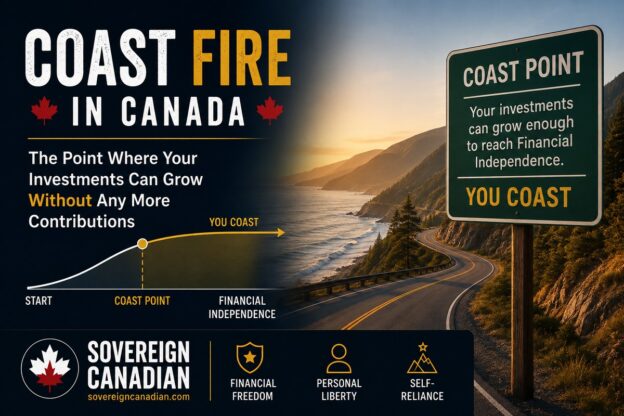
Coast FIRE describes a specific financial state, not a lifestyle. You reach it the moment your invested assets are large enough that, with no further contributions, ordinary compound growth will carry them to your full retirement target by a traditional retirement age. From that point you still have to work and pay your own bills. What changes is that you no longer have to save for retirement. The account is, in effect, on autopilot.
That distinction matters because the internet routinely blurs it. Coast FIRE is not early retirement. It is not quitting. It is not passive income covering your expenses. It is the narrower and more defensible claim that the retirement portion of your financial life is fully funded in advance, so your future earnings only need to cover today.
The appeal is obvious. Saving is front loaded when you are young, which is exactly when income is lowest and the demands on money are highest. Coast FIRE says get the heavy lifting done early, let time do the rest, and buy yourself decades of lower financial pressure. The catch is that the whole promise rests on a growth assumption you cannot control and cannot verify until it is far too late to correct.
Coast FIRE Versus Every Other Flavour of FIRE
The FIRE movement has splintered into a vocabulary that often obscures more than it clarifies. It helps to place Coast FIRE precisely.
| Variant | Core idea | Is work still financially necessary? |
|---|---|---|
| Traditional FIRE | Portfolio can cover all expenses; work becomes optional | No |
| Lean FIRE | Same, on a deliberately minimal budget | No |
| Fat FIRE | Same, on a generous budget requiring a large portfolio | No |
| Barista FIRE | Portfolio carries much of the cost; lighter or part-time work fills the gap, often for benefits | Partly |
| Coast FIRE | Retirement is pre-funded; current work covers only current living costs | Yes, for now |
| Slow FI | Optimise for a good life along the way rather than a hard finish line | Yes, by choice |
The cleanest way to separate them is to ask two questions. Could the portfolio pay your bills today, and do you still need to save for retirement? For Traditional, Lean, and Fat FIRE, the portfolio could cover the bills and further saving is unnecessary, whether or not the person stops working. Barista FIRE sits in between. Coast FIRE is the odd one out: the portfolio does not need to pay a dollar of your current bills, yet the retirement account is already funded, so you are working for the present while the past funds the future.
Many online definitions blur Barista and Coast FIRE together, and the distinction is worth keeping. Barista FIRE typically leans on the portfolio now, and in its American form it often assumes a part-time job kept partly to retain health insurance, which makes it less directly transferable to Canada. Here, basic physician and hospital coverage is not tied to employment, so a Canadian Barista arrangement is usually about topping up income and supplemental benefits rather than securing core healthcare, while Coast FIRE is built around not touching the portfolio at all. The community uses all of these terms loosely, so treat them as points on a spectrum rather than rigid categories. What matters for planning is the underlying question, whether your retirement is funded and whether you are still drawing on invested assets, not which label you pick.
Why Coast FIRE Caught On
Coast FIRE did not spread because Canadians learned to love spreadsheets. It spread because the traditional deal, forty years of maximum effort for a comfortable end, stopped feeling trustworthy. A generation that watched the 2008 crisis, a pandemic, and genuine housing unaffordability is skeptical of grinding for a payoff decades out, remote work made a lower-stress job in a cheaper place feel possible, and priorities shifted toward flexibility and time over title and peak earnings.
Underneath the emotional drivers is a colder one. Younger professionals increasingly prefer optionality to maximised wealth, the ability to say no, to change direction, to take a pay cut for a better life without catastrophe. Coast FIRE is a machine for producing exactly that. It does not promise you will be rich, only that once the retirement account is funded, your remaining working years belong to you in a way they did not before. That is why the idea resonates with people who have no interest in retiring at 40 and every interest in not hating their Mondays.
The Mathematics, in Plain English First
Before any formula, here is the intuition. Money you invest young does most of the work in a portfolio, because it compounds for the longest. A dollar invested at 30 has 35 years to grow before a 65-year-old retirement. A dollar invested at 55 has only 10. Coast FIRE weaponises this asymmetry. It asks how much you need invested today so that growth alone, with zero new deposits, reaches your target.
Everything hinges on three numbers. The first is your retirement target, the portfolio you eventually want. The second is your assumed real rate of return, meaning the growth rate after inflation is stripped out. The third is the number of years until you retire. Working in real terms, with your target expressed in today’s dollars, is the single most important modelling choice, because it lets you ignore inflation bookkeeping entirely. If your return is real and your target is in today’s money, the arithmetic stays honest.
The Coast FIRE Formula
Your Coast FIRE number is your future retirement target discounted back to the present at your assumed real return:
Coast number = Retirement target / (1 + r) raised to the power of n
Here r is the real annual return and n is the years until retirement. The retirement target itself comes from your spending and a safe withdrawal rate. If you plan to spend 50,000 dollars a year and use a 4 percent withdrawal rate, your target is 50,000 divided by 0.04, which is 1,250,000 dollars.
So a 30-year-old planning to retire at 65, targeting 1,250,000 dollars, assuming a 5 percent real return, needs 1,250,000 divided by 1.05 raised to the power of 35. That works out to roughly 227,000 dollars today. Reach that balance, never contribute another cent to retirement, and the math says you land on target at 65.
There is one Canadian wrinkle to fold in before the examples. Your spending target has to account for tax. A Coast FIRE target built on 60,000 dollars of annual lifestyle spending may require more than 60,000 dollars of gross withdrawals if much of the portfolio sits in an RRSP or RRIF, where every dollar withdrawn is taxable, while a TFSA withdrawal needs no gross-up because it is tax-free and does not even count as income. Two Canadians with identical balances can therefore hold different effective Coast FIRE positions depending on where those assets sit. It is one more reason a generic calculator, which treats the target as a single pre-tax number, is not enough here.
Why Return Assumptions Break the Whole Model
Now watch what happens when I hold everything constant except the return assumption. Same person, same target, same 35 years.
| Real return | Coast number needed today | Share of full target |
|---|---|---|
| 4 percent | roughly 317,000 dollars | 25 percent |
| 5 percent | roughly 227,000 dollars | 18 percent |
| 6 percent | roughly 163,000 dollars | 13 percent |
| 7 percent | roughly 117,000 dollars | 9 percent |
The number you need nearly triples between the optimistic and conservative ends of a perfectly reasonable range. This is not a rounding issue. It is the central fragility of Coast FIRE. A calculator that quietly defaults to 7 percent real returns will tell a 30-year-old they are Coasted at 117,000 dollars. If the real, realised return over their 35 years turns out to be 4 percent, they needed 317,000 dollars and will arrive at retirement with well under half of what they planned for, having stopped saving decades earlier on the strength of a hopeful default.
Credible Canadian planning bodies do not use 7 percent real. FP Canada’s 2026 Projection Assumption Guidelines assume nominal returns of 6.3 percent for Canadian equity, 6.4 percent for United States equity, 6.6 percent for international developed markets, and 7.5 percent for emerging markets, against 2.1 percent assumed inflation, all before fees. That works out to roughly 4 to 5 percent real for equities before fees. It is lower once you blend in fixed income, which the same guidelines put at 3.2 percent nominal, and lower again after the investment costs a real portfolio actually pays. So a diversified, fee-paying portfolio has a lower expected real return than the equity figures alone suggest, and 7 percent real is optimistic by a wide margin. When you see a Coast FIRE result, the very first thing to check is the return assumption baked into it.
Safe Withdrawal Rates and the Target You Are Coasting Toward
The Coast number is only as good as the retirement target underneath it, and that target depends entirely on your safe withdrawal rate. The famous 4 percent rule comes from Bill Bengen’s 1994 research and the subsequent Trinity study, which found that a portfolio withdrawing 4 percent in the first year and adjusting for inflation thereafter survived a 30-year retirement across historical US market conditions.
Two problems arise when FIRE adopts that number wholesale. First, the research studied a 30-year retirement, and while a conventional retirement from 65 to 95 is exactly that long, Coast FIRE stacks something in front of it. The Coaster spends 35 years in accumulation, relying entirely on an assumed return, before the 30-year withdrawal problem even begins. That is 35 years of return uncertainty layered on top of the horizon Bengen actually studied, not a longer withdrawal period, and it is a distinct risk the 4 percent rule was never meant to address. Second, the original work is US-centric, and researchers using broader global data, including Ben Felix at PWL, have argued that a more defensible sustainable rate is meaningfully below 4 percent, often cited in the low 3 percent range for long horizons. Karsten Jeske’s Early Retirement Now series makes a similar case with exhaustive sequence-of-returns modelling.
The practical consequence is direct. Drop your withdrawal rate from 4 percent to 3.5 percent and your target rises from 25 times spending to roughly 28.6 times spending. On 50,000 dollars of spending, that moves the target from 1,250,000 to about 1,430,000 dollars, which raises every Coast number in the table above by roughly 14 percent. A conservative withdrawal rate and a conservative return assumption stack on top of each other, and together they can nearly double the conservative Coast number relative to an optimistic one. Neither assumption is pessimism. Both are just refusing to plan on the best case.
Canadian Worked Examples
Formulas are abstract, so here are worked cases using Ontario as the default tax setting and 5 percent real returns unless noted. Treat the numbers as illustrations of method, not as targets for your own life.
The 30-Year-Old on 90,000 Dollars
A single professional aged 30, earning 90,000 dollars and targeting 50,000 dollars of retirement spending, wants to know whether they can Coast from today and still retire at 65. That leaves 35 years to compound. Target portfolio at a 4 percent withdrawal rate is 1,250,000 dollars, and the Coast number at 5 percent real is about 227,000 dollars, the same figure as the sensitivity table above. On a 90,000 dollar salary in Ontario, after tax and typical living costs, reaching 227,000 dollars invested by age 30 is demanding but achievable for a disciplined saver who started in their early twenties, particularly using registered accounts. The honest caveat is that same table. If they believe 7 percent and Coast at 117,000 dollars, they are taking a large, silent bet on markets.
The Dual-Income Family
Two partners, both 35, with children, targeting 80,000 dollars of combined retirement spending in a paid-off home. Target is 2,000,000 dollars at 4 percent, and the combined Coast number over 30 years at 5 percent real is roughly 463,000 dollars. Children work against the plan in two directions at once, raising current expenses that slow accumulation and lengthening the list of future obligations. A family that hits its Coast number and stops saving must be honest that education costs, a larger home, or a single-income stretch can quietly break arithmetic they thought was finished.
The Government Employee With a Pension
This is where Coast FIRE math changes character. A defined benefit pension does not need to be converted into an imaginary portfolio balance to be useful. The cleaner approach is to subtract the guaranteed income from the spending target and fund only the gap. Take a public servant who wants 80,000 dollars a year in retirement and expects a 40,000 dollar indexed pension. Estimated CPP and OAS might add, conservatively, another 25,000 dollars. That leaves an income gap of roughly 15,000 dollars a year for the portfolio to cover. At a 4 percent withdrawal rate the portfolio target is about 375,000 dollars, not the 2,000,000 dollars an 80,000 dollar lifestyle would otherwise imply, and you then discount that smaller target back to today to find the Coast number. The pension does not have to be valued as capital, because it simply shrinks the problem. For many pension holders, the honest question is not how to reach a Coast number but whether the gap is so small they passed it years ago without noticing. The caution is that indexation, survivor terms, commencement age, and plan security all affect how much of that income is truly guaranteed, so treat the pension figure conservatively. These amounts are also pre-tax, so a real plan reconciles gross income against after-tax spending, as noted above.
The Incorporated Business Owner
For an incorporated owner, the Coast portfolio often lives inside the corporation as retained earnings and investments rather than in personal accounts, and the friction is higher. Corporate passive investment income is taxed, and once it exceeds 50,000 dollars in a year, access to the federal small business deduction grinds down, eliminated entirely at 150,000 dollars. Ontario, the default here, does not mirror that federal grind, so the provincial small business rate can survive even where the federal limit is reduced. Growth compounds against a tax headwind, and extraction to personal hands triggers another layer of tax. The concept still applies, but the return assumption should account for corporate tax drag, and business equity should be treated as a separate, concentrated, illiquid asset rather than part of the diversified portfolio.
The High Earner and the Late Starter
A physician or senior engineer earning well into six figures can reach a Coast number quickly, because savings capacity is large. The risk for high earners is not the math but lifestyle inflation, which raises the target faster than the portfolio grows. The late starter faces the opposite and crueller problem. Someone beginning at 45 with a 65 retirement, targeting 1,250,000 dollars, has a Coast number at 5 percent real of about 471,000 dollars, which is 38 percent of the full target against 18 percent for the 30-year-old. Compounding needs time, and time is what the late starter lacks. Coast FIRE offers them far less leverage, and anyone selling it to a 45-year-old as a shortcut is misrepresenting the arithmetic.
After the Business Sale
Someone who sells a business often lands a lump sum that already exceeds their Coast number, which hands them immediate optionality. The Lifetime Capital Gains Exemption can shelter a substantial portion of the gain on qualifying small business shares, though the exact figure is indexed and should be verified. The temptation is to treat the whole proceeds as retirement money and Coast at once. The discipline is to ring-fence the portion that funds retirement, invest it in a diversified way rather than the concentrated bet that just paid off, and only then decide how hard to keep working.
How Coast FIRE Interacts With Canadian Accounts
Coast FIRE is agnostic about where the money sits, but Canadians have a specific toolkit, and using it well changes both the size of the Coast number and the tax you pay to reach and spend it.
Registered Accounts
The RRSP, TFSA, and FHSA each do different jobs. The RRSP defers tax, which suits high earners in their peak years who expect a lower rate in retirement, and it grows tax-sheltered until withdrawal. For 2026 the RRSP dollar limit is 33,810 dollars, or 18 percent of prior-year earned income, whichever is lower. The TFSA grows and is withdrawn entirely tax-free, and its withdrawals do not count as income, which makes it uniquely valuable for controlling taxable income in retirement. The 2026 TFSA annual limit is 7,000 dollars, with cumulative room of 109,000 dollars for someone eligible since 2009. The FHSA is narrower, built for a first home, with an 8,000 dollar annual limit and a 40,000 dollar lifetime cap, and it combines an RRSP-style deduction with tax-free qualifying withdrawals.
For a Coaster, the TFSA deserves special respect. Because its withdrawals are invisible to the income-tested benefits discussed below, a large TFSA is the closest thing Canada offers to a clean, controllable retirement income source. For most people, filling registered room before investing in a taxable account is a reasonable default, though the right order among the RRSP, TFSA, and FHSA depends on your marginal rate now versus in retirement, your access to income-tested benefits, your liquidity needs, and whether you are incorporated.
Pensions Change the Entire Calculation
A defined benefit pension and a defined contribution pension work differently in this math. A DC pension is simply an invested balance that belongs to you, so it counts directly toward your Coast number like any other account. A DB pension is a stream of future income, so the cleaner treatment is the one shown above, subtracting the pension income from your spending target and funding only the remaining gap. Either way, a pension usually shrinks the private portfolio you need to well below what a generic Coast FIRE calculator, which ignores pensions entirely, would suggest.
CPP, OAS, and GIS
Government benefits reduce the portfolio you need, but a Coaster should model them carefully. The maximum CPP retirement pension at 65 in 2026 is 1,507.65 dollars a month, yet the average for new beneficiaries is only about 877 dollars, because the maximum requires a long history of contributions at or near the annual ceiling. A Coaster who deliberately earns less will contribute less and should assume a below-maximum CPP. For the July to September 2026 quarter, OAS pays a maximum of 751.97 dollars a month for ages 65 to 74, indexed quarterly and subject to the clawback below. GIS is an income-tested top-up few Coasters will plan around, though a lean retirement drawn largely from a TFSA can interact with it. All of these figures move annually and must be verified before planning.
Tax Planning Around Coast FIRE
Coast FIRE does not end at accumulation. How you eventually draw the money determines how much of it you keep, and the planning starts long before the first withdrawal.
Asset location is another lever, though less mechanical than it first appears. Interest is taxed as ordinary income, eligible Canadian dividends receive the dividend tax credit, and under current law one-half of a capital gain is generally included in taxable income (a proposed increase to a two-thirds inclusion rate was cancelled in 2025). Foreign dividends are treated differently again, and even the registered accounts are not identical, since RRSPs and TFSAs receive different treatment for foreign withholding taxes. The larger point is not that there is a single universal optimum, but that the same portfolio can produce different after-tax outcomes depending on which assets sit in which accounts.
Withdrawal sequencing matters just as much. In retirement, the interplay between RRSP or RRIF withdrawals, TFSA draws, CPP timing, and the OAS clawback becomes a genuine optimisation problem. The OAS recovery tax runs on a July-to-June cycle: the period from July 2026 to June 2027 is based on 2025 net income above roughly 93,454 dollars, while the threshold applying to 2026 income is roughly 95,323 dollars. Either way it claws back 15 cents of every dollar above the line, a punishing effective marginal rate. Because TFSA withdrawals do not count toward that net income figure, a large TFSA becomes a tool for staying under the clawback line, and deferring CPP to 70 raises the guaranteed, indexed benefit for those betting on longevity. None of this is individual advice, and the optimal sequence for one household is wrong for the next. The point is that the tax phase deserves as much thought as the saving phase, and Coast FIRE, by front-loading the saving, gives you decades to plan it.
Coast FIRE Is Not Retirement
This deserves its own section because it is the most common misunderstanding. Reaching your Coast number does not mean you stop working. It means the reason you work changes. The retirement account is funded, so your income now needs to cover only your present life, not your future one.
That shift is the entire point, and it is more interesting than early retirement. It opens the door to consulting on your own terms, to a business you could not have risked while saving, to part-time work, a sabbatical, or a career change into something lower paid but more meaningful. The common thread is that Coast FIRE converts money you already earned into freedom over the work you do next.
This is precisely where Coast FIRE aligns with a Sovereign Canadian frame. The goal was never to maximise the number on a statement. The goal is optionality, the capacity to structure your life around your own priorities rather than around the next contribution. A funded retirement account is not the finish line. It is permission.
Coast FIRE Is a Milestone, Not a Switch
The way Coast FIRE is usually described, and the way I have partly described it so far, makes it sound like a switch. You hit the number, you flip off retirement saving, you coast. That framing is where most of the danger lives, because it turns a flexible milestone into a hard binary that invites people to stop saving the moment a hopeful calculator turns green.
The more accurate picture is a dial, not a switch. Reaching your Coast number is a threshold that unlocks a decision about where the next dollar goes, and stopping retirement contributions entirely is only one of the options it unlocks. You can dial contributions down rather than to zero, which keeps some momentum in the account while freeing up cash flow. You can redirect the savings you were making toward a mortgage, a business you want to start, a sabbatical, a child’s education, travel while you are young enough to enjoy it, or a taxable account that gives you liquidity a locked retirement plan does not. You can keep contributing at a reduced rate purely to build a margin of safety. Or you can genuinely stop, if the numbers and your risk tolerance both support it.
Seen this way, Coast FIRE resolves the false binary that runs through the whole concept. It does not force a choice between grinding at full intensity and quitting the savings habit cold. It marks the point where saving for retirement stops being mandatory and starts being optional, which is a very different and much more useful thing. It also provides a simple buffer against the return risk described in the next section. Continuing to add even modest contributions for a few years past the milestone is the simplest way to protect yourself against a weak first decade of returns. The milestone tells you that you have earned the right to choose. It does not tell you the choice has to be all or nothing.
The Behavioural Risks Nobody Puts in the Spreadsheet
A Coast FIRE calculator produces a clean point estimate, and that cleanliness is a lie of omission. Real life is a distribution, not a point, and the spreadsheet hides every risk that actually breaks plans.
Start with sequence of returns, which is subtler for Coasters than for anyone else. A person still contributing who hits a market crash is buying assets cheaply, so a downturn early in accumulation actually helps them. A Coaster who has stopped contributing loses that particular advantage. If a lost decade arrives right after they stop saving, growth alone may never recover the trajectory, and they have removed the very mechanism, ongoing contributions, that would have rescued the plan. Coasting therefore trades away a real form of insurance.
Then come the human events the model ignores. Lifestyle inflation raises the target after you thought it fixed. Divorce can halve a portfolio and double a household’s costs. Disability or illness can end the earning Coast FIRE assumes will continue. Children, elder care, a long bear market, stubborn inflation, a career interruption, and simple longevity each attack a different assumption, and goals themselves change, so the retirement you funded at 30 may not be the one you want at 50. The spreadsheet treats every input as fixed and every future year as average. Neither is true, and the false certainty of a single tidy number is the most dangerous thing about the concept.
Housing and Coast FIRE
Housing is often the largest variable in a Canadian financial life. A paid-off home lowers retirement spending, which lowers the target and the Coast number, while a renter faces the opposite, since housing remains a lifelong indexed expense the portfolio must fund forever.
Underneath sits the pay-down-versus-invest question. Paying down a mortgage is a guaranteed after-tax return equal to the mortgage rate; investing offers a higher but uncertain one. Investing hard may reach the Coast number faster, but arriving at retirement still carrying a mortgage reintroduces the fixed cost the plan was meant to remove, and foreign real estate or downsizing can lower housing costs outright. A housing plan and a Coast FIRE plan are the same plan, and treating them separately produces numbers that do not survive contact with reality.
Coast FIRE Across Canada
Geography may be the single most decisive input, because your target is a function of your cost of living, and that varies enormously across Canada.
In Toronto and Vancouver, housing costs push the Coast number to levels that feel out of reach for many, while in Calgary, Edmonton, Ottawa, Halifax, and London the same lifestyle costs materially less, and in smaller communities less again. Two people with identical incomes and savings rates can have Coast numbers that differ by hundreds of thousands of dollars purely because of where they intend to live.
This is where international geographic arbitrage enters, and where the Sovereign Canadian frame becomes concrete. Keeping the option to spend part or all of retirement in a lower-cost country lowers your effective target and your Coast number with it. A retirement that costs 50,000 dollars a year in Toronto might cost materially less in parts of Mexico, Portugal, or Southeast Asia, though whether it is worth it turns on healthcare, language, residency rights, family proximity, and taxation, which the site’s geographic-arbitrage and expat coverage works through. The optionality does not even require you to leave Canada, only that leaving is possible, and that alone can move your Coast number more than any change to your savings rate.
Coast FIRE for Business Owners
Business owners face a structurally different version, because their largest asset is frequently the business itself, which is concentrated, illiquid, and correlated with their own income in a way no diversified portfolio would be. The temptation is to count that equity toward the Coast number. The discipline is to discount it heavily, because a business sale that funds retirement is a plan with a single point of failure. Coast FIRE works best for an owner when a diversified portfolio, held personally or in a holding company, grows independently of the business, so the retirement account does not depend on a successful exit. For entrepreneurs, it is less a calculation than a hedge against the business not working out.
Healthcare and the Coverage Gap
The Canadian advantage here is real and specific. Universal provincial healthcare removes much of the American FIRE problem of needing employment primarily to hold basic health insurance, because physician and hospital coverage is not tied to a job. That does not make Canadian healthcare comprehensive. It narrows the employment-benefit question rather than closing it.
What a Coaster may actually lose by leaving full-time work is narrower but still real: dental, prescription drug, vision, and paramedical coverage, plus disability and other employer insurance. Provincial plans do not universally cover those services, and coverage varies by province, age, income, and program, so much of the gap may fall to private insurance or out-of-pocket spending when a Coaster goes self-employed or part-time. Disability insurance deserves particular attention, because Coast FIRE assumes continued earning and disability is the event that ends it. Medical tourism may also reduce the cost of certain dental, elective, or privately paid procedures, although that introduces its own quality, travel, continuity-of-care, and insurance considerations. A Coaster who drops employer benefits should price replacement coverage explicitly, because a plan that assumes uninterrupted health has a hole in it.
The Case Against Coast FIRE
A fair analysis has to make the strongest possible argument against its own subject. Here is the case for skepticism, taken seriously.
The return assumptions are the first and best criticism. As the sensitivity table showed, the whole model is hostage to a growth rate no one can guarantee, and popular calculators lean optimistic. Inflation may not cooperate either, and a sustained stretch above the Bank of Canada’s 2 percent target erodes real returns precisely where Coast FIRE is most fragile. Future employment is not guaranteed, yet the plan depends on decades of continued earning. Most damning, Coast FIRE can encourage under-saving, telling a young person they are finished on the strength of a hopeful assumption and leaving them short at the age when catching up is hardest. Tax policy can shift, sequence risk hits Coasters harder because they have surrendered the contribution stream that cushions downturns, and the opportunity cost of slowing contributions is real, since money not invested during the Coasting years is growth forgone.
Weighing these honestly, most are not reasons to reject Coast FIRE outright, but reasons to build in margin, use conservative assumptions, and keep contributing longer than the minimum the math demands. The criticism that lands hardest is the under-saving one, because it exploits the very relief that makes Coast FIRE appealing.
Who Coast FIRE Actually Fits
Coast FIRE works best for a specific profile: young professionals with a long runway, because compounding needs decades and they have them; high savers who convert years of intensity into decades of flexibility; defined benefit pension holders, who are often further along than they realise; and business owners hedging a concentrated exit. The unifying trait is time, discipline, and a stable enough income to keep covering the present.
Who Should Probably Skip It
It is a poor fit for others. Late starters get little from it, because the compounding window is too short and the Coast number too large a share of the target. High spenders undermine it, since lifestyle inflation outruns growth. Highly leveraged and single-income households are fragile, and people in unstable or physically demanding careers, or in poor health, cannot safely assume decades of continued earning. Anyone assuming a 7 percent real return with an early exit and no margin is not doing Coast FIRE. They are doing wishful thinking with a spreadsheet.
The Psychology of a Funded Life
The financial case for Coast FIRE is contested. The psychological case may ultimately be the more interesting one, and for some people it is the real reason to consider it.
Knowing the retirement account is funded removes a chronic form of financial stress, the low hum of never having saved enough. It increases bargaining power, because someone who does not need the next raise negotiates from strength. It makes career risk survivable, which allows the pivot into entrepreneurship or lower-paid meaningful work, and it buys family time. Wealth stops being the objective and becomes the enabler of a life organised around purpose rather than accumulation. Those benefits do not depend entirely on hitting the portfolio target. Even an imperfect Coast calculation can change how someone thinks about work, risk, and the next dollar they earn.
Coast FIRE and the Sovereign Canadian View
Coast FIRE is not a Sovereign Canadian invention, but it rhymes with the philosophy: a preference for optionality over maximisation, for structuring a financial life around freedom rather than the largest possible number.
Coast FIRE fits because it is, at heart, a system for buying options. It connects to geographic flexibility, since spending retirement in a lower-cost country lowers the target directly, to business ownership, where a diversified portfolio hedges the concentration of building a company, and to international diversification, flag theory, foreign real estate, and medical tourism. The common principle is that a rational Canadian does not simply accumulate. They build a structure that widens their choices. Used with conservative assumptions and honest margins, Coast FIRE is one such structure. Used with default calculator optimism and no margin, it is a way to feel free while quietly under-saving. The difference is entirely the discipline you bring to it, which is the least exciting and most important thing I can tell you about it.
Frequently Asked Questions
What is the difference between Coast FIRE and Barista FIRE? Coast FIRE means your retirement account is pre-funded and you work to cover current expenses, built around not drawing on the portfolio yet. Barista FIRE means your portfolio covers much of your expenses now and lighter or part-time work covers the rest. In the American version that part-time work is often kept for health insurance, a weaker motive in Canada where core physician and hospital coverage is not tied to a job. The main difference is whether you typically lean on the portfolio today: Coasters try not to, while Barista FIRE usually does.
How do I calculate my Coast FIRE number in Canada? Set a retirement spending target, divide it by a safe withdrawal rate to get your portfolio target, then discount that target back to today using your assumed real return and years until retirement. The formula is target divided by one plus the real return, raised to the power of the number of years. Use a conservative real return, in the 4 to 5 percent range rather than 7 percent, and verify current account limits and benefit figures.
Does a pension change my Coast FIRE number? Significantly. The cleanest way to handle a defined benefit pension is to subtract its income from your annual spending target and fund only the remaining gap. A worker wanting 80,000 dollars a year with a 40,000 dollar indexed pension and 25,000 dollars of expected CPP and OAS only needs the portfolio to cover about 15,000 dollars a year, a far smaller target than the headline lifestyle number implies. Many pension holders are closer to their Coast number than they assume.
Is Coast FIRE realistic in expensive Canadian cities? It is harder, because your retirement target scales with your cost of living, and Toronto or Vancouver costs inflate that target. Retiring in a lower-cost Canadian city, or retaining the option to spend retirement abroad, lowers the target and the Coast number substantially.
What return assumption should I use? Lower than most calculators default to. FP Canada’s 2026 guidelines imply roughly 4 to 5 percent real for equities before fees, and less for a diversified, fee-paying portfolio, not 7 percent. Because the Coast number is highly sensitive to this input, an optimistic figure is the most common way people fool themselves.
What I Would Actually Do
If I were building a Coast FIRE plan in Canada today, here is the sequence I would follow.
- Set the target with a conservative withdrawal rate, 3.5 percent rather than 4 percent, to build additional margin into the plan, and express it in today’s dollars.
- Run the Coast number at 4 and 5 percent real returns, never 7, and plan around the more conservative of the two.
- Subtract any defined benefit pension and my estimated CPP and OAS from the spending target and fund only the remaining gap, rather than treating the pension as a portfolio balance.
- Fill registered room deliberately, weighing the RRSP deduction against TFSA flexibility based on my marginal rate now versus the rate I expect in retirement, rather than assuming one account always comes first.
- Keep contributing past the bare Coast number for several years to build margin against sequence risk, rather than stopping the instant the calculator turns green.
- Price replacement disability and health coverage explicitly before dropping any employer benefits.
- Treat the housing plan and the Coast plan as one plan. My own preference is to clear the mortgage before leaning on the portfolio, though that is a preference for certainty, not a rule the math requires.
- Verify every government figure, contribution limit, and threshold against current sources before acting, because they change every year.
A Note on What This Is and Is Not
This article is for information and general education. It is not financial, tax, investment, or legal advice, and it does not account for your specific circumstances. I am not a licensed financial advisor. Every dollar figure, contribution limit, benefit amount, and tax threshold cited here reflects the best available information at the time of writing and changes regularly, so confirm current numbers with official sources or a qualified professional before making any decision. Coast FIRE rests on assumptions about returns, inflation, and continued employment that may not hold, and no formula can guarantee an outcome. Do your own diligence.