
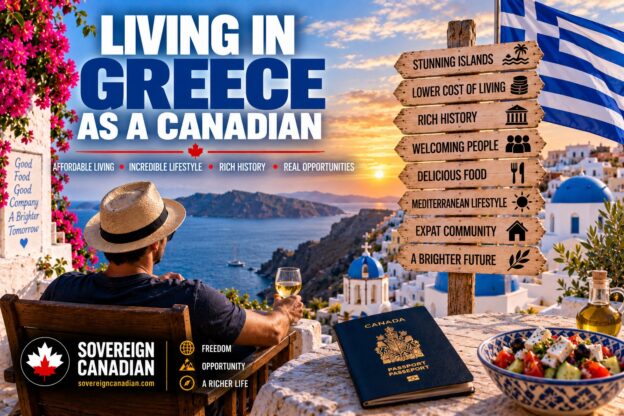
Greece sells itself in about four seconds. Light on limestone, a table under a fig tree, a swim before dinner, a bill that would embarrass a Toronto patio. The pitch is real, and it is one of the most effective lifestyle arguments in Europe. What the pitch never mentions is the machinery underneath it: the tax office, the residence permit, the hospital map, the ferry timetable in February, the time zone that sits seven hours ahead of your Canadian clients. This is a publication about sovereignty, not sunsets, so the question here is not whether Greece is beautiful. It obviously is. The question is whether the beautiful version survives contact with the paperwork, the winter and the years.
My working conclusion, argued through the rest of this piece, is that Greece is unusually good at one specific job and unusually awkward at another. It is close to ideal as a place to spend money you earned somewhere else, and it is decidedly difficult as a place to earn money locally. Almost everything a Canadian needs to decide about Greece comes back to which of those two things you are actually asking it to do.
The bargain Greece actually offers
Here is the tension worth holding onto. Greece rewards imported income and punishes local income. A Canadian pension, a portfolio, a foreign salary or a remote contract lands in Greece with enormous purchasing power and, for the right profile, a tax rate that Western Europe cannot match. The average Greek net salary runs around EUR 1,000 to 1,100 a month, a fraction of Canadian-income levels. Those two facts are the whole story. The country that gives a retired couple a gracious life on a teacher’s pension is the same country that gives a local graduate a wage they cannot build a life on.
So the honest way to sort Canadians is by where their money comes from and how long they intend to stay. A retiree with foreign pensions, a financially independent couple, a seasonal snowbird and a remote worker are all spending imported money, and Greek life rewards that generously, whatever the tax treatment of any particular income stream turns out to be. A Canadian hoping to find work, launch a locally focused business or integrate into the domestic economy is fighting the current. The best version of Greek life for most Canadians is therefore a season or a chapter, and only sometimes a permanence. The rest of this article is an attempt to say which, for whom, and at what cost.
Suitability at a glance
Greece is not being graded here. Different ways of using Greece are. The variation down this table is the whole thesis, and every grade in it is argued out in the sections that follow rather than asserted.
| Use case | Grade |
|---|---|
| 2-8 week reconnaissance | Excellent |
| 2-3 month seasonal stay | Excellent |
| Traditional five-month snowbird, as visitor | Weak |
| 6-12 month sabbatical | Strong |
| One school year, young children | Good |
| 1-5 year family relocation | Mixed |
| Employed remote worker | Good |
| Freelancer | Good |
| Entrepreneur or local earner | Weak |
| Seasonal semi-retiree | Excellent |
| Full retiree, mainland or Crete | Strong |
| Full retiree, small island | Mixed |
| High-net-worth retiree | Strong |
| Permanent relocation | Mixed |
| EU citizenship strategy | Weak |
| Tax-motivated retiree | Strong |
| Tax-motivated high-net-worth resident | Strong |
| Tax-motivated ordinary remote worker | Mixed |
| Golden Visa or optional-residence strategy | Strong |
The pattern is consistent throughout: Greece scores highest as a season, as a spend-your-foreign-income retirement, and as a targeted tax play, and lowest as a place to earn locally, to snowbird as a visitor, or to sprint toward an EU passport. Read “tax-motivated” carefully. Greece does not have low taxes; it has strong special regimes for specific profiles, which is a different claim.
Ninety days: Greece as a season, and the Schengen wall
Start with the cheapest option, which is to not become a resident at all. As a Canadian you can enter Greece visa-free for 90 days in any rolling 180-day period. That is a Schengen-wide limit, not a Greek one, and Greece has no bilateral side deal that quietly extends it. The traditional Canadian snowbird model, five or six months in the sun, simply does not fit inside that box, and there is no polite workaround as a visitor.
Two 2026 developments make this harder to ignore than it used to be. The EU’s Entry/Exit System went fully live on 10 April 2026, replacing passport stamps with a biometric record of every entry and exit. The old grey zone, where an unstamped passport and a relaxed border officer let people quietly overstay, is closing. Overstay is now a database entry. The second system, ETIAS, the pre-travel authorization, is still not operational. The EU’s stated target has been the last quarter of 2026 at the earliest, with the exact date to be announced well in advance, and the launch has already slipped repeatedly over several years. Whenever it arrives it is a EUR 20 authorization, valid three years, and it does not change the 90/180 math at all.
The practical read for a Canadian: Greece is a superb 90-day country and a poor five-month one unless you take residence. This is the opposite of the Mexico answer, where a Canadian can legally winter for six months without residency, and it is roughly the same wall Spain puts up. If your dream is half the year in the Aegean with a Canadian tax home, you either compress it to 90 days, split it with a non-Schengen country, or stop being a tourist and become a resident. Those are the only honest options.
The residence routes that matter to Canadians
Three routes cover almost every Canadian case, and they are genuinely different animals.
The Financially Independent Person permit, now formally the residence permit for persons with sufficient financial means, is the retiree and passive-income route. Under the 2024 Immigration Code and its implementing decision, the income test is EUR 3,500 a month for the main applicant, rising 20% for a spouse and 15% per child, or a lump-sum savings equivalent of roughly EUR 126,000 for the three-year permit. It requires comprehensive private health insurance and it forbids work in Greece of any kind, including remote work for a foreign employer. It is built for people who genuinely live in Greece rather than merely hold optional residence, and prolonged absences can affect the permit’s continuity. The more important point for planning is a tax one: anyone actually using this permit to make Greece their home will usually cross the Greek tax-residency threshold, whether through the 183-day count or the centre-of-vital-interests test, so it should be treated as a tax-residency route, not just an immigration one. Note that some consulates still display the old EUR 2,000 figure from the previous law; the current figure is EUR 3,500, and you should get written confirmation from your consulate before you file.
The Digital Nomad Visa is the remote-work route. It needs EUR 3,500 a month in net income (again plus 20% for a spouse and 15% per child), earned from employers or clients outside Greece, with no local Greek work permitted. It runs 12 months as an entry visa and converts to a two-year renewable permit. As of early 2026 you must apply at a consulate before arriving; the in-country application window has closed. Do not blur this with the FIP route: pick the permit that matches how you actually earn, because officers will bounce a remote salary out of the passive-income lane.
The Golden Visa is the money route, and it changed hard. Since the 2024 reforms the property threshold is EUR 800,000 in Attica, Thessaloniki, Mykonos, Santorini and islands over 3,100 people; EUR 400,000 elsewhere with a 120 square metre floor; and EUR 250,000 only for a commercial-to-residential conversion or a listed-building restoration. Golden Visa properties cannot be let short-term on platforms like Airbnb, with a EUR 50,000 fine for breaking that. Crucially it carries no minimum stay, which is its defining feature and the mirror image of the FIP permit. The mechanics of buying belong in the dedicated real-estate piece; here the only question is whether it changes the case for living in Greece, and mostly it does not. It changes the case for holding optional residence in Greece more than it changes the case for actually living there.
When you become a Greek taxpayer
Immigration status and tax status are separate systems, and confusing them is where Canadians get hurt. You become a Greek tax resident if you spend 183 days there in a year, or if your centre of vital interests, meaning your family, home and economic life, sits in Greece. Cross that line and Greece asserts the right to tax your worldwide income, not just what you earn locally.
This is where the residence route quietly decides your tax fate. The FIP retiree who actually relocates their home and life to Greece will generally become a Greek tax resident, whether through the day count or the centre-of-vital-interests test. The Golden Visa holder, with no stay requirement, can keep visits under 183 days and never trigger Greek worldwide taxation at all. The remote worker is somewhere in between, and usually ends up resident because that is the point of moving.
Standard Greek rates are not gentle. The scale runs in six progressive bands from 9% to 44%; the 2026 reform under Law 5246/2025 trimmed the middle bands by about two points and, most importantly, lifted the point at which the top 44% rate bites from EUR 40,000 to EUR 60,000, inserting a new 39% band for income between EUR 40,000 and EUR 60,000. Investment income sits on separate schedules: dividends at 5%, interest and listed-securities gains at 15%, and rental income on its own progressive scale that tops out in the mid-forties. Where Canada and Greece both claim you, the Canada-Greece tax treaty breaks the tie using the familiar sequence of permanent home, centre of vital interests, habitual abode and nationality, and it assigns taxing rights income type by income type. The treaty is the reason a Canadian in Greece rarely pays full tax twice, and the reason Canadian tax-residency rules and cross-border advice are not optional here.
The special regimes: 7 per cent, 100,000 euros, and 50 per cent
Greece’s special tax regimes are the real reason this country belongs in a sovereignty publication, and they are more nuanced than the brochures suggest.
The headline is the foreign pensioner regime, Article 5B. The gate is specific: you must be the recipient of a pension arising abroad, you must not have been a Greek tax resident for five of the previous six years, and you must move from a country that exchanges tax information with Greece, which Canada does. Clear that gate and you can elect a flat 7% for 15 years, and the scope is wide: the 7% covers not just the pension but all your foreign-source income, foreign dividends, interest, rents and gains alike. You apply by 31 March of the relevant year and pay in one instalment by late July. Here is the part worth sitting with, because it is where Greece quietly beats Italy. Italy’s 7% southern regime makes you settle in a small municipality in the deep south to qualify; Greece’s 5B attaches to the person, not to a postcode, so you can take it in Athens, on Crete, in Nafplio, anywhere. You qualify as the right incoming pensioner and then choose your town on healthcare and lifestyle, instead of letting the tax rate choose your town for you. The catch is that 7% is the Greek tax, not necessarily the whole invoice. The Canada-Greece treaty still gives Canada taxing rights over Canadian pensions, and it is unusually favourable in the detail: broadly, the first CAD 15,000 of Canadian pension income in a year can be exempt from Canadian tax, while Canadian tax on periodic pension payments above that exemption is generally capped at 15% of the excess, subject to the treaty’s alternative Canadian-tax calculation. The CRA currently applies 15% to CPP and OAS for residents of Greece, with the exemption claimed through Form NR5. How that Canadian tax then interacts with Greece’s 7% and with foreign-tax-credit limits depends on the exact mix, so CPP, OAS, employer pensions and RRSP or RRIF withdrawals are worth modelling separately rather than lumping under a single rate. Seven per cent is the ceiling on the Greek side, not a promise about the Canadian side.
The high-net-worth non-dom regime, Article 5A, offers a flat EUR 100,000 a year on all foreign income regardless of size, for 15 years, plus EUR 20,000 per added family member, in exchange for a EUR 500,000 investment in Greece within three years and a clean prior-non-residence record. Its selling point in 2026 is comparative: Italy raised its equivalent lump sum to EUR 300,000 (plus EUR 50,000 per family member), so Greece now dramatically undercuts Italy’s equivalent regime. For a Canadian with very large foreign income, that gap is the whole argument.
The relocating-worker regime, Article 5C, is the one most often misdescribed, so read it carefully. It exempts half of your Greek employment or business income for seven years, but only if you actually move your working life into Greece: taking a job that provides services to a Greek employer or to the Greek establishment of a foreign company, or starting a business in Greece, and committing to stay at least two years. It is aimed at Greek-source activity, not at a Canadian who keeps a Canadian employer and a Canadian salary and simply opens the laptop in Athens. Digital-nomad marketing loves to imply the two are the same. They are not, and assuming this 50% exemption applies to ordinary foreign-remote-work is a mistake that will not survive contact with the tax office.
| Regime | Flat rate or fee | What it covers | Term | Key condition |
|---|---|---|---|---|
| 5B pensioner | 7% | All foreign-source income | 15 yrs | Prior non-residence 5 of 6 yrs; treaty country |
| 5A non-dom | EUR 100,000/yr | All foreign income | 15 yrs | EUR 500,000 Greek investment; prior non-residence |
| 5C worker | 50% exemption | Greek employment or business income | 7 yrs | Relocate and stay 2+ yrs |
Your Canadian accounts do not travel cleanly
This is the section where I most want a professional in the room, because the treatment is genuinely uncertain in places. A Canadian who becomes a Greek tax resident should assume that the tidy Canadian wrapper around their savings does not automatically survive the border.
Your RRSP and RRIF remain Canadian registered plans, but the Canadian tax treatment of withdrawals depends on the nature of the payment and the treaty; what Greece does with the internal growth and withdrawals themselves is exactly the sort of question to resolve with a cross-border adviser before you move, not after. The TFSA is the one to worry about most: Greece does not give a TFSA the Canadian tax exemption merely because Canada does, so a Greek tax resident should not assume the account stays tax-free in Greece, and its treatment should be confirmed before establishing Greek residence. RESP treatment is similarly unprotected. Canadian rental property stays taxable in Canada, and the treaty gives the property’s country first claim. CPP and OAS are governed by the treaty’s pension articles. A Canadian corporation or CCPC that a Greek resident controls raises hard questions about where it is now managed and taxed, and is not a do-it-yourself project. Add foreign-asset reporting on both sides and the automatic exchange of financial information between Greece and Canada, and the theme is clear: nothing hides, and the wrappers leak.
Leaving Canada is a separate decision
Getting a Greek permit does not end your Canadian tax residency. Canada looks at your actual ties: home, spouse, dependants, and the rest of your factual footprint. Keep enough of them and Canada still considers you resident, treaty tie-breaker notwithstanding.
If you do sever residency, Canada runs a departure tax, a deemed disposition of most of your assets at fair market value on the day you leave, with major categories such as registered plans and Canadian real property excluded. That single event, not the Greek side, is often the largest number in the whole move, and it deserves its own modelling well before you book a one-way flight. Provincial health coverage is a separate casualty: OHIP and its equivalents impose absence limits, and a long Greek stay can quietly end your Canadian coverage, which is one more reason the healthcare section below matters. The full mechanics live in the dedicated pieces rather than here.
Healthcare: the map that matters at eighty
Do not accept the phrase “Greece has universal healthcare” at face value, because for the Canadian who actually moves there it is misleading. Public care through the national system, the ESY, is real, but entitlement to it is not automatic on arrival. The AMKA is a social-security number, an identifier more than an entitlement, and full public coverage generally flows from contributing to the EFKA fund the way an employed or self-employed resident does. A FIP retiree, a digital nomad or a Golden Visa holder who is not contributing that way is, in the general case, not simply enrolled in the public system, which is exactly why their permit requires private health insurance. That private insurance is what most of them actually use, at least until any contributory basis exists, and the precise entitlement path for a given permit and family situation is worth confirming rather than assuming.
That is not a disaster. Private care in Greece is reasonable by Canadian standards, with specialist visits around EUR 50 to 100 out of pocket (cheap enough that Greece shows up in the medical-tourism conversation), short waits, and English spoken in the good private hospitals. The problem is geography, and it is the single most important thing a retiring Canadian must think through. Serious medicine concentrates in Athens and Thessaloniki, with real hospitals also in Heraklion and Chania on Crete. Small islands run health centres and medevac anything complicated to the mainland or Crete. A Greek island can be a wonderful place to be 60 and healthy. It is a much harder place to be 80 and dependent on a cardiologist, an oncologist or a dialysis chair. The map that matters when you are old is the hospital map, not the beach map, and choosing island geography for the postcard while ignoring the specialist-care distance is one of the easiest expensive mistakes to make in this whole subject.
Families and schools
Greece is a genuinely warm country for children, and that is not a small thing. Family is close to the centre of Greek social life, kids are welcome everywhere, and the outdoor, late-evening rhythm suits them. Whether it works for a Canadian family depends heavily on the length of stay and the school choice.
Greek public schools are free and will enrol foreign children, but they teach in Greek, full stop. For a one-year sabbatical with young children, immersion can be a gift or a wall depending on the child and the family’s tolerance for a hard first term; Greek is a genuinely difficult language for English speakers, harder to fake your way into than Spanish or Italian, and a nine-year-old parachuted into a Greek classroom in September is in for a real winter. International schools, which teach in English and offer the IB or a British or American curriculum, solve the language problem and reintroduce the cost problem, with tuition that runs into five figures per child and most of the good options clustered in and around Athens, with thinner choice in Thessaloniki and on Crete. For a family whose priority is a smooth academic year and an easy re-entry to the Canadian system, Athens plus an international school is the path of least resistance; for a family chasing genuine immersion and willing to absorb the friction, a smaller city and a public school is the braver and cheaper bet. My honest recommendation for the default one-year case sits later in this piece.
What it costs
“Greece is cheap” is half true and getting less true. Housing has climbed, tourism has bid up the desirable spots, and the islands have their own economics. What remains genuinely cheap is daily life: food, produce, eating out, wine, public transport. What is no longer a bargain is a long-term rental in central Athens or on a famous island in summer.
Rough monthly ranges, in euros, for a Canadian-income household, treat as illustrative rather than precise:
| Household | Athens | Thessaloniki | Crete | Desirable island |
|---|---|---|---|---|
| Seasonal couple (rent + living) | 2,400-3,600 | 2,000-3,000 | 2,000-3,000 | 2,800-4,500 |
| Retired couple, year-round | 2,600-4,000 | 2,200-3,200 | 2,200-3,300 | 2,600-4,200 |
| Remote-working couple | 2,800-4,200 | 2,300-3,400 | 2,300-3,400 | 3,000-4,800 |
| Family of four, local schools | 3,200-5,000 | 2,600-3,800 | 2,600-3,900 | 3,200-5,200 |
| Family of four, international school | 5,500-8,500 | 4,500-6,500 | 4,500-7,000 | not generally viable |
A one-bedroom in central Athens now runs roughly EUR 700 to 1,400, Thessaloniki EUR 600 to 1,000, and Heraklion or Chania EUR 400 to 700, which is a big part of why Crete keeps winning arguments. Groceries for one land around EUR 180 to 300. Against Toronto or Vancouver the comparison is not close, especially on rent and restaurants; against the local Greek wage of about EUR 1,000 a month, these budgets are a different planet, which is the whole imported-income point restated in numbers. Two island-specific costs to plan for: air conditioning through a long hot summer, and heating through a damp island winter, both of which the brochures forget.
Renting, buying, and the Airbnb problem
Rent before you buy, without exception. You do not yet know which neighbourhood, which island, or which season will break you, and Greece is a country where the answer changes with the calendar. The Athens rental market is tight and rising; Thessaloniki is easier and cheaper; Crete has a real year-round market in Heraklion and Chania; and the smaller islands have a specific trap that catches newcomers.
On tourist islands, many landlords will not sign a normal year-round lease, because a summer holiday let earns more in three months than a resident pays in twelve. So you are offered a winter-only contract, or a year-round rent inflated to compete with tourist yields, or nothing at all in July. This is not a detail. It is the reason island living looks affordable in a spreadsheet and turns out unstable in practice. Housing pressure has also become political: Airbnb concentration, foreign buyers and Golden Visa money are blamed, with some justification, for pricing young Greeks out of Athens and the islands, and the Golden Visa’s short-let ban is part of the response. As a resident you will feel the tail end of that resentment in the rental market even if you never buy. The transaction mechanics, taxes and buyer’s-side detail belong in the dedicated article; the living question is only where you would want to wake up.
Where a Canadian should actually live
Forget the top-ten lists. The useful question is which Greek geography fits which Canadian use case, and the honest answers cluster around a handful of places.
Athens is the only genuinely complete option: real hospitals, international schools, the one airport with year-round intercontinental flights, the bulk of the professional economy, and an urban culture that has quietly become one of Europe’s most interesting. The price is heat that turns brutal in July and August, pollution, traffic and bureaucracy in its densest form. If you need career, schools or medicine, you live in or near Athens and accept the summer.
Thessaloniki is Athens’s smaller, cheaper, more relaxed cousin, with excellent food, a strong university culture, a milder northern feel and lower rents. It gives up global connectivity, a thinner international-school bench, and the sense of being one step removed from the centre of things. It is underrated for a remote worker or a family who wants a real Greek city without Athens prices.
Crete is, on my reading, the strongest all-rounder for retirement and semi-retirement, and it is worth saying why rather than just asserting it. Crete has a large permanent population, so it does not empty in winter; it has actual cities in Heraklion and Chania; it has proper hospitals and airports; and it has a year-round economy that does not depend entirely on tourists. Chania is the prettier, softer choice; Heraklion is the bigger, more practical one with the better hospital. The one real cloud is water: Crete is in a run of dry years and its reservoirs are under strain, which is a genuine long-horizon question rather than a today problem. Even so, Crete is the island that behaves like a country.
The Cyclades, Santorini and Mykonos and the more livable Naxos, Paros and Syros, are where the destination-versus-home distinction bites hardest. These are magnificent places to visit and difficult places to grow old. Winters are isolated, healthcare is thin, housing is seasonal, and the ground itself is restless: the early-2025 earthquake swarm near Santorini produced tens of thousands of tremors, a state of emergency and mass evacuation in the dead of winter. A postcard is not a plan.
The Peloponnese, especially Kalamata and Nafplio, is the underrated mainland answer for a retiree who wants sea, quiet and connectivity to Athens without living in it. Corfu and the Ionian islands are greener and milder than the Aegean, with established foreign communities and a softer winter, at the cost of weaker connectivity and the usual island medical limits.
Heat, fire, water, and the ground itself
Greece’s climate is not a sunshine amenity; it is increasingly a risk to underwrite. The summers are intensifying. Summer 2026 brought record heat across Europe and major wildfires in Greece, including blazes west of Athens and on Crete and Paros that killed firefighters and forced evacuations. Fire season runs June to September, peaks in July and August, and the most exposed zones are Attica, the Peloponnese, Evia and the islands, where dry shrubland and strong meltemi winds turn a spark into a catastrophe. The 2018 Attica fire killed more than 100 people, and the 2023 Evros fire was the largest ever recorded in the EU. This is not background colour. It is a thing you check before you buy a house near a pine forest.
Water is the slower crisis. Seven Aegean islands sat under water emergencies in 2026, Crete is in a fourth consecutive dry year, and the southern Aegean is projected to lose a large share of its water through mid-century. Greece has responded with a national water plan and a multi-billion-euro desalination programme, but a Canadian choosing a small island for a 20-year retirement is making a bet on water infrastructure, not just on views. And Greece is the most seismically active country in Europe; the Santorini-Amorgos swarm was a reminder that the Aegean is geologically alive. None of this argues against Greece. It argues for the same discipline I push everywhere: scout the worst season, not the best, which for an island means visiting in both August and January before you commit.
Safety
By the numbers Greece is a safe country, and it is worth not inflating ordinary European risks for drama. Violent crime is low, and Greece is a comfortable place to be a woman, a child or a family in daily life. The realistic hazards are petty: pickpocketing and tourist scams in the busy parts of Athens, and Greek road-and-scooter driving, which is genuinely more aggressive than Canadians expect and is the risk most likely to actually hurt you. The larger dangers are the environmental ones already covered, fire and earthquake, plus the occasional transport strike and protest, which are a Greek civic tradition more than a safety threat. Weigh Greece against a Canadian city honestly and it comes out well.
Language and the difference between welcome and belonging
English gets a Canadian surprisingly far and then stops abruptly. In tourist Greece, in Athens professional circles, in the good hospitals and among younger Greeks, English is fine. In the tax office, the migration department, the utility company, the village and the small island, it thins out fast, and the Greek alphabet means you cannot even bluff your way through signage the way you can in Spain or Italy. Greek is a hard language for English speakers, and that difficulty is the quiet reason so many foreign residents never leave the expat bubble.
Which raises the distinction that matters most here. Greeks are among the most hospitable people you will meet, and a foreigner is welcomed as a guest immediately and generously. Belonging as a resident is a different and slower thing, gated by language and by a family-centred social world that does not have many open seats. You can live a happy, comfortable Greek life without ever crossing from guest to member, and many foreigners do exactly that. Just go in clear-eyed: hospitality is not the same as friendship, and being adored as a visitor is not the same as being woven into a place. If integration matters to you, learn Greek, and know that even then it is a long project.
Daily life after the third month
The honeymoon ends around the time you first need something from the state. This is where the old euro-crisis stereotype of Greek bureaucracy needs updating, because it is genuinely half wrong now. Greece has digitized aggressively: the gov.gr platform, digital tax through the AADE, and a real reduction in the number of offices you must physically visit for routine things. For a lot of daily administration, 2026 Greece is far better than its 2010 reputation.
The other half of the stereotype survives. Getting your tax number and your residence permit, dealing with a utility, or resolving anything non-standard can still mean queues, in-person appointments, documents in triplicate and a rhythm of opening hours that assumes a long lunch and an early Friday. Add island logistics, where a ferry cancellation reroutes your week and winter schedules thin out to a trickle, and the occasional national strike, and you have the texture of resident life. The mood of it is not corruption so much as friction, and the Canadians who thrive here are the ones who treat the friction as the price of the light rather than a personal insult. The ones who are miserable are the ones who expected Greek administration to run like a Canadian bank.
Working from Greece, and the time-zone tax
If you earn foreign income remotely, Greece is a great place to spend it and a mediocre place to build a local career. The domestic labour market is weak, wages are low, youth unemployment is high, and the startup and tech scenes in Athens and Thessaloniki, while real and growing, are small. Broadband and coworking are fine in the cities and patchy on small islands. The advice writes itself: bring your income with you, do not expect to find it there.
Then there is the time zone, which is a real sovereignty issue and not a footnote. Greece is about seven hours ahead of Eastern Canada. A workday anchored to Toronto or Montreal clients turns into roughly 4 p.m. to midnight in Greece. That schedule quietly eats the exact thing you moved for: the long Greek evening, dinner at 9, the social life that happens after dark. A Canadian who keeps Canadian hours can end up living in Greece and experiencing almost none of it, sleeping through the mornings and working through the evenings. The workable versions are asynchronous work, a European or global client base, or a deliberate decision to serve Canadian clients only in a compressed morning-in-Canada window. If your income is chained to the Eastern time zone in real time, think hard about whether you are moving to Greece or just relocating your desk to a more expensive, more distant office.
Getting back to Canada
Connectivity has quietly improved, and 2026 is a turning point worth knowing about. Air Canada now flies Athens to Toronto and Montreal at close to year-round frequency: up to 11 weekly flights to Toronto and 10 to Montreal in the summer 2026 season, an earlier March start, and winter service extended through early January before a short deep-winter gap and a March restart. Driven by one of the world’s largest Greek diasporas, the Athens-Canada corridor is maturing past its old summer-only shape. A nonstop from Toronto or Montreal runs roughly nine and a half to ten hours.
Two caveats keep this from being a solved problem. First, the nonstops are Athens only; western Canadians connect through Europe or eastern Canada, and the deep-winter gap still exists. Second, and more important for anyone considering an island, every trip home from Crete or the Cyclades is a ferry or a domestic flight, plus Athens, plus the Atlantic, which turns a family emergency or a grandchild’s birthday into a full day of transit each way. For retirees with aging parents in Canada, grandchildren to visit, or a two-country life to run, that connection burden is a genuine input into the where-to-live decision, and it is one more reason Crete and the mainland beat the small islands for people who will actually be flying back and forth.
Permanent residence, citizenship, and the passport question
If the goal is an EU passport, understand what Greece actually asks, because this is the use case where Greece is weakest. Permanent residence comes after five years of legal residence, subject to absence limits of no more than six consecutive months and roughly ten months total across the five years. Citizenship by naturalization is a longer road: seven years of continuous legal residence under the Greek Nationality Code, with reduced timelines only for narrow cases such as EU nationals or spouses of Greek citizens with a shared child. And the residence has to be substantive rather than merely nominal. A Golden Visa’s zero-stay feature should therefore not be confused with a seven-year passport clock: naturalization requires the qualifying lawful, continuous residence the nationality rules demand, plus the integration requirements, and years spent not actually living in Greece do the applicant little good.
Then there is the exam. Naturalization requires B1 Greek plus a civics test covering history, geography, culture and government, and Greek is a hard language for English speakers, so this is not a formality you clear on the plane. Processing is slow on top of that, with decisions frequently taking two to four years after you apply. For a Canadian, the good news is that both countries permit dual nationality, so a Greek passport does not cost you the Canadian one; the bad news is the time and the Greek-language bar. Set against Portugal, where the historical route asked less presence and a lower language standard, or against the general European scramble for fast passports, Greece is a poor sprint and a demanding marathon. It is a fine byproduct of genuinely moving to Greece and a bad reason, on its own, to go.
Five ways a Canadian can actually use Greece
The point is not to describe Greece but to use it. Five models cover almost everyone.
Model A, seasonal Greece. Remain Canadian-resident, keep your tax home in Canada, rent for up to 90 days, and treat Greece as a recurring season rather than a residence. No Greek tax residency, no departure tax, no residence permit. This is, for a lot of Canadians, the single best version: all of the upside, almost none of the machinery. Its only real limit is that 90 days is not five months, so pair it with shoulder-season travel elsewhere if you want more sun.
Model B, full Greek retirement. Take the FIP permit, accept Greek tax residency, and if you qualify, elect the 7% pensioner regime for 15 years. Insure privately, rent first, and choose geography for healthcare and connectivity before you fall in love with a view, which in practice means Crete or the mainland over a small island. This is the flagship retirement case and Greece is very good at it, with the treaty and the Canadian-withholding nuance handled by a professional, not a blog.
Model C, one-year family sabbatical. Match the permit to your income, choose a base city, settle the school question before the housing question, rent, and go home after the year unless Greece has earned more than a year. Detailed recommendation below.
Model D, remote worker. Take the Digital Nomad Visa and keep your foreign income, but remember the permit is immigration permission, not a tax status. If you actually relocate and become a Greek tax resident, expect that foreign employment income to enter the Greek tax analysis at ordinary rates unless a specific provision applies, and do not assume the 50% relocating-worker exemption is one of them; it is built for people who move their work into Greece, not for a Canadian keeping a foreign employer and a foreign salary. Solve the time-zone problem before you sign a lease, not after.
Model E, wealthy permanent resident. Here Greece has a distinctive answer. The EUR 100,000 non-dom regime undercuts Italy’s new EUR 300,000 fee, and the Golden Visa’s zero-stay rule lets a high-net-worth Canadian hold residence without becoming a Greek tax resident at all. For a certain profile, that combination is genuinely better than Spain or Italy, but only for the profile; the regime existing is not a reason to move.
The one-year family sabbatical, decided
This deserves an actual answer rather than a menu, so here it is. For a Canadian family with young children doing a single school year, my default is Athens with an international school, and it is not close. Athens gives you the medical backstop, the airport, and the deepest bench of English-language schools with a curriculum your kids can re-enter cleanly in Canada, and a one-year clock is too short to make Greek-language public school a low-risk bet for most children. The cost is real, both in tuition and in trading some authenticity for a smoother year.
If the family’s whole purpose is immersion, and the parents have the temperament for a hard first term, the braver and more rewarding choice is Thessaloniki or Chania with a public school, cheaper, more Greek, and more likely to actually change the children. That is a genuine fork, not a hedge: pick the smooth year in Athens if re-entry and medicine top your list, and pick the immersive year in the north or on Crete if transformation does. What I would not do is choose a small island for a family year, because the school options thin out and the medical and logistical fragility is the wrong bet with young kids.
What money solves, and what it doesn’t
A well-funded Canadian can buy away most of the daily friction. Money buys premium private healthcare, an international school, a good accountant and immigration lawyer, air conditioning, taxis instead of buses, flights instead of ferries, and a nice flat in the right neighbourhood. A lot of what makes Greece hard for a tight budget simply disappears at a higher one, and it would be dishonest to pretend otherwise.
But money has hard limits here, and naming them is the whole point of a sovereignty publication. Money cannot buy you out of the 90/180 rule as a visitor, or out of Greek tax residency once you cross 183 days. It cannot make Greek easy, or turn a welcomed guest into a woven-in resident. It cannot move a specialist closer to a small island, extinguish a wildfire, refill a reservoir, or shorten the Atlantic between you and an aging parent in Canada. It cannot fix the time zone that eats your evenings, or conjure a local career out of a weak labour market. Money buys comfort and options. It does not buy independence from the systems, the geography and the distance, and mistaking the first for the second is how comfortable people end up trapped in a beautiful place.
Greece against Portugal, Italy, and Spain
Kept short, and only to sharpen Greece’s edges. Against Portugal, Greece trades away the easier English and the Atlantic mildness for a warmer sea, a more restless summer, and a retirement-tax proposition that Portugal, having wound down its old regime, no longer really counters.
Against Italy, the comparison is the sharpest and matters most to retirees, because both offer a 7% southern regime. Italy’s version chains you to small towns in the deep south; Greece’s 7% has no such geographic cage, so you can take it in Athens, on Crete, anywhere, which is a real advantage for anyone who wants a city or a hospital nearby. At the top end, Greece’s EUR 100,000 non-dom now badly undercuts Italy’s EUR 300,000. Italy counters with deeper infrastructure, rail, and a denser network of serious hospitals.
Against Spain, Greece is usually cheaper and offers the stronger special-tax treatment for a retiree, while Spain offers more consistent healthcare, bigger cities, real trains, and the same Schengen wall for snowbirds. Both punish local earners and both are heat-and-drought exposed. I would not crown a winner in the abstract; the use case picks it.
The verdict
Greece is not one answer, and the scorecard near the top of this piece is the whole argument in miniature: the grades swing from Excellent to Weak depending entirely on what you ask the country to do. The through-line is the one everything here keeps returning to. Greece is superb at absorbing imported money and thin at generating local money, which is why it rewards the seasonal visitor, the foreign-income retiree and the targeted tax mover, and frustrates the local earner, the snowbird chasing a full five months, and the person hoping to sprint to an EU passport on a language they have not learned. A retiree who lands on Crete or the mainland with foreign pensions and, where eligible, the 7% regime is looking at one of the better deals in Mediterranean Europe. The remote worker can make it work if the time zone cooperates. The wealthy resident has a genuinely distinctive optionality play that Spain and Italy do not quite match. Everyone else should be honest about which of those they actually are before they sign anything.
What I’d actually do
- Decide honestly whether Greece is a season, a chapter or a permanent move, because that single choice drives everything else.
- Decide whether Greek tax residency is actually desirable, or whether a no-stay structure keeps you out of it.
- If you want the tax residency, confirm whether a special regime, most likely the 7% pensioner regime, applies to you before you become resident, not after.
- Choose geography for healthcare, climate and Canada connectivity before you fall for a property, which for most Canadians means Crete or the mainland over a small island.
- Scout in the worst season, not the best, and for an island that means both August and January.
- If you are seriously considering an island, spend a real winter month there before committing to anything.
- Rent first, and be ready for the island winter-lease trap.
- If you are moving with children, settle the school before the house.
- Model your Canadian departure, including the departure tax, and your Greek tax consequences, with a cross-border professional.
- Review your RRSP, RRIF, TFSA, RESP and any corporation for how they behave under Greek residence, and expect the TFSA to lose its magic.
- Price healthcare and specialist access for the age you will be at the end of the plan, not the age you are at the start.
- Preserve your Canadian optionality until Greece has earned permanence, rather than assuming it.
- Buy property only after the lifestyle experiment has actually succeeded, and route the buying decision through the dedicated real-estate analysis.
Greece is one of the most seductive lifestyle propositions available to a Canadian, and for the retiree spending foreign income, the seasonal couple, and the disciplined remote worker, the seduction holds up under inspection. It holds up least for the person trying to earn a living inside it, and it demands more of the person trying to age on a small island than the photographs admit. Treat it as a season or a chapter, let it earn its way to permanence, and Greece is very hard to beat. Ask it to be everything at once, all year, forever, from day one, and it will quietly hand you a Greek version of the problems you left. For a fuller sense of how it sits against the alternatives, the rest of the expat living series and the most popular destinations for Canadians are the place to look.
This article is general information for Canadians, not immigration, tax, healthcare, legal or financial advice. Rules for residence, taxation, special tax regimes, healthcare eligibility and border systems change, and several figures in this piece are flagged for verification against primary sources at the time of reading. Your own situation, income mix, family circumstances and timing will change the answers materially. Before acting, confirm current rules with the relevant Greek and Canadian authorities and retain qualified cross-border immigration, tax and financial professionals.