
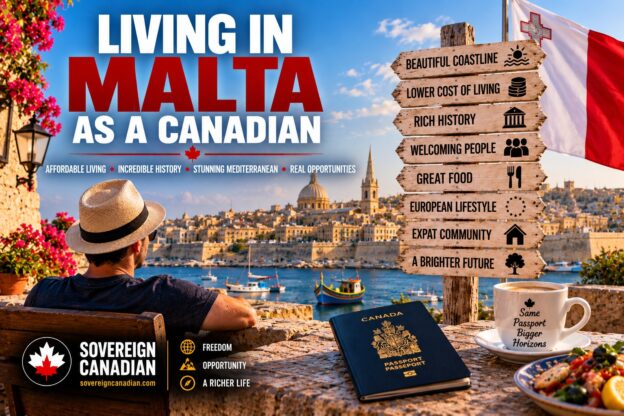
I went into Malta expecting to write that it is Cyprus with the volume turned up. Denser, hotter, more crowded, same idea. That is not what the evidence says.
Malta is the easiest Mediterranean country for a Canadian to actually function in. English is not merely widely spoken, it is an official language. The schools teach in it, the hospital keeps its records in it, the government answers in it. You can land on a Tuesday and be operating a life by Friday in a way that Italy, Greece, Spain and even Portugal do not allow. That functional ease is real, and it is the single best thing Malta offers.
The harder truth is what that ease costs, and what it hides. Malta packs more than half a million residents, a full tourism economy and a major international-services industry onto a set of islands smaller than the city I am writing this from. The cost arbitrage that once justified the move has quietly disappeared. The Canada-Malta tax treaty gives Canadian pensioners none of the exempt-tranche shelter that Cyprus and Greece both provide. And the island’s excellent routine medicine outsources its hardest cases abroad. So Malta turns out to be two very different propositions depending on who you are: a superb base and a demanding home, and a far better place to hold capital than to draw a pension.
This article is not a sales brochure and it is not a tourism piece. The question is narrow and Canadian: what role, if any, should Malta play in your life, and how does it stack up against the Cyprus chapter that came just before it.
What Malta is, in the numbers that matter
Malta is a Commonwealth member, an EU member, a euro user and, unlike Cyprus, a full member of the Schengen Area. The legal system is a British and continental hybrid, a legacy of colonial rule that ended in 1964. There are two official languages, Maltese and English, and for most practical purposes as a foreigner you will live in the second.
The scale is the first thing a Canadian has to internalize. The whole country, the main island of Malta plus Gozo and tiny Comino, covers roughly 316 square kilometres. That is smaller than the City of London, Ontario. Onto that surface Malta fits somewhere around 540,000 residents, which gives a national density near 1,700 people per square kilometre and puts Malta among the ten most densely populated countries on earth.
The national average understates the lived reality, because the density is concentrated. Statistics Malta puts Sliema at over 18,000 people per square kilometre and the inner-harbour towns of Pieta, Gzira, Fgura and Hamrun not far behind. Gozo, by contrast, has villages under 250 per square kilometre. So there is not one Malta but at least three: the harbour conurbation that is effectively one continuous dense city, the quieter centre and north of the main island, and Gozo, which behaves like a different, slower country a ferry ride away.
The other structural fact is migration. Foreign nationals have gone from under five per cent of the population in 2011 to roughly a third today, concentrated in gaming, construction and financial services. That number is not trivia. It shapes housing costs, it shapes whether Malta still feels Maltese, and it shapes how easy or hard it is for one more foreigner to belong.
A Canadian use-case scorecard
Before the detail, here is where Malta lands for the profiles a Sovereign Canadian reader actually occupies. The spread is the point. Malta is not a B-plus at everything.
| Use case | Grade | The reason in one line |
|---|---|---|
| Reconnaissance trip (2 to 8 weeks) | A- | English, well connected, easy to test quickly |
| Seasonal or snowbird base | B- | Schengen caps the long winter at 90 days, with no second allowance |
| One-year family sabbatical | A- | English-medium schooling makes the transition seamless |
| 1 to 5 year family relocation | B+ | Function is superb, but cost and density are the tax |
| Retirement on Canadian pensions | C+ | No exempt Canadian pension tranche; Canada retains source tax and Malta taxes the remitted pension with double-tax relief |
| Retirement on a gains-heavy investment portfolio | A- | Foreign capital gains escape Maltese tax even when remitted; income-heavy portfolios are less attractive |
| Remote work for North America | B | The 10 per cent nomad rate is strong, but the time zone and the four-year cap are not |
| Remote work for Europe | A- | Central, Schengen, and superbly connected short-haul |
| Ordinary entrepreneur | B- | The famous low effective rate needs real substance to earn |
| Internationally mobile investor | B+ | The remittance basis is powerful, but Schengen constrains movement |
| Tax residence | B+ | Excellent for gains, with minimum-tax floors and a worldwide-basis trap to watch |
| Permanent-residence flag | B | Genuinely permanent, no presence required, but costly and not a citizenship path |
| EU citizenship with no ancestry | C | Discretionary naturalisation, long and uncertain after the 2025 court ruling |
| Aging in place past 75 | C+ | Routine care is strong, but tertiary medicine is outsourced and the heat is real |
| Permanent relocation | B- | A base that has to work hard to earn the word home |
Short stays, Schengen, and the second-winter question
For a Canadian passport holder, Malta is a 90-days-in-any-180 Schengen destination, no visa required for tourism, passport valid for the length of stay plus a margin. The EU Entry and Exit System became fully operational in April 2026, so expect biometric capture, fingerprints and a facial image, at the external border. The separate travel authorisation, ETIAS, has still not gone live and has no confirmed start date as of this writing.
Here is the strategic contrast the Cyprus chapter sets up. Cyprus is outside Schengen and gives Canadians their own independent 90-in-180 allowance, which is what makes a genuine five-month European winter possible if you split it. Malta gives you no such thing. Its 90 days count against the entire Schengen zone, so a long Maltese winter eats the same allowance you would want for France, Italy or Spain.
The practical read is that Malta is more convenient for ordinary European travel and less useful as a standalone snowbird allowance. As a two-to-eight-week reconnaissance base it is close to ideal. As a single 90-day winter it works. As a five-month seasonal life it does not, at least not without a residence permit that takes you out of the visitor count entirely.
Three systems that are not the same
The most important conceptual move in this whole article is to stop treating three different things as one. In Malta, the right to reside, the status of tax resident, and the clock toward citizenship are separate systems with separate rules.
You can hold a residence permit and not be tax resident. You can be tax resident without being anywhere near citizenship. You can spend years in Malta on a low-presence permit that builds no meaningful citizenship entitlement at all. A Canadian who conflates these will make expensive mistakes, most often by assuming that a residence programme marketed with tax language actually confers tax benefits, or that residence years automatically ripen into a passport. Neither is generally true. Keep them in separate boxes, because Malta does.
The residence routes a Canadian would actually use
There is no point cataloguing every Maltese permit. Two routes matter for this readership, plus a retiree track that is in the middle of a significant change.
The Nomad Residence Permit is Malta’s remote-work route, open to third-country nationals, which includes Canadians. The current income threshold is EUR 42,000 a year, raised from EUR 32,400 on 1 April 2024, so ignore any guide still quoting the lower figure. You must be working remotely for foreign employers or clients, not for the Maltese market. The permit runs one year at a time to a maximum of four years, with an application fee around EUR 300 and mandatory health insurance of at least EUR 100,000. The tax treatment is the draw: under Legal Notice 277 of 2023, authorised remote-work income is exempt for the first twelve months, measured from the date the permit is issued or from 1 January 2024 if later, and is then taxed at a flat 10 per cent. It does not lead to permanent residence or citizenship, and four years is a ceiling, not a runway.
The Malta Permanent Residence Programme, the MPRP, is the country’s residence-by-investment route, and it was materially rewritten by Legal Notice 146 of 2025. Most of what is online is out of date. The current shape, for a third-country national, is a capital requirement of EUR 500,000 including EUR 150,000 in financial assets, or EUR 650,000 including EUR 75,000 in financial assets, plus a qualifying property bought from EUR 375,000 or rented from EUR 14,000 a year and held for five years, plus a government administrative fee of EUR 60,000, a government contribution of EUR 37,000, a EUR 2,000 charitable donation, and EUR 7,500 for each adult dependant beyond the spouse and under-18 children. The old discount for property in the south of Malta and Gozo was abolished from 1 January 2025.
| MPRP component (2026) | Purchase route | Rental route |
|---|---|---|
| Qualifying property | from EUR 375,000, held 5 years | from EUR 14,000 per year |
| Government administrative fee | EUR 60,000 | EUR 60,000 |
| Government contribution | EUR 37,000 | EUR 37,000 |
| Charitable donation | EUR 2,000 | EUR 2,000 |
| Each adult dependant | EUR 7,500 | EUR 7,500 |
| Non-recoverable, over 5 years | around EUR 99,500 | around EUR 169,500 |
What the MPRP gives is genuine permanence with no minimum-stay requirement, up to four generations on one application, and visa-free Schengen travel. What it does not give is any tax benefit, any automatic right to work, or any path to citizenship, since naturalisation turns on genuine residence and integration that a no-presence card does not build. Against the Cyprus Regulation 6(2) fast-track permanent residence, both are legitimate permanent-residence structures that last as long as you keep meeting their conditions. Malta is the more expensive and more elaborate flag, but its real distinction is that it removes even the minimal presence Cyprus asks for, the requirement to land on the island at least once every two years. For a diversification-minded Canadian, that genuine no-presence feature is what the MPRP is buying.
The retiree track deserves its own paragraph, because a deadline is closing. Malta’s special retiree status, the Malta Retirement Programme, has now been extended to third-country nationals, so a Canadian retiree can use it: a flat 15 per cent on foreign income remitted to Malta, a minimum tax of EUR 7,500 a year plus EUR 500 per dependant, on the condition that pension income is at least 75 per cent of your chargeable income and is received in Malta. That programme, along with the Global Residence Programme and two others, is being replaced by a consolidated Individual Tax Programme under Legal Notice 195 of 2026, in force 1 January 2027. The new terms are meaningfully worse for a retiree: the minimum tax rises to EUR 15,000, and the property bar jumps to a EUR 700,000 purchase with no area discount, or EUR 14,000 in rent. Crucially, anyone whose application is in by 31 December 2026 stays on the old rules until the end of 2031. So Malta’s best retirement tax deal has an expiry date, and it is this year.
The remittance basis, in plain English
Malta’s tax system is the main reason this article runs long, so it is worth getting right.
If you are ordinarily resident in Malta but not domiciled there, and most Canadians who move will be exactly that, you are taxed on the remittance basis. That means Malta taxes income and gains arising in Malta, plus foreign income that you receive in Malta, and nothing else. Foreign income you leave offshore is not taxed. And the feature that surprises everyone, confirmed in the Maltese Revenue’s own guidance: foreign capital gains are not taxed in Malta even if you bring the money in.
Read that twice, because it is the crux. Malta taxes the income you land to live on. It does not tax the gains you realize on what you own, even when you spend those gains in Malta. A retiree drawing dividends and interest from a portfolio is remitting income, which is taxable. An investor selling appreciated holdings and living off the proceeds is remitting capital gains, which are not. Same person, same balance sheet, very different Maltese outcome depending on the character of the cash flow.
Three cautions keep this from being a fairy tale. First, remittance is broad. A foreign card swiped in a Sliema restaurant is a remittance. Foreign income paid into a Maltese account is a remittance. The theoretical advantage shrinks the more your actual spending runs through Malta. Second, systematic trading is income, not capital gain, so a frequent trader loses the exemption on remitted profits. Third, and most important for anyone contemplating permanence, the remittance basis is displaced by the worldwide basis only in specific situations, not simply by the passage of time. The worldwide basis applies if you acquire a Maltese domicile, which is deliberately hard and turns on an intention to make Malta your permanent home for good; if you obtain formal long-term-resident status or an EU permanent-residence certificate or card, as defined in the relevant regulations; or if you are married to and living with a person who is ordinarily resident and domiciled in Malta. Merely living in Malta for many years does not by itself end non-domiciled status, and the MPRP residence card is not the long-term-resident status that triggers worldwide taxation. The regime is powerful for a mobile investor, but it is a status to protect, not one that runs on autopilot.
There is also a floor, and it applies to income, not gains. A non-domiciled resident on the remittance basis whose foreign income, counted together with a spouse’s where you are married and living together, reaches at least EUR 35,000 and is not received in Malta in full pays a minimum tax of EUR 5,000 a year, before double-tax relief. It does not bite below EUR 35,000 of foreign income, and it does not apply to those already inside a special-status programme, which carry their own higher floors. So Malta is not a zero, and the minimum-tax numbers matter when you run your own case.
Malta versus Cyprus, profile by profile
This is the comparison the reader wants, so I will commit to winners where the evidence allows it. Cyprus, as covered in the previous chapter, offers non-domiciled residents no tax on dividends or interest, generally no capital gains tax on securities, a very light 60-day tax-residence route, and health-system contributions capped on passive income. Malta offers the remittance basis described above. They are not the same instrument, and they do not favour the same person.
| Canadian profile | Likely winner | Why |
|---|---|---|
| CAD 100,000 remote employment income | Malta short-term, Cyprus long-term | Malta’s 10 per cent nomad rate is unbeatable for four years, but Cyprus’s employment exemption is durable |
| CAD 100,000 Canadian pension or RRIF | Cyprus | Cyprus shelters a first tranche on the Canadian side, Malta shelters nothing |
| CAD 150,000 foreign dividends and interest | Cyprus | Dividends and interest are exactly what the Cyprus non-dom regime exempts |
| CAD 150,000 portfolio withdrawals, mostly gains | Roughly a tie | Cyprus generally exempts securities gains too, so Malta’s edge is narrower: gains can be remitted and spent in Malta without becoming taxable |
| CAD 300,000+ investment household | Depends on the mix | Income-heavy leans Cyprus, gains-heavy leans Malta, and the minimum-tax floors matter |
| Canadian business owner | Cyprus for simplicity | Malta’s low effective rate needs real substance, Cyprus’s headline rate is simpler to access |
| Part-year mobile investor | Cyprus | The 60-day tax-residence route has no Maltese equal |
The pattern is clean once you see it. Cyprus is the stronger jurisdiction for capital that throws off dividends and interest, for pensions, for the ordinary business owner, and for the investor who wants tax residence on the lightest possible footprint. For a straightforward securities portfolio the two are closer than Malta’s reputation suggests, because Cyprus generally exempts capital gains on securities as well, and the Cyprus result is arguably cleaner, since it does not depend on Malta’s remittance accounting or on how each withdrawal is characterized as income or capital gain. Malta’s genuinely distinctive advantage is narrower, and worth stating precisely: foreign capital gains can be remitted and spent in Malta without becoming taxable merely because the money was brought in. That is a real edge for a gains-funded life, but it is not the same as Malta broadly beating Cyprus for investment capital. Where Malta pulls ahead is not on the tax return at all, but in the parts of life the next sections are about.
The Canada-Malta treaty, and why pensioners should read it first
If you are moving on a Canadian pension, read the treaty before you read the brochures.
The Canada-Malta Income Tax Agreement was signed in 1986 and has been in force since 1987. Under Article 18, a periodic Canadian pension paid to a Malta resident may be taxed in Malta at the applicable rate, and may also be taxed in Canada, with the Canadian tax capped at the lesser of 15 per cent of the gross or the rate a Canadian resident would pay on that pension as their only income. The Maltese Revenue confirms this directly. In practice CPP, Old Age Security and periodic RRIF withdrawals are all caught by that 15 per cent ceiling as periodic payments. Three details matter: the cap applies only to periodic pensions, not to lump-sum withdrawals, which face full Canadian withholding; Canadian war-veterans’ pensions are exempt in Malta if untaxed in Canada; and Malta then taxes the remitted pension too, with a credit for the Canadian tax.
The decisive point is what the treaty does not contain. There is no exempt tranche. The Canada-Cyprus treaty protects a first slice of periodic pension, roughly CAD 10,000, from Canadian tax. The Canada-Greece treaty protects roughly CAD 15,000. The Canada-Italy treaty protects about CAD 12,000. Malta protects none of it. Malta’s treaty network is considerably more generous to some other pensioners. Ordinary UK pensions, for example, are generally taxable only in Malta, so the Canadian pensioner receives neither an exempt Canadian tranche nor the clean residence-only treatment available under some of Malta’s other treaties. This is the structural reason Malta scores a C-plus for pension-funded retirement and Cyprus does not.
There is one significant softening detail on the Maltese side. From basis year 2026, qualifying pension income received after age 61 is fully exempt from Maltese tax up to EUR 37,104. So a Canadian pensioner taxed under Malta’s ordinary rules, rather than a special flat-rate programme, may face little or no Maltese tax on a moderate pension even though Canada still retains its treaty source-tax right. That relief is worth modelling. It does not change the Canadian-side reality, which is that the treaty gives you nothing Cyprus and Greece both give.
Canadian registered accounts
Here I will not pretend to certainty I do not have, because the honest answer is that Malta publishes no rules recognising Canadian registered wrappers.
There is no Maltese provision that respects an RRSP, RRIF, TFSA, RESP or FHSA as a tax-sheltered vehicle. What governs instead is the remittance basis and the treaty. Periodic RRIF payments are treated as pension and caught by Article 18. RRSP and RRIF lump sums are non-periodic and face full Canadian withholding, with practitioners generally treating the receipt as capital on the Maltese side, though this is interpretation rather than published rule. The TFSA is the genuine unknown and probably the biggest trap, and it has to be unbundled into separate questions. On the Canadian side, becoming non-resident does not make Canada start taxing the income already sitting inside an existing TFSA, but you generally cannot keep contributing, because contributions made while non-resident attract a penalty tax of one per cent per month and no new room accrues. On the Maltese side, Malta does not necessarily recognise the wrapper or give it any treaty protection, so the real question is how Malta treats the income and gains arising inside the account, and there the remittance distinction applies: foreign income is potentially taxable if remitted, while foreign capital gains are not. Whether Malta looks through the wrapper to that underlying income and gains is not something I can establish from authoritative Maltese guidance, so anyone with a meaningful TFSA should obtain a Maltese ruling or professional advice rather than assume a result. The RESP and FHSA are even less mapped.
The responsible conclusion is that anyone with meaningful balances in these accounts should get a Maltese ruling or professional advice before assuming any particular treatment. I would rather tell you the honest gap than invent a clean answer that does not exist.
Leaving Canada properly
Malta can decide whether it considers you resident. It cannot decide whether Canada has stopped considering you resident. That distinction is the whole of Canadian departure planning.
Ceasing Canadian tax residence turns on severing significant residential ties, home, spouse, dependants, and the secondary ties around them, backstopped by the treaty tie-breaker if both countries claim you. Departure triggers a deemed disposition, the departure tax, on most non-registered capital property, with registered accounts and Canadian real property treated separately. Retained Canadian real estate keeps you in the Canadian system for that income and its eventual sale. Canadian-source income to a non-resident faces Part XIII withholding, reduced by the treaty rates covered above. And provincial health coverage in Ontario ends once you are no longer ordinarily resident, which matters more than people expect when planning the medical side.
None of this is Malta-specific, and all of it is easy to get wrong. Model it before you move, not after.
Healthcare: excellent island medicine, outsourced at the edges
Malta ranks well for healthcare, and for routine and much specialist care that ranking is earned. Mater Dei Hospital in Msida, opened in 2007 with over a thousand beds, is the country’s single acute and teaching hospital and handles most tertiary care, supported by the Sir Anthony Mamo Oncology Centre, a national cardiac centre and a renal unit. Everything runs in English, records included. Private hospitals such as the St James group buy speed for a modest supplement, with a private policy of roughly EUR 25 to 60 a month solving the public system’s one real weakness, which is the wait for a non-urgent specialist.
The limit only shows up at the hard edge, and it is narrower than a casual small-island description implies. Mater Dei handles the large majority of tertiary care on the island itself, including cardiac surgery, oncology at the Mamo centre, neurosurgery, intensive care and renal work. What it does not attempt is full self-sufficiency in the rarest and most highly specialised interventions, which it refers abroad through three channels: the long-standing UK-Malta bilateral agreement, the EU cross-border route, and an agreement with ISMETT in Palermo. The Maltese health service treats that overseas programme as an extension of local care and actively works to shrink it, including by flying in visiting consultants, so only a small number of patients ever travel. The honest reading is that Malta has far more domestic tertiary depth than its size suggests, without the full depth of a large mainland country.
Gozo makes the point sharper. Gozo General Hospital is the island’s only hospital, and serious cases are air-ambulanced to Mater Dei. For a healthy 60-year-old that is an abstraction. For an 80-year-old with a cardiac event it is the difference between a ten-minute drive and a helicopter. When we get to the retirement decision, this is the fact that decides it. The map that matters when you are old is the hospital map.
Families and schooling: the quiet strength
If Malta has an unambiguous advantage over Italy, Greece, Spain and Portugal, it is here. Because English is an official language and a medium of instruction, a Canadian child does not have to learn a new language to attend school, and re-entry to the Canadian system afterward is straightforward.
State schools are free to residents, bilingual from the start, and run a British-influenced curriculum toward the Secondary Education Certificate and the Matriculation Certificate, with an induction unit for children who arrive without Maltese or English. Church schools are low-fee, Catholic and English-medium, a genuine middle option. The international sector is deep for a country this size: Verdala International School in Pembroke runs a full International Baccalaureate continuum, St Edward’s College offers the IB in a Catholic setting, QSI runs an American programme, and Chiswick House and St Martin’s run the British IGCSE and A-level track. All-in international cost runs roughly EUR 6,000 to 17,000 per child once fees, registration, uniforms and transport are counted, and the strongest schools carry waiting lists, so early application matters.
The decision splits by time horizon. For a family staying several years with re-entry to Canada in mind, an international school buys a globally portable qualification. For a single sabbatical year, the same schools give the smoothest landing, but the state and church system is genuinely usable too, which is not something you can say in most of the series.
Cost of living, and the arbitrage that left
Malta is described as both cheap and expensive, and the contradiction resolves by postcode. A one-bedroom flat averages somewhere near EUR 900 a month nationally, but EUR 1,050 to 1,600 on the Sliema and St Julian’s coast and EUR 500 to 750 in Gozo or the south. Two-bedrooms run from around EUR 1,180 as a national average to EUR 1,800 to 2,800 on the central coast. The median apartment asking price sits around EUR 317,000. Utilities are modest at roughly EUR 84 a month for a mid-size flat, with two traps: a tiered electricity tariff that punishes heavy summer air-conditioning, and a residential-versus-domestic billing quirk that quietly overcharges tenants whose landlord has not filed the right form. Fibre internet is cheap and fast, and public transport has been free for residents since October 2022.
Realistic monthly budgets run about EUR 1,300 to 3,000 for a single person depending on where they live, EUR 2,500 to 4,500 for a couple, and EUR 3,000 to 7,000 for a family of four, with schooling the biggest swing. Against the Greater Toronto Area, Malta’s rents look moderate and its dining and transport look cheap.
The uncomfortable part is the peer comparison. On consumer prices including rent, Malta now sits slightly above Rome, Madrid, Barcelona and Lisbon. The arbitrage that once justified the move, the sense that you were buying a Mediterranean life at a discount, has largely gone. What remains is English and tax structure, not cheapness. That is the same lesson Portugal taught, and it is worth saying plainly: Malta is increasingly a place to spend an internationally sourced income, not a place to save money.
Density, construction and the compression problem
Every country in this series poses one defining question. Malta’s is whether you can live at close quarters.
Malta’s convenience comes from compression. Everything is fifteen minutes away because everything is on top of everything else. The same compression is the country’s biggest lifestyle liability. The harbour towns are among the densest urban areas in Europe, the construction sector is relentless, and cranes, jackhammers and dust are a permanent feature of the skyline rather than a passing phase. Open space is scarce, the coastline is heavily built, and traffic on a small road network is genuinely bad. Vehicle ownership is high, parking is a daily negotiation, and in the busiest districts the island can feel like one continuous, unfinished city.
Gozo is the release valve, and it is a real one. It is quieter, greener and slower, and for many people it is the version of Malta they fall for. But Gozo trades density for dependence, and everything scarce on Gozo, from a hospital bed to a flight, ends with a ferry crossing. The honest framing is that Malta’s compression is not a flaw you can renovate away with money. It is the structure of the place. You either find close quarters energizing or you find them exhausting, and no budget changes which.
Climate: Europe’s best winters, and the summers that make you leave
Malta has the warmest average temperature in Europe, and Valletta has the mildest winters of any European capital, with January days around 16 degrees and nights around 10. For a Canadian escaping an Ontario February, that is close to ideal on paper.
Two seasons complicate the postcard. Winter is mild but damp, humidity sits high, and the island’s older limestone housing insulates poorly, so January can feel colder indoors than the numbers imply. Summer is the season that actually makes people leave. July and August bring typical highs in the low 30s, humid nights above 20 degrees, and heatwave spikes into the high 30s and low 40s, plus the xlokk, a hot, humid wind off North Africa that arrives with Saharan dust. Water is desalinated for more than half the supply, so the taps do not depend on rain, but Malta is a genuinely water-scarce place and the trend is hotter and drier.
The scouting rule from the Cyprus chapter applies here too, with a twist. Do not visit in May and fall for it. Visit in the damp of January to test the housing, and again in an August heatwave to test whether you can actually live through the summer. Scout the season most likely to make you leave, not the one most likely to make you buy.
Safety, governance and the consulate in Rome
On personal safety Malta is easy. The Government of Canada rates it at the lowest advisory level, take normal security precautions, and the main flagged risk is mundane: apartment-rental and deposit scams. Violent crime is low, beaches are supervised, and day-to-day life is about as safe as a mid-size Canadian city.
Two structural notes belong here. There is no Canadian embassy in Malta; consular coverage runs through the Embassy of Canada in Rome, which is a minor inconvenience most of the time and a real one in a crisis. And Malta carries a governance reputation that Cyprus does not, from the 2017 assassination of the journalist Daphne Caruana Galizia, whose case is still working through the courts, to a period on the international financial grey list in 2021 and 2022, since lifted, to the 2025 European court ruling that struck down its passport scheme. None of this affects daily life. All of it is part of an honest picture of the jurisdiction you are joining: sophisticated services, contested governance.
Language and integration: functioning is not belonging
Malta lets a Canadian live entirely in English. Government, healthcare, schooling, banking, work and an enormous expat social scene are all available without a word of Maltese. On the narrow question the brief poses, whether Malta is the easiest Southern European country for a Canadian to function in, the answer is yes.
The harder question is whether the same feature makes it easier to never actually integrate. It does. When you never need the local language, you never learn it, and Maltese society, close-knit, Catholic and family-centred, remains a room you can see into but not always enter. Add a foreign-born population near a third and a housing market visibly strained by it, and you get a place where a Canadian can be comfortable and included in the expat world while remaining, after years, a permanent guest of the Maltese one. This is not unique to Malta, but Malta’s English ease makes the trap easier to fall into, because nothing ever forces you out of it.
Daily life, remote work, and getting off the island
Daily Maltese life is walkable in the harbour towns and car-dependent in the north and on Gozo. You drive on the left, the buses are free and frequent in the centre and thin elsewhere, ride-hailing is everywhere, and e-commerce is decent if slower than Canadians expect. The rhythms are Mediterranean and Catholic, with a real August slowdown and a Sunday quiet, and construction noise is the background track of the dense districts.
For remote work the infrastructure is strong. Fibre reaches a gigabit, mobile data is cheap, coworking is plentiful, and power is reliable. The friction is the clock. Malta runs on Central European Time, six hours ahead of Toronto, one hour closer than Cyprus but still a stretch. A Toronto nine-to-five becomes a Maltese mid-afternoon-to-late-evening, so serving a North American employer means giving up your evenings, while European and Middle Eastern clients line up naturally. Grade Malta A-minus for European remote work, B for North American, and remember the nomad permit’s four-year ceiling.
Then there is the island question that defined the Cyprus chapter, where every serious problem was a plane problem. Malta answers it better, though not completely. There is no nonstop flight to Canada, so every trip home is a one-stop routing of roughly sixteen to seventeen hours through a European hub. But Malta International Airport is far better connected short-haul than Larnaca, with dense low-cost service across Europe, and, unlike Cyprus, a fast ferry runs to Sicily. That ferry is the difference. Malta is not a pure plane-only island; you can reach mainland Europe by sea and drive on. Malta does not fully solve the island problem for a Canadian. It does have both better planes and a boat.
Business: the five per cent that isn’t
Malta is often sold as a five per cent corporate-tax jurisdiction. That number is real and misleading at the same time. The statutory rate is 35 per cent. The effective rate falls toward five per cent only through a shareholder refund system that returns six-sevenths of the tax on distribution, alongside a full imputation system and a participation exemption for qualifying holdings. It works, but it is machinery, not a headline, and it demands genuine substance, real management and control in Malta, and non-trivial compliance cost.
For a Canadian entrepreneur the practical question is whether you are building a substantial operation or looking for a simple low rate. If it is the latter, Cyprus’s more straightforward regime, with a headline rate now at 15 per cent, is easier to access and defend. Malta rewards sophisticated structures with real people and real activity on the ground. It is a structuring jurisdiction more than a simple operating one, and treating it as the latter is how Canadians get into trouble.
Five Canadian models
Concrete beats abstract, so here are five ways a Canadian actually uses Malta, each with its logic and its exit.
Model A, Seasonal Malta, is for the reader testing the Mediterranean without commitment. The legal basis is the Schengen visitor allowance, a single winter of up to 90 days, which keeps you outside tax residence entirely and therefore outside the Maltese tax system. Base yourself in Sliema or Gzira for walkability and services. The main risk is that 90 days is the ceiling and the allowance is shared with the rest of Schengen. The exit is simply flying home, which is the point.
Model B, One-Year Family Malta, is a single school year built around English-medium education. The legal basis is most often a residence permit tied to remote work or means, and you become Maltese tax resident for the year, which is manageable if your income is modest or structured. Base near an international school. The main risk is treating a one-year decision as if it were permanent and overbuying on housing and schooling. The exit is a clean return to the Canadian curriculum, which the English schooling makes easy.
Model C, Remote Malta, is a professional living on a foreign income under the Nomad Residence Permit. The legal basis is that permit, the tax treatment is zero in year one and ten per cent thereafter, and the geography should favour a connected harbour town. The main risk is the four-year cap and the six-hour gap to North American colleagues. The exit is built in: when the four years end, you move, convert to another status, or go home.
Model D, Malta Retirement, is a pensioner or portfolio retiree seeking a mild-winter base. The legal basis is the special retiree status, and the deadline matters: entering under the current Malta Retirement Programme before 31 December 2026 locks in a EUR 7,500 minimum tax and the lower property bar until the end of 2031, versus the tougher Individual Tax Programme terms that follow. Base for hospital access, not harbour views. The main risk is the treaty’s missing pension shelter and the tertiary-medicine ceiling as you age. The exit is a sale and a move, which is why you should rent first.
Model E, Malta Tax-Resident and Internationally Mobile, is the investor using the remittance basis deliberately. The legal basis is ordinary non-domiciled tax residence, the tax logic is to realize and spend capital gains, which escape Maltese tax even when remitted, while keeping foreign income offshore. Geography is wherever suits, since the work is portfolio management, not local life. The main risk is losing the remittance basis by acquiring Maltese domicile or formal long-term-resident status, rather than by time alone, and the minimum-tax floors. The exit is the reversibility that non-domiciled status is designed to preserve.
The one-year family decision
A Canadian couple, two primary-school children, exactly one school year, one location, no menu. I would choose Swieqi, next to Pembroke and a short hop from St Julian’s.
The reasoning is friction, not glamour. The obvious pick, the Sliema and St Julian’s seafront, is dense, expensive and nightlife-heavy, which is the wrong texture for young children. Swieqi is a quieter residential neighbourhood immediately beside Pembroke, which puts Verdala International School and its IB continuum within a short daily run, gives coastal walks and green space that the harbour core lacks, keeps you close to St Julian’s amenities without living inside the noise, sits about twenty-five minutes from the airport for the trips home, and is a manageable distance from Mater Dei. The English-medium school makes the year seamless in and seamless out, the cost is high but predictable, and the children get a genuinely international classroom. For a single defined year, that combination of English schooling, quiet, coast and connectivity beats every flashier option.
The retirement decision
A healthy Canadian couple, age 60, intending to stay past 80. One base. The instinct is Gozo, and the instinct is wrong.
Gozo at 60 is wonderful and Gozo at 80 is a liability, because its only hospital air-ambulances serious cases to Mater Dei and everything scarce ends with a ferry. Weight the decision the way an eighty-year-old body will: hospital proximity, walkability without a car, flat terrain, everyday services within reach, and access to private care. On those criteria I would choose the Ta’ Xbiex and Gzira harbour corridor on the main island. It is flat and walkable, it is minutes from Mater Dei, it has services and a ferry to Valletta, and it lets a person age without depending on driving. The cost is real, the density and construction noise are the trade-off you accept, and the summer heat still has to be managed with good air-conditioning and a possible escape in August.
I am choosing hospital access over harbour romance on purpose. At 60 the beach map is tempting. At 80 the hospital map is the only one that counts, and it points to the corridor around Mater Dei, not to Gozo.
What money solves, and what it doesn’t
Money solves a surprising amount in Malta. It buys private healthcare and next-week specialists, a well-insulated and air-conditioned home, a quieter neighbourhood away from the worst construction, parking, international schooling, good accountants and lawyers, flights home in comfort, and the property thresholds that residence programmes require. For the affluent Canadian, most of the daily friction of Maltese life is purchasable.
Money does not solve the structural things. It cannot un-crowd the island, un-jam the roads, silence the construction sector, or manufacture wilderness where there is none. It cannot give Malta tertiary medicine it does not have, or move it closer to Canada, or lower the August heat, or conjure water. It cannot buy the second Schengen allowance that Cyprus grants for free, restart the citizenship clock, or make an English-only life into genuine Maltese belonging. The line to hold in your head is the line between purchasable friction and structural constraint. Malta has a lot of the first and a hard core of the second, and the affluent reader should be honest about which problems a chequebook actually closes.
Does Malta increase a Canadian’s sovereignty?
This publication cares, in the end, about optionality. On that test Malta genuinely delivers on several fronts. It is a real EU foothold with Schengen access, an English-speaking base that needs no language runway, a jurisdiction with a powerful remittance-basis tax system for the right income profile, a sophisticated banking and business environment, accessible schooling, and a permanent-residence flag that asks for no presence. For a Canadian building geographic and tax diversification, those are meaningful additions to the map.
But the counter-question is fair, and the evidence answers it honestly. Malta also swaps a familiar set of Canadian dependencies for the dependencies of an extremely small, dense island: on imports and desalinated water, on a single tertiary hospital that exports its hardest cases, on the Schengen clock, on air links for anything serious, and on a housing market strained by the same foreign demand you would be joining. Malta increases a Canadian’s optionality most for the person who treats it as one base among several, and least for the person who makes it a sole and final home. It adds a flag. It does not, on its own, add independence.
The verdict
The fifteen questions the analysis has to answer, answered plainly.
- Who should seriously consider Malta? Families wanting an English-medium year or few years, capital-gains-funded investors, and remote workers who serve Europe.
- Who should probably choose elsewhere? Pension-funded retirees, anyone craving space and wilderness, and those wanting a five-month winter on one allowance.
- Season, chapter or permanent home? A superb chapter and a strong base, a demanding permanent home.
- Is there real geographic arbitrage left? No. The cost advantage is gone; what remains is English and structure.
- Is Malta better than Cyprus for a Canadian? It depends on the money. Cyprus is stronger for pensions, income-throwing capital and low-presence tax residence; Malta’s strongest advantages are families, functional ease and a defined remote-work chapter.
- Is Malta strong for affluent Canadians? Yes, because money closes most of its daily friction, though not its structural limits.
- Is Malta good for Canadian pensioners? Weakest use case, because the treaty gives no exempt tranche like Cyprus and Greece do.
- For portfolio-funded retirees? Yes on its own terms, because foreign capital gains escape Maltese tax even when remitted, though on a securities portfolio this roughly ties Cyprus rather than beating it.
- Is the island constraint materially important? Yes, but the Sicily ferry softens it in a way Cyprus cannot match.
- Best family base? Swieqi, beside Pembroke, for the school and the quiet.
- Best retiree base? The Ta’ Xbiex and Gzira corridor near Mater Dei, not Gozo.
- Best remote-worker base? A connected harbour town, on the nomad permit, serving Europe.
- Is Malta a good permanent-residence flag? Yes if you value permanence with no presence, at a real price and with no citizenship path.
- Is EU citizenship realistically attainable? Not as a plan. The investor-citizenship route was closed by the 2025 European court ruling, and its replacement citizenship by merit is explicitly discretionary and not a purchasable programme. Ordinary naturalisation requires the final twelve months of continuous residence plus at least four aggregate years during the preceding six, along with the other integration requirements, and approval remains discretionary, while the MPRP’s no-presence design builds none of that residence. So citizenship is legally attainable, but not something I would build the Malta strategy around.
- Does Malta increase sovereignty or swap dependencies? Both, and which one wins depends entirely on whether Malta is one base or your only one.
What I’d Actually Do
Not generic advice. The sequence I would follow if I were a Canadian weighing Malta this year.
- Decide first whether I want a season, a chapter or a permanent home, because everything below changes with the answer.
- Separate the three systems in my planning: immigration residence, tax residence, and any citizenship clock, and never let one masquerade as another.
- Work out whether the Schengen visitor allowance is enough, because if it is, I skip residence and tax residence entirely.
- Model my Canadian departure first, ties, deemed disposition, retained property and provincial coverage, before modelling anything Maltese.
- Test whether Malta’s remittance basis actually helps my income profile, which means knowing how much of my cash flow is income versus capital gains.
- Compare that result directly against the Cyprus non-domiciled regime, because for pensions and income-throwing capital Cyprus usually wins.
- Model the Canadian pension withholding under Article 18, with no exempt tranche, and see what the treaty really leaves me.
- Get a Maltese ruling or professional advice on RRSP, RRIF and TFSA treatment rather than assuming a clean answer.
- If Malta’s special retiree status is central to the case, run the numbers on entering under the current Malta Retirement Programme before 31 December 2026 to lock the lower minimum tax and property bar until 2031.
- Choose geography by daily friction and healthcare, not by postcard, which for retirement means the corridor near Mater Dei and not Gozo.
- Visit in the damp of January to test the housing, not in the flattering shoulder season.
- Visit again in an August heatwave, and sit through it, before deciding I can live through Maltese summers.
- Experience the traffic during an ordinary working week, not on a quiet Sunday.
- If Gozo tempts me, test its hospital and airport dependence in person before I romanticize the quiet.
- Rent before I buy, and enter the MPRP or any tax programme only after Malta has earned permanence rather than merely charmed me.
Related in this series: Living in Cyprus as a Canadian, Living in Portugal as a Canadian, Living in Spain as a Canadian, Living in Greece as a Canadian, and Living in Croatia as a Canadian.
This article is general information for Canadians considering international diversification, not tax, legal, immigration or investment advice, and it does not create a professional relationship. Figures, thresholds, tax rules and residence-programme terms are current to September 2026 and change often; several are indexed or subject to legislation still coming into force, including the Individual Tax Programme that takes effect on 1 January 2027. Verify every load-bearing number against the primary source and obtain qualified Canadian and Maltese cross-border advice before acting on anything here.