
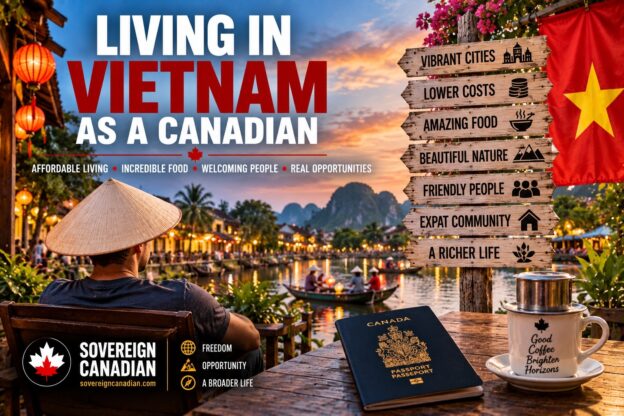
Vietnam is the easiest country in this series to fall for and one of the hardest to build a permanent life inside. That is the whole story, and it is worth saying plainly before the enthusiasm sets in. You can land in Da Nang with a portfolio, a warm-weather plan and a genuine love of the place, live extraordinarily well for very little, and still discover a year later that the country has given you almost nothing you can hold. No retirement visa. No route to permanent residence that fits you. No ownership of the land under your apartment. No realistic citizenship. What Vietnam gives freely is access. What it withholds, almost systematically, is architecture.
The single line I kept returning to during the research is this: Vietnam is easier to afford than to formalize. Every attractive fact about the country, and there are many, survives the affordability test and stumbles on the formalization test. And there is a smaller, stranger truth sitting underneath it that captures the mismatch better than anything else I found. Under the Personal Income Tax Law that took effect on 1 July 2026, spending most of a year in Vietnam makes you a Vietnamese tax resident on worldwide income, whether or not the immigration system has given you any status at all. So you can be a Vietnamese taxpayer and an immigration tourist at the same time. The tax net catches you the moment the residence system refuses to.
That is the difference from Thailand, the country I looked at just before this one, and the comparison runs through the entire piece. Thailand rents you dependability; Vietnam only lends you presence. Thailand is legally conditional but can plausibly carry an affluent foreigner deep into old age on paid and semi-permanent arrangements. Vietnam can be wonderful during the healthy, working, cost-conscious years and then quietly ask you to leave at exactly the point you become least able to move. This article is an attempt to break the Vietnam thesis before recommending the country, and to tell you precisely what kind of Canadian it actually works for.
The country is not one lifestyle
There is no such thing as “living in Vietnam” as a single decision. There are at least three serious bases for a Canadian, and they are not interchangeable.
Ho Chi Minh City, still Saigon to most people who live there, is the commercial engine: the deepest pool of international schools, the strongest private hospitals, the largest expat economy, and the most genuine business ecosystem in the country. It is also hot, congested, prone to flooding, and busy in a way that never really stops.
Hanoi is the political and cultural capital, with real international schools and strong hospitals of its own, a genuine four-season northern climate that surprises people, and one load-bearing problem I will not bury in a list of disadvantages: some of the worst recurring major-city air pollution in the region during parts of winter.
Da Nang is the lifestyle answer everyone arrives wanting: a mid-sized coastal city with beaches, a good airport, clean-enough air, lower costs than the two big cities, and a relaxed expat scene. It is also where the immigration and healthcare ceilings show up most clearly, because what Da Nang cannot do medically has to be done somewhere else.
Around these sit the satellites. Hoi An, thirty minutes south of Da Nang, is charming and floods most years; it is a place to live near, not a place to build a durable base. Nha Trang is a beach-retirement candidate with a thinner professional and medical layer. Dalat, Vung Tau and Phu Quoc each have a narrow use case and none of them changes the national picture. The honest structure of this article is that it eventually forces choices between these places rather than handing you a menu, because the menu is how people talk themselves into decisions the evidence does not support.
Immigration is the wall the whole country runs into
Start here, because immigration is the load-bearing section and almost everything attractive about Vietnam is downstream of it.
There is no retirement visa. Not a difficult one, not an expensive one, not a slow one. As of September 2026 Vietnamese immigration law simply contains no category that lets a foreigner reside long term on the basis of being retired and financially self-sufficient. This is confirmed by the immigration statute itself and by every serious legal source; it is contradicted only by visa agents selling a “retirement visa” product that does not correspond to any law. Thailand has a retirement visa. Malaysia has one. The Philippines has the SRRV. Vietnam has an intention, discussed for years, to maybe build one someday.
What exists instead is the e-visa: a fully online permission, valid up to 90 days, single entry for USD 25 or multiple entry for USD 50, and, critically, not extendable from inside the country: to reset it you leave Vietnam and obtain a fresh e-visa before re-entry. Canadians are not on Vietnam’s visa-exemption list, so a Canadian needs the e-visa every time. And the enforcement environment has tightened, not loosened: Decree 282/2025, effective 15 December 2025, raised overstay penalties, and Decree 59/2026, effective 1 April 2026, introduced deportation for overstays of sixteen days or more, with blacklisting for repeat or serious violations. The enforcement environment is becoming less forgiving rather than more.
So what are the thousands of foreigners who describe themselves as “retired in Vietnam” actually using? A rolling sequence of 90-day e-visas, punctuated by border runs to Cambodia, Thailand or Laos to reset. That is not a residence status. It is a repeated permission to visit, held together by a stapler and good weather. It works until it doesn’t: until a rule changes, an officer declines, an illness makes travel impossible, or the day count quietly turns you into a tax resident. I will say this bluntly because the internet will not: a renewable tourist permission is not a residence strategy, and building a retirement on top of one is building on sand you do not own.
The seasonal reality, stated correctly
Because the e-visa is sold as “90-day multiple-entry,” people assume it stretches to cover a whole snowbird winter. It does not. Multiple entry means you can leave and re-enter during the visa’s own validity window; it does not turn ninety days into five months. A stay of up to roughly three months is genuinely easy on a single e-visa. A four or five month winter requires a second visa cycle: an exit, a fresh application, and re-entry under whatever the rules are at that moment. That is a manageable friction for a healthy 45-year-old with flexible plans. It is a materially worse arrangement for a 74-year-old who does not want to fly to Phnom Penh in February to keep a beach apartment legal.
The golden visa does not rescue this. Vietnam has floated a 5 to 10 year “golden visa” for investors and long-stay visitors since 2025, and the headlines have run well ahead of the law. As of mid-2026 the 10-year investor golden visa remains a draft that has not been submitted to the National Assembly, let alone opened for applications. What is actually enacted is a narrow talent visa aimed at a handful of people: senior experts in priority sectors, distinguished scientists, and figures of genuine international standing. Vietnam is courting talent, not retirees, and certainly not ordinary affluent foreigners with a self-directed portfolio and a good tan. Treat the golden visa as a rumour to verify, not a plan to rely on.
Vietnam rewards people who do something
Here the picture changes, and this is where Vietnam becomes genuinely interesting rather than merely cheap. The country has real, legal, workable status for foreigners who arrive with a business purpose. It just does not have any for foreigners who arrive with only money.
The mechanism is capital plus role. Under Decree 219/2025, which replaced the old work-permit regime with immediate effect on 7 August 2025, a foreign owner or capital-contributing member of a limited liability company, or a chairperson or board member of a joint-stock company, is exempt from the work-permit requirement where the contributed capital is at least VND 3 billion, roughly USD 120,000. That exemption, combined with the underlying company and investment, is what supports a Temporary Residence Card. Below that capital threshold, or in a purely employed role, a work permit is generally required first. Either way, the residence right is tethered to genuine substance: a real entity, real capital, a real role, and the accounting, auditing, licensing and renewal obligations that keep the whole structure alive.
This is the correct way to understand Vietnamese residence. It is not “move here and stay.” It is “build or run something here, hold the right role, contribute the right capital, and maintain it.” A Temporary Residence Card for an investor or work-permit holder typically runs one to a few years and is renewable, and it can extend to a spouse and children as dependants. It is durable in the sense that it renews. It is fragile in the sense that it is conditional on the business continuing to exist and comply. That is a very different proposition for a 38-year-old founder than for a 66-year-old who wants to read on a balcony.
Investor residence, and what it actually costs in substance
For those who want the investment route explicitly, Vietnam’s DT investor categories tie the length and stability of your visa and residence card to how much capital you actually commit. Small contributions buy short permissions; larger ones buy multi-year Temporary Residence Cards. The important discipline, and the thing visa-agent marketing obscures, is the gap between nominal capitalization and real, deployed, operating substance. A shell with a number on paper is not the same as a functioning enterprise, and the compliance load, tax filings, audited statements, licences, is continuous rather than one-time.
The honest read is that, for the route described here, meaningful capital begins around the VND 3 billion threshold, with longer and more stable investor status requiring more, and a real operating footprint throughout, not the “incorporate for a few thousand dollars and relax” story that circulates online. If you are willing to run an actual business, Vietnam has a lawful, renewable place for you. If you want passive residence in exchange for a bank balance, Vietnam has nothing for you, and no amount of money changes that, because the categories that would apply do not exist.
Vietnam as a country to build in
This deserves more room than it got in the Thailand piece, because it is Vietnam’s strongest positive case and the clearest reason a Canadian might rationally choose it over its neighbours.
Vietnam is in the middle of a genuine industrial rise: manufacturing, electronics, machinery, textiles, furniture, and the broad “China plus one” supply-chain diversification that has pulled serious foreign direct investment into the country. For a Canadian who wants to source products, contract manufacturing, build an export business, develop software with a local team, or operate a real company in Asia, Vietnam offers something Thailand structurally makes harder. Thailand’s Foreign Business Act constrains foreign ownership across wide swaths of the economy and pushes foreigners toward minority stakes and nominee-adjacent structures. Vietnam permits full foreign ownership in many sectors through a foreign-invested enterprise, with genuine wholly-owned company formation available in a broad range of activities, subject to sector-specific limits in areas the state protects.
That is a real sovereignty advantage on the operating side. It is not unqualified. Vietnam has its own frictions: bureaucracy, uneven contract enforcement, intellectual-property protection that is improving from a low base, corruption that has to be managed, and a banking and foreign-exchange system that watches capital carefully, which I come back to below. But the core point stands and it is the most important secondary conclusion in this article: Vietnam makes more sense when you arrive with a business purpose than when you arrive with only money. The retiree hits walls at every turn. The operator finds doors. If your reason for going is to build, source, manufacture, employ people or run something in a fast-growing economy, Vietnam moves dramatically up the ranking, and the same immigration system that fails the retiree quietly works for you.
Remote work: excellent facing Asia, nocturnal facing Toronto
The legal position first, because “everyone does it” is not the same as “it is authorized.” Vietnam has no dedicated digital-nomad visa as of September 2026. A Canadian working remotely from Vietnam for a Canadian employer, a Canadian corporation, their own foreign company or foreign clients is operating in a grey zone: tolerated in practice on tourist permissions, not affirmatively provided for, and increasingly awkward as both immigration enforcement and the new tax law tighten. If you cross into tax residence, which I will get to, the grey zone acquires a tax dimension as well.
The practical experience splits hard by time zone, and this is where Vietnam matches Thailand almost exactly. Vietnam runs roughly eleven to twelve hours ahead of Eastern Canada depending on daylight saving. For an Asia-facing worker, dealing with Singapore, Tokyo, Seoul, Sydney or Bangkok, Vietnam is excellent: you are in the region, on the right clock, near the right airports. For an Asia-and-Europe-straddling business, the overlap with European mornings is workable. For a Toronto-facing worker, Vietnam is nocturnal: a 9 a.m. Toronto meeting is 9 p.m. in Da Nang, and a full North-American workday means living upside down. An asynchronous owner who does not need live overlap can make it work anywhere. So the same phrase that fit Thailand fits here: Asia-facing, excellent; Toronto-facing, you become a creature of the night.
Vietnamese tax residence, and the irony in full
Now the mismatch that anchors this whole piece. Vietnam’s new Personal Income Tax Law (Law 109/2025/QH15), effective 1 July 2026, keeps the residence test that matters here: you are a Vietnamese tax resident if you are present in Vietnam for 183 days or more in a calendar year or in any rolling twelve-month period from your first arrival, or if you maintain a permanent or leased dwelling in Vietnam for a qualifying term. Residents are taxed on worldwide income; non-residents only on Vietnam-source income. Employment income for residents runs on a progressive scale to a top rate of 35 per cent, with investment income and other categories taxed at their own fixed rates. Crucially, residence is determined by physical presence, not by your visa, and the authorities check it against passport entry and exit records.
Read that against the immigration section and the irony is complete. Vietnam will not give an affluent retiree a residence status, but it will make that same retiree a worldwide-income tax resident the moment the day count crosses 183. The rolling-e-visa “retiree” who spends most of the year in Da Nang has, in the eyes of the tax authority, become a Vietnamese resident taxpayer, and may be doing so without filing or even realizing the exposure exists. That is a latent exposure, not a theoretical one. Enforcement against foreign retirees’ foreign-source pension and investment income has so far been light in practice, which is a statement about administration, not about law. The law says worldwide income. Do not confuse the current softness of collection with a permanent exemption. This is precisely the kind of structural fact that generic “Vietnam is so cheap” content never mentions, and it is one of the strongest reasons to model your tax position before you build your life.
The Canada to Vietnam treaty, benefit by benefit
Vietnam and Canada have a tax treaty, signed 14 November 1997 and in force since 28 October 1999. A treaty existing is not the same as a treaty helping, so here is the actual, article-by-article result for a Canadian who has become non-resident of Canada and is drawing Canadian retirement and investment income. Two principles first. One: the foreign tax credit that prevents true double taxation comes from domestic law, the Income Tax Act and form T2209 on the Canadian side and the credit mechanism in the treaty’s relief article on the Vietnamese side, not from the treaty itself; the treaty supplies rate ceilings and predictability, not the credit machinery. Two: the treaty’s pension relief is narrower than people assume, and getting this wrong is the classic error.
Periodic pension payments that are not social security are capped by the treaty at 15 per cent Canadian withholding, down from the domestic Part XIII default of 25 per cent. That covers a normal employer pension paid periodically. It also covers the periodic portion of a RRIF: under the Income Tax Conventions Interpretation Act, a RRIF payment qualifies as periodic where the year’s payments do not exceed the greater of twice the annual minimum or 10 per cent of the fund’s value at the start of the year. Within that band, 15 per cent; above it, the excess is treated as a lump sum.
Lump-sum RRSP withdrawals are not periodic and get no treaty reduction: 25 per cent. Annuities are worse than most people expect, because this particular treaty places no ceiling on annuity payments at all, so a Canadian annuity paid to a Vietnamese resident is exposed to the full domestic rate, 25 per cent. And CPP and OAS are the trap: the treaty’s 15 per cent cap explicitly excludes payments made under a country’s social security legislation, so CPP and OAS to a Vietnamese resident are not reduced to 15 per cent. Canada’s own published guidance confirms the point by omission: Vietnam is not among the treaty countries whose social security payments enjoy the reduced rate. CPP and OAS therefore face 25 per cent Canadian withholding. A section 217 election lets a lower-income non-resident file a Canadian return and pay graduated rates instead of flat withholding where that produces a better result, and it is worth modelling.
On the rest: Canadian dividends to a Vietnamese resident are capped at 15 per cent; interest at 10 per cent, though most arm’s-length Canadian interest is already exempt under domestic law; capital gains on ordinary Canadian portfolio holdings generally escape Canadian tax after you become non-resident, with the departure-tax deemed disposition doing the heavy lifting on the way out; and Canadian rental property stays taxable in Canada, with a section 216 election available to be taxed on the net rather than 25 per cent of the gross. Vietnam, as the residence country, may also tax these streams under its domestic rules, with double-tax relief generally available for qualifying Canadian tax paid, subject to the treaty and Vietnamese credit rules. The treaty stops you from being taxed twice at full rates. It does not make Vietnam a tax haven, and for CPP, OAS and annuities it does noticeably less than the treaties of several other countries in this series.
The missing piece: no social security agreement
People conflate the tax treaty with a social security agreement. They are different instruments, and the difference matters here because Vietnam has the first and not the second. Canada and Vietnam have no social security agreement.Vietnam is not among Canada’s roughly fifty totalization partners.
The consequences are concrete. CPP is unaffected: you earned it, and it is paid to you anywhere in the world regardless of where you live. OAS is where the gap bites. To keep receiving OAS after leaving Canada you generally need twenty years of Canadian residence after age 18; fall short and payments stop six months after you depart. Because there is no agreement with Vietnam, your years in Vietnam cannot be totalized to help you reach that twenty-year threshold, the way they could in an agreement country. GIS is not payable to non-residents at all. For a Canadian with a full domestic residence history, this is a manageable footnote. For an immigrant to Canada with a shorter residence record, or anyone near the twenty-year line, it is a decision-changing fact that has to be checked against your own residency and departure position before you go.
Leaving Canada cleanly
The mechanics of departure are covered in depth elsewhere on this site, so I will keep this tight and Vietnam-specific. Becoming non-resident of Canada triggers a departure tax, a deemed disposition of most non-registered property at fair market value, with real estate and registered accounts among the exceptions; the full treatment is in the departure tax guide. Registered accounts behave in their own ways: an RRSP or RRIF can generally be retained as a non-resident and is then subject to the withholding rules above; a TFSA keeps its existing balance but you stop accruing new contribution room while non-resident and should not contribute during that period. Provincial health coverage lapses once you cease to be a resident of your province, which for an Ontario departure means the clock and the reinstatement rules matter if you ever return.
The Vietnam-specific wrinkle is the interaction between your Canadian departure and Vietnam’s worldwide taxation of residents. If you become a Vietnamese tax resident by presence, you are, on paper, exposing your Canadian-source retirement and investment income to Vietnamese tax as well, with foreign-tax-credit relief for the Canadian tax already withheld. This is exactly the calculation to run before you commit, not after, and it is a reason to think of the tax-residence line as a planning variable you control through your day count rather than an accident that happens to you.
Healthcare: do not grade a country from one shiny hospital
Vietnam’s private healthcare is genuinely inexpensive and, at its best, genuinely good. That is not the same as saying it can carry you through a serious illness, and the distinction between routine medicine, good private medicine and true tertiary medicine is where careful analysis earns its keep.
For routine and secondary care, Vietnam is excellent value across all three major cities. English-speaking private clinics and hospitals handle the ordinary business of living, from infections to imaging to minor surgery, quickly and cheaply.
For serious tertiary care, depth is real but concentrated. In Ho Chi Minh City, FV Hospital, the French-Vietnamese hospital in District 7, is internationally accredited and runs a cardiac catheterization lab doing angiography, angioplasty and stenting, a robotic surgery programme, and a cancer centre with modern linear-accelerator radiotherapy. Vinmec Central Park adds accredited cardiology, oncology, neurosurgery and robotic surgery, and the large public Cho Ray hospital anchors the tertiary base. In Hanoi, Vinmec Times City is the standout, with accredited neurosurgery, oncology and organ transplantation, and it is the one hospital network in the country performing certain advanced cell therapies in-house, with an international academic affiliation; the major public hospitals, Bach Mai and Viet Duc, carry enormous tertiary volume.
Da Nang is where the ceiling becomes visible. Vinmec Da Nang and the established private and public hospitals handle cardiology, orthopaedics, emergency medicine and much of daily life competently. But the genuinely complex work, advanced oncology, electrophysiology, neurosurgery, transplantation, often requires referral to Ho Chi Minh City, Hanoi, or out of the country to Bangkok or Singapore. This is the crucial fact the beach brochures skip: Da Nang is a wonderful place to be well and a limited place to be seriously ill. And even at the top of the Vietnamese system, the advanced-care ceiling sits a step below Thailand’s Bumrungrad-and-Bangkok-Hospital ecosystem, which is why affluent Vietnamese and long-term expats still fly to Bangkok or Singapore for the hardest cases. Vietnam’s medicine is cheaper than Thailand’s. Its ceiling is also lower.
The age-75 test
Run the same scenario I ran for Thailand. A healthy Canadian couple arrives around 60. At 75 and beyond, one develops atrial fibrillation, then a cancer, then needs a joint replacement, and eventually one begins a slow cognitive decline. Can they remain in Vietnam through that sequence?
The honest answer has three parts and it is more negative than the marketing, and I am not going to soften it. Da Nang is the better place to be 62: clean-enough air, a relaxed coastal life, competent everyday medicine, low costs. Ho Chi Minh City is the safer place to be 78: when the atrial fibrillation needs an electrophysiologist, the cancer needs a full oncology-and-radiotherapy pathway, and the joint replacement needs a high-volume orthopaedic centre with strong intensive care, you want to be near FV and Vinmec, not two flights away. And Vietnam itself may not be the rational place to still be at 85: dementia care, English-speaking long-term nursing, emergency response times in dense traffic, and the sheer difficulty of a 24-plus-hour medical evacuation to Canada all compound at exactly the age when moving becomes hardest.
That is the finding, and it is an important one because it is where Vietnam diverges most sharply from Thailand. Thailand is legally conditional but can plausibly carry an affluent foreigner into deep old age, with mature private hospitals, strong aging infrastructure and paid long-stay arrangements. Vietnam can be marvellous during the healthy years and then, medically and practically, ask you to leave just as you become least mobile. If the rational plan is “excellent until serious old age, then relocate,” you must say so at the start and build the exit in, rather than discovering it in a hospital corridor.
Health insurance and the ceiling problem
Insurance is where the Vietnamese and Thai stories invert in an instructive way. In Thailand, medical depth is superb but international health insurance becomes the effective ceiling: premiums climb steeply with age, renewals and pre-existing conditions get harder, and self-insuring against a serious event is a real risk. Vietnam presents the opposite shape. Local Vietnamese private cover and international expat policies both exist; premiums are lower because the underlying care is cheaper; but the thing you are insuring, the genuinely advanced tertiary intervention, is precisely what the local system handles least well, which pushes serious claims toward evacuation and foreign treatment. So in Vietnam the constraint is less the price of the insurance and more the ceiling of what the local system can deliver, with the expensive advanced care happening in Bangkok, Singapore or Canada. As always, guaranteed renewability, age limits and pre-existing-condition terms are the clauses that decide whether a policy is protection or decoration, and they should be read at 55, priced again at 65, and stress-tested at 75. The specifics here are volatile and should be quoted from current policies at the time you buy, not from any article.
Aging and long-term care
Cheap labour does not automatically create a mature elder-care industry, and Vietnam has to earn this conclusion independently rather than borrowing Thailand’s. Thailand proved unusually strong on live-in caregivers, private nursing, assisted living and English-speaking dementia support. Vietnam has abundant, affordable domestic labour and a strong family-care culture, which makes home help and private nursing genuinely accessible and inexpensive. What is thinner is the formal, English-speaking, institutional layer: purpose-built assisted living, specialized dementia facilities and Western-standard long-term-care operators are far less developed than in Thailand, and concentrated where they exist at all in the two big cities. For the early stages of aging, Vietnam’s low-cost home care is a real asset. For the late, complex, cognitive-decline stages, the institutional infrastructure is not yet there, which loops straight back to the age-75 finding and the case for an exit plan.
Air pollution, treated as load-bearing
I am not going to bury Hanoi’s air in a paragraph of general disadvantages, because for a family with children or a retiree with a heart or a set of lungs, it can be the single factor that decides the city.
Hanoi’s average fine-particulate level in 2025 was about 45.9 micrograms per cubic metre, roughly nine times the World Health Organization’s annual guideline, and the annual average understates the problem because the exposure is seasonal. Northern Vietnam’s winter, from roughly November through March, brings temperature inversions and stagnant air that trap pollution close to the ground, and through those months Hanoi repeatedly ranks among the most polluted major cities on earth, second only to the worst South Asian capitals on bad days. Applying the principle I used for Thailand, scout the season most likely to make you leave: for Hanoi, that month is January. If you are considering Hanoi, go in January, not in the pleasant autumn, and see how you and your children feel breathing it.
Filtration helps indoors and changes the lived experience meaningfully, but it does not follow a seven-year-old to school or a retiree onto a morning walk. Ho Chi Minh City is meaningfully cleaner than Hanoi, its southern coastal geography sparing it the winter inversions, though it is not pristine. Da Nang is the clean-air base of the three and this is a genuine point in its favour. For a cardiovascular or respiratory retiree, and for young children, Hanoi’s winter air is a real, recurring, health-relevant cost, and it is the strongest single reason the family and retirement answers do not point north.
Climate and natural hazards
The environment sorts the map as much as it colours it. The south, around Ho Chi Minh City, is hot and humid year-round with a distinct wet season and localized urban flooding. The north, around Hanoi, actually has a cool, damp winter that surprises people expecting the tropics, alongside the pollution season. The centre, around Da Nang, Hoi An and Hue, carries the country’s most serious typhoon and flood exposure, concentrated roughly from September through December, with October and November the peak; Hoi An’s old town floods in most years, and coastal and low-lying property anywhere on the central coast has to be chosen with water in mind. None of this is disqualifying, but it changes where and when you should live. Scout central Vietnam in the wet season, not in the dry brochure months, and if you are drawn to the coast, sit with the fact that the same beach that sells you the lifestyle in June is the one that floods in November.
Getting around, and whether money buys you out of the risk
Vietnam’s roads are dangerous, and this is a family-and-retiree issue as much as a statistic. Depending on which source you use, the country’s road death rate runs somewhere between about 17 and 26 per 100,000, and the deaths are overwhelmingly motorcycle deaths, with head injuries the dominant cause. Thailand’s raw rate is actually worse, so this is not a reason to prefer Thailand. But the important distinction is about what money can and cannot fix.
An affluent Canadian can reduce road risk substantially: never ride a motorcycle, use Grab and private drivers, choose a walkable neighbourhood, and put children in school transport. What money buys you out of less completely in Vietnam than in Bangkok is the road system itself, because Bangkok’s extensive urban rail lets a careful person conduct much of daily life without touching a road, while Vietnam’s metros are still nascent. Ho Chi Minh City’s first metro line opened only at the end of 2024, and Hanoi has a couple of partial lines; neither city yet offers the rail-first daily life that changes the risk equation in Bangkok. So the answer is a qualified yes: money reduces the road-risk problem meaningfully, through drivers and choices, but it does not yet let you retreat onto rail the way it does in Thailand’s capital.
Cost of living, and where the arbitrage quietly disappears
There is no single “Vietnam costs X” number worth printing, so model it by life. Housing, food and domestic labour are genuinely, substantially cheap across all three cities, and this is real: a comfortable apartment, wonderful food, and household and personal help that would be unthinkable at Canadian prices. A single remote worker lives well in Da Nang for less than in Ho Chi Minh City or Hanoi; a retired couple can run a good coastal life in Da Nang on a modest budget; the local-input side of the ledger is where Vietnam earns its reputation.
Then the arbitrage narrows exactly where an affluent Canadian actually spends. International school is the clearest example: credible English-medium international schools in Ho Chi Minh City run from roughly USD 18,000 at the mid tier to USD 38,000 at the flagship IB and British schools for senior years, with registration and development fees adding twenty to thirty per cent in the first year. That is Bangkok-level pricing, because international education is a globally priced product, not a local one. The same compression hits imported goods, international health insurance, advanced private healthcare and anything else denominated in global rather than Vietnamese terms. So pressure-test the headline claim honestly: Vietnam is dramatically cheaper than Thailand on rent, food and labour, and roughly level once an affluent Canadian rebuilds the exact services they are unwilling to give up. The cost win is real, but it lives in the parts of the budget you can compress, not the parts you cannot.
Property: what you can actually own
Vietnamese property law is unusual and secondary sources routinely describe it wrongly, so here is the precise position under the current framework, the Land Law (Law 31/2024/QH15), the Housing Law (Law 27/2023/QH15) and the implementing Decree 95/2024, all in force from 1 August 2024.
Land in Vietnam is constitutionally owned by the whole people and administered by the state. Foreigners cannot own land. What a foreigner can own is the dwelling, an apartment or a house in an approved commercial project, for a statutory term of up to 50 years from the date the ownership certificate is issued, extendable once for up to another 50 years, while the land beneath it remains within Vietnam’s land-use-right system. This is deliberately not “leasehold” in the way people use the word, and it is not “freehold” either; it is time-limited ownership of the structure, without ownership of the land under it. Two quotas cap it: foreigners may own no more than 30 per cent of the units in a single apartment building, and no more than 250 houses within a defined ward-level area, and foreigners are barred from property in zones designated for defence or national security. Marriage to a Vietnamese citizen, or recognized Vietnamese origin, changes the picture entirely and grants near-local rights, but that is a different person than the one this article is written for.
Against Thailand, the comparison is genuinely a matter of shape, not simple ranking. Thailand gives foreigners clean condominium freehold within a 49 per cent building quota but no land; Vietnam gives foreigners time-limited ownership of the dwelling within a 30 per cent quota, cleaner on paper after the 2024 reforms than Thailand’s older land-lease structures, but still a clock-limited right rather than perpetual title. Stronger in some respects, weaker in the one that matters most to people who think in inheritance and permanence: the Vietnamese interest expires and its renewal is untested in practice. The full mechanics for buyers are in the Vietnam real estate guide; if you are comparing markets, the Thailand real estate guide sets the regional benchmark.
Does buying property buy status? No.
This has to be said plainly because it drives the sovereignty analysis. Buying Vietnamese real estate provides noresidence, no investor visa, no Temporary Residence Card, no permanent residence, no citizenship and no immigration advantage of any kind. Property ownership and immigration status are entirely separate systems in Vietnam. You can own an apartment for fifty years and still be required to leave the country every ninety days on a tourist e-visa. Any source that implies a property purchase creates a residence right, or that an investor route ripens into permanent residence after a few years, is describing something the law does not contain, and you should treat that source with suspicion on everything else too.
Rent before you buy
Given all of the above, renting is the structurally rational default for most Canadians, as it was in Thailand, and for overlapping reasons. The foreign resale pool is thin and quota-constrained, so exit liquidity is uncertain; the ownership interest is time-limited and its renewal untested; the currency is one you cannot freely move; and the purchase buys you no status whatsoever. Buy Vietnamese property to use it or to earn rental yield with your eyes open, not to park capital and not as a proxy for belonging. Rent first, ideally through a full seasonal cycle including the wet or pollution season for wherever you are considering, and only buy if you have a concrete reason that survives the currency and the clock.
Banking, currency and the capital account
This matters more in Vietnam than almost anywhere in the European series, and it belongs in the sovereignty analysis rather than a technical appendix. The distinction to hold onto is between ordinary consumer banking and regulated investment-capital repatriation, because they are not the same and conflating them produces both false comfort and false alarm.
On the consumer side, a foreign resident can open and operate a Vietnamese bank account, receive money from abroad easily, live in dong, and wire ordinary personal funds out through authorized banks with the right documentation. Getting money in is straightforward and welcomed. On the investment side, the controls are real: the dong is not freely convertible, domestic pricing and settlement are generally required to be in VND except in authorized cases, and repatriating investment capital, business profits, dividends or property-sale proceeds runs through registered capital accounts, requires tax clearance and audited statements, and can be timed and documentation-gated by the State Bank. Profit repatriation is blocked where a company shows accumulated losses. So the honest formulation is: easy to fund a life in Vietnam, harder and more procedural to extract capital from it. You will not be trapped, and an ordinary resident is not prevented from moving reasonable personal money home; but a serious investor should assume that getting capital out is a paperwork-heavy, bank-supervised process rather than a wire transfer, and should price that friction into any decision to hold real wealth inside the country. Against Thailand’s cleaner, well-documented condo-money-in-and-out flow, Vietnam’s capital account is more controlled, and that is a genuine sovereignty cost.
Language and integration
Vietnamese is hard for English-speaking Canadians, with its tones and unfamiliar structure, but the practical question is what that difficulty actually costs, and the answer splits in two. Can you function without Vietnamese? Largely yes, in the expat districts of the three main cities, where private healthcare, international schools, professional services, upscale landlords and the daily apps operate in enough English to run a comfortable life. Can you integrate without Vietnamese? No, and that is a different question. Real bureaucracy, genuine friendship networks, local institutions and the texture of belonging remain behind the language, and English penetration thins quickly outside the expat bubble and the big cities. So Vietnam is a country you can live in comfortably as an English-speaking foreigner and integrate into only shallowly without serious, sustained effort at the language, which is itself part of the “presence without permanence” pattern: you are hosted graciously, and kept slightly outside.
The political and legal environment, soberly
Vietnam is a one-party socialist republic, and the practical rather than ideological question is what that means for a Canadian living quietly there. For an ordinary foreigner going about business and daily life, the answer is mostly: not much visible friction, day to day. Where the boundaries are real is around political expression, public demonstration, organized activism, media and online speech critical of the state; these are genuinely restricted, occasionally prosecuted, and not an area where a foreigner enjoys any special protection. Contract enforcement and civil dispute resolution are improving but uneven, and outcomes can be slower and less predictable than a Canadian expects, which matters most to the business operator. Corruption exists and has to be managed rather than wished away. The realistic read is that a Canadian living an unpolitical private life is unlikely to encounter the hard edges of the system, while a Canadian who wants to invest, litigate, publish or campaign should understand that the rules of the road are set by a state that does not share Canadian assumptions about due process or speech. That is not a reason for panic or for complacency; it is a reason for clear eyes.
Personal safety, without the false halo
Vietnam has genuinely low violent crime, and street safety for foreigners is a real and pleasant feature of daily life. But it would be dishonest to let low violent crime inflate an overall safety score, because the risks that actually injure and kill foreigners in Vietnam are not muggings. They are traffic, by a wide margin, then petty theft and scams, particularly phone-snatching and inflated fares, then environmental exposure from air pollution and, on the central coast, seasonal storms and flooding, then the ordinary hazards of food and water adjustment. So the accurate summary is that Vietnam is very safe from other people and meaningfully less safe from its roads and its air, and an honest safety assessment weights the second category heavily rather than rounding up because the first is reassuring.
Distance from Canada
Quantify it, because distance is one of the few problems money cannot meaningfully solve. There is no nonstop flightbetween Canada and Vietnam. Every routing connects through an Asian hub, Taipei, Hong Kong, Seoul or Tokyo, or through a trans-Pacific gateway; Vancouver connects appreciably better than Toronto because the trans-Pacific leg is shorter. Realistic door-to-door time from central or southern Vietnam to Ontario runs somewhere around a full day to a day and a half once you include the connection, and this is roughly comparable to Thailand rather than materially worse. Then apply the family-emergency test, which is the one that matters most. A parent in Ontario is admitted to hospital unexpectedly. From Da Nang or Ho Chi Minh City, the realistic time to be at the bedside is on the order of 24 to 36 hours: book, position to a hub, cross the Pacific, cross the continent. No amount of money compresses that to a same-day arrival. If aging parents in Canada are part of your picture, this is the cost that does not go away, and it is the same for Vietnam as for most of Southeast Asia.
Permanent residence: excluded, not merely difficult
Here is where Vietnam is more closed than even the earlier sections suggest, and where the primary law is unusually clear. Under Article 39 of the Law on Entry, Exit, Transit and Residence of Foreigners (Law 47/2014/QH13, as amended), permanent residence is available only to four categories of person: foreigners who have made recognized meritorious contributions to Vietnam and been awarded state medals or honorary titles; scientists and experts residing in Vietnam who are formally proposed by a minister or equivalent authority; foreigners sponsored by a parent, spouse or child who is a Vietnamese citizen with permanent residence; and stateless persons who have lived continuously in Vietnam since 2000 or earlier.
Read that list against the person this article is written for. An ordinary affluent Canadian investor or retiree, with no Vietnamese spouse, parent or child, and no state medal, is not in any of those categories. The right way to state the conclusion is therefore stronger than “permanent residence is hard.” Vietnam does not merely make permanent residence difficult for an ordinary affluent foreigner; its ordinary permanent-residence categories largely exclude that person from the starting gate. There is no “live here lawfully for five or ten years and eventually qualify” ladder in the statute. Long, lawful, tax-paying residence on an investor or work-based Temporary Residence Card does not, by itself, ripen into permanent residence. This is one of Vietnam’s most important structural weaknesses for anyone thinking about a permanent base, and it is precisely the point where the “presence without permanence” reading stops being a phrase and becomes law.
Citizenship
Citizenship closes the door, but for a subtler reason than the one people expect. Vietnam amended its nationality law in 2025, through Law 79/2025/QH15, effective 1 July 2025, and it is no longer accurate to describe the system as a flat requirement to renounce your existing citizenship. The amended law expressly allows applicants to retain a foreign nationality on naturalization, subject to presidential approval, in specified categories, and Vietnam now openly acknowledges that some of its citizens also hold a second nationality. Dual status is not the categorical bar it once appeared to be.
The bar is earlier in the chain. Ordinary naturalization still requires, among other conditions, at least five years of permanent residence in Vietnam, plus Vietnamese-language ability and evidence of self-sufficiency. And permanent residence, as the previous section showed, is category-gated by Article 39 to a narrow set of people that does not include the ordinary affluent Canadian. So the reason citizenship is effectively unavailable to our reader is not renunciation; it is that the ordinary naturalization route is effectively blocked upstream, because its permanent-residence prerequisite is itself unavailable to most Canadians who lack a qualifying Vietnamese family connection or another Article 39 category. Distinguish the legally possible from the realistically attainable: for a Canadian with no Vietnamese spouse, parent or child, citizenship is unreachable not because Vietnam demands your passport, but because it will not first make you a permanent resident.
What money solves, and what it doesn’t
Pull the threads together, because this is the synthesis the whole article has been building toward. What an affluent Canadian can solve with money in Vietnam is substantial and genuine: excellent housing, full-time drivers and domestic staff, international schooling, routine and much serious private healthcare, translation and legal help, pollution filtration indoors, comprehensive travel and medical-evacuation insurance, and the flights that keep a mobile life stitched together. On the lived-experience axis, Vietnam offers a very high ratio of purchasable quality of life to dollars spent.
What money cannot solve is the entire architecture layer, and it is a long list: the absence of a retirement visa, the exclusion from permanent-residence categories, the near-closure of citizenship, the inability to own land, the time limit on owning even the dwelling, the controlled capital account, the tertiary-medicine ceiling that sends the hardest cases abroad, Hanoi’s winter air, the road system’s residual risk, and the 24-to-36-hour distance from a parent’s hospital bedside. Money buys you a wonderful life in Vietnam. It does not buy you the country. The dividing line between those two things is sharper in Vietnam than almost anywhere in this series, and locating it precisely is the difference between an informed decision and a beautiful mistake.
Five Canadian models
The seasonal Canadian, two to three months of winter, is where Vietnam is at its best. One e-visa covers up to about three months, you stay comfortably under the 183-day tax-residence line, the climate and food and value are exactly what you came for, and the only real costs are distance and the friction of a second visa cycle if you push past ninety days. Grade: strong. This is Vietnam working as designed.
The one-year family, two primary-school children enrolled for a full academic year, is a harder call than a solo sabbatical, and the immigration fragility itself has to count against Vietnam here. A family with children in school for a year should not be running Cambodia visa runs to stay legal; they need a work-based or investor-based Temporary Residence Card, which means a parent with a real job or a real company, or they need to accept a precarious status that is wrong for people with dependants and school commitments. With a proper visa route, a one-year family chapter in Ho Chi Minh City is genuinely good. Without one, the immigration precarity is a reason to pick a different country for the family year.
The remote worker splits by clock, as covered: Asia-facing is excellent, Toronto-facing is nocturnal, and the legal status is a grey zone with no digital-nomad visa and a tax-residence line to watch. Grade: excellent for the Asia-facing, poor for the Toronto-facing, with a compliance asterisk on both.
The retiree is where Vietnam divides most sharply. The modest, pension-funded retiree is where the cost story shines and the structure story fails: the money goes far, but there is no visa built for you and no permanence on offer. The affluent, portfolio-funded retiree hits every wall at once: no residence status, a controlled capital account, worldwide-income tax exposure by presence, and the age-75 medical ceiling. Vietnam is not legally structured for either retiree, and that is the finding, not a footnote.
The second-base or flag Canadian gets the clearest verdict of all. As a place to spend time, Vietnam is wonderful. As a sovereignty flag, it is weak: no durable long-stay right, a capital account you cannot freely cross, property that confers no status, and no permanence to plant. It is an attractive place to be, not a useful flag to hold.
The scorecard
Grades run A through F and the spread is the point. Vietnam has one of the most discontinuous shapes in the series: near-top marks for sampling, daily life and building a business, and outright failing marks for the architecture of permanence.
| Dimension | Grade |
|---|---|
| Reconnaissance trip | A |
| Seasonal / snowbird (up to 3 months) | A- |
| Cost and daily value | A |
| Food and lived experience | A |
| One-year family sabbatical | B- |
| One-to-five-year family relocation | C+ |
| Pension-funded retirement | C- |
| Portfolio-funded retirement | C- |
| North-America-facing remote work | C |
| Asia-facing remote work | A- |
| Entrepreneur / operator | B+ |
| Mobile investor / second base | C- |
| Ordinary tax residence | C |
| Visa architecture | D |
| Property ownership | C- |
| Permanent residence | F |
| Citizenship | F |
| Healthcare, routine to serious | B- |
| Aging past 75 | D |
| Permanent relocation | D- |
Read the top and the bottom of that table together and you have the article. The things you can sample, spend and build score in the A and B range. The things you would need to make Vietnam permanently yours score D and F. That discontinuity is not noise. It is the country’s actual shape.
The forced family choice
A Canadian couple with two primary-school children must live in Vietnam for exactly one school year. One city, no hedging.
Ho Chi Minh City. The reasoning is straightforward once the load-bearing factors are weighted. Ho Chi Minh City has the deepest bench of credible international schools, the strongest tertiary hospitals for the inevitable childhood emergency, and materially better air than Hanoi, whose winter pollution is a genuine health cost for young lungs. Da Nang is the more pleasant place to be day to day, with beaches and calmer streets and cleaner air than Saigon, and for a family that valued lifestyle above all it would be defensible; but Da Nang cannot match Ho Chi Minh City’s combination of school depth and tertiary medicine, and over a full year with two children the downside of not having them available is large enough to decide it. Hanoi is eliminated primarily by its winter air. So the family year is Ho Chi Minh City, in the expat districts of District 2 or District 7, with a proper visa route secured before the school deposit is paid, not after.
The forced retirement choice
A healthy Canadian couple arrives at 60 intending to remain through their eighties. This is the choice I will not soften to make Vietnam look better, because the evidence genuinely does not support forcing it to pass.
The layered answer is the honest one. Da Nang is the better place to be 62, and if the question were only about the healthy early years, Da Nang wins on air, pace, cost and coast. Ho Chi Minh City is the safer place to be 78, because when serious illness arrives, tertiary medicine dominates lifestyle, and you want to be near FV and Vinmec rather than a flight away. And Vietnam itself may not be the rational place to still be at 85, because the combination of a thin institutional elder-care layer, dementia-care limits, dense-traffic emergency response and a day-and-a-half evacuation distance to Canada all peak at the age you are least able to absorb them. So the retirement verdict is not a single city. It is a sequence with an exit built into it: Da Nang for the strong years, a move to Ho Chi Minh City if you stay as the medical needs rise, and a candid acknowledgment that the last chapter may rationally belong somewhere else entirely. If a Canadian is unwilling to plan that exit, Vietnam is the wrong permanent retirement base, and that is a legitimate and important conclusion rather than a failure of the country to measure up.
Vietnam against Thailand, directly
Because Thailand is the immediate predecessor in this series and the natural benchmark, the comparison deserves a clean statement rather than a vibe. Vietnam is cheaper on rent, food and labour, and roughly level once you rebuild affluent services. It is younger and faster-growing, and more commercially interesting for someone who wants to own and operate a real business, thanks to fuller foreign-ownership rights than Thailand’s Foreign Business Act allows. It is less medically mature at the tertiary ceiling, less immigration-friendly by a wide margin, and weaker for retirees, who in Thailand have actual visas and in Vietnam have only rolling permissions. It is harder to formalize at every level: no retirement visa, category-gated permanent residence, a controlled capital account, and time-limited dwelling ownership.
The single strongest reason to choose Vietnam over Thailand is that you intend to build something: to source, manufacture, employ, own and operate in a fast-rising economy that lets a foreigner hold more of the business outright. The single strongest reason to choose Thailand over Vietnam is durability across a whole life: mature private medicine, real long-stay and retirement visas, and aging infrastructure that can plausibly carry you into deep old age. Which is why the series line holds and distinguishes the two cleanly: Thailand rents you dependability; Vietnam only lends you presence. Do not write Vietnam off as cheaper Thailand, and do not buy it as one either. It is a different instrument for a different purpose. (For the fuller Thai picture, see the companion piece: Living in Thailand as a Canadian.)
The one that would eventually make a rational Canadian leave
Every country in this series has a thing that eventually ends the chapter, and Vietnam’s is unusually specific. It is not the cost, which stays low. It is not the food or the warmth or the energy, which stay wonderful. What eventually makes the rational Canadian leave is the collision of two facts: you are aging, and the country will not let you settle. The tertiary-medicine ceiling and the thin elder-care layer make serious old age medically precarious, and at exactly that moment the immigration architecture, no retirement visa, no permanent residence you qualify for, no citizenship, offers you nothing to hold onto. Vietnam is the country that is most generous with the years you are strong and least accommodating of the years you are not.
What I’d Actually Do
If I were a Canadian seriously weighing Vietnam, here is how I would translate all of this into action, in order.
- Decide your purpose before your city. Vietnam rewards builders and disappoints passive retirees. If you are arriving with a business, everything below gets easier. If you are arriving with only a portfolio, be honest that you are choosing a wonderful long stay, not a permanent home.
- Settle the legal long-stay route first, not last. Confirm which status you can actually hold: a work or investor Temporary Residence Card if you will operate a company with at least VND 3 billion of contributed capital and the right role, a dependant card through a family member’s status, or an honest acceptance that you are on rolling e-visas with all the fragility that implies. Do not build a lifestyle on top of a visa run.
- Find the tax-residence line and decide which side of it you want to live on. Model both scenarios: under 183 days, non-resident and simpler; over 183 days, a Vietnamese worldwide-income tax resident under the 2026 law, with real reporting exposure. Then manage your day count deliberately.
- Do the treaty and pension math for your own income. Price the Canadian withholding on each stream: 15 per cent on periodic employer pension and periodic RRIF, 25 per cent on RRSP lump sums, annuities, CPP and OAS, and check whether a section 217 election helps. Confirm the RRIF periodic thresholds and mechanics with a cross-border accountant before you move a dollar.
- Check your OAS position specifically. With no Canada-Vietnam social security agreement, verify the twenty-year residence rule against your own record, because Vietnamese years cannot rescue a short one.
- Map the tertiary hospitals against your health, not the brochures. Know before you choose a city what FV and Vinmec can do, what Da Nang can and cannot handle locally, and where the nearest genuine solution is when the answer is Bangkok or Singapore.
- Scout the seasons that would make you leave. See Hanoi in January and central Vietnam in the October-to-November wet season before committing to either. Judge the country in its worst month, not its best.
- Rent through a full cycle before you buy anything. And if you do buy, buy the dwelling with open eyes about the fifty-year clock, the quota, the thin foreign resale pool, the currency you cannot freely move, and the fact that it buys you no status at all.
- Test the capital account before you park real wealth. Move a meaningful sum in and, more importantly, back out, and see how the documentation and timing actually work, before you decide how much of your net worth belongs inside Vietnam.
- Keep an exit plan, and build it in from the start. Vietnam is a superb place for the strong years and a questionable place for the frail ones. Decide in advance what event, a diagnosis, a mobility loss, a rule change, triggers the move, and keep the Canadian and regional options warm. The Canadians who do best in Vietnam are the ones who treat it as a chapter they chose, not a permanence they assumed.
That is the country in one sentence, and it is the sentence to carry: Vietnam is unusually generous with access and unusually stingy with architecture. It will let you live cheaply, work dynamically, raise a family for a season and even become a worldwide-income taxpayer, without ever giving an ordinary affluent Canadian a convincing path to make the country permanently theirs. Presence, freely. Permanence, almost never. Go for the years it fits, and do not ask it to be the last place you live.
This article is general information for Canadians and is not legal, tax, immigration, or financial advice. Immigration rules, tax law, treaty administration, healthcare capabilities, and costs described here are current to the best available information as of September 2026 and change frequently; several figures are volatile and should be verified against primary sources at the time you act. Confirm your own position with qualified Canadian and Vietnamese cross-border professionals before making any decision.