
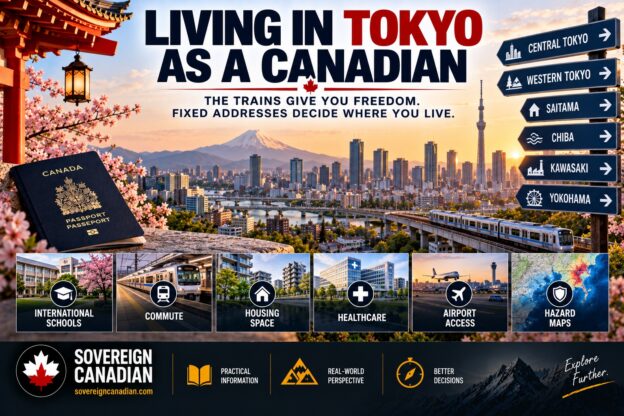
Tokyo has, by most honest measures, the most extraordinary urban railway system on earth. Someone living in a different prefecture, an hour’s drive from the Imperial Palace on a map, can step onto a platform and be standing in Marunouchi before a typical Torontonian has cleared the Don Valley Parkway. A Canadian moving to Greater Tokyo could, in principle, live in Kanagawa, Saitama or Chiba and still reach central Tokyo faster than they reached their own downtown back home.
That fact creates a seductive impression. If the trains are that good, does it even matter where you actually live?
I expected the answer to look something like the one that worked for Kansai: pick your railway line, not your city, and let the region’s transit redundancy do the rest of the work. Osaka, Kobe, Kyoto and Nara turned out to function as one interconnected living region, and the useful question there was which station you woke up next to, not which municipality’s name appeared on your lease.
Greater Tokyo does not work that way, and the reason is more interesting than “it’s just bigger.”
The Tokyo Map Lies to You, Just Not About Distance
Here is the finding that reshaped this whole article. Headline commute times across Greater Tokyo are often startlingly short, shorter than most newcomers expect and, in several cases, shorter than the equivalent trip across a single Canadian city. Shin-Urayasu, on the JR Keiyo Line, reaches Tokyo Station directly in under twenty minutes on fast services. Kawasaki to Tokyo Station can run in roughly the twenty-minute range. Musashi-Kosugi reaches Shibuya in roughly the mid-teens and Yokohama even faster. Kichijoji reaches Shibuya in roughly the same territory on the Keio Inokashira Line. Even Yokohama, a genuinely different city with its own downtown, can sit within roughly half an hour of major central-Tokyo stations depending on the line and destination.
Put those numbers next to each other and something strange happens: the “outer” locations and the “inner” ones start to blur together. If Shin-Urayasu is under twenty minutes away and parts of Yokohama are within a similar commuting universe, distance alone stops being a useful sorting variable.
That is the opposite of what made Kansai’s “choose your railway line” thesis work. Osaka, Kobe, Kyoto and Nara are distinct cities whose rail connections let you treat a surprisingly large part of the region as one practical living system.
Greater Tokyo’s transit network is bigger, faster and more redundant, but that scale doesn’t make the region more interchangeable. It makes raw distance a weaker discriminator, because once you’re inside a reasonable commuting radius, the differences in train time between your options can be smaller than the differences in what actually waits for you at either end of the ride.
That is the real thesis of this article, and I want to state it plainly before we go anywhere else: Greater Tokyo’s rail network gives you extraordinary geographic freedom, right up until something in your life has a fixed address.
A child’s school has a fixed address. An office does, most of the time. A hospital you’ll depend on as you age has one. An airport does.
If nothing in your household has a fixed address yet, because you’re single, a couple without kids, financially independent, or working remotely for people who don’t care which side of the Pacific you’re on, then Greater Tokyo genuinely does open up into something close to the freedom the railway map implies.
But the moment one fixed point enters the picture, the useful map for your household collapses around it, often much more sharply than the transit numbers alone would suggest.
Consider two homes, both a genuine thirty-minute train ride from central Tokyo. One sits inside the realistic bus catchment of the international school your child needs. The other doesn’t. On a transit map, those two homes are equivalent. In practice, they are not remotely the same decision, and no amount of railway redundancy closes that gap.
The same principle applies, in weaker or stronger form, to offices, airports and hospitals, and it’s the thread running through everything that follows.
Greater Tokyo Is Not One Housing Market, and It Isn’t Six Either
Before going further, it’s worth being honest about scale. “Tokyo” in casual conversation usually means Shibuya, Shinjuku, Minato and a handful of famous wards. Greater Tokyo is something else entirely: the twenty-three central wards, the western half of Tokyo Metropolis stretching toward the mountains, Yokohama and Kawasaki in Kanagawa Prefecture, Saitama City to the north, and the Chiba side of Tokyo Bay to the east.
Treating all of that as one undifferentiated “Tokyo area” is how a lot of English-language relocation content goes wrong.
For the rest of this article, I’m working with six practical groupings, chosen because the evidence supports treating them differently, not because they’re administratively neat.
Central and southwest Tokyo covers Minato, Shibuya, Meguro, Shinagawa, Setagaya and the residential wards around them: the default “Tokyo” of the brochures and the deepest concentration of international schooling and English-language services.
Close western Tokyo means Kichijoji, Musashino and Mitaka: dense, established, genuinely desirable, and much closer to the centre than their reputation as “the suburbs” suggests. Outer western Tokyo means places like Machida and Tachikawa, where the character, price and daily rhythm of life start to look meaningfully different from anything inside the Yamanote Line.
Yokohama gets treated as its own thing because the evidence says it deserves to be: Japan’s second-largest municipality, with roughly 3.75 million residents, its own employment base and its own international-school cluster, not a Tokyo suburb with a nicer waterfront.
Kawasaki sits between Tokyo and Yokohama, and I’m going to insist on splitting it in two: Musashi-Kosugi, which has become something quite different from what its reputation suggests, and the rest of the city, which may still be closer to what people expect Kawasaki to be.
Saitama and Chiba get split further still: Omiya versus Urawa in Saitama, and Urayasu, Ichikawa, Funabashi and Makuhari as distinct propositions in Chiba, not one homogeneous “east of Tokyo” story.
Here is a compact orientation to how those groupings compare on the factors that actually seem to drive the decision. Treat this as a starting map, not a scorecard. Nobody wins across every row, and that’s the point.
| Factor | Central/SW Tokyo | Close Western Tokyo | Outer Western Tokyo | Yokohama | Kawasaki | Saitama | Chiba side |
|---|---|---|---|---|---|---|---|
| Housing cost | Highest | Higher than its reputation suggests | Genuinely more affordable | Moderate | Split: premium at Musashi-Kosugi, softer elsewhere | Moderate | Moderate |
| Housing space | Smallest for the money | Reasonable | Better value for family space | Reasonable | Reasonable outside the towers | Good | Good |
| Commute to central Tokyo | Shortest by definition | Very fast from the best-connected stations | Meaningfully longer | Fast from well-connected nodes | Excellent from Kawasaki and Musashi-Kosugi | Longer but very workable | Surprisingly fast from some corridors |
| Western-style international schools | Deepest concentration | Some important options within wider western Tokyo | Thin | Real second cluster | Thin | Very limited; one notable bilingual public option | Limited; some elementary options |
| Healthcare depth | Deepest | Thin locally, close to the centre | Thinner locally | Real major-hospital depth | Strong regional access | Major hospitals exist, less international-service depth | Major hospitals exist, less international-service depth |
| Career depth | Deepest across most sectors | Mostly a residential choice | Mostly a residential choice | Strong in auto, engineering, tech, logistics and regional finance | Industrial, technology and logistics | More commuter-oriented | More commuter-oriented |
| Airport access | Strong overall | Reasonable | More variable | Excellent to Haneda | Excellent to Haneda | Weaker to either airport | Varies considerably by corridor |
| Car necessity | Unnecessary | Optional | Increasingly useful | Unnecessary centrally | Optional | Increasingly useful for family life | Increasingly useful |
That table is the map. Everything else in this article is an explanation of why it looks the way it does, and where it hides more nuance than a single row can carry.
The School Map Is the Clearest Proof of the Whole Problem
If you want to see the fixed-constraint thesis in its purest form, look at where Greater Tokyo’s international schools actually are.
Not “Tokyo has good international schools,” which is true but useless. I mean the specific geography.
The American School in Japan’s main campus sits in Chofu, in western Tokyo, with its Early Learning Center in Roppongi. The British School in Tokyo splits between Azabudai Hills in Minato for younger students and its Showa campus in Setagaya for secondary students. Nishimachi International School sits in Moto-Azabu. St. Mary’s and Seisen are in Setagaya. The International School of the Sacred Heart is in Hiroo. Canadian International School Tokyo operates in the Shinagawa and Nakameguro areas.
Tokyo International School is worth flagging because older relocation guides can already be stale: for the 2026–27 academic year it completed its expansion to K–12 and moved to Takanawa Gateway City.
And central and southwest Tokyo do not have a monopoly. K. International School Tokyo, for example, is a serious K–12 English-language school in Koto-ku near Kiyosumi-Shirakawa, offering the IB Primary Years and Diploma programmes alongside IGCSE. Wider western Tokyo has other options as well.
Then Yokohama forms a genuine second cluster, including Yokohama International School and Saint Maur International School.
The useful conclusion, therefore, is not that every international-school family must live in one narrow strip of southwest Tokyo. The map is more distributed than that.
The useful conclusion is stronger: once you choose a specific school, that school becomes one of the most important pieces of geography in your household.
A family using ASIJ in Chofu faces a different housing map from one using K. International in Koto, the British School in Azabudai or Showa, Canadian International School in Shinagawa, or YIS in Yokohama. Two apartments with identical commutes to Marunouchi can be completely different propositions once a school run is added.
That is the fixed-address thesis in its clearest form.
School buses can widen the practical catchment, sometimes substantially, but routes change and are school-specific. Before signing a lease, confirm the actual bus route or realistic door-to-door journey from the specific address you are considering. A twenty-minute train journey to an office does not compensate for an impractical twice-daily school run.
For a family, the school comes before the apartment.
Get Chiba’s School Story Right, Because the Internet Gets It Wrong
Urayasu, in particular, sometimes gets treated as an important international-family hub. That needs qualification.
There is no full-continuum Western international school called “Urayasu International School.” What does exist is the Shin-Urayasu campus of Chuo International School, offering an elementary programme for Grades 1 through 6 built around a Montessori-influenced approach and Cambridge framework.
Separately, Makuhari International School runs through Grade 6 and follows Japanese curriculum objectives, with most subjects taught in English. It is a real international education option, but it is not a K–12 Western-curriculum substitute for schools such as ASIJ, KIST or YIS.
There’s a genuinely useful naming trap worth flagging too. Two unrelated schools can appear under the initials “CIS” in Tokyo-area research: Canadian International School Tokyo and Chuo International School. If a source mentions “CIS,” check which one it actually means before building a plan around it.
The honest read on the Chiba side, then, is that schooling options exist, particularly for younger children, but the full-continuum international-school depth found elsewhere in Greater Tokyo does not.
If your household needs a specific English-medium secondary curriculum, choose the school first and work backward from there.
The School Constraint Changes With the Child’s Age, and That Changes Everything
One nuance the national Japan article already covers, and worth repeating specifically for the regional decision: the schooling constraint is not identical for every family.
A six-year-old starting Japanese public school has a very different set of realistic options from a fourteen-year-old arriving with no Japanese.
That widens the map for a young family enormously, and it’s the reason Saitama, Chiba and outer western Tokyo can genuinely open up for households comfortable with Japanese public education.
By the time a child is ten to fourteen and needs English-medium instruction, the map may narrow around whichever international school fits the child’s curriculum and admissions requirements. By seventeen, curriculum continuity and university-track requirements narrow it further still, and the practical list of schools able to absorb a new student late in secondary school may be shorter than a simple school directory suggests.
If you’re weighing this with a specific child in mind rather than an abstract “family with kids,” it’s worth reading The Expat Year with Kids alongside this section, because the age question there and the geography question here are really the same decision viewed from two angles.
Central Tokyo: What Is the Premium Actually Buying?
Once you accept that several of the region’s strongest fixed constraints concentrate in and around central Tokyo, its price premium starts to look less like a lifestyle tax and more like a specific, purchasable bundle.
So what does paying for Minato, Shibuya or the inner wards actually get you?
The honest list is unusually deep access to international schooling, shorter commutes to a huge share of the region’s white-collar employment, the deepest concentration of English-accessible everyday services, excellent public transport, strong access to Haneda and workable access to Narita, and direct proximity to Tokyo’s enormous market in finance, consulting, technology and multinational corporate work.
Central Tokyo’s sheer scale also means that living in Tokyo is not synonymous with living in Shibuya Crossing. Tourist pressure is intense in particular districts, but enormous areas of the central wards remain overwhelmingly residential.
None of that is a knock on central Tokyo. It’s a genuinely strong bundle, if you’re using it.
The uncomfortable flip side: if your household doesn’t need the international school, doesn’t need the office a fifteen-minute walk away, and doesn’t lean heavily on English-language services because you or your partner has real Japanese, how much of that bundle are you actually consuming?
For plenty of households the honest answer is still “most of it.”
But it’s worth asking before defaulting to Minato because it’s the name every guidebook uses.
Housing: The Premium Is Real, But the Story Is More Complicated Than It Looks
This is where I want to be careful, because the easy version of this section writes itself with a single scary number, and the easy version would be misleading.
SUUMO, Japan’s largest property-listing platforms, shows just how wide the market can be even inside one ward. Current 3LDK listings in Minato span from roughly the ¥300,000 range into ¥500,000-plus territory, with luxury towers and unusually large units going dramatically higher.
That range is more useful than pretending there is one meaningful “Minato rent.”
The same problem applies across Greater Tokyo. A brand-new tower beside a major suburban station can cost more than an older apartment closer to central Tokyo. Musashi-Kosugi is the obvious example: redevelopment and exceptional rail connectivity have pushed its newest tower inventory into pricing that no longer resembles a conventional discount suburb.
The real space-and-cost advantage of moving outward shows up most clearly when you compare ordinary housing of similar age and quality, not when you compare a thirty-year-old apartment in Setagaya with a brand-new tower in Saitama.
That distinction matters for a Canadian house-hunting online because the newest, glossiest inventory is disproportionately easy to find from abroad. You can move forty minutes outward and wonder why the savings look disappointing, when what you have actually done is replace location premium with new-construction premium.
Once you broaden the search into ordinary housing stock, western Tokyo, Saitama and parts of Chiba generally give you substantially more space for the money than the most expensive central wards.
The exact spread changes constantly. Treat any rent in this article as a snapshot, not a quote.
For the mechanics of Japanese leases, deposits, key money and the broader ownership question, Japan Real Estate for Canadians covers that ground properly. This section is deliberately about living somewhere, not investing in it.
Kichijoji and Mitaka: Close Enough That “Suburb” Is the Wrong Word
Kichijoji and neighbouring Mitaka get filed, by a lot of English-language content, under “affordable Tokyo suburbs.”
I don’t think that’s the right frame.
Kichijoji can reach Shibuya in roughly the mid-teens on fast Keio Inokashira services, and the area is desirable on its own merits: leafy, walkable, anchored by Inokashira Park, with enough retail and restaurant life that people travel there rather than merely commute out of it.
Housing there is not the bargain the “suburb” label implies.
For a family, the honest pitch is more space and quieter streets than the most central wards without giving up a genuinely fast connection to the city. It is also geographically much closer to ASIJ’s Chofu campus than most central-Tokyo locations, although that does not automatically mean a particular apartment is on a workable school-bus route.
That last distinction is the entire thesis of this article in miniature: geographical closeness helps, but the actual fixed destination still decides whether the address works.
Machida and Tachikawa: Where Moving Outward Actually Changes Something
If Kichijoji shows you that “further out” doesn’t automatically mean “cheap,” Machida and Tachikawa show you where the outward move genuinely starts to change the housing proposition.
Commuting into the central wards becomes meaningfully longer, but the housing market also starts offering more space and more conventional family inventory for the money.
The daily rhythm changes with it. These are not central-Tokyo neighbourhoods wearing suburban clothing. They are substantial cities within Tokyo Metropolis where ordinary life can be more locally oriented and where central Tokyo becomes somewhere you commute to or visit rather than the place every errand runs through.
This is also where a car starts to earn its keep.
Neither city requires one, but the calculation tips meaningfully compared with the close-in band, particularly for a family running the ordinary weekly grocery, sports and errand circuit rather than living entirely along one rail line.
The key question is the same as everywhere else: what are you travelling to every day?
If the answer is a central-Tokyo office and an international school in Minato, the extra space may not compensate for the logistics. If the household works remotely and uses Japanese public schools, the calculation can reverse completely.
Yokohama: The One Place That Isn’t Really a Tokyo Suburb
Yokohama deserves more space than a paragraph in someone else’s article about Tokyo, and the evidence supports treating it as its own proposition rather than a satellite.
As of September 2026, Yokohama has roughly 3.76 million residents. It has a real economic base independent of Tokyo, including major automotive, engineering, technology, logistics and regional-finance employers. It has its own international-school cluster, including Yokohama International School and Saint Maur International School, rather than merely functioning as overflow for Tokyo schools.
It also has major teaching and specialist hospitals, a huge commercial centre of its own and excellent access to Haneda.
So: could a Canadian with no daily obligation in Tokyo build a complete life in Yokohama without treating Tokyo as the centre of it?
For a meaningful range of households, yes.
The clearest case is a professional whose actual career sits inside Yokohama’s own economy, automotive, engineering, technology, logistics or related sectors, rather than someone who simply likes the idea of a city with its own waterfront.
The important caveat is that Tokyo remains substantially deeper for generalist finance, consulting and multinational-headquarters work. Yokohama does not need to match Tokyo on those things to function independently, but a household tied to one of those sectors may still find Tokyo itself is the fixed address that matters.
I’d also resist the comparison some people reach for automatically, calling Yokohama “Tokyo’s Kobe.” Both are major port cities beside larger metropolitan centres, but the underlying relationship is different enough that forcing the parallel obscures more than it explains.
Yokohama should be evaluated as Yokohama.
Kawasaki: Musashi-Kosugi Is Not Kawasaki
The natural assumption is that Kawasaki generally, and Musashi-Kosugi specifically, should be the practical, undersold alternative: good access to both Tokyo and Yokohama, close to Haneda, without the prestige tax of a famous address.
Musashi-Kosugi doesn’t fit that story anymore.
Its rail connectivity is genuinely exceptional, and large-scale high-rise redevelopment has transformed the area into a premium commuter node. New tower inventory can price surprisingly close to desirable Tokyo neighbourhoods rather than undercutting them.
That doesn’t make Musashi-Kosugi a bad choice. It means the reason to choose it is function, not bargain pricing.
The rest of Kawasaki is a different proposition. Kawasaki Station itself offers extremely strong access to both Tokyo and Yokohama and excellent positioning for Haneda. The likely value proposition is therefore strongest outside the most aggressively redeveloped nodes, although building-by-building pricing matters too much to reduce the whole city to one number.
International schooling is the more obvious limitation. Kawasaki does not have the depth of international-school options found in Tokyo proper or Yokohama, so a family requiring a particular international curriculum needs to model the school journey explicitly.
Again, the fixed address wins.
Saitama: Omiya and Urawa Are Not the Same Proposition
Saitama City is a 2001 merger of several formerly separate municipalities, and treating Omiya and Urawa as interchangeable “wards of Saitama” undersells how different their roles are.
Omiya is the transit and commercial hub.
It’s a genuine Shinkansen station, with major northern Shinkansen services converging alongside the ordinary commuter network, and that gives it a domestic-travel advantage almost nowhere else in this comparison can match. It has a real commercial centre rather than functioning purely as a bedroom community.
Urawa is more residential in character and functions differently despite sitting inside the same municipality.
Both can make sense for a household willing to accept a longer commute in exchange for more housing choice, but the household that regularly travels north through Japan may value Omiya in a way a household whose entire life points south toward Tokyo never will.
Saitama City is also home to something that doesn’t fit neatly into “international school” or conventional public school.
Saitama Municipal Omiya International Secondary School is a public school offering both the IB Middle Years and Diploma Programmes, with English and Japanese among its instructional languages. The current Saitama City fee schedule lists upper-secondary tuition at ¥118,800 per year; the lower-secondary stage is part of the public system and is treated differently.
That needs to be understood correctly. It is not ASIJ transplanted to Saitama, and it is not a plug-and-play international school for a newly arrived Canadian teenager with no Japanese.
It is, however, a genuinely interesting option for a bilingual or integration-minded household planning a longer horizon in Japan, and dismissing Saitama simply because it lacks a conventional expat-school cluster misses that nuance.
Chiba: Stop Treating It As One Place, Because It Isn’t
Several different propositions live under the “Chiba side” label, and lumping them together is where casual coverage goes wrong.
Urayasu and Shin-Urayasu are two different stations on two different railway lines, a few kilometres apart, and worth keeping straight.
Shin-Urayasu sits on the JR Keiyo Line and offers very fast direct service toward Tokyo Station. Urayasu Station sits on the Tokyo Metro Tozai Line and offers similarly strong access toward Otemachi and central Tokyo.
A family comparing listings near one should not assume they’re getting the other’s railway line.
That speed also explains why Urayasu does not always deliver the discount people expect from the words “Chiba Prefecture.” Excellent access to central Tokyo has value, and the housing market knows it.
Combine that with the limited full-continuum international-school infrastructure described earlier and Urayasu’s documented liquefaction history from the 2011 Tohoku earthquake, and the honest proposition is fast access to central Tokyo, not “cheap Chiba” and not a hidden international-school hub.
Its location on the Chiba side can also be useful for Narita depending on the exact address and mode of transport, but don’t confuse geography with a direct rail link: neither the Keiyo Line nor the Tozai Line simply carries you to Narita Airport. Airport access needs to be checked from the actual station, just like everything else.
Ichikawa and Funabashi are closer to what most people picture when they hear “Chiba commuter city”: substantial residential markets with good Tokyo access and, in many cases, a clearer housing-value proposition.
Makuhari is something else again: a planned business and residential district with its own character and Makuhari International School’s elementary programme.
None of these places should be reduced to “Chiba.”
The railway line, the school and the actual destination matter far more than the prefecture written on the address.
Healthcare: Tokyo’s Advantage Runs Further Into the Region Than You Might Expect
Healthcare gets muddled because three different questions are often treated as though they are the same thing.
The first is medical quality and specialist depth. Major hospitals across Greater Tokyo can provide very high-level care.
The second is a hospital’s capability to receive international patients specifically: formal international-patient departments, coordinators, multilingual administration and systems built around overseas patients.
The third, and the one that matters most for ordinary life, is English-accessible primary care: a family doctor, pediatrician, routine referral or specialist appointment that you can navigate without turning every minor medical problem into a logistical project.
Those are different things.
One useful indicator for the second category is Japan International Hospitals, a programme run by Medical Excellence JAPAN that identifies hospitals with systems for accepting international patients. It is useful, but it should not be mistaken for a generic ranking of hospital quality or a directory of neighbourhood clinics.
The regional finding that matters is that internationally oriented major-hospital infrastructure does exist beyond Tokyo’s twenty-three wards. Kanagawa, Saitama and Chiba are not medical hinterlands.
Central Tokyo still has the deepest concentration of international-facing medical services, but moving to Yokohama or a major suburban centre does not mean leaving high-level medicine behind.
What this research does not establish cleanly is the density of ordinary English-speaking primary care in every suburban municipality.
That distinction matters more day to day than a list of famous hospitals. If English-language healthcare is a fixed requirement for your household, I would map the actual clinics and specialists you expect to use before choosing the apartment, exactly the same way I would map the school.
Aging in Greater Tokyo: The Map Narrows Again, For a Different Reason
The fixed-constraint thesis has a nice symmetry once you follow a household through a full life rather than a single snapshot.
At thirty-five, with no children, the map can be enormous.
Add school-age children needing a particular international curriculum, and it collapses around a school.
Once those children are grown, the map has room to reopen.
Moving into the seventies and eighties, it narrows again for an entirely different reason: healthcare, accessible housing, walkability, elevators, grocery access and everyday service density start doing the work the school did decades earlier.
At sixty-five, a healthy financially independent household can plausibly make many parts of Greater Tokyo work.
At seventy-five, the practical distance to specialist care and the amount of daily life that can be done without a car or complicated transfers matter more.
At eighty-five, I would stop choosing at the ward or city level almost entirely.
I would choose a specific accessible building, on a manageable piece of terrain, within a short and simple journey of the healthcare I expected to use, with groceries and ordinary services close enough to reach even if mobility deteriorated.
That could describe parts of central Tokyo. It could describe parts of Yokohama. It could also describe a carefully chosen suburban station centre better than an inconvenient address in a famous ward.
This is where hazard geography matters too. Higher ground may reduce certain flood or liquefaction risks, but Tokyo’s plateau areas are not universally flat, and some desirable neighbourhoods are surprisingly hilly. Yokohama is even more obviously mixed, with flat waterfront districts, hills and reclaimed areas creating very different accessibility and hazard profiles within the same city.
For an eighty-five-year-old, the address matters more than the brand name.
One honest gap is worth naming: this article does not attempt a dedicated comparison of home-care networks, geriatric specialists or elder-care facilities by municipality. Detailed late-life planning would require that additional work.
Airports: A Genuine Tokyo Advantage Over Kansai
This is one of the clearest advantages Greater Tokyo has over the Kansai comparison.
Air Canada’s own Tokyo network information describes year-round nonstop service between Haneda and Toronto, Narita and Vancouver, and Narita and Montreal.
For a Canadian household, that’s not a minor detail.
It means airport geography can genuinely influence where in the region it makes sense to live.
Haneda strongly favours the southern side of Greater Tokyo. Shinagawa, Kawasaki and Yokohama are particularly well positioned, and a Toronto traveller using the Haneda nonstop has a different airport map from a Vancouver or Montreal traveller using Narita.
Narita naturally favours parts of eastern Greater Tokyo, but this needs the same station-by-station discipline as everything else. “Lives in Chiba” does not automatically mean “easy Narita trip,” and some central-Tokyo neighbourhoods with direct airport services can be easier than a poorly connected Chiba address.
Central Tokyo remains reasonably positioned for both airports.
The larger point is the important one: unlike Kansai, where direct Canadian connectivity is thinner and more seasonal, Greater Tokyo gives a Canadian household multiple year-round nonstop links home.
That is a genuine structural advantage.
Cars and Summer: The Ordinary Friction of Living There
Two shorter points, because neither needs much space to say something true.
On cars: nobody in this comparison needs one in the way rural Japan does. Central Tokyo and central Yokohama genuinely don’t need a car. Kichijoji, Mitaka and central Kawasaki sit in an optional middle ground. Outer western Tokyo, Saitama and parts of Chiba tip further toward useful, particularly once a family’s errands stop following a single train line.
“Useful” is still a long way from “necessary.”
On summer, I want to be disciplined rather than manufacture a tidy ranking out of tiny temperature differences.
Central Tokyo’s urban heat-island effect and hot, humid nights are real. Inland Saitama can produce more extreme daytime heat. Coastal areas can receive some moderation, but coastal does not mean comfortable, particularly overnight.
The one conclusion worth stating plainly: nowhere in this comparison is a Canadian escaping a Japanese summer.
Natural Hazards: The Address Matters More Than the Ward Name
The national Japan article already covers earthquake and typhoon risk at the country level, so I won’t repeat it here.
What’s worth adding regionally is how much micro-location, not city choice, drives the actual risk picture.
Tokyo’s geography broadly divides between higher terrace and plateau areas and the lower ground toward the east and the bay. Flooding and liquefaction exposure can change substantially over surprisingly short distances, which is why Tokyo maintains detailed hazard and liquefaction mapping rather than a simple list of “safe wards.”
The Tokyo Metropolitan Government updated its liquefaction potential map again in March 2026, and its own warning is important: the map indicates relative potential, not a guarantee that a particular property will or will not liquefy.
Two examples show why broad neighbourhood reputations aren’t enough.
Setagaya is routinely recommended as a family-friendly western ward, but parts of it sit along the Tama River and were affected during the extreme water levels associated with Typhoon Hagibis in 2019.
Urayasu, meanwhile, suffered substantial liquefaction effects during the 2011 Tohoku earthquake. The city is still dealing with land-boundary issues created by that event.
Neither fact means “don’t live there.”
It means “Setagaya” and “Urayasu” are still too large to be the unit of analysis.
Once you’ve chosen a station and general area, check the exact address against the relevant municipal flood, liquefaction and landslide maps before signing anything, the same discipline Japan Real Estate for Canadians recommends for anyone buying rather than renting.
Tokyo’s International Bubble: An Honest, Cautious Note
One idea is worth raising, then immediately hedging properly because the evidence doesn’t support more than that.
It’s plausible that Tokyo’s sheer scale and depth of international services make it one of the easiest places in Japan to function without much Japanese, and that this same ease may reduce the everyday pressure to actually learn the language.
That fits the general pattern the national Japan article establishes about the difference between functioning in Japan and integrating into it.
What I don’t have is direct evidence that this produces worse social integration in Tokyo specifically than elsewhere.
File this under an interesting, plausible idea rather than a finding, and see the fuller language and integration discussion in Living in Japan as a Canadian, since nothing here changes that article’s core conclusion.
The Flag Theory View
I’ve written before about how Flag Theory breaks a country decision into separate, independently optimizable pieces rather than expecting one place to win on every dimension simultaneously.
Greater Tokyo illustrates why that framing matters, because it resists a single verdict.
A specific corner of the region can function as a temporary residence flag for a defined expat chapter, a career flag for someone whose work sits in Marunouchi or Yokohama’s own economy, an education flag for a family using one of the schools mapped out above, a lifestyle base for a remote worker with no fixed point at all, or, for the smaller number of households whose immigration pathway supports it, a long-term residence base.
None of that requires deciding, on day one, between “Tokyo forever” and “Tokyo never.”
A few years for a specific career opportunity, a defined expat year built around a child’s schooling, a longer remote-work chapter, or a later-life return once immigration status and healthcare needs are settled can each justify a genuinely different answer to “where in Greater Tokyo.”
The region’s real advantage, once you stop looking for one winning neighbourhood, is how much optionality it offers a household willing to treat the decision as a sequence rather than a single choice.
What I’d Actually Do
Not a single winner.
The fixed-constraint thesis, applied honestly, produces a different answer for nearly every household, and pretending otherwise would undo the point of this article.
- Thirty to forty, no children, career-focused. Start with the office, not the neighbourhood’s reputation. If the work genuinely requires central Tokyo’s deepest generalist market, central Tokyo earns its premium. If the actual job sits inside Yokohama’s own economy, living there instead of commuting from a “more famous” Tokyo address may make far more sense.
- Young children, Japanese public school genuinely acceptable to the family. This is one of the widest maps available to a household with kids. Saitama, Chiba and outer western Tokyo all become real options, and the space and cost advantages start to matter more than proximity to an international-school cluster the family doesn’t need.
- School-age children requiring international schooling. Start with the specific school. Not “international schools in Tokyo.” The actual school. ASIJ creates one housing map. KIST creates another. The British School creates another. A Yokohama school creates another. Pick the home only after confirming the school journey or bus route from the address you’re considering.
- Remote worker or financially independent household with no fixed daily destination. This may be the most interesting profile here because it’s the one conventional relocation coverage serves worst. With nothing pinning the household to a specific address, the optimization can genuinely shift toward space, character, greenery, airport access and cost. Kichijoji, Mitaka and Yokohama are particularly credible places to investigate, but this is also the household for whom Saitama or Chiba can make sense on their own terms rather than as compromises.
- Established professional or business owner, fifty to sixty-five. Follow the actual business geography, with more room to trade commute time for space if the work allows it.
- Financially independent retiree, sixty-five to seventy-five, immigration status already settled. Central Tokyo and Yokohama both remain credible, but so can carefully selected suburban nodes. At this age I would start paying more attention to the specific hospital, building and terrain rather than simply choosing the city.
- Seventy-five and beyond. Healthcare access, accessible housing, elevators, terrain, walkability and everyday service density should increasingly dominate the decision. Choose the address that still works if walking gets harder, not the neighbourhood that looks best while you’re healthy.
Conclusion: The Map Expands and Contracts as Your Life Does
Stare at Greater Tokyo’s railway map for long enough and it starts to look almost infinitely flexible.
In one real sense, it is.
You genuinely can live in a different prefecture and reach central Tokyo faster than many Canadians reach their own downtown, which alone should retire the lazy “how many minutes from Shibuya” framing that passes for Tokyo advice online.
But the railway map isn’t the life map.
A school has a fixed address.
An office usually does.
A hospital you’ll depend on eventually does.
An airport does.
The moment one of those enters your household’s actual life, the useful version of Greater Tokyo collapses around it, often far more sharply than the headline transit times would predict.
And if none of those things has a fixed address yet, if you’re the remote worker, the financially independent couple, the household between chapters, Greater Tokyo hands you something genuinely rarer than a good neighbourhood: real freedom to choose on your own terms, in a region most newcomers never realize is that flexible.
The right place to live in Greater Tokyo isn’t determined by how close it is to Tokyo.
It’s determined by what in your life can’t move.
Everything else in this article is just the evidence for that one idea.
This article is general information for Canadians researching a move abroad, not legal, immigration, tax, financial, medical or real estate advice. Rents, school admissions, flight schedules, hospital accreditation and hazard designations all change, and several figures here reflect a specific point in 2025 and 2026 that should be verified again before you rely on them. Confirm anything material to your own decision directly with the relevant school, hospital, airline or municipal government, and with a qualified professional where your own money, visa status or family is involved.