
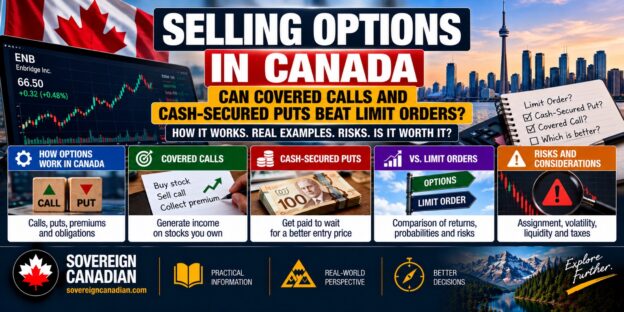
General information, not tax, legal or investment advice. Option examples use quotes observed on October 19, 2026 and are historical observations, not current prices.
You have been watching Enbridge for months. It is a business you understand and would happily own, but you think it is a few dollars too expensive. So you do what disciplined investors do: you decide on a price and place a limit order to buy below the market.
Then someone suggests a smarter way. Instead of waiting with a limit order, sell a cash-secured put at that same price and collect a premium while you wait. It sounds like getting paid for patience.
The honest question is not whether selling options generates cash. It does. The question is whether selling options in Canada improves the outcome compared with the limit order you were going to place anyway, or whether it simply swaps one set of risks for another.
The short answer: for most long-term investors, buying quality businesses and using ordinary limit orders remains the better default. Options can occasionally substitute for a planned purchase or sale, but they are not free income, and after costs and taxes the extra benefit is small and sometimes negative. Here is the evidence.
Options explained without the jargon
An option is a contract that gives its buyer a right, and gives its seller an obligation. That asymmetry is the whole story, so it is worth being precise.
A call gives the buyer the right to buy 100 shares at a fixed price (the strike) on or before a set date (the expiration). A put gives the buyer the right to sell 100 shares at the strike. The buyer pays the seller a premium for that right. Standard contracts cover 100 shares, so a premium quoted at 0.45 per share is 45 per contract in total.
The seller receives the premium upfront, but that does not guarantee a profit. Assignment losses or the cost of closing the position can exceed the premium collected. In return, the seller must be ready to perform if the buyer exercises. When that happens, the seller is assigned: a put seller must buy the shares at the strike, and a call seller must sell the shares at the strike.
| Position | You receive or pay | What you can be forced to do |
|---|---|---|
| Buy a call | Pay a premium | Nothing. You choose whether to buy shares at the strike |
| Sell a call | Receive a premium | Sell 100 shares at the strike if assigned |
| Buy a put | Pay a premium | Nothing. You choose whether to sell shares at the strike |
| Sell a put | Receive a premium | Buy 100 shares at the strike if assigned |
This article is about the two seller positions: selling puts and selling calls. A cash-secured put means you hold enough cash to buy the shares if assigned (the strike times 100). A covered call means you own the 100 shares you might have to deliver.
Cash-secured puts: getting paid to wait?
Here is a real-world illustration. On October 19, 2026, US-listed Enbridge (ENB) options for the November 20, 2026 expiration, about 32 days out, showed the following in Cboe’s delayed data. These are historical observations of US-listed contracts quoted in US dollars. They are not current prices and not Canadian-listed contracts, and nobody should treat them as an executable quote.
| Item | ENB November 20 put, strike 45 |
|---|---|
| Bid / ask | 0.45 / 0.55 USD per share |
| Premium at the bid, one contract | 45 USD |
| Cash needed to secure the put | 4,500 USD |
| Premium as a share of that cash | about 1.0% over 32 days |
| Open interest / volume | 1,220 / 45 |
The share price was not reported in the chain data. Put-call parity implies roughly 47 USD, but that is an estimate, so treat “about 5% below the market” as approximate.
Now compare two ways of pursuing the same plan: buy ENB at 45. Option A is to sell the 45 put at the bid. Option B is to place a good-till-cancelled limit order to buy at 45 and keep the cash.
Three outcomes
The stock stays above 45. The put expires without assignment, and you keep the 45 USD premium. The limit order never fills and you earn nothing from it. Here the put clearly did better, but notice what you did not do: you did not buy the business you said you wanted.
The stock falls well below 45 and stays there. The put is assigned and you buy 100 shares at 45, with an effective cost of 44.55 after the premium. The limit order also fills at 45. The put seller is ahead by the premium, but both of you own a stock that is now worth less than you paid. The premium offsets a small slice of the loss, not the loss itself. If the stock closes at 38, the put seller is down 6.55 per share and the limit-order buyer is down 7.00.
The stock dips to 45 and then recovers. This is the case that matters most. The price touches 45 during the month, your limit order fills, and the stock then climbs back to 46.50 by expiration. The limit buyer owns shares and is up 1.50 per share. The put expires unassigned, so the put seller keeps only the 0.45 premium and never owns the stock.
The put pays you a modest, certain amount in exchange for forgoing those temporary-dip fills.
In a simulation calibrated to the quoted volatility and the dividend carry implied by the chain (a hypothetical model, not a forecast), the share price finished below 45 about 28% of the time, so the put was assigned about 28% of the time. But the price touched 45 at some point about 46% of the time, which is when the limit order fills. In roughly 18% of paths the limit order filled and the stock then recovered above 45, with an average gain of about 1.36 per share that the put seller never received.
Why the premium is not free money
That 0.45 is not a gift. The model’s fair value for this put was about 0.46, essentially the bid. The market charged about what the risk was worth. A premium is compensation for accepting a potential obligation and for missing temporary-dip fills, so before your own view of the business, the expected edge over the limit order is close to zero.
Costs also bite at this size. A bank-owned broker charging a 9.95 CAD base fee plus 1.25 CAD per contract (11.20 CAD to open) would absorb roughly a fifth of a single 45 USD premium, and this put’s half-spread is about 10% of the midpoint premium. Some brokers charge much less or nothing.
Writers often annualize premiums, turning a 1.0% monthly yield into a 12% “income” figure. That assumes the same opportunity repeats every month with no assignment losses, and it treats the premium as a return rather than payment for risk. This article does not annualize premiums.
Covered calls: getting paid to sell?
The mirror-image case is the call. Suppose you own 100 shares of ENB and you would be glad to sell them at 50. You could place a sell limit at 50, or you could sell the November 20 call with a 50 strike.
| Item | ENB November 20 call, strike 50 |
|---|---|
| Bid / ask | 0.20 / 0.25 USD per share |
| Premium at the bid, one contract | 20 USD |
| Shares required | 100 |
| Open interest / volume | 1,348 / 101 |
Again, these are historical observations from October 19, 2026 for a US-listed contract.
If ENB never reaches 50, the call expires and you keep both your shares and the 20 USD. The sell limit earns nothing. If ENB rises above 50 and stays there, the call is assigned and you sell at 50 plus the premium, while the limit seller receives 50. In both cases you have given up everything above 50. If ENB touches 50, the limit order sells your shares right then, and if the price then falls back, the limit seller has sold at the high while the call writer is still holding shares and keeps only 0.20.
In the simulation, the call finished in the money about 13.5% of the time, but a sell limit at 50 would have filled in about 28% of paths because it triggers on a touch. Again the call was priced near fair value (about 0.215 against a 0.20 bid), so the premium compensates for the upside you surrender.
Dividends and early assignment
Equity options can in principle be exercised early, which matters mainly for calls near an ex-dividend date. Enbridge pays a large dividend, so if a call is in the money just before that date, a buyer may exercise to capture it, and you lose both the shares and the payment. A call 5.7% out of the money is rarely at risk. In the simulation, ex-dividend assignment trimmed the covered call’s advantage only slightly, because only in-the-money calls are exposed.
Note the scale too: 20 USD is smaller than a bank-broker commission of 11.20 CAD plus the spread. For small premiums, a covered call often does not clear its own costs.
A covered call fits when you already intend to trim, the strike is a price you would gladly accept, and the shares are not a permanent core holding. The trouble comes when selling calls becomes a habit. Capping the upside on a long-term compounder month after month quietly overrides the reason you bought it, because compounders pay off through the rare big years and calls remove exactly those years. A permanent core holding should stay uncapped.
The wheel strategy
The conventional wheel is a loop. You sell a cash-secured put. If it expires worthless, you sell another. If you are assigned, you own the shares and start selling covered calls against them. If the shares are called away, you go back to selling puts. Each turn collects premium, and the strategy is popular with income-focused investors because the cash arrives regularly.
Its weaknesses are real. You own the downside in falling stocks, since the put premium is small relative to a large drop. You give up recoveries, because calls cap the rebound that usually follows a decline. Each leg has trading costs and a tax record to keep. Emphasis on premium income misleads, because premium is not return. And if implied volatility is not meaningfully higher than what the stock later delivers, the loop only collects what the risk was worth.
In the research simulation, the traditional wheel finished below buy and hold across every volatility-premium assumption tested, from deeply negative to +30%. Its result swung by more than 20,000 CAD per 100,000 CAD across plausible assumptions, which tells you how sensitive it is to something you cannot observe in advance.
A valuation-driven partial wheel is different. You write buy and sell prices from your own valuation work, use options only when the strike equals one of those prices, and only on part of the position. It is occasional, not a loop that runs because the calendar says so. The research rates it conditional, not recommended as a default.
What the research actually found
The centrepiece is a scenario simulation. I want to be clear about what that means. It is a model, run over thousands of simulated price paths in seven market regimes, not a historical backtest. It tells you how strategies behave under stated assumptions. It does not tell you what will happen.
The model was audited before this article was drafted. The original analysis reproduced exactly, and one programming error was found and fixed: interest on cash used by intra-month limit orders was being under-credited. Correcting it reduced the headline edge by about 9%.
The headline. In the base simulation, a valuation-driven partial wheel beat equivalent limit orders by about 1,345 CAD per 100,000 CAD over roughly three years. That is about 0.45% a year, a small advantage. The base case assumes implied volatility runs 15% above the volatility subsequently realized.
That assumption does the heavy lifting. The break-even is about +3%. At a zero volatility premium, the partial wheel trails limit orders by about 311 CAD.
| Scenario (simulation) | Partial wheel versus limit orders, per 100,000 CAD, about three years |
|---|---|
| Base simulation | +1,345 CAD |
| Collateral earns no interest | -283 CAD |
| Wider spreads, bank-broker fees and no collateral interest | -1,011 CAD |
| After tax, premiums treated as capital gains | +1,234 CAD |
| After tax, premiums treated as income | -674 CAD |
The tax rows are conditional modelling assumptions, not predictions of how the CRA would treat any particular investor. The point is the range: depending on characterization, the same strategy is a small plus or a small minus.
The no-collateral-interest row matters because some brokers pay nothing on part of a cash balance. Interactive Brokers Canada’s schedule, for example, credited nothing on the first 13,000 CAD as of September 21, 2026. Confirm what your broker pays inside registered accounts.
What about the volatility premium?
Whether implied volatility really exceeds realized volatility is the crux. For broad index options there is decent evidence that it does. A study hosted by Cboe found the VIX averaged about 19.3 against realized volatility of about 15.1 from 1990 to 2018, roughly a 28% premium, and a Journal of Finance study found a premium of about 19% in S&P 100 index options from 1996 to 2003. The same research found no significant premium in individual stock options.
That distinction matters, because a valuation-driven investor writes options on single companies, not on the S&P 500. I found no peer-reviewed study of volatility premiums in Canadian-listed options, so the 15% assumption should not be read as established for Canadian stocks.
Cboe’s index history gives context, not proof. The BuyWrite index (BXM) returned 8.6% annually from June 1986 to September 2026 with 10.6% volatility, against 11.2% and 15.2% for the S&P 500 total return. The PutWrite index (PUT) returned 7.2% annually from January 2007 against 11.0%. Both reduced volatility and drawdowns, and both gave up return. They are at-the-money index strategies on a full position, so they say little about occasional single-stock writing at a valuation-based price.
The bigger advantage is buying at the right price
If the options edge is small, what matters more? The simulation offers a striking answer.
I tested three sensitivity cases in which prices drift back toward the investor’s own fair-value estimate. With no predictive value in the estimate, limit orders at a discount finished about 4,149 CAD behind plain cash and 14,318 CAD behind buy and hold, because waiting for a dip meant sitting out rising markets. With a modest valuation signal, limit orders finished about 13,200 CAD ahead of cash. With a strong signal, they finished about 26,700 CAD ahead of cash.
Compare that with the options effect, which in those same cases ranged from roughly +1,800 to -1,000 CAD. The accuracy of the valuation signal moved outcomes by 17,000 to 31,000 CAD, about ten times as much.
These are sensitivity scenarios. They assume levels of valuation accuracy. They do not demonstrate that any investor actually possesses that skill, and for most people the honest assumption is somewhere between none and modest. What they do show is where the effort belongs: a sound investment thesis, a defensible valuation, sensible position sizes and patience. Optimizing premiums comes a distant second.
Canadian tax rules: where options get complicated
This is the section where confident-sounding blog posts most often go wrong, so the wording here is deliberately careful. Tax characterization is fact-dependent, and parts of it remain unsettled.
Registered accounts
CRA’s Income Tax Folio S3-F10-C1 (Qualified Investments) is the key administrative document. Paragraph 1.40 explains that writing an option does not, by itself, trigger the qualified-investment rules because the writer generally does not acquire property. Paragraph 1.41 treats covered calls more favourably than written puts or uncovered calls when considering whether a registered plan might be carrying on a business. Writing a covered call does not, by itself, establish a business, while writing puts or uncovered calls may. Paragraph 1.42 addresses borrowing restrictions, and paragraph 1.43 raises a separate concern about certain broker collateral deposits, which must be distinguished from ordinary qualified cash balances. Paragraph 1.44 discusses advantage tax in connection with certain option transactions, including non-arm’s-length arrangements and transactions that artificially shift value. Do not read this as saying every written put creates a business, and do not read it as saying cash-secured puts are automatically safe.
The ground differs between plans. For an RRSP or RRIF, subsection 146(4)(b) of the Income Tax Act taxes the trust on business income, except the portion that can reasonably be considered income from, or from the disposition of, qualified investments. It would be a mistake to assume that premiums from written options automatically fall inside that exception, and I have not found an authority confirming that they do. A TFSA has no equivalent carve-out: subsection 146.2(6) taxes business income in the trust, and the holder is jointly and severally liable under 146.2(6.1). The FHSA framework follows the same logic, but check the specific provisions.
For TFSAs, the leading case is Canadian Western Trust Company (Fareed Ahamed TFSA) v The King, 2023 TCC 17, affirmed in 2024 FCA 108. A TFSA was found to be carrying on a business of trading penny stocks: frequent, short-term trades by an investment professional spending real time on it. Options were not involved. The factors (frequency, holding period, knowledge, time spent, how speculative the securities are) are the ones to keep in mind. The case does not say how many trades are safe, and nobody can honestly give you that number.
Broker permission is a separate question. A broker allowing a strategy in a TFSA tells you its own risk rules. It does not tell you the CRA considers the activity tax-safe.
Non-registered accounts
Under section 49(1) of the Income Tax Act, granting an option is a disposition of property with an adjusted cost base of nil. For capital-account treatment, the statutory starting point is therefore the grant, subject to adjustments, so an expired written option should not be assumed to be taxable only in the year it expires. Some broker-education articles say the expiry year. Subsection 49(4) allows an amended return when an option granted in one year is exercised in a later year, so options that straddle year-end deserve a call to an accountant.
If a call you wrote is exercised, section 49(3) treats the grant and exercise as not being dispositions, and the premium is added to your proceeds on the shares. If a put you wrote is exercised, section 49(3.1) reduces your cost of the shares you buy by the premium you received. Buying back a short option to close it generally creates a gain or loss measured against the premium received. CRA’s archived IT-479R discusses this treatment in paragraphs 29 and 32, with the applicable reporting depending on whether the transactions are on capital or income account. A “roll” is a close plus a new grant. Subsection 49(5), by contrast, treats extensions and renewals of the same option specially.
The bigger question is capital versus income. CRA’s IT-479R, Transactions in Securities, is archived guidance from 1984, and I found no current folio replacing it. Paragraph 25 presumes that the gain or loss of a writer of covered options is on the same account as the underlying shares, while a writer of naked options is normally on income account (though CRA says it accepts capital treatment if applied consistently). A cash-secured put is not automatically a covered option merely because you hold the cash. The shares are not yours. So I cannot promise capital gains treatment for written puts. It depends on your facts and on how consistently you report.
Two other points. If you trade US-listed options, convert premiums and settlements to Canadian dollars using the applicable exchange rate on the transaction date. Foreign-exchange gains and losses arising from capital transactions are generally treated on capital account, while those connected with business activities may receive income treatment. And watch the superficial-loss rule when selling shares at a loss and reacquiring identical property within the surrounding 61-day period. Writing a put does not, by itself, establish that you have acquired the shares or a right to acquire them, but subsequent assignment and repurchases can create complications. Check the specific circumstances before claiming a capital loss.
Which Canadian brokers allow these strategies?
Brokers differ, and their documentation does not always agree. In the table below, “Confirmed” means the broker’s own pages say so. “Not listed” means the broker’s published list of registered-account strategies omits it, which is not proof of prohibition. Confirm with your broker for your specific account.
| Broker | Covered calls in TFSA or RRSP | Cash-secured puts in TFSA or RRSP | Commission | Interest on collateral | USD or FX cost |
|---|---|---|---|---|---|
| Interactive Brokers Canada | Confirmed (also FHSA) | Not listed | US: 0.25 to 0.65 USD per contract, 1.00 USD minimum; Canadian: 1.25 CAD, 1.50 CAD minimum | Nothing on first 13,000 CAD or 10,000 USD, then tiered; registered accounts not addressed | Not found |
| Wealthsimple | Confirmed | Confirmed in TFSA and RRSP (must be cash-secured); FHSA and LIRA per Feb 2026 product news | 0 commission | Not stated | Not stated |
| RBC Direct Investing | Confirmed | Not listed (“naked puts with special exception”) | 9.95 CAD plus 1.25 CAD per contract | Not stated | Not stated |
| Scotia iTRADE | Confirmed (long options and covered calls only) | Not listed | Published schedule dated 2018, outdated | Not stated | Bank spread, unspecified |
| BMO InvestorLine | Confirmed in RRSP; uncovered puts and calls prohibited | Not listed | 0.90 CAD per contract | Not stated | Wide spread on small USD trades |
| Questrade | Confirmed up to Level 2 | Confirmed in a guide dated November 20, 2025 (TFSA, RRSP, FHSA); the overview page omits it | “0” on most contracts; Canadian options not verified | Not stated | Not verified |
The pattern that matters: cash-secured puts in registered accounts are documented at Wealthsimple and Questrade, while the other four publish lists that include covered calls but not puts. Assignment fees vary widely (RBC lists representative rates of about 35 CAD plus 1.75 CAD per contract), so read the fee schedule for the whole trade. And foreign-exchange spreads on USD options can exceed the commission itself.
When might options actually make sense?
Selling options is worth considering only when it is an alternative way to execute a decision you have already made. The tables below turn that into a checklist.
| A cash-secured put may be worth considering when | Why it matters |
|---|---|
| You already want to buy the stock | The put should replace a planned purchase, not create one |
| The strike is a genuinely attractive price | Premium should never move the strike |
| Contract size fits your account | One ENB contract ties up 4,500 USD; one RY contract at a 190 strike ties up 19,000 USD |
| The premium is meaningful after costs | Compare premium, less commission and half the spread, with interest on the cash |
| You accept missing temporary-dip fills | That is exactly what the premium pays for |
| The account permits it and you understand the tax | Permission is not tax safety |
| A covered call may be worth considering when | Why it matters |
|---|---|
| You already intend to sell or trim | The strike is a price you would be glad to get |
| The shares are not a permanent core holding | Compounders pay off in the big years that calls cap |
| The premium justifies the limits | A 20 USD premium rarely clears fees and spreads |
| No ex-dividend date puts the call in the money | Early assignment costs you the dividend |
Account size matters less than people assume, and the research does not support a fixed minimum such as 100,000 CAD. What matters is the size of one contract relative to the account (a single SPY put at a strike 10% below the market would tie up roughly 69,000 USD) and whether fixed fees swallow the premium. Capping one position near 5% of the account implies roughly 90,000 USD of capital for one ENB contract and well over a million for SPY. That is arithmetic, not a scientific rule.
Ordinary limit orders are preferable whenever the premium after costs is thin, the account does not clearly permit the strategy, you want the temporary-dip fill, the holding is a core position, or you are tempted by the premium instead of the price. Doing nothing is often right.
Final verdict
| Strategy | Rating | In one line |
|---|---|---|
| Buy and hold, with ordinary limit orders | Recommended | The default; led the simulation unless the valuation signal was strong |
| Occasional cash-secured puts | Conditional | Edge over a limit order is about zero before costs; account, tax and business risks apply |
| Partial covered calls | Conditional | Only on fully valued, non-core holdings at your intended sale price |
| Valuation-driven partial wheel | Conditional | Convenience at best; negative after realistic costs or income treatment |
| Traditional wheel | Not recommended | Below buy and hold at every premium tested; heaviest tax and operating load |
| LEAPS | Not recommended | Not modelled here; no dividends, time decay |
| Speculative options | Not recommended | Contradicts a long-term, capital-preservation approach |
Protective puts may have a narrow role as insurance for a concentrated, low-cost-base position, but they are not a return-enhancement strategy and were not modelled here.
What would I actually do? Write down, before you ever look at an option chain, the price at which you would buy and the price at which you would sell. If you cannot do that, skip options. If you can, place the ordinary limit orders first. Consider an option only if it clearly beats that limit order after the bid, the commission, the interest on your cash, the fills you would miss and your tax situation, and even then, only now and then.
The best investment strategy is not necessarily the one that generates the most transactions or premiums. It is the one that compounds the most wealth after costs, taxes and mistakes.
Frequently asked questions
Can I sell cash-secured puts in a TFSA or RRSP in Canada?
The broker and the tax rules are separate questions. Wealthsimple and Questrade document cash-secured puts in registered accounts, while IBKR, RBC, Scotia and BMO publish lists with covered calls but not puts. On tax, CRA’s folio treats written puts and uncovered calls as more likely than covered calls to raise a business-income question, and a TFSA has no business-income carve-out. No safe number of trades exists.
Are option premiums capital gains in Canada?
Not automatically. CRA’s archived IT-479R presumes covered options follow the account of the shares, while naked writers are normally on income account, though consistent capital treatment is accepted. A cash-secured put is not automatically covered, so treatment is fact-dependent. Ask a tax professional.
Is selling a put better than a limit order to buy?
Not reliably. The put fills only at expiration, so it can miss a temporary dip that a limit order would have caught. In the ENB example the premium was roughly fair value, so the expected edge was about zero before your own view, and costs reduce it further.
Is the wheel strategy a good way to generate income?
Not as a default. The conventional wheel finished below buy and hold at every volatility assumption tested, and its tax and operating load is heavy. Premium is not return.
Sources
Tax and legal
CRA Income Tax Folio S3-F10-C1 – Qualified Investments
Income Tax Act, section 49 (options)
Income Tax Act, section 146 (RRSPs)
Income Tax Act, section 146.2 (TFSAs)
CRA IT-479R, Transactions in Securities (archived)
CRA, Completing Schedule 3 (foreign currency conversion)
Canadian Western Trust Company v The King, 2023 TCC 17
Canadian Western Trust Company v The King, 2024 FCA 108
Evidence
Bondarenko, put-write study hosted by Cboe
Driessen, Maenhout and Vilkov, The Price of Correlation Risk, Journal of Finance (abstract)
Israelov and Nielsen, Covered Call Strategies: One Fact and Eight Myths
Brokers
Interactive Brokers Canada, RRSP and TFSA information
Interactive Brokers Canada, interest rates
Wealthsimple, Sell a secured put
Wealthsimple, strategy upgrades (February 2026)
Scotiabank, options in a registered account
BMO InvestorLine, self-directed FAQs
Questrade, cash-secured put guide
Related reading on Sovereign Canadian
If you want to go deeper on the holdings and accounts behind this decision, see our Enbridge stock analysis, our guide to Canadian bank stocks, our comparison of the best Canadian utility stocks, and our look at Berkshire Hathaway for Canadian investors. For the wider framework, read ETFs vs mutual funds vs individual stocks, the TFSA deep dive, RRSP vs TFSA and our explainer on capital gains tax in Canada.