
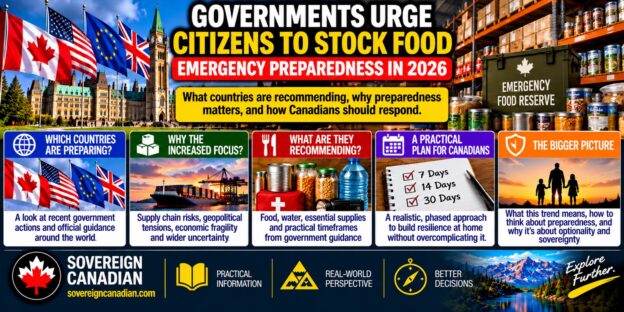
Governments around the world are increasingly encouraging their citizens to maintain emergency supplies of food, drinking water, medicine, and other essentials.
From Sweden and Norway to Germany, the Netherlands, and the European Union itself, the message is becoming remarkably consistent: households should be prepared to survive independently for at least 72 hours, and in some countries considerably longer.
Some governments are explicitly discussing the possibility of war. Others emphasize cyberattacks, natural disasters, infrastructure failures, and disruptions to global supply chains.
Whatever the motivation, the underlying message is worth considering.
A little personal preparedness may be one of the best investments a household can make. And unlike the next promising stock tip, its value doesn’t depend on the market going up.
Which Countries Are Encouraging Citizens to Prepare?
The recommendations are not entirely new. Countries such as Canada have advised households to maintain emergency supplies for decades. Winter storms can keep you locked up at home for days or a week. And at worst, you could be without power for an extended period. Either way, you definitely shouldn’t be heading out to the store. I believe that if done right, you could even be enjoying yourself and the downtime.
What has changed is the prominence of preparedness in national security discussions, particularly across Europe.
In March 2025, the European Commission introduced its Preparedness Union Strategy, calling for the development of guidelines to help households across its 27 member states become self-sufficient for a minimum of 72 hours.
The strategy goes beyond household emergency kits. It includes strengthening Europe’s strategic stockpiles, protecting critical infrastructure, and improving civilian readiness for emergencies ranging from natural disasters to military conflict.
Several countries have gone further.
| Country or region | Recommended preparedness | Notable developments |
|---|---|---|
| European Union | Minimum 72 hours | EU-wide preparedness strategy introduced in March 2025 |
| Sweden | At least 7 days | Updated civil-defence guidance addressing crises and war |
| Norway | 7 days | Increased recommendation from 3 days in 2024 |
| Germany | Ideally 10 days | Federal guidance recommends substantial household food and water reserves |
| Finland | 72 hours | Established national preparedness programme |
| Netherlands | 72 hours | National household emergency preparedness guidance |
| United Kingdom | Approximately 3 days | Public awareness and household preparedness guidance |
| Canada | Minimum 72 hours | Longstanding federal emergency preparedness recommendations |
These are household preparedness recommendations, not indications that any particular government expects an imminent emergency.
Nevertheless, the growing attention being paid to civilian resilience is significant.
Sweden: Preparing for Crisis or War
Sweden has been particularly direct.
Its civil-defence guidance explains how citizens should respond to disruptions affecting electricity, communications, food supplies, and other essential services.
The recommendations include keeping enough food for at least one week, maintaining drinking water reserves, having alternative heating arrangements, and keeping cash available if electronic payment systems fail.
Sweden’s approach reflects its broader emphasis on total defence, in which civilian preparedness supports national resilience.
Norway: From Three Days to Seven
Norway increased its recommended household preparedness period from three days to one week in May 2024.
Its Directorate for Civil Protection recommends approximately 20 litres of drinking water per person, along with food, medicine, heating supplies, and alternative means of communication.
The Norwegian government explicitly identifies extreme weather, pandemics, sabotage, and war among the potential disruptions households should consider.
Germany: Ten Days of Supplies
Germany’s Federal Office of Civil Protection recommends maintaining enough food and drinking water for ideally ten days, while acknowledging that even a three-day reserve is useful.
Its guidance emphasizes ordinary, shelf-stable groceries rather than specialized survival products.
The principle is straightforward: maintain a reserve of products your household already consumes, rotate them regularly, and avoid depending entirely on refrigeration or electricity.
Germany’s ten-day recommendation also predates the latest European security concerns. This is an established civil-protection policy rather than a sudden warning.
Why Are Governments Making These Recommendations?
There are several explanations, and they are not mutually exclusive.
1. Growing Geopolitical Tensions
Russia’s invasion of Ukraine has fundamentally changed European security planning.
Countries bordering Russia or situated near the Baltic Sea have particular reasons to consider the resilience of civilian infrastructure during a military confrontation.
Sweden and Finland have joined NATO, European governments have increased defence spending, and civilian preparedness has become a more prominent component of national security planning.
This does not mean European governments are predicting an imminent war.
It does demonstrate that civilian resilience is increasingly being treated as a national defence responsibility.
2. Cyberattacks and Infrastructure Vulnerability
Modern societies depend on interconnected systems.
Electricity powers water treatment facilities, telecommunications networks, payment terminals, fuel pumps, and much of our food distribution infrastructure.
A serious cyberattack or prolonged electricity outage could therefore create consequences far beyond the initial disruption.
Consider how much of everyday life depends on functioning digital payment systems.
A household might have substantial savings and investments, yet temporarily lose the ability to purchase groceries or fuel.
Financial wealth is not necessarily the same thing as immediate access to essential goods.
3. Supply Chain Disruptions
The COVID-19 pandemic demonstrated how quickly supply chains can become strained.
Products that had previously been available on demand suddenly became difficult to obtain.
European policymakers have subsequently placed greater emphasis on securing critical supplies, including medicines, energy equipment, and other essential materials.
In July 2025, the European Commission introduced a separate stockpiling strategy intended to improve access to essential goods during major emergencies.
The concern is not necessarily that shortages are inevitable. It is that highly efficient supply chains may lack sufficient redundancy when something goes wrong.
4. Natural Disasters and Extreme Weather
Not every emergency involves geopolitical conflict.
Flooding, wildfires, winter storms, earthquakes, and prolonged power outages can disrupt communities with little warning.
For Canadians, severe winter weather alone provides a compelling reason to maintain basic household reserves.
A prolonged power failure during an Ontario winter presents challenges considerably different from those associated with a temporary summer blackout.
And these are situations in which preparedness can make an immediate difference.
5. Governments Recognize Their Own Limitations
Perhaps the most important explanation is also the simplest.
Governments cannot guarantee immediate assistance to every household during a widespread emergency.
Norway’s preparedness guidance makes this point explicitly: emergency services must prioritize those who cannot manage without assistance.
The more households capable of looking after themselves for several days, the more resources remain available for vulnerable citizens.
That is a practical argument for individual responsibility, regardless of one’s political views.
What Should Canadians Actually Keep at Home?
There is no need to construct a bunker or purchase years of freeze-dried food.
For most households, the sensible starting point is a reserve of everyday necessities.
Consider the following:
- Water: At least 2–3 litres per person per day for drinking, with additional water for cooking and hygiene. Canada’s federal minimum is two litres daily.
- Food: A minimum seven-day supply of non-perishable food, with a longer-term objective of 30 days.
- Medicine: Essential prescriptions, basic first-aid supplies, and any necessary medical equipment.
- Lighting and communication: Flashlights, batteries, charged power banks, and a battery-powered or hand-crank radio.
- Cash: A reasonable amount in smaller denominations in case electronic payment systems become unavailable.
- Heating: Warm clothing, blankets, and a safe alternative heating plan for winter power failures.
- Cooking: A means of preparing food without household electricity, used only in accordance with the manufacturer’s safety instructions.
- Documents: Copies of important identification, insurance information, and emergency contact numbers.
- Transportation: Adequate fuel, essential vehicle supplies, and a family evacuation plan.
Households with children, elderly relatives, pets, or particular medical needs should adjust their preparations accordingly.
For a family of four, a three-day drinking-water reserve at three litres per person per day amounts to just 36 litres.
Extending that to seven days requires 84 litres.
Neither is an unreasonable amount to store in a typical Canadian home.
Thirty days of drinking water at that rate would require 360 litres for four people. That is a more substantial storage commitment, and households pursuing longer-term independence should also consider safe water treatment and alternative sources.
Food preparation deserves similar consideration. Rice and dried beans may store well, but they are considerably less useful if you have no electricity, cooking fuel, or clean water.
The goal should be a functioning household reserve, not simply a collection of supplies.
Preparedness Is Another Form of Personal Sovereignty
At Sovereign Canadian, we spend considerable time discussing investment opportunities, international diversification, financial independence, and strategies for reducing dependence on individual governments and institutions.
These are important components of building long-term security.
Our Financial Roadmap explores the accumulation and protection of wealth, while our Flag Theory Roadmap examines ways to diversify personal and financial exposure across jurisdictions.
But there is another dimension to sovereignty that deserves attention.
The ability to look after yourself and your family when normal systems temporarily stop functioning.
A diversified investment portfolio is valuable.
So is having enough food, drinking water, medicine, and cash to navigate an unexpected disruption without immediately depending on outside assistance.
These are complementary forms of security.
One protects your financial future. The other helps protect your immediate circumstances.
And unlike most investments, basic preparedness requires relatively little capital.
A few hundred dollars thoughtfully allocated toward household resilience may deliver considerably more practical value during an emergency than the same amount invested in a speculative stock.
That doesn’t mean abandoning financial markets or preparing for societal collapse.
It means recognizing that not every worthwhile investment needs to generate a financial return.
Is Something Bigger Coming?
Whenever multiple governments begin issuing similar preparedness recommendations, speculation naturally follows.
Are European governments anticipating a wider conflict with Russia?
Are intelligence agencies warning of major cyberattacks?
Are policymakers concerned about another pandemic or an extended disruption to international trade?
These are reasonable questions, particularly given the geopolitical environment.
However, the public guidance examined here does not establish that governments possess knowledge of a specific impending catastrophe.
Many of the recommendations have existed for years. Others have been expanded in response to identifiable security concerns.
The European Union’s strategy explicitly adopts an all-hazards approach, covering everything from natural disasters to cyberattacks and military threats.
The most reasonable interpretation is that governments increasingly recognize the vulnerability of modern infrastructure and the importance of households being able to function independently for short periods.
That is worth paying attention to without assuming the worst.
The Sovereign Canadian Perspective
Most Canadians probably spend more time thinking about their next investment, vehicle purchase, or vacation than whether their household could function for a month without access to a grocery store.
There is nothing particularly surprising about that. Modern life is built around convenience, just-in-time deliveries, and reliable infrastructure.
But we should expect more of ourselves.
Seven days of household supplies should be a minimum, not a long-term preparedness goal. For most established households, maintaining a week’s worth of food and basic necessities requires little more than sensible grocery shopping and some additional storage space.
A more meaningful objective is 30 days of household self-sufficiency.
Could you close your doors today and remain at home for the next month without visiting a grocery store?
You might run out of fresh milk, eggs, and produce. Your meals might become repetitive, and you may find yourself eating things that don’t perfectly align with your preferred diet. There will undoubtedly be some inconvenience.
But inconvenience is not an emergency.
With a reasonably stocked pantry, freezer, essential medications, drinking water, and basic household supplies, most families should be capable of getting through a month without outside shopping.
Of course, a prolonged power outage or interruption to municipal water would require additional planning. Thirty days of food in the house is not the same as thirty days of complete independence from infrastructure.
The objective isn’t to prepare for the collapse of civilization. It’s to build enough resilience that a temporary disruption doesn’t immediately become a personal crisis.
We spend considerable effort building financial reserves to protect ourselves against unexpected expenses. Maintaining physical reserves of essential goods deserves similar consideration.
Because sometimes the best investment isn’t another stock, ETF, or piece of real estate.
Sometimes it’s knowing that, if necessary, you can close your doors for the next 30 days and your family will be just fine.
Official Government Sources
- European Commission: EU Preparedness Union Strategy
- Sweden: Seven Days — Household Preparedness Guide
- Norway: Directorate for Civil Protection — Self-Preparedness
- Germany: Federal Office of Civil Protection — Stockpiling
- Netherlands: Government Emergency Kit Recommendations
- Canada: Government of Canada — Emergency Preparedness Guide