
November 1, 2026 | Sovereign Canadian | Finance & Economics
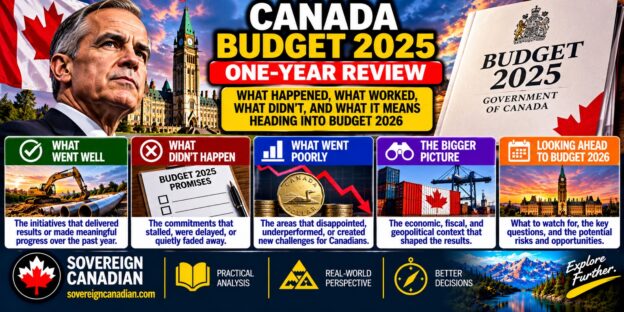
Nearly one year ago, Prime Minister Mark Carney’s government presented its first federal budget under the banner Canada Strong. With a projected $78.3 billion deficit, approximately $285 billion in proposed federal investment support, and an ambition to mobilize $1 trillion in total investment, Budget 2025 represented a substantial shift in Canada’s economic direction.
The government’s central argument was that Canada needed to invest in productive capacity, infrastructure, energy, defence, and industrial competitiveness to reduce its economic dependence on the United States and strengthen its long-term sovereignty.
In our original analysis, Canada’s 2025 Federal Budget: Building Sovereignty on Borrowed Money?, we identified the fundamental tension: borrowing to finance productive investment can strengthen a country’s economic position, but only when those investments generate sufficient economic returns to justify their costs.
Finance Minister François-Philippe Champagne is scheduled to present Budget 2026 on November 5. With four days remaining, we have nearly twelve months of developments to examine.
Canada’s economy has shown some encouraging improvements, including stronger productivity and exports during the second quarter of 2026. The government has also advanced major-project initiatives and introduced additional investment incentives.
However, federal deficits remain substantial, the labour market weakened during the late summer, and the government’s ambitious investment announcements have yet to translate into equivalent completed infrastructure.
The question heading into Budget 2026 is whether Canada’s policy changes are beginning to generate sustained economic improvements, and whether those improvements will justify the associated public borrowing.
The Fiscal Picture: Improved Revenues, Persistent Deficits
Budget 2025 projected a federal deficit of $78.3 billion for 2025–26, followed by $65.4 billion in 2026–27.
The government’s April 2026 Spring Economic Update revised the estimated 2025–26 deficit downward to $66.9 billion, an improvement of $11.4 billion from the original projection.
This was a meaningful improvement, but its composition matters.
The update identified $17.7 billion in favourable economic and fiscal developments for 2025–26, partially offset by additional policy measures.
For 2026–27, the government continued to project a deficit of approximately $65.3 billion.
The distinction between stronger revenues and spending restraint is important. A deficit that improves because economic conditions exceed expectations does not necessarily demonstrate that structural spending pressures have been resolved.
The Parliamentary Budget Officer’s October 20 Economic and Fiscal Outlook provides a more recent independent assessment.
The PBO projects a deficit of $63.3 billion for 2026–27, followed by $70.2 billion in 2027–28. Annual deficits are expected to remain above $63 billion through 2030–31.
The PBO also projects that federal debt will increase from 40.8% of GDP in 2026–27 to 42.6% by 2030–31.
There is an important distinction between the government’s two fiscal objectives.
The PBO currently expects the government to meet its target of balancing operating revenues and expenditures in 2028–29, with a projected operating surplus of $6.2 billion.
However, it does not expect the government to meet its second fiscal anchor: a consistently declining deficit-to-GDP ratio.
The PBO concludes that the two fiscal anchors have imposed limited discipline on government spending and borrowing.
Another concern is the difference between reported deficits and actual federal borrowing.
The PBO projects cumulative deficits of $333.3 billion over the next five years, compared with $732.9 billion in additional federal borrowing. Much of the difference reflects financing for loans, financial assets, and other transactions that do not immediately appear as budgetary expenses under accrual accounting.
These are not interchangeable measures of fiscal deterioration. Some borrowing creates financial assets with potential future value. Nevertheless, the distinction is important for understanding the government’s financing requirements.
The government’s original argument was that borrowing for productive investment should be treated differently from borrowing for operating expenditures.
There is economic merit to that distinction, but it becomes less meaningful when capital investment includes tax incentives, subsidies, and other expenditures that do not necessarily create government-owned productive assets.
The PBO and International Monetary Fund have both raised concerns about the transparency and comparability of the government’s capital classifications.
The fiscal outlook has improved relative to the original 2025–26 deficit projection, but Canada continues to face substantial borrowing requirements and a rising federal debt burden relative to GDP.
Productivity: Encouraging Results, but No Established Turnaround
One of the central objectives of Budget 2025 was improving Canada’s productivity.
For years, Canada’s economic growth relied heavily on population expansion while business investment per worker and labour productivity remained disappointing.
This matters because sustained improvements in wages and living standards depend heavily on producing more economic value per hour worked.
Budget 2025 introduced the Productivity Super-Deduction, designed to encourage investment in machinery, equipment, technology, and other productive assets through accelerated depreciation and immediate-expensing provisions.
The government has subsequently announced a broader Productivity Mega Deduction. According to the PBO, this measure accounts for approximately $36 billion in additional fiscal costs over five years.
The policy approach recognizes that Canada’s businesses need incentives to modernize and expand their productive capacity.
There have been encouraging economic developments.
According to Statistics Canada’s October 28 review of the Canadian economy, labour productivity increased during the second quarter of 2026 at its fastest pace since the pandemic-related shutdowns of early 2020.
Real GDP per capita also recorded its largest quarterly increase since the second quarter of 2022.
Business investment contributed to the expansion, alongside stronger exports, household spending, and government expenditures.
These developments are meaningful after an extended period of weak productivity performance.
However, one strong quarter does not establish a sustained structural improvement.
Productivity can fluctuate because of changes in employment, hours worked, capacity utilization, and the composition of economic activity.
It would also be premature to attribute the improvement directly to Budget 2025.
In its May assessment, the PBO specifically noted that the budget’s productivity measures had not been fully implemented and that their effects could not yet be reliably evaluated.
Capital investments take time to plan, finance, purchase, install, and bring into production.
The more important question is whether Canadian businesses begin consistently investing more capital per worker.
That requires competitive taxation, reliable infrastructure, access to financing, skilled labour, and confidence in the regulatory environment.
The improvement in productivity is encouraging. Demonstrating that it represents a durable change in Canada’s economic performance remains unfinished business.
Major Projects: $125 Billion Announced, but How Much Is Being Built?
One of the most visible developments since Budget 2025 has been the government’s effort to accelerate projects of national significance.
The Major Projects Office was established to coordinate federal reviews and advance strategically important infrastructure, energy, mining, and transportation investments.
By April 2026, the government reported that 15 projects had been referred to the office, representing more than $125 billion in potential capital investment and an estimated 60,000 construction jobs.
These figures are substantial.
Canada possesses enormous natural-resource advantages, including oil, natural gas, uranium, critical minerals, hydroelectric potential, and access to three oceans.
The country’s challenge has rarely been a shortage of resources. It has been the difficulty of developing major projects competitively and connecting them to domestic and international markets.
The Major Projects Office represents an attempt to address some of these obstacles.
However, the PBO’s May 4 assessment of the government’s major capital priorities identified an important distinction.
Of the 15 projects, only two were in active construction at the time of its assessment.
The two largest proposed projects—LNG Canada Phase 2, estimated at approximately $33 billion, and Ksi Lisims LNG, estimated at approximately $30 billion—had not reached final investment decisions.
The PBO also noted that the Major Projects Office had not published progress reports or approval-timeline scorecards assessing performance against its two-year mandate.
This does not mean the initiative has failed. Major infrastructure projects routinely require years of planning, financing, consultation, and construction.
But it demonstrates the difference between identifying potential investments and actually developing productive infrastructure.
The government has made some concrete progress. The April 2026 Spring Economic Update highlighted the beginning of work on the Port of Montreal’s Contrecoeur Container Terminal project, supported by a $1.16 billion financing commitment from the Canada Infrastructure Bank.
That is a more tangible milestone than simply referring a project for consideration.
For Sovereign Canadian, the relevant indicators remain final investment decisions, construction starts, completed infrastructure, operational capacity, and export revenues.
Canada’s economic sovereignty will improve when its resources can reliably reach customers through infrastructure that has actually been built.
For a closer examination of these opportunities, see our analysis of Canada’s Projects of National Significance and How Investors Can Participate.
Energy and Critical Minerals: Strategic Opportunity, Commercial Reality
Budget 2025 placed energy and critical minerals near the centre of Canada’s industrial strategy.
The government proposed a $2 billion Critical Minerals Sovereign Fund, alongside additional financing and infrastructure measures intended to support resource development.
The April 2026 Spring Economic Update also highlighted a $1.5 billion First and Last Mile Fund intended to address infrastructure constraints affecting critical-mineral projects.
These initiatives recognize an important reality: mineral deposits have limited commercial value if producers cannot economically develop them or transport their output to market.
Roads, electricity, rail connections, ports, and processing facilities can determine whether a resource project becomes commercially viable.
Canada has opportunities to develop additional export industries in uranium, copper, nickel, lithium, rare earth elements, and other strategic materials.
However, these commodities do not all share the same market conditions.
Some face supply shortages and attractive long-term demand prospects. Others experience periodic oversupply, price volatility, or rapidly changing production economics.
Government support cannot eliminate commodity cycles.
Nor does the designation of a mineral as strategically important guarantee attractive returns for investors.
A mine can be economically important while generating disappointing shareholder returns if construction costs exceed expectations or commodity prices decline.
The same principle applies to energy infrastructure.
Additional export capacity can improve Canada’s commercial flexibility, particularly when it provides access to markets beyond the United States.
But new infrastructure must still demonstrate sufficient long-term demand and competitive operating costs.
Canada’s resource wealth is a strategic advantage. Converting that advantage into durable economic value requires commercial discipline as well as supportive public policy.
Defence: A Strategic Commitment With Significant Future Costs
Budget 2025 included a substantial expansion of defence commitments, reflecting Canada’s NATO obligations and a changing international security environment.
The government’s broader strategy includes increased procurement, domestic industrial development, and measures intended to strengthen Canadian defence manufacturing.
The April 2026 Spring Economic Update highlighted the government’s Defence Industrial Strategy and proposed additional funding to establish the Defence Investment Agency as a stand-alone organization.
These measures indicate that defence spending is increasingly being treated as an industrial-policy priority rather than simply a procurement expense.
That distinction could have significant implications for Canadian engineering, aerospace, shipbuilding, electronics, cybersecurity, and advanced manufacturing businesses.
The PBO’s May assessment confirmed that NATO had recognized Canada as reaching the 2% defence-spending benchmark in 2025–26.
However, Canada’s longer-term commitment to reach 5% of GDP in defence-related spending by 2035 presents a much larger fiscal challenge.
The PBO estimated that meeting the commitment could require core defence spending of approximately $159 billion in 2035–36, with substantial implications for future deficits and federal debt.
The government had not yet published a detailed year-by-year spending path demonstrating how the longer-term target would be achieved.
A larger domestic defence industry could reduce dependence on foreign suppliers for selected critical capabilities while creating opportunities for Canadian firms to participate in international supply chains.
However, procurement reform and industrial development are long-term undertakings.
The creation of an agency does not immediately produce additional military capability. Nor does an announced procurement budget guarantee domestic production.
Defence programs are particularly vulnerable to delays, cost escalation, changing technical requirements, and political intervention.
The economic case for domestic production also depends on achieving sufficient scale and maintaining internationally competitive capabilities.
For national sovereignty, the objective is to develop reliable defence capabilities and secure supply chains while understanding the fiscal costs involved.
The strategic direction has changed. The practical results will take longer to measure.
Housing: The Gap Between Ambition and Construction
Housing was another major component of Budget 2025.
Build Canada Homes was intended to expand affordable housing construction, encourage innovative building methods, and support greater housing supply.
The government has since announced partnerships and additional measures intended to increase construction activity.
Yet the fundamental housing challenges remain.
Construction costs, municipal development charges, land-use restrictions, infrastructure constraints, and financing conditions continue to influence the feasibility of new projects.
Federal funding can support construction, but it cannot independently resolve every obstacle.
The PBO’s May assessment identified a significant gap between the government’s stated ambitions and the available implementation evidence.
The government had previously committed to doubling the pace of homebuilding over the next decade.
However, the Spring Economic Update did not provide specific targets for the pace of housing construction.
The PBO also observed that the six-month trend in housing starts had been declining since September 2025.
Its analysis estimated that Build Canada Homes could add approximately 26,000 housing units over five years—an increase in supply, but insufficient on its own to achieve the government’s broader homebuilding objective.
This is a useful example of why announced spending should be distinguished from measurable results.
Housing affordability also depends on household incomes and the cost of financing.
Even where home prices stabilize or decline, high mortgage balances and substantial ownership expenses can leave households financially constrained.
For Canadians pursuing financial independence, housing presents a particular challenge.
A primary residence provides security and utility, but excessive housing costs can absorb income that might otherwise support retirement savings, business investment, travel, or other personal priorities.
A larger home is not automatically a stronger financial position.
The relevant measures will be completed housing units, construction costs, household income growth, and the financial burden of ownership or renting.
Immigration: A Change in Direction, With Results Still Emerging
Canada’s immigration policy has undergone a significant adjustment.
Budget 2025 accompanied a federal plan to reduce temporary resident arrivals and stabilize permanent resident admissions at 380,000 annually between 2026 and 2028.
This represented a departure from the rapid population growth of the preceding years.
The change reflects growing recognition that population growth must be considered alongside housing availability, infrastructure capacity, labour-market conditions, and public-service delivery.
Immigration can support economic development by attracting skilled workers, entrepreneurs, and investment.
However, rapid population growth does not automatically translate into higher living standards.
If capital investment and infrastructure development fail to keep pace with labour-force expansion, productivity and housing affordability can suffer.
The policy challenge is to align immigration with Canada’s economic capacity while continuing to attract individuals whose skills and experience support productive growth.
The effects of the revised immigration targets will emerge gradually.
Population growth, labour supply, housing demand, and public-service pressures respond over different time horizons.
For now, the government’s change in direction is clear. Its long-term economic consequences remain uncertain.
The Labour Market: A Recovery That Lost Momentum
Canada’s labour market experienced considerable volatility during 2026.
According to Statistics Canada’s October 28 economic review, employment declined by a cumulative 112,000 positions during the first four months of the year.
Conditions subsequently improved, with employment increasing by 181,000 between April and July.
These gains were concentrated among private-sector employees and core-aged workers, with full-time employment contributing to the recovery.
However, the improvement did not continue uninterrupted.
Employment declined by a combined 110,000 positions in August and September, with much of the reduction concentrated in public-sector employment and full-time positions.
The unemployment rate increased to 6.5% in September, compared with 6.4% in July.
Youth employment was particularly affected during the late-summer downturn.
This volatility complicates the economic narrative.
Canada experienced stronger output and productivity during the second quarter, but labour-market conditions weakened again before the autumn.
It is possible for productivity to improve while employment growth remains weak, particularly when businesses adjust staffing or increase output without proportionate increases in labour hours.
The challenge is to generate productivity growth that ultimately supports higher real wages, profitable business expansion, and sustainable employment opportunities.
A durable economic recovery requires more than isolated improvements in GDP.
It requires private businesses to invest, hire, expand, and compete successfully in domestic and international markets.
Trade Diversification: Progress, but the United States Remains Central
One of the central arguments behind Budget 2025 was that Canada needed to reduce its vulnerability to American trade policy.
The government’s response has included efforts to expand commercial relationships with European and Asian partners while supporting infrastructure capable of connecting Canadian producers to additional markets.
Trade diversification is economically sensible, particularly for a country whose manufacturing, energy, and agricultural sectors are deeply integrated with a single foreign market.
However, establishing trade agreements and diplomatic partnerships is only the beginning.
Businesses must identify customers, develop distribution networks, satisfy regulatory requirements, and establish commercially competitive supply chains.
Transportation infrastructure and access to ports remain critical.
The United States will continue to be Canada’s dominant trading partner because of geography, existing infrastructure, and the scale of the American economy.
The objective should not be to replace American trade, but to create additional commercial options.
Statistics Canada’s October economic review provides some encouraging evidence.
Export volumes contributed to the second-quarter economic expansion, and Canada recorded its first quarterly current account surplus in four years.
The surplus was also the largest in more than two decades.
These developments demonstrate an improvement in Canada’s external economic position during the period.
However, a single quarterly current account surplus does not establish that Canada’s dependence on the American market has materially declined.
That requires sustained changes in export destinations, market access, and commercial infrastructure.
Trade diversification remains a long-term project rather than an accomplishment that can be measured through a single year’s diplomatic announcements.
Government Efficiency: Promised Savings Remain Difficult to Evaluate
Budget 2025 proposed approximately $60 billion in combined savings and additional revenues over five years, including measures associated with the Comprehensive Expenditure Review.
The government targeted approximately $13 billion in annual savings by 2028–29.
These commitments were intended to demonstrate that higher capital investment would be accompanied by restraint in operating expenditures.
The distinction is important.
A government can increase investment while improving operating efficiency, but only if spending reductions are real and sustainable.
In its May assessment of departmental spending and new measures, the PBO noted that the Spring Economic Update did not provide updated figures for expenditure-review savings or federal employment reductions for 2026–27.
This limits Parliament’s ability to assess whether the government’s operating-restraint commitments are progressing as planned.
The PBO also raised questions about implementation capacity, particularly given the number of new initiatives and their proposed spending schedules.
Government efficiency should ultimately be assessed through expenditures, staffing, service delivery, procurement performance, and program outcomes.
Reducing spending does not necessarily improve efficiency if essential services deteriorate. Equally, maintaining or increasing expenditure does not demonstrate that taxpayers are receiving corresponding value.
The government’s expenditure-review commitments remain an important part of its fiscal framework.
However, the available evidence does not yet establish that the planned savings have produced a sustained improvement in the federal government’s overall financial position.
The Canada Strong Fund: A New Fiscal Question
The April 2026 Spring Economic Update introduced another significant initiative: the proposed $25 billion Canada Strong Fund.
The government presents the fund as a vehicle for mobilizing capital and supporting Canadian investment.
The concept raises an interesting question for a country seeking greater economic sovereignty.
A public investment fund can potentially generate financial returns while supporting domestic economic development.
However, the financial structure matters.
Unlike a country investing accumulated fiscal surpluses, Canada would be establishing the fund while continuing to operate substantial federal deficits.
The PBO therefore describes the proposal as a leveraged investment for taxpayers.
It also notes that the government has not clearly established how the fund’s investment performance will be evaluated, how risks will be allocated, or whether borrowing costs will be included when calculating commercial returns.
These are important considerations.
An investment earning 5% annually is not necessarily attractive if the government must borrow at a comparable rate while assuming additional risk.
Similarly, supporting strategically important projects does not eliminate the need to evaluate commercial returns and alternative uses of public capital.
The Canada Strong Fund could become a useful financing mechanism. Its value will depend on governance, investment discipline, transparency, and the actual returns generated.
For a government already facing substantial borrowing requirements, these questions deserve attention before additional capital is committed.
What Has Gone Well, and What Remains Unfinished?
Nearly one year after Budget 2025, several developments stand out.
Canada has experienced a meaningful improvement in productivity and real GDP per capita during the second quarter of 2026. The economy also recorded stronger exports and a substantial current account surplus.
The federal government has established a more coordinated approach to major infrastructure and resource projects, with 15 projects representing more than $125 billion in potential investment referred to the Major Projects Office by the spring.
Industrial investment incentives, critical-mineral financing, and defence procurement reforms have advanced the government’s stated objective of strengthening domestic productive capacity.
The federal deficit outlook also improved relative to the original 2025–26 projection.
These developments provide evidence of progress, although the extent to which individual budget measures caused the economic improvements remains uncertain.
At the same time, significant challenges remain.
Federal borrowing requirements continue to be substantial, and the PBO expects large deficits throughout its forecast horizon.
The labour market weakened again during August and September, despite stronger economic output earlier in the year.
Housing affordability remains a major household-finance challenge, while the benefits of government housing initiatives will depend on actual construction and completed units.
Major-project announcements have not yet translated into an equivalent amount of completed infrastructure.
The government’s expenditure-review savings remain difficult to assess because of incomplete reporting.
And although Canada’s trade relationships are expanding, the country remains deeply dependent on the American economy.
The central distinction is between establishing a policy direction and demonstrating measurable economic results.
Budget 2025 has produced substantial activity in the first category. The second will require several more years of evidence.
What Budget 2026 Needs to Clarify
On November 5, Finance Minister François-Philippe Champagne is scheduled to present the government’s second federal budget.
The next budget provides an opportunity to move beyond the broad ambitions of 2025 and establish clearer measures of progress.
First, Canadians need transparent reporting on major capital projects. Announced investment values should be distinguished from committed private capital, projects under construction, and completed infrastructure.
Second, the fiscal framework needs greater clarity. The government should explain how it intends to manage persistent deficits, debt-servicing costs, and operating expenditures while maintaining its investment commitments.
Third, productivity policy should be evaluated against actual business investment. Accelerated depreciation and tax incentives are useful only to the extent that they encourage additional productive activity.
Fourth, housing initiatives require measurable construction outcomes. Funding commitments and partnerships are insufficient substitutes for completed homes and improvements in affordability.
Fifth, Canada’s trade diversification strategy should be connected to commercial results. New agreements matter when they generate sustained exports, investment, and additional market access.
Finally, the government should provide sufficient detail for independent institutions, Parliament, businesses, and taxpayers to evaluate whether its policies are delivering the intended results.
These measures would make it easier to distinguish productive public investment from spending that produces limited long-term economic benefits.
The Sovereign Canadian Perspective
The central lesson of Budget 2025 remains relevant as Canada approaches its next federal budget.
Economic sovereignty cannot be created through government expenditure alone.
It depends on productive businesses, competitive industries, reliable infrastructure, diversified markets, capable institutions, and sustainable public finances.
Canada possesses many of the resources necessary to strengthen its economic independence. It has an educated workforce, substantial energy and mineral reserves, established financial institutions, and access to major international markets.
But these advantages do not automatically translate into rising productivity or improved living standards.
They must be supported by private investment, sound economic incentives, and the ability to execute major projects efficiently.
The past year has produced encouraging economic indicators alongside continuing fiscal and structural challenges.
For individual Canadians, the implications are familiar.
Financial independence remains closely connected to the ownership of productive assets, manageable financial obligations, diversified investments, and the ability to adapt when economic conditions change.
Government policy can influence the opportunities available, but it cannot eliminate investment risk or guarantee personal financial security.
As Budget 2026 approaches, Canadians should pay attention not simply to the size of new commitments, but to the results of those already made.
The real measure of Canada’s economic sovereignty will not be how much money Ottawa promises to invest. It will be how much additional productive capacity, commercial independence, and financial resilience the country ultimately develops.
That is the standard against which the next federal budget should be examined.
Sources and Further Reading
- Government of Canada — Spring Economic Update 2026, April 28, 2026.
- Parliamentary Budget Officer — Economic and Fiscal Outlook, October 2026, October 20, 2026.
- Statistics Canada — Recent Developments in the Canadian Economy: Fall 2026, October 28, 2026.
- Parliamentary Budget Officer — Assessment of Government’s Major Capital Priorities, May 4, 2026.
- Parliamentary Budget Officer — Assessment of Departmental Spending and New Measures, May 4, 2026.
- Department of Finance Canada — Budget 2026 Announcement, October 20, 2026.
Related Sovereign Canadian Reading
- Canada’s 2025 Federal Budget: Building Sovereignty on Borrowed Money?
- Canada’s Projects of National Significance: What They Mean for Canadians and How Investors Can Participate
Disclaimer: This article provides general economic commentary and does not constitute personalized financial, investment, tax, or legal advice.