
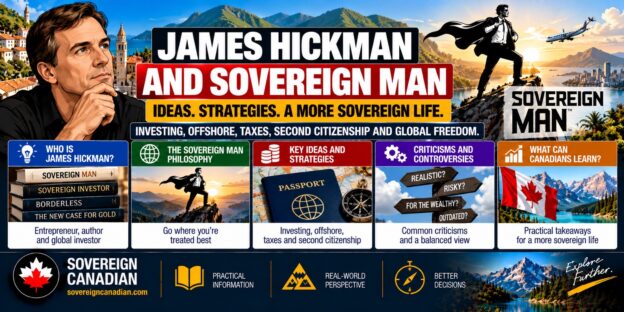
Sovereign Thought Leaders is a series where I profile the writers, investors and thinkers worth understanding and then test their ideas against Canadian rules. This is personal documentation, not financial, tax, legal or immigration advice. Read me as a peer taking notes, not an analyst issuing a rating.
For well over a decade, one of the most widely read voices in the Plan B corner of the internet wrote under a name that wasn’t his. The man behind it is James Hickman, and Simon Black was his pen name. As Simon Black, he wrote the daily letter for Sovereign Man, warning that Western governments were overspending and overpromising, and showing readers how to hold a second citizenship, a second residency and some assets outside one government’s reach. On January 24, 2024, he announced that Sovereign Man was joining forces with Peter Schiff to form Schiff Sovereign, and that he would write under his real name from then on.
So this profile covers three things that are really one: the persona, the man and the business. It also answers a question that matters more to a Canadian reader than any biography: how much of this playbook was built for people like us? The short answer is that the philosophy travels well, a lot of the tax machinery doesn’t, and the reason comes down to one difference in how the United States and Canada decide who owes tax.
Who James Hickman (Simon Black) Is
Almost everything known about Hickman’s background comes from his own publications, so I’ll attribute it to him and say what I could and couldn’t confirm.
Schiff Sovereign describes him as a West Point graduate and former intelligence officer with more than 25 years of business and investment experience. The company says he has travelled to more than 120 countries on all seven continents and has started, invested in or acquired businesses in sectors from technology to agriculture to banking. An older biography of Hickman, republished by Malone News, adds that he bought a prominent Australian retail brand from its founder, a former 1980s rock star; I didn’t find that claim on Schiff Sovereign’s current pages. The company dates the Simon Black name to 2007, and in his 2024 announcement Hickman described Sovereign Man as having run for nearly 15 years on its own.
I couldn’t find independent confirmation of the military service or of the individual companies, and I didn’t find anything contradicting them either. That’s a consequence of the pen name more than a red flag: for most of those years, readers had no real name to look up. Dropping the pseudonym and attaching his own name, and Peter Schiff’s, to the operation makes the whole enterprise easier to hold to account, and that deserves credit.
The Plan B Idea
The core idea is Plan B: don’t let one government hold every piece of your life. Spread your citizenship, residency, assets and business across more than one jurisdiction so that a policy shock, a banking problem or a political crisis in one place can’t take everything at once. If that sounds like flag theory, it is, and my introduction to flag theory for Canadiansexplains the framework from the Canadian side. What gives Hickman’s version its character is the macro argument underneath it: that Western debt loads, inflation and political dysfunction make a Plan B necessary rather than optional.
Several pieces on the site open with a historical scene before turning to a modern parallel: the spring of 1982, a 1958 book about how a pencil gets made, an earthquake and tsunami in 2011. That habit is the part I’d borrow. It trains you to treat the present as one data point in a long series rather than as permanent.
What He Believes
Schiff Sovereign’s material comes back to four ideas.
Western governments are carrying more debt than they can service without inflating it away. In his January 2024 launch letter, Hickman wrote that US national debt would be roughly USD 55 trillion in ten years, that interest payments could consume more than USD 3 trillion a year of tax revenue, that Social Security would have run out of money, and that the dollar would probably have lost its status as the global reserve currency. He said these forecasts rest on the federal government’s own projections. They are his forecasts, not established outcomes. They are dated and checkable, and he hedged the reserve-currency call with “probably.”
Inflation is the default outcome, so own real assets. The site defines a real asset as something that takes work to produce and can’t be conjured by politicians or central bankers, with gold as the obvious example, and it’s openly bullish on gold, silver, oil and gas, and nuclear energy.
Individual freedom is eroding. As I read it, the answer is personal rather than political: you don’t fix the state, you reduce your dependence on it.
Civilizations move in cycles, and the West, the United States especially, is late in the cycle. The site says Hickman has tracked civilizational cycles for years and has predicted the decline of the American Empire and the dollar losing ground as a reserve currency.
You don’t need to accept the whole thesis to use the operating advice that falls out of it. Holding some hard assets, having a second-residency option before you need one, and not keeping everything in one country is sound risk management even if the dramatic scenario never arrives. I’d treat it as insurance, not prophecy.
The Peter Schiff Merger
Hickman announced the merger on January 24, 2024, writing that after nearly 15 years of flying solo he was joining forces with Peter Schiff, whom he called one of his closest friends. The new venture is Schiff Sovereign. Emails now come from SchiffSovereign.com rather than the Sovereign Man address, and Hickman told readers that content and vision wouldn’t change.
The company’s About page says Schiff’s career began at Shearson Lehman Brothers, that he founded Europacific Capital in 1996, advised Ron Paul’s 2008 presidential campaign, later ran for the US Senate in Connecticut, and wrote Crash Proof. It credits him with publicly predicting the 2007 housing collapse and the 2008 financial crisis.
The announcement says the two men see the world similarly, so I read the merger as combining two voices that already agreed, not as a change of direction for Hickman. The practical result for readers is a larger media operation, with videos and podcasts alongside the emails.
What Schiff Sovereign Sells
The business runs a familiar funnel: a large free list feeding paid tiers. The prices below are in US dollars, as listed on the Schiff Sovereign products page on October 22, 2026.
| Product | Price | What the site says it covers |
|---|---|---|
| Sovereign Letters | Free | The daily letter; the Sovereign Letters page cites 150,000 subscribers |
| Schiff Sovereign Premium | USD 9 per month | Real-asset research, diversification, gold and metals strategies, tax and retirement planning, monthly action items |
| Strategic Assets | USD 99 per month | Research on undervalued, dividend-paying real-asset producers such as miners, gold and platinum producers, and energy companies |
| Plan B Confidential | USD 995 per year | Residency and citizenship, tax and asset protection intelligence, video interviews, monthly question-and-answer sessions, a service provider network |
| Total Access VIP | USD 9,995 enrollment, then USD 2,495 per year | All publications, private deal flow, Caribbean citizenship-by-investment savings, events, one-on-one analyst calls |
The site cites more than 6,000 premium members and describes a Black Book of vetted attorneys, bankers, residency specialists and tax advisors for Confidential and Total Access members. Older reviews online use earlier product names such as Sovereign Confidential, and one page on the site still does, so check current pricing and descriptions with the company rather than trusting a review.
The Puerto Rico Problem: Where the Playbook Stops Fitting Canadians
A large share of the specific tax content in this corner of the internet is built around Puerto Rico’s Act 60. That older biography says he has written extensively on business incorporation and tax residency in Puerto Rico, and Sovereign Man published a detailed guide to the territory’s incentives. For a Canadian, this is where the playbook needs the most sorting.
Why It Works for Americans
The company’s own 2021 guide to Puerto Rico’s tax incentives calls the territory the best route for US taxpayers who don’t plan to renounce their citizenship. That audience is the clue. The United States taxes its citizens on worldwide income wherever they live, so the usual ways out are renouncing citizenship or becoming a bona fide resident of a territory with its own rules. Under section 933 of the Internal Revenue Code, a bona fide Puerto Rico resident for the whole tax year can exclude Puerto Rico-source income from US federal tax. Act 60 adds local incentives on top, but only through a granted decree and only on conditions. Puerto Rico changed the program this year. Under Act 38-2026, enacted March 10, 2026, the DDEC’s April 2026 bulletin says applications received through December 31, 2026 are treated as seeking the 0 percent rate on capital gains, interest and dividends, with a decree running to December 31, 2035, while pending applicants can switch to a 4 percent preferential rate with a decree running to December 31, 2055. Applicants filing before 2027 must not have been Puerto Rico residents between January 17, 2006 and January 17, 2012, and later applicants must not have been residents for the six years before moving. Law firm summaries say applications filed from January 1, 2027 fall under the 4 percent rate, and that the 5 percent rate on gains that built up before the move, if recognized ten or more years after becoming a resident, is unchanged. The bulletin tightens how applicants filing from 2027 may hold their home and does not address the annual donation, so confirm that requirement before relying on it. Whether any of this holds up federally depends on passing the residency tests and on the income being Puerto Rico-source, not simply on arriving. That combination is what made Puerto Rico famous among Americans.
How Canada Works Instead
Canada taxes on residency, not citizenship. The CRA decides residency on the facts, weighing significant residential ties (a home in Canada, a spouse or common-law partner, dependants) most heavily, then secondary ties such as bank accounts, a driver’s licence and provincial health coverage. Once you’re a non-resident, Canada taxes only your Canadian-source income.
Two things follow you out. You’re treated as having sold most of your property at fair market value on the day you leave, with Canadian real property, registered plans such as RRSPs and TFSAs, and Canadian business property excluded. That business exclusion covers qualifying property, including inventory, of a business carried on through a permanent establishment in Canada. And if the combined fair market value of your property exceeds CAD 25,000 after the CRA’s exclusions, you file Form T1161 to list it. Those exclusions include cash, registered plans, and any single item of personal-use property worth less than CAD 10,000. Canadian real property and Canadian business property are excluded from the deemed disposition, but as I read the CRA’s list they are not excluded from T1161 reporting. My guide to departure tax in Canada walks through the mechanics, and my residency flag post covers how the CRA decides who is still a resident.
What Act 60 Means for a Canadian
Act 60 isn’t limited to Americans. I found no US citizenship requirement for the resident investor decree in the DDEC bulletin or in Invest Puerto Rico’s earlier guide, and section 933 itself speaks of individuals generally. What a Canadian would be solving by going there is a different question. The problem that made Act 60 famous, escaping US citizenship-based taxation, isn’t a Canadian problem, and the pre-move gains rule that Americans trip over is, by its terms, aimed at people who were US citizens or residents in the previous ten years. A Canadian who wants to stop being taxed in Canada on worldwide income doesn’t need a US-territory structure to do it, because ceasing to be a Canadian tax resident does that, although Canadian-source income stays taxable in Canada.
How the US and Puerto Rico would treat a Canadian citizen living on the island is a question for cross-border counsel, and I couldn’t confirm it from public sources.
The Enforcement Picture
Even for Americans, the ground has shifted. A December 2025 GAO report found that about 2,200 people claimed the resident investor incentive in 2021. Comparing up to five years before each person’s move with up to five years after, in inflation-adjusted 2023 dollars, GAO found that average federal taxable income fell about 39 percent, from roughly USD 875,000 to USD 534,000, and average federal tax paid fell about 46 percent, from roughly USD 278,000 to USD 151,000. That is a before-and-after comparison of averages, with no comparison group of similar taxpayers who stayed on the mainland, and GAO doesn’t state that the move or the incentive caused the decline. It estimated that the total drop in federal revenue could reach hundreds of millions of dollars a year. GAO also found that the IRS, which opened a compliance campaign in 2021, lacked complete Social Security number data on claimants until 2025 and hadn’t acted on referrals from Puerto Rico officials about taxpayers whose residency couldn’t be confirmed. The IRS agreed with all three of GAO’s recommendations. On the criminal side, one case is worth knowing about, and it is only one. In its announcement, the US Attorney’s Office for the Southern District of Florida said an investor pleaded guilty in June 2025 to making a false statement to the IRS. The release says he filed a document claiming his company had intended to become an S corporation as of January 1, 2019, to avoid capital gains tax on about USD 30 million in built-in gains, roughly USD 7 million of tax, and that he did not become a bona fide Puerto Rico resident until January 1, 2020, after the gains had built up.
Which Parts Travel
| Bucket | Examples | Fit for Canadians |
|---|---|---|
| US-specific tax machinery | Puerto Rico individual-investor incentives, US exit tax and renunciation planning, US entity structuring | Background reading; built to solve citizenship-based taxation |
| Portable sovereignty planning | Second citizenship, tax residency and leaving cleanly, holding assets across borders with proper reporting, hard-asset diversification | Applies, with Canadian mechanics |
My flag theory series covers the portable bucket from the Canadian side, starting with the citizenship flag and the asset haven flag.
Where I Push Back
The Track Record Is Self-Assessed
Schiff Sovereign says Hickman has accurately predicted the West’s debt bubble, inflation, bank failures and social unrest. Those are broad themes, and broad calls are easy to claim in hindsight. The more useful test is a dated, specific forecast like his ten-year debt, interest-cost and reserve-currency scenario above, which runs to about 2034 and remains his forecast, not an outcome. A warning that’s early forever is indistinguishable from one that’s wrong if you traded on its timing, so I’d use the framework and discount the calendar.
The Politics Are Part of the Product
This is an openly political voice. The launch letter called the world “run by inspired idiots,” named a then-sitting US congressman as an example, and used the phrase “savage stupidity” for the ideas it cited. If you want a politically neutral signal on jurisdictions and assets, you’ll be filtering a fair amount of commentary about American politics to get it.
Price and Fit
The ladder runs from a free letter to USD 9,995 plus USD 2,495 a year, and the public pages don’t show how much of the paid tax content assumes a US reader. The 2021 Puerto Rico guide certainly does. That doesn’t make the product a bad one; it means a Canadian should ask what’s Canada-relevant before paying.
What I’d Actually Do
Here’s how I’d use Hickman’s work as a Canadian.
- Read the free letter for the mental models, not the trades. The historical framing is the best part, and it costs nothing.
- Sort everything he writes into the two buckets before acting on it. Puerto Rico’s individual-investor incentives, exit taxes, renunciation and US entity structuring are background reading. Second citizenship, tax residency, cross-border assets and hard-asset diversification are portable, and the Canadian mechanics sit in my flag theory series.
- Pay only if you’re acting on the residency and citizenship side, and ask what’s Canada-specific first. Plan B Confidential is USD 995 a year, and the useful question is whether the material you’d actually use was written for a US taxpayer.
- Take any departure through a Canadian cross-border accountant before you act. Deemed disposition, T1161 reporting and CRA residency ties are Canadian questions. A newsletter is where an idea comes from, not where it gets checked.
- Size hard assets as insurance, not as a bet on a date. The real-asset idea is sound diversification against the scenario he describes. I’d size any gold or real-asset position on that logic and not on his timeline.
The Bottom Line
Hickman built a lasting audience on an idea worth borrowing: don’t let one government hold every piece of your life. The byline was invented for most of the run, the headline tax play was built for Americans, and the macro timetable is a forecast, not a fact. Take the framework, check the mechanics against Canadian rules, and leave the rest.
This post is personal documentation, not financial, tax, legal or immigration advice. Product details and prices are as shown on the Schiff Sovereign website on October 22, 2026, and they change often. Departure tax, residency and cross-border decisions carry serious consequences under Canadian and US law, so speak to a qualified Canadian cross-border accountant or tax lawyer before acting.