
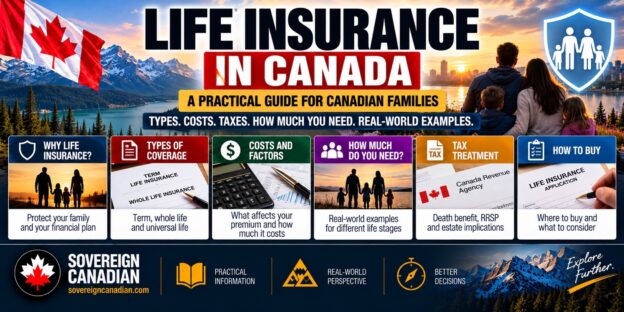
Life insurance in Canada gets sold far more often than it gets explained. Most advisors work on commission, and commission structures can create a real conflict of interest between what pays best and what fits your household. That is not an argument that every advisor pushes an unsuitable product; plenty do careful work. It is a reason to understand the mechanics yourself before signing anything.
This piece works through three questions. What type of insurance should you buy. How much do you actually need. And when should you stop paying for it. That third question gets skipped constantly: a household with a paid-off mortgage, a seven-figure portfolio, and no dependants may need almost no ongoing income-replacement insurance, whatever a multiple-of-salary rule says. Insurance should be sized against your actual balance sheet, not a generic formula.
The position this article argues, and backs with the numbers below: for most Canadian households, individually owned term insurance is the most efficient way to cover a temporary need. Mortgage creditor insurance, the product your bank offers when you sign a mortgage, is frequently inferior to an equivalent term policy, though not for every borrower. Permanent insurance has real, specific uses, mostly around liabilities that never expire, but it needs careful analysis rather than a blanket verdict either way. I have already written a full teardown of whole life insurance, including where that pitch holds up and where it does not, so this piece points there rather than repeating it, and goes deep instead on term, mortgage insurance, and the calculation that should drive the decision.
I am not a licensed insurance advisor, and nothing here is personalized advice. See the disclaimer at the end.
The Three Categories, and a Distinction Worth Getting Right
Canadian life insurance splits into term, mortgage (creditor) insurance, and permanent insurance.
Term insurance covers a defined period. You pay a premium, and if you die within the term, your named beneficiary receives a tax-free lump sum; if you outlive it, the policy simply ends. It is priced on the statistical odds of death during that specific window, which is why it is cheap for a healthy, working-age person.
Mortgage life insurance is a form of creditor insurance, not a separate category of its own. It is optional coverage, sold through your lender, that repays some or all of your outstanding mortgage if you die. Worth being precise here: mortgage life insurance is not mortgage default insurance, the CMHC-style coverage required on most mortgages with less than 20 percent down, which protects the lender if you stop paying. Mortgage life insurance protects the lender, or in practice your family’s ability to keep the house, if you die instead. Nobody is required to buy it; it is an opt-in product offered at closing.
Permanent insurance covers you for life rather than a term, and includes whole life, universal life, and term-to-100. These are not identical products. Whole life and universal life typically build cash value alongside the death benefit; term-to-100 generally does not. Premiums run dramatically higher than term, because the insurer knows with certainty a claim is coming. I think permanent insurance is oversold relative to how often the underlying need applies, and the whole life deep dive covers that case in full. This article flags the two or three situations, mainly a cottage or a corporation, where the permanent conversation is genuinely worth having, and sends you there for the rest.
Term Life Insurance: The Workhorse, Examined Properly
Term insurance solves one problem: if you die during your working years, the people who depend on your income are not financially destroyed. It is not an investment or a legacy vehicle. It is a bridge from “my family depends on my income” to “the portfolio and the paid-off house can carry them.”
Policy terms, and when each fits
Canadian insurers typically offer 10, 15, 20, 25, and 30-year terms, plus term-to-65 or similar structures from some carriers. The right length matches how long the underlying need runs. A household with children aged three and six is looking at close to two decades of real dependence, arguing for a 20-year term, possibly layered with something longer to match the mortgage amortization. A household with teenagers and a mortgage eight years from payoff has a very different shape of need, and a shorter or laddered structure, discussed below, likely fits better and costs less.
Level premiums, renewal, and convertibility
During the initial term, your premium is guaranteed level regardless of what happens to your health. Renewal is different: most policies are guaranteed renewable without new medical underwriting, but the renewal premium is set on your attained age and is typically several times the original rate. This is disclosed in the premium schedule at purchase, not hidden, and it is priced this way because the renewal pool skews toward people who could not qualify for a new policy elsewhere. Treat renewal as an emergency backstop, not a plan.
Many policies also include a conversion privilege: the right to convert some or all of the coverage to an eligible permanent policy before a cutoff age, commonly 65 or 70, without new medical underwriting. This is a genuine contractual right worth confirming your policy includes, but it is not free. The resulting permanent premium is calculated at your age at conversion and runs well above what you paid for term. The value is optionality, not a discount: if your health changes and a legitimate permanent need shows up later, such as the cottage liability discussed below, convertibility preserves access to coverage you might not otherwise qualify for.
Individual, joint first-to-die, and joint last-to-die
You can insure two spouses with separate individual policies, a joint first-to-die policy paying out on the first death, or a joint last-to-die policy paying only after both have died. For ordinary income protection, two individual policies are usually the more flexible structure, each sized to its owner’s own economic contribution and surviving a separation intact. Joint first-to-die coverage can be modestly cheaper for the same combined amount but pays out only once, leaving the survivor to requalify medically if they want new coverage. Joint last-to-die belongs to a different conversation entirely: it is built for permanent, second-death liabilities, most commonly a cottage’s or a corporation’s eventual tax bill, not family income replacement.
Laddering
Insurance need is rarely constant; it tends to peak while the kids are young and the mortgage is large, then decline. Laddering means buying several term policies of different lengths instead of one large policy sized to the peak need for its full duration, so coverage, and cost, step down as obligations do.
A worked comparison: a household calculates a CAD 2,000,000 need today, roughly half tied to a mortgage that should be substantially paid down within ten years, the rest to longer-horizon income replacement. One option is a single CAD 2,000,000, 20-year policy. A laddered alternative is CAD 1,000,000 of 20-year term layered with CAD 1,000,000 of 10-year term, so the second policy expires once the debt-related need has largely resolved. A shorter term is reliably cheaper than a longer term for the same coverage amount, so the laddered combination will generally cost less in total than carrying the full CAD 2,000,000 at the 20-year rate for the whole period, with the saving concentrated in the years after the 10-year piece expires and the household is carrying less coverage than the single-policy alternative. How much that actually saves in dollars depends on the specific insurer, your age, sex, smoking status, and health class at the time you apply, so get both structures quoted side by side before assuming a specific number; the saving is real, but it is not guaranteed to be any particular size.
One caution specific to mortgage-linked laddering: do not assume the balance falls exactly on schedule. Refinancing, a HELOC draw, or a longer renewal can leave the debt larger, later, than the original amortization implied. Revisit the plan at each renewal rather than assuming it held.
Group insurance, and what it costs
Employer group life insurance is real coverage, typically one to two times salary, though plans vary. Most include a short conversion window after employment ends, commonly 31 days, letting you convert to an individual policy without medical underwriting; valuable if your health has changed, but the resulting premium is set at your current age with no discount for prior group coverage. Group coverage should not be the entire foundation of a family’s protection, since it can disappear, or at minimum require a costly conversion, the day you change jobs, but it is not worthless either.
Table 1: Illustrative 20-year term life insurance premiums, Canada
| Age | Coverage | Male (monthly) | Female (monthly) | Source and date |
|---|---|---|---|---|
| 30 | CAD 500,000 | CAD 30 | CAD 20 | Ratehub.ca, June 2026 |
| 40 | CAD 500,000 | CAD 44 | CAD 33 | Ratehub.ca, June 2026 |
| 50 | CAD 500,000 | CAD 121 | CAD 81 | Ratehub.ca, June 2026 |
| 30 | CAD 1,000,000 | CAD 57 | CAD 40 | PolicyAdvisor, 2023 data, page updated January 2026 |
| 40 | CAD 1,000,000 | CAD 87 | CAD 64 | PolicyAdvisor, 2023 data, page updated January 2026 |
| 50 | CAD 1,000,000 | CAD 235 | CAD 162 | PolicyAdvisor, 2023 data, page updated January 2026 |
These are illustrative brokerage quotes, not guaranteed rates, and the million-dollar figures draw on data originally published in 2023 with only the page metadata refreshed in 2026, so treat them as directional. Actual pricing depends on insurer, medical history, occupation, and underwriting class, which is why a live quote from a broker who shops multiple carriers matters more than any published table. What the table does support is the order of magnitude: for most healthy applicants in their thirties and forties, a seven-figure term policy costs well under a daily coffee habit, and that ratio is the central case for buying term rather than skipping coverage. Underwriting weighs age, sex, smoking status, medical and family history, occupation, and coverage amount, with larger policies typically requiring more extensive medical evidence.
Mortgage Life Insurance: What the Record Actually Shows
Your lender will offer creditor life insurance at closing to repay the mortgage if you die. The pitch is effective: would you want the house paid off if something happened to you. Of course. But the product has structural characteristics confirmed directly by the Financial Consumer Agency of Canada and by banks’ own product documents, worth understanding before signing.
Declining benefit, level premium, and who gets paid
The Financial Consumer Agency of Canada states that premiums for mortgage life insurance are generally set at your age and the mortgage amount when you apply, and typically stay the same as the balance falls, while the death benefit declines along with it. The benefit shrinks every year for a price that generally does not. A term policy, by contrast, pays the same face amount in year nineteen as in year one, for a premium fixed at the outset.
Mortgage life insurance is creditor insurance: the lender, not your family, is the beneficiary, and proceeds go straight to the mortgage. A term policy pays its named beneficiary, who can decide whether paying off the mortgage, keeping it and investing the money, or covering near-term expenses fits the family’s actual situation. The FCAC’s own comparison makes this point directly: term or permanent insurance lets you choose the beneficiary and how the money is used, while mortgage life insurance proceeds must go to the mortgage.
Underwriting, examined honestly
This is where the original draft of this piece overreached, and it is worth being precise about what the record supports. Not every Canadian mortgage life insurance product defers all underwriting to the claim; the application includes a health questionnaire, and some products trigger a fuller medical review at application, for instance once the insured balance crosses a threshold. What is documented, in a major bank’s own creditor insurance product summary, is narrower but still significant: coverage can begin automatically based on your questionnaire answers, without independent verification at that point, and the insurer explicitly reserves the right to review those answers when a claim is filed, warning that an untruthful or incomplete answer “could invalidate your insurance coverage.” That is the real shape of the concern: simplified issue at application, with scrutiny of your stated health history concentrated at the point of claim rather than the point of sale, a meaningfully different sequence than fully underwritten term, where the medical review happens before the policy is issued. It is not evidence that every creditor policy defers all underwriting until death, and it is not evidence that fully underwritten term is immune to disputes either; insurers contest individual claims too, typically over misrepresentation or exclusions that were part of the contract from the start. The honest comparison is about where scrutiny concentrates, not whether one product guarantees payment and the other does not.
Portability, cost, and where it genuinely fits
Creditor insurance is generally tied to the specific mortgage it was sold with. Switching lenders at renewal, a healthy habit if chasing a better rate, commonly means the coverage does not carry over, requiring reapplication at your current age and health. Some products allow continuation on refinancing with the same lender; confirm this directly rather than assume either way. A term policy, owned by you rather than tied to the loan, is unaffected by which institution holds the mortgage.
Reliable, apples-to-apples cost data is harder to find than marketing claims on either side suggest, since few lenders publish creditor insurance rate tables the way term insurers publish illustrative premiums. Directionally, because creditor insurance combines a declining benefit with simplified underwriting, it is often, though not universally, more expensive per dollar of initial coverage than comparable term for a healthy applicant; for someone who would be rated up or declined on a fully underwritten application, the comparison can run the other way, since simplified underwriting may be the only coverage available to them at any price.
None of this makes mortgage life insurance wrong for everyone, and the right conclusion is not automatic cancellation. It can be the practical choice for a borrower with a health condition that would complicate a fully underwritten application, someone who wants coverage in place immediately, or someone whose other coverage already covers most of the need and only wants a modest top-up. If you already hold it and are considering a switch to term, do not cancel until the new policy is formally approved and in force; a gap between the two is an avoidable risk.
Table 2: Mortgage life insurance versus individually owned term insurance
| Feature | Mortgage life insurance | Individual term insurance |
|---|---|---|
| Beneficiary | The lender | Whoever you name |
| Death benefit | Declines with the mortgage balance | Level for the term |
| Premium | Generally level, for a shrinking benefit | Level, for a level benefit |
| Underwriting | Often a simplified health questionnaire at application; underwriting and claims verification procedures vary by insurer and product | Traditional policies are fully medically underwritten before issuance; simplified-issue and no-medical individual options also exist, with their own eligibility, pricing, and claims considerations |
| Portability | Generally tied to the specific mortgage and lender | Owned by you; unaffected by refinancing or switching lenders |
| Best suited to | Borrowers who cannot easily qualify individually, or want immediate, simple coverage | Most healthy applicants seeking the most coverage per dollar and control over proceeds |
How Much Life Insurance Do You Actually Need
This is the most practical section here, and the one worth the most time. The goal is not a multiple of your salary. It is calculating what actually disappears financially when you die, and insuring that.
Starting principle: insurance should replace the financial contribution that disappears, not your entire gross income. A surviving household typically faces lower taxes on a lower income, reduced personal spending for the person who died, the surviving spouse’s continuing income, investment income, pension benefits, CPP survivor benefits, and existing assets. A calculation ignoring all of that and multiplying gross salary by ten overstates the need, sometimes significantly.
Method A: the components
A workable formula: insurance required equals debts to repay, plus income replacement capital, plus future obligations such as education, plus final expenses, minus available assets, minus reliable existing coverage.
Debts are not an automatic add-up of every balance. A mortgage, investment-property debt, a HELOC balance, and personal guarantees on business debt all belong in the conversation, but not every debt should necessarily be retired with proceeds; a surviving spouse might reasonably keep a low fixed-rate mortgage rather than cash it out if that capital could do more elsewhere. This is a cash-flow decision as much as a debt-elimination one, and households running leveraged strategies like the Smith Manoeuvre should decide specifically whether the need is sized to retire the investment loan, maintain it, or something in between.
Income replacement should target household spending the income supported, not the gross pay stub figure, adjusted for the surviving spouse’s own earnings. Existing investments offset the need, with one caveat: an RRSP is not after-tax cash. It can roll to a surviving spouse or common-law partner on a tax-deferred basis, meaning it need not be cashed out to cover an immediate shortfall, but it is not literally spendable at its stated balance without eventual tax. Treat it as available capital for planning purposes, not a dollar-for-dollar offset.
Employer group insurance offsets the need too, with the portability caveats above. CPP survivor and children’s benefits are real but modest relative to most income-replacement needs, and depend on the deceased’s own contribution history, so treat them as a partial offset rather than the maximum. As of 2026, the maximum CPP survivor’s pension is roughly CAD 804 a month under 65 and CAD 905 at 65 or older, with average new amounts running well below that; the children’s benefit runs up to roughly CAD 308 a month per eligible child. Full figures and the combined-benefit rules are in the CPP owner’s manual.
Method B: finite-period income replacement
The original version of this calculation used a 4 percent withdrawal rate to capitalize an annual income need, the same heuristic used in retirement planning. That is the wrong tool for a temporary need: it assumes capital supporting withdrawals indefinitely, so it meaningfully overstates the capital required when a family only needs income replaced for ten or fifteen years, since it is sized to never run out rather than to be spent down over a known period.
The better tool for a defined period is a present-value calculation for an income stream of known length:
PV = P x [1 – (1 + r)^(-n)] / r
Where P is the annual income required, r is an assumed real (after-inflation) return, and n is the number of years the income is needed. Using a real return expresses the result in today’s purchasing power, on the assumption withdrawals rise with inflation.
Table 3: Capital required to replace CAD 60,000 a year
| Years needed | At 0% real return | At 2% real return (central case) | At 4% real return |
|---|---|---|---|
| 10 | CAD 600,000 | CAD 539,000 | CAD 487,000 |
| 15 | CAD 900,000 | CAD 771,000 | CAD 667,000 |
| 20 | CAD 1,200,000 | CAD 981,000 | CAD 815,000 |
| 25 | CAD 1,500,000 | CAD 1,171,000 | CAD 937,000 |
None of these real-return assumptions is guaranteed: 0 percent assumes the capital earns exactly inflation and draws to zero on schedule; 2 percent is a reasonably conservative central assumption after inflation, fees, and some tax drag; 4 percent assumes stronger real returns and is less conservative. The table also assumes a level real income paid over exactly the stated period, which will not match every drawdown pattern. Use it as a planning anchor, not a guarantee.
Method C: the long-horizon case
For some households, income replacement is not temporary. A surviving spouse who will never return to full-time work, or whose working years are mostly behind them, may need capital for several decades, closer to a retirement-funding problem than a bridge. The 4 percent rule has more legitimate footing here, since it is built for a multi-decade horizon, though it still depends on asset allocation, the sequence of returns, taxes, and fees, none of which are guaranteed to cooperate. On that heuristic, a household planning for a multi-decade retirement-style withdrawal horizon might use roughly CAD 1,500,000 as an initial heuristic for CAD 60,000 a year, not a guarantee of indefinite income. The point of presenting both methods is that a finite 15-year need and a genuinely permanent one produce very different numbers, and conflating them is one of the most common ways households end up over- or under-insured.
Two worked examples
These are hypothetical households built to illustrate the method, not real financial profiles.
Example 1: a young family. Two children, ages three and six. One primary earner supporting roughly CAD 70,000 a year of household spending beyond what the surviving spouse’s own income already covers, figured on the basis that the mortgage itself has already been paid off with the insurance proceeds, so it excludes mortgage principal and interest to avoid counting that expense twice against the separate mortgage payoff below. A CAD 550,000 mortgage. CAD 150,000 combined in investments, and CAD 150,000 of employer group life insurance. The family plans to fund roughly CAD 75,000 combined toward two children’s post-secondary education. Using a 20-year income-replacement horizon, roughly until the younger child is independent, at the central 2 percent assumption, income replacement is approximately CAD 1,145,000.
Table 4: Young family, insurance calculation
| Component | Amount |
|---|---|
| Mortgage | CAD 550,000 |
| Income replacement (20 years, 2% real) | CAD 1,145,000 |
| Education | CAD 75,000 |
| Final expenses | CAD 25,000 |
| Subtotal | CAD 1,795,000 |
| Less: liquid investments | (CAD 150,000) |
| Less: employer group insurance | (CAD 150,000) |
| Estimated need | CAD 1,495,000 |
That rounds to roughly CAD 1,500,000, a figure driven by the household’s specific obligations and the finite horizon the need actually runs over, rather than a flat ten-times-income rule.
Example 2: an established household approaching financial independence. Two working spouses, teenage children close to independence, so the income-replacement window is closer to five years than twenty. A mortgage down to CAD 150,000. A cottage with meaningful unrealized appreciation, addressed separately below rather than folded into this calculation. Combined RRSP, TFSA, and non-registered investments of CAD 900,000, and CAD 200,000 of combined employer group life insurance.
Table 5: Established household, insurance calculation
| Component | Amount |
|---|---|
| Mortgage | CAD 150,000 |
| Income replacement (5 years, 2% real, reduced target) | CAD 189,000 |
| Final expenses | CAD 25,000 |
| Subtotal | CAD 364,000 |
| Less: investable assets (RRSP, TFSA, non-registered; gross balances) | (CAD 900,000) |
| Less: employer group insurance | (CAD 200,000) |
| Estimated need | CAD 0 (fully offset) |
The CAD 900,000 figure is a gross portfolio balance, not necessarily CAD 900,000 of immediately available after-tax capital; the RRSP portion carries deferred tax that comes due on withdrawal (though it can roll to a surviving spouse without triggering that tax immediately, as discussed above), and any non-registered holdings may carry unrealized capital gains of their own, so a proper calculation should estimate the after-tax value actually accessible to the surviving household rather than treat the gross balance as equivalent to cash. This household’s temporary, income-replacement need is effectively covered by existing assets and employer coverage, not because the household is simply wealthier, but because the years of dependence remaining, and the debt remaining, are both small relative to what has already accumulated. Here the estimated obligation of roughly CAD 364,000 sits far enough below the CAD 900,000 gross portfolio, before even counting the CAD 200,000 of employer coverage, that the fully offset conclusion remains reasonable under most realistic assumptions about the account mix; it would not necessarily hold for a household whose comparable obligation ran closer to its gross investment balance, where the after-tax figure would need to be estimated more carefully. That is the distinction this article keeps returning to: income and insurance need are not the same thing, and a high-income household well into its accumulation years can genuinely need less temporary coverage than a younger household with a smaller income but two decades of dependants ahead of it. This household’s cottage, however, still carries a real, permanent tax liability that this calculation does not address at all. That is a separate problem, covered below.
When Should You Stop Buying Life Insurance
This question gets asked far less often than it should. Insurance needs decline, often substantially, as a mortgage is paid down, children become independent, a portfolio compounds, a pension becomes available, and business debt is retired. At some point, for many households, the gap this article has been calculating closes entirely, as it did in the second worked example above.
That does not necessarily mean cancelling an existing policy the moment the math turns favourable. There is a real difference between letting an existing term policy expire on schedule and actively cancelling it mid-term. If the policy is inexpensive relative to your current budget, there is often little cost to simply keeping it until the term ends, and a real cost to giving up insurability if your health changes later. Weigh the modest ongoing premium against the risk of becoming uninsurable, not just against the currently calculated need.
It is also worth separating temporary, income-replacement insurance from permanent, estate-liquidity needs. A household can genuinely age out of needing term coverage for income replacement while still facing a real, permanent liability, most commonly the tax bill a cottage or a private corporation triggers at death, covered in the next two sections. Self-insuring against a temporary need once your portfolio can absorb it is a legitimate milestone on the way toward financial independence. It is not, on its own, a reason to assume every form of insurance has become unnecessary.
Life Insurance and Cottage Ownership
Cottage ownership creates a financial exposure a principal residence generally does not, and it is one of the few places in this article where a permanent insurance conversation has real footing.
The deemed disposition problem
When a Canadian taxpayer dies, the Income Tax Act treats them as having disposed of their capital property, including a cottage, immediately before death at fair market value. Any accrued, unrealized gain becomes a capital gain on the final return. Under the current rules, which the CRA’s capital gains guide confirms, the inclusion rate is 50 percent, meaning half the gain is added to taxable income for the year of death. A proposal to raise that rate to roughly two-thirds was formally cancelled in 2025, so 50 percent remains current for 2026. A cottage bought decades ago for a fraction of its current value can generate a substantial taxable gain, and at top marginal rates in most provinces, the resulting bill on a large, long-held cottage can run into six figures.
The principal residence exemption, and why it is a choice
A family owning both a house and a cottage can generally shelter only one property’s gain per year under the principal residence exemption, since the exemption applies to one property per family unit per calendar year, and only if the property qualifies for designation for that year. A cottage held primarily to earn rental income may not qualify merely because the family visits occasionally. Families are not required to default the exemption to the house every year; the designation is made when a property is eventually sold or at death, and can be allocated to whichever property makes sense for the years in question, including the cottage, if its gain per year of ownership has been larger. That is a genuine planning decision, depending on comparing the relative appreciation of both properties over the specific years each was owned.
First death versus second death
Property, including a cottage, generally transfers to a surviving spouse or a qualifying spousal trust on a tax-deferred rollover basis, meaning the deemed disposition gain is not triggered at the first death; it is deferred until the property is sold or the surviving spouse dies. This is the single most important mechanic for cottage-owning couples to understand, since it means the liability, while real, typically does not come due until the second death. Ownership structure matters here; the rollover generally applies on a transfer to a spouse or a qualifying spousal trust specifically, and the result can differ under other arrangements, worth confirming with an accountant rather than assumed automatic.
Funding the liability
Because the bill typically lands at the second death, a joint last-to-die policy, paying out only after both spouses have died, is a structure built specifically for this kind of liability, and usually costs less than insuring either life individually for the same amount, since it is priced on the second death rather than the first. It is not the only way to fund the obligation; dedicated investment assets earmarked for the eventual bill, the sale of other assets at the second death, or, if necessary, the sale of the cottage itself are all legitimate alternatives, and which fits best is a math and preference question, not an automatic case for insurance. This is exactly the kind of permanent, non-expiring liability where the broader whole life conversation, covered in full separately, is worth having on its own terms, since unlike a mortgage, this liability does not shrink on a schedule. It should not become a default assumption that permanent insurance is the only answer; the honest starting point is simply recognizing the liability exists and choosing deliberately how to fund it.
Cottage rental operations and adjusted cost base
Cottages run as short-term rentals add bookkeeping that affects this calculation directly. A genuine capital improvement, potentially a substantial roof upgrade, a new septic system, or a winterization upgrade, generally increases the relevant property’s capital cost and can reduce an eventual capital gain; an ordinary repair or maintenance expense is generally deducted against rental income in the year incurred and does not increase the adjusted cost base. A roof replacement or septic job is not automatically capital: CRA looks at whether the work restores the property or improves it beyond its original condition. Not every rental-related expense increases it, only genuine capital improvements do, and the distinction is worth documenting as improvements happen, since reconstructing it years later is far harder than keeping receipts along the way. A detailed walkthrough of this distinction, including the change-in-use rules that can apply when a property shifts between personal and rental use, is covered separately, and our own first-month experience hosting a Lake Huron cottage on Airbnb goes through what that bookkeeping looks like in practice.
Life Insurance for Business Owners
Owning a business, particularly an incorporated one, adds exposures personal income-replacement insurance was never built to cover. Three structures are worth knowing.
Key person insurance
If a founder, owner, or employee whose departure would materially damage revenue dies, the business can face an immediate cash crunch at exactly the moment it is least able to absorb one. Key person insurance, typically owned and paid for by the corporation on the key individual’s life, gives the business cash to manage the transition: a hiring search, reassuring lenders and suppliers, or an orderly wind-down rather than a forced one. Premiums paid by the corporation are generally not deductible, but the death benefit is generally received tax-free by the corporation as named beneficiary, the core trade-off of most corporately owned life insurance.
Buy-sell agreements
If you have a business partner, your shareholders’ agreement should specify in writing what happens to a deceased partner’s shares, and life insurance is the standard way to fund that buyout so the survivor can actually execute the agreement rather than scrambling for financing while grieving. This can be structured as cross-owned policies, each partner personally owning a policy on the other, or corporately owned policies funding a share redemption; the right structure depends on the specific tax and legal circumstances, including how the corporate ownership structure itself is set up, and is worth coordinating closely with both a lawyer drafting the agreement and an accountant modelling the result, rather than buying a policy first and fitting the agreement around it. Without a funded buy-sell agreement, a surviving partner’s options narrow considerably, and a deceased partner’s family can end up holding shares in a business they cannot run and the survivor cannot immediately buy.
Business borrowing and corporate tax treatment
Lenders financing a small business frequently require life insurance on the owner, often assigned directly as collateral. Whether an individually or corporately owned policy can substitute depends entirely on that lender’s own policies, some accept an assignment and some do not, so confirm directly rather than assume flexibility that may not exist. Where available, an owned policy generally offers more flexibility than the lender’s own creditor product, for the same reasons discussed in the mortgage insurance section above.
When a corporation owns a policy and receives the death benefit, the proceeds are not simply added in full to the capital dividend account available for tax-free distribution. The addition is the proceeds received minus the policy’s adjusted cost basis immediately before death, so a policy carrying meaningful adjusted cost basis produces a smaller tax-free credit than the full benefit, and distributions exceeding the available CDA balance require separate tax analysis rather than being assumed tax-free. This is a genuinely technical area, involving the capital dividend account provisions and a proper filing election, and deserves a dedicated conversation with an accountant for anyone considering corporately owned permanent insurance as part of a succession plan. The full mechanics, including where this structure earns its keep and where it is oversold, are in the whole life deep dive.
It is also worth remembering a business owner’s family can face exposure that has nothing to do with the corporation’s own liquidity. A personal guarantee on a business loan does not disappear because the guarantor has died; depending on the loan documents, the estate can remain exposed. Insurance planning for a business owner should look at both sides: what the corporation needs to survive the transition, and what the owner’s own family needs covered personally, including any personal guarantees outstanding.
Beneficiaries, Taxation, and Estate Planning
Life insurance death benefits are generally received tax-free in Canada by the named beneficiary. That is distinct from several related situations: investment income earned on the proceeds after receipt is taxable in the ordinary way; corporately owned policies involve the capital dividend account mechanics above; and proceeds payable to the estate, rather than a named individual, generally become part of the estate and subject to the usual administration process.
Naming a beneficiary directly, rather than defaulting to your estate, carries two meaningful advantages in most provinces: it generally keeps proceeds out of probate, avoiding both the delay and the provincial probate fee, called the Estate Administration Tax in Ontario, currently roughly 1.5 percent on estate value above a CAD 50,000 exemption. In Ontario specifically, under section 196 of the provincial Insurance Act, proceeds payable to a named beneficiary are generally not part of the insured’s estate and not subject to the insured’s creditors, and where the designation favours a spouse, child, grandchild, or parent, the insured’s own interest is specifically exempt from seizure.
Neither protection is absolute, and it is worth being direct about that rather than overselling it. Designations can still be challenged through equitable claims; the Supreme Court of Canada’s 2018 decision in Moore v Sweet upheld a constructive trust redirecting proceeds away from a named beneficiary where an earlier agreement with the deceased had created a competing equitable claim. The statute does not override that kind of common-law or equitable remedy. For most households, naming a beneficiary directly is still the right default. It is simply not an ironclad guarantee against every complication, and provincial rules, including how designations interact with minor beneficiaries, who generally cannot receive proceeds directly without a trustee or trust structure, vary enough that a proper wills and estate plan should address beneficiary designations explicitly rather than leaving them as an afterthought on an insurance application.
Beneficiary designations deserve periodic review, not a set-and-forget approach. Marriage, divorce, a new child, and the death of a previously named beneficiary are all specific triggers worth reviewing every policy against, since an outdated designation, naming an ex-spouse, for instance, generally remains legally valid until formally changed.
What I’d Actually Do
- Calculate the actual need first, using the components and methods above, before shopping for a specific product. A number arrived at honestly beats any rule of thumb.
- For temporary, income-replacement protection, look at individually owned term insurance first. It is generally the most coverage per dollar for a healthy applicant, and it puts control of the proceeds with your family rather than a lender.
- Do not dismiss mortgage creditor insurance automatically, but compare it honestly against an equivalent term policy rather than accepting the bank’s offer by default, and never let an existing creditor policy lapse before replacement term coverage is actually in force.
- Insure both spouses according to their real economic contribution, paid and unpaid, rather than defaulting all the coverage to whoever earns the higher salary.
- Account for what you already have, investments, employer coverage, and CPP survivor benefits, before buying more than you need.
- Consider laddering coverage against a schedule of declining obligations rather than buying one large policy sized to the peak need for its entire duration.
- Revisit the calculation periodically, particularly at mortgage renewal, after a major life event, and as children approach independence, since the honest answer changes over time, in both directions.
- Treat permanent estate and business liabilities, chiefly a cottage’s eventual tax bill and a corporation’s succession needs, as a separate planning conversation from temporary income protection, with its own dedicated analysis rather than a blanket verdict either way.
The objective underneath all of this is not to own the maximum amount of insurance. It is to protect your family’s financial independence at a reasonable, honestly calculated cost, while keeping control of your own capital rather than handing it to a lender by default. Insurance is not wealth-building. It is the moat around the wealth you are building, and a moat sized correctly costs far less than most households assume, and far more than a bank’s single default product typically delivers.
Disclaimer: This article is for general educational and informational purposes only and does not constitute financial, insurance, tax, or legal advice. Insurance needs, product terms, and tax treatment vary by individual circumstances, insurer, and province, and the figures in this article are illustrative examples, not quotes or guarantees. Consult a licensed insurance advisor, accountant, and lawyer before making decisions based on the content of this article.