
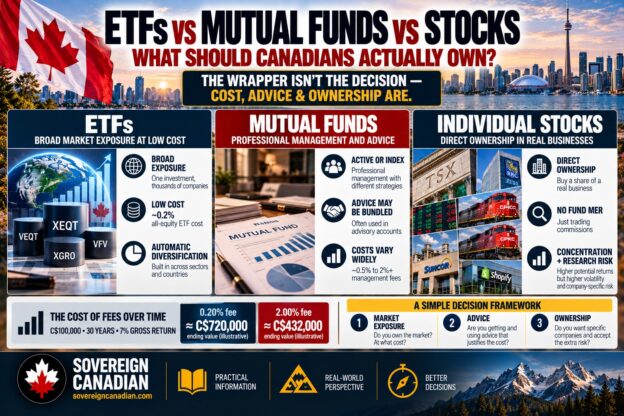
A Canadian who has been investing for fifteen or twenty years and logs into every account at once will often discover that they own all three categories already. There is a balanced mutual fund at the bank, opened when an adviser suggested it and never revisited. There is a one-ticket ETF of the XEQT or VEQT variety, accumulated in the TFSA more recently and with considerably more conviction. And in the non-registered account there are the holdings someone chose on purpose: a Canadian bank or two, Enbridge, CN or CPKC, Brookfield, perhaps Berkshire Hathaway. Each came from a different decision, made at a different time, for a different reason, and most of them have never been compared with each other on any common basis.
The question that follows from that picture is not “which investment type is best?” That framing invites a tournament, and tournaments produce slogans. The more useful question is what job each holding is doing, what it costs, and whether it is earning its place. I own funds, ETFs and individual companies myself, and the purpose of this exercise is not to defend one camp. It is to work out which parts of a portfolio deserve to be paid for, which deserve to be owned directly, and which are simply inherited habits.
Continue reading