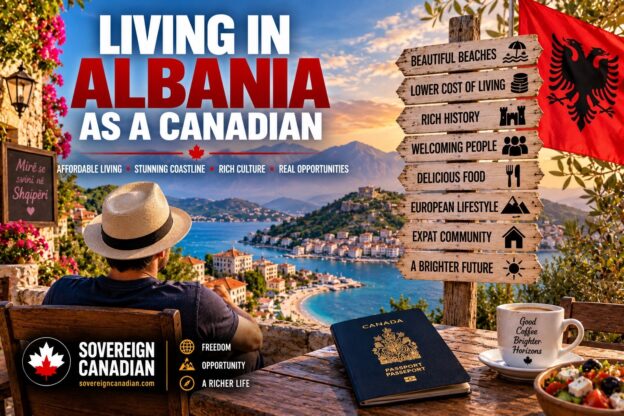
Albania looks, at first, like one of the last obvious arbitrage trades left in Europe. Mediterranean beaches directly across the water from Italy and next door to Greece. Warm winters on the Ionian coast. Housing that costs a fraction of anything in the Mediterranean core. Mountains behind the beaches. A capital in the middle of a construction boom. Residence options that seem unusually relaxed. And an EU accession process that, unlike a decade ago, has started to look genuinely serious.
That is the version of Albania you find on the internet, and every line of it is technically true.
The problem is that the internet is pricing the restaurant bill. This article prices the other things: healthcare when something goes seriously wrong, schooling if you bring children, the tax interaction between Canada and a country Canada has no treaty with, the reliability of institutions you would eventually have to depend on, and the specific question of what happens to a Canadian in Albania at seventy-five rather than fifty-five. When you price those, a cleaner picture emerges, and it is the thesis this article will defend: Albania is cheap to sample and costly to depend on. Nearly everything that makes it easy is front-loaded. Nearly everything that makes it hard shows up later, at exactly the moment you would most need the country to carry more of the weight.
What Albania actually is
Start with the shape of the place, because outdated impressions do real damage here. Albania is a country of about 2.4 million people and shrinking: the 2023 census counted roughly 2.4 million usual residents, down from 2.8 million in 2011, and the official estimate had already slipped to about 2.36 million by the start of 2025, a decline of more than one per cent a year driven overwhelmingly by emigration to Italy, Greece, Germany and North America. Some demographers argue even the census figure flatters the true resident number. It is one of Europe’s poorer countries by GDP per capita, with wage levels a small fraction of Canadian ones, which is the entire engine of the cost arbitrage. It is a NATO member, which matters for the geopolitical baseline. It is an official EU candidate that, as of September 2026, has opened all of its accession negotiating chapters and begun, tentatively, to close a few. It is not in the European Union, and it is not in the Schengen area. The currency is the lek, though euros circulate widely and much of the coastal property market is quoted and transacted in euros.
The transition is real and fast. Tirana in 2026 is not the Tirana of the 1990s or even 2015. There is a serious restaurant and cafe culture, a functioning airport with a growing list of direct European routes, a coastline that has been physically rewired by new highways and a mountain tunnel, and a construction sector building at a pace that is visible from any rooftop. Anyone still carrying a 1997-vintage mental image of Albania is simply wrong.
But the more useful question is not how far Albania has come. It is whether the development is outrunning the institutions. New towers go up faster than the cadastre can cleanly title them. Tourist arrivals grow faster than the tertiary hospital system. Prices converge toward European levels faster than the courts, the tax administration and the planning system converge toward European reliability. Hold that gap in mind. It reappears in almost every section that follows.
There is no single Albanian expat experience
The single most common mistake Canadians make about Albania is treating it as one destination. It is not. The gap between Tirana and a half-built coastal resort town in February is larger than the gap between two different countries. A few places are worth weighting seriously; most are not, at least not for a Canadian trying to actually live somewhere rather than holiday there.
Tirana is the capital, and for most serious Canadian use cases it is the answer by default. It has the international airport within reach, the private hospitals, essentially all of the international schools, the business and professional services, and the only genuinely year-round urban life in the country. It also has the worst traffic, meaningful air pollution, relentless construction noise, and housing costs that in the better neighbourhoods have climbed toward Western European levels. It is the least scenic option and the most functional one, and that trade sits at the centre of several decisions later in this article.
Durres is the large coastal city half an hour to forty-five minutes from Tirana and the airport. That proximity is its whole thesis: beach access without severing yourself from the capital’s hospitals and flights. It is not beautiful in the postcard sense, and parts of it are heavily overbuilt, but it is the most practical way to be on the water and still inside Tirana’s orbit.
Vlore anchors the start of the Riviera in the south, warmer and increasingly developed, the subject of heavy investment and, correspondingly, heavy speculation. Sarande sits on the Ionian coast directly opposite the Greek island of Corfu, and it is the town the internet is usually selling when it sells Albania: turquoise water, cheap apartments, a thirty-minute ferry to Greece. It is also intensely seasonal, congested and expensive in summer, quiet and thinly serviced in winter, ringed by construction, and far from any tertiary hospital. Himare is a smaller, prettier version of the same seasonal problem.
Shkoder in the north offers a different proposition entirely, lower cost, lakes and mountains, quick access to Montenegro, a colder and wetter climate, and a more local rather than tourist rhythm. Korce, inland and higher, is cooler still and is one of the few places on this list where you would be choosing Albanian life rather than a coastal holiday extended into residence.
The practical filter for the rest of the article is simple. Tirana and, for the coast-minded, Durres are the only two places that clear the bar for a Canadian who needs healthcare, schooling and year-round function. Everything south of Vlore is a season, not a life, unless you are unusually healthy, unusually mobile, and content to drive or ferry out for anything serious.
Getting in and staying: the ninety-day correction, then the ladder
Here is a fact worth stating plainly, because a great deal of English-language content gets it wrong: Canadians do not get Albania’s famous one-year visa-free stay. That generous 365-day allowance is a specific, reciprocal privilege extended to United States passport holders, and a surprising amount of “move to Albania” writing quietly assumes it applies to everyone.
It does not apply to Canadians. According to the Government of Canada’s travel advice and the Albanian Ministry for Europe and Foreign Affairs, Canadian passport holders enter visa-free for up to 90 days within any 180-day period, the same short-stay window as the Schengen rule, even though Albania is not a Schengen country. If you want to stay longer, you need a residence permit. Treat any source telling a Canadian they can simply live in Albania for a year on a passport as mistaken.
There is, however, a genuine and often-missed advantage buried in that correction. Because Albania is outside Schengen, days spent in Albania do not consume your Schengen 90-in-180 allowance. For a Canadian rotating around Europe, that is the real structural value: Albania is a place to spend 90 days without burning the Schengen clock, a buffer inside a European itinerary rather than a long-stay base in its own right. That is a smaller and more precise benefit than the internet advertises, but it is real.
Beyond the visitor window, the ladder runs from temporary residence to permanent residence to citizenship, and only a few routes are relevant to a Canadian reader. The financially independent or means-based route and any dedicated retiree route rely on showing stable outside income and accommodation. The employment and business routes require a local job or a company. The remote-work route is the one generating the headlines: the “Unique Permit for Digital Mobile Workers,” Albania’s digital-nomad permit, aimed at people earning from foreign employers or clients. It is applied for through a Type D long-stay visa and then the Unique Permit, largely online, the government fee is modest, and the income bar is low: Albanian tax practitioners put the required foreign income at roughly EUR 1,600 a month, evidenced through twelve months of bank statements. The permit is issued for up to one year and is renewable. Its real draw is written into the tax law, and I return to it below, but in outline: under Law 25/2022, as amended by Law 36/2023, a qualifying digital mobile worker is not treated as an Albanian tax resident for the first twelve months. That is a valuable exemption from Albania’s normal residence test, but it should not be read more broadly than the statute: the treatment of particular income still depends on Albania’s source rules, so anyone relying on the first-year tax position should confirm their specific foreign employment or self-employment income with an Albanian tax adviser.
The whole framework sits in Law 79/2021 on Foreigners, which consolidated these routes into a single Unique Permit issued through the e-Albania portal and, importantly for this article, created explicit categories for pensioners, digital mobile workers, and owners of Albanian real estate. Permanent residence follows after five years of continuous legal residence under Law 79/2021, and the continuity rule is more forgiving than it sounds: what breaks it is leaving Albania for an uninterrupted period of more than twelve months, not ordinary travel in and out. The permanent card is unlimited once granted. Citizenship is a separate and slower path under Law 113/2020 on Citizenship. The current Ministry of the Interior guidance sets ordinary naturalisation at not less than five years of continuous legal residence, alongside a held permanent-residence status, demonstrated knowledge of the Albanian language and history, and financial stability, and it is granted at the discretion of the President by decree rather than as a right. The clock is shorter only for categories that will not apply to most Canadians: three years for people of Albanian origin, and one year of residence plus three years of marriage for the spouse of an Albanian citizen. Albania does allow dual citizenship. On property, Law 79/2021 (Article 84) gives owners of habitable Albanian real estate a defined route to a renewable residence permit, with implementing rules pointing to something like twenty square metres of habitable space per person, held at least half in your own name. But note what it is and is not: a temporary, renewable permit, not a golden visa, not permanent residence and not citizenship, still applied for and granted separately. The sequence a Canadian must internalise is that a visitor allowance is not residence, a residence permit is not permanence, and owning an apartment supports a permit without ever, by itself, handing you the deeper statuses.
The tax reality: lifestyle arbitrage, not tax arbitrage
This is the section that separates a serious analysis from a brochure, and it is where Albania’s low prices stop telling you the truth about your money.
Begin with the Albanian side, which in isolation looks friendly. An individual becomes an Albanian tax resident by having a permanent home in Albania or by spending more than 183 days there in a calendar year, and residents are taxed on worldwide income. Personal income tax on employment income is progressive, with a lower 13 per cent band and a 23 per cent top rate. Dividends are taxed at 8 per cent, interest and capital gains at 15 per cent, and the corporate rate is 15 per cent. The most advertised feature is a 0 per cent income tax regime for self-employed people and small businesses with annual turnover under ALL 14 million (roughly EUR 135,000 to 140,000), set out in Article 69 of the income tax law and scheduled to run to the end of 2029. An initial attempt to carve the liberal professions, consultants, IT workers, lawyers and doctors among them, out of that 0 per cent was struck down by Albania’s Constitutional Court in 2024, so as things stand the relief reaches professional-service activity too, which is why remote freelancers keep appearing in Albania’s tax marketing. What the marketing tends to omit is that the 0 per cent covers profit tax only. Social and health contributions are still payable, VAT registration bites above ALL 10 million of turnover (though services to foreign clients generally fall outside Albanian VAT), the regime expires at the end of 2029, and using it at all means registering locally and, in most cases, becoming an Albanian tax resident taxed on worldwide income. None of that, on its face, looks like a country that will hurt you, but it is a good deal with conditions attached rather than a free lunch.
Now the Canadian side, which is where the arithmetic turns. Canada does not have an income tax treaty with Albania. Albania appears on none of Canada’s lists of treaties in force, treaties signed but not yet in force, or treaties under negotiation, and I am treating the absence of a Canada-Albania income tax treaty as a settled research conclusion rather than an open question. One clarification travels with that conclusion, because the two instruments get conflated: Canada and Albania do have a separate social security agreement, in force since 2022, but that coordinates pensions, not taxes, and it does nothing to allocate taxing rights, break a residence tie or reduce withholding. That absence of a tax treaty is not a footnote. It is the load-bearing fact of this entire section.
What no treaty means, with certainty, on the Canadian side: when you become a non-resident of Canada and Canadian-source retirement money is paid to you, it is subject to Part XIII withholding tax under the Income Tax Act at the statutory rate of 25 per cent, and the Canada Revenue Agency is explicit that the full 25 per cent applies to amounts paid to residents of non-treaty countries. There is no treaty to reduce it. Your Canada Pension Plan and your Registered Retirement Savings Plan and Registered Retirement Income Fund withdrawals take the full 25 per cent as a resident of Albania, where a retiree in a treaty country such as Greece, Cyprus, Malta or Italy would often see a reduced rate on periodic pensions. Lump-sum RRSP and RRIF withdrawals attract the 25 per cent regardless of treaty status anywhere, so on those Albania is no worse than elsewhere, but on the ordinary flow of pension income the missing treaty is a direct and permanent cost. Old Age Security deserves its own line, because it is not simply another 25 per cent. On top of the non-resident tax, OAS carries a recovery tax that claws back the benefit once worldwide income passes an indexed threshold (around C$93,000 for the 2025 income year), and non-residents must file a separate Old Age Security Return of Income to report that worldwide income. More fundamentally, OAS is normally payable abroad indefinitely only if you accumulated at least twenty years of Canadian residence after age eighteen, and below that it would ordinarily stop about six months after departure. But here Albania is not simply a non-agreement country. Canada and Albania have had a Social Security Agreement in force since August 1, 2022, and Service Canada states that creditable periods under Albania’s pension system can, in some circumstances, be counted toward the Canadian residence requirements for OAS, including the twenty-year test for payment abroad. That makes Albania materially different from a country with no Canadian social-security agreement at all: a Canadian who does not independently satisfy the OAS residence requirement may still qualify through totalisation. The agreement does not create an income-tax treaty and does not reduce Canada’s Part XIII withholding, but for OAS eligibility it can matter enormously.
There is one meaningful Canadian-side relief lever even without a treaty. A non-resident can elect under section 217 of the Income Tax Act to be taxed on Canadian pension-type income as if still resident, applying the basic personal amount and the progressive brackets. For a retiree whose worldwide income is modest, that election can pull the effective Canadian tax below the flat 25 per cent. It is not automatic, it depends on your total income, and it is exactly the kind of calculation to run with a cross-border accountant before you leave rather than after.
Then there is the part that requires genuine Albanian professional interpretation, and here I am going to resist the temptation to invent a clean answer. Albania does exempt foreign pension income from tax, and retiree-focused marketing leans on this heavily. But the exemption is narrower than the marketing implies, and this time the limit sits in the statute rather than in practitioner folklore. Albania’s income tax law (Law 29/2023, carrying forward the wording of the previous law) exempts foreign pension income for pensioners who are nationals of European Union countries, for foreign nationals of Albanian origin, and for foreign nationals who have taken Albanian citizenship, in each case holding an Albanian residence permit. A Canadian with no EU passport, no Albanian ancestry and no Albanian citizenship reads as falling outside all three doors. This is the single most consequential line in the retirement case, so confirm it directly with an Albanian tax adviser before relying on it, but on the face of the law a plain Canadian retiree does not get the exemption. If that is right, then a Canadian retiree who becomes tax resident in Albania could find their worldwide pension income inside the Albanian tax base at 13 to 23 per cent, on top of the 25 per cent already withheld in Canada. Albania grants a foreign tax credit under its own law, which should relieve most or all of the Albanian tax given that Canadian withholding is higher, but the interaction between a 25 per cent Canadian withholding and an Albanian credit is precisely the sort of thing that turns on facts and on how Albania characterises a specific Canadian pension. Do not assume it nets cleanly to zero. Get it modelled.
The registered-account question is where the absence of published Albanian guidance becomes its own planning cost. On the Canadian side the treatment is more precise than the slogans suggest. RRSP and RRIF withdrawals face the 25 per cent. A TFSA is subtler than the common claim that it dies on departure: an existing TFSA stays sheltered from Canadian tax after you leave, but you stop accruing new contribution room while non-resident, and any contribution made as a non-resident is hit with a penalty tax of one per cent per month until it is withdrawn, so the practical advice is to stop contributing and simply hold it. RESP and FHSA are Canadian-specific wrappers whose contribution and payment rules turn on residency, and while non-residency affects who can contribute and receive payments and can jeopardise government grants in particular circumstances, departure itself does not automatically trigger an immediate grant clawback, so the honest word is complicated rather than doomed. On the Albanian side, whether Albania recognises the tax-deferred character of an RRSP or RRIF, or instead looks through the wrapper and taxes the income and gains inside a TFSA as ordinary investment income at 8 or 15 per cent, is not something Albanian published guidance clearly resolves. That silence is not comfort. For a Canadian, the honest conclusion is that the treatment of Canadian registered accounts in Albania is unsettled, that you should assume the worst case until an Albanian cross-border specialist tells you otherwise in writing, and that the cost of obtaining that advice is a real line item in any Albania retirement budget.
Leaving Canada properly is the other half of this. Becoming a non-resident is not a mood, it is a facts-and-circumstances test built on severing significant residential ties, and without a treaty there is no tie-breaker article to lean on if the CRA disputes your status, which raises the stakes on doing it cleanly. Departure can trigger the deemed-disposition departure tax on many assets, at the current 50 per cent capital gains inclusion rate, verifiable at the time you act. Canadian real estate kept and rented attracts its own 25 per cent Part XIII withholding on gross rent unless you elect to be taxed on the net, and your provincial health coverage lapses after a defined absence. These are not Albania problems, they are Canada problems, and they are covered in depth in the companion pieces on how Canadian tax residency actually works and Canada’s departure tax.
The distilled version: Albania offers Canadians a convincing lifestyle arbitrage and, at best, a neutral and at worst a negative tax arbitrage. The freelancer under the small-business regime may do genuinely well. The retiree living on Canadian pensions is the profile most likely to discover that “cheap country” and “tax-efficient country” are not the same sentence.
Healthcare: the section that quietly decides it
If tax is where the money story turns, healthcare is where the whole thesis is decided, and it is the reason Albania reads as a chapter rather than a permanent home.
Routine and moderate care is genuinely fine and genuinely cheap. Albania has a public National Health system that legal residents can access, but almost no foreign resident relies on it; it is underfunded, crowded and uneven. Expats use private care, which is concentrated in Tirana. The American Hospital in Tirana is internationally accredited and English-speaking, and there are credible private options alongside it, including German and Greek-affiliated hospitals and a private hospital in Durres. For blood work, imaging, a GP visit, a specialist consult, dental work and minor procedures, the experience is fast, modern and inexpensive by Canadian standards, often a fraction of Canadian out-of-pocket costs, with private insurance available in the range of tens of euros a month.
The ceiling is real but higher than outsiders assume, and this is where Albania deserves the same scrutiny that corrected the Malta analysis. Albania is not a country with no serious medicine. Its national referral centre, the Mother Teresa University Hospital Centre in Tirana, performs open cardiac surgery, neurosurgery, vascular surgery and the country’s organ transplants, and the national oncology service runs chemotherapy and radiotherapy on Albania’s linear accelerator; private hospitals in Tirana, German, American and Hygeia among them, add their own cardiac and cancer capacity. A great deal of genuinely serious care happens domestically, and cheaply. What thins out is the top of the pyramid and the depth behind it: the most complex oncology, advanced and high-volume cardiac surgery, rare-disease management, and anything requiring capacity a single national centre with a single linear accelerator cannot supply on demand. For those cases, and the 2026 guidance for foreign residents is explicit about this, treatment abroad, usually Italy or Greece and sometimes Turkey, remains the standard recommendation. And nearly all of it, public and private, is concentrated in Tirana. For a resident on the southern coast the operative fact is not that Albania lacks tertiary care but that the tertiary care is four to five hours away by road, in one city.
Which answers the question the brief posed and that every prospective retiree should ask honestly. What happens to a seventy-five-year-old Canadian in Sarande who has a serious cardiac event or a cancer diagnosis? The realistic answer is not “the local hospital.” It is stabilisation at the regional hospital, and then a transfer, and the transfer is the problem. A ferry is transport, not a referral pathway: a cardiac emergency in Sarande does not become a relaxed thirty-minute crossing to Corfu, it becomes an ambulance and a four-to-five-hour road transfer to Tirana, or a cross-border medical evacuation to Greece or Italy that has to be arranged, authorised and paid for, ideally through the evacuation insurance you were sensible enough to carry. Corfu is close on a map and much further away as a hospital you can actually be admitted to in a crisis. That is a workable answer for an active sixty-year-old with good insurance and the mobility to travel for treatment. It is a far less comfortable answer for someone frail, alone, or eighty-two.
Set this against the two most recent countries in this series. Malta, for all its density, has surprisingly deep domestic tertiary care at Mater Dei and does not routinely export its serious cases. Cyprus has capable private medicine but the island-dependence caveat. Albania does have real domestic tertiary care, more than the coastal marketing lets on, but the depth behind it is thinner than Malta’s, it sits entirely in one inland-facing capital, and for the hardest cases it leans on proximity to Italy’s and Greece’s hospitals. That continental proximity is a genuine advantage over a remote island, and it is still a dependency. Healthcare is the single factor most likely to convert Albania, in an honest assessment, from a place you retire to into a place you spend a good decade of an active early retirement and then leave.
Families and schooling
For a Canadian family, Albania collapses into one city faster than for anyone else, and the reason is schooling.
Tirana has a real cluster of international schools: an American-curriculum school offering Advanced Placement and the International Baccalaureate, an IB school, additional English-medium options, and French and German schools serving those communities. Enrolment runs into the hundreds across dozens of nationalities, the teaching is credible, and re-entry to a Canadian curriculum afterwards is manageable, which matters if this is a one-year experiment rather than emigration. Tuition is lower than Malta’s or Western Europe’s top tier but is not trivial; figures reported for the most established school reach into the low tens of thousands of euros a year at senior grades, and exact current tuition should be confirmed directly with each school rather than taken from aggregators.
The hard constraint is geography. These schools are in Tirana. The coast, the part of Albania the internet is selling, has essentially no international schooling. A family that wants Sarande’s water or Vlore’s warmth and also wants an IB education for two children is describing two things that do not exist in the same place. In practice, a Canadian family doing Albania properly lives in Tirana, near a school, in traffic, and treats the coast as weekends and summers.
This also quietly undoes part of the cost story. Albania’s cheap-housing headline is real for a couple in a modest flat. It is much less impressive once you add two international-school tuitions to the annual budget, at which point the family’s total cost of living converges toward numbers that no longer feel like a bargain relative to what the same money buys in stability, healthcare depth and school quality back in Canada or in an EU country with a pension treaty. Cheap becomes conditional on not needing the expensive things, and children are one of the expensive things.
Cost of living and the housing reality
Now the number everyone actually came for, handled without leaning on a single crowd-sourced index.
Albania is cheap, but it is no longer as cheap as its reputation, and it is getting less cheap quickly. In Tirana, a furnished one-bedroom in a decent central area runs roughly EUR 400 to 600 a month, a three-bedroom in the centre climbs toward EUR 900 to 1,000, and prime neighbourhoods now list at prices that would not embarrass a mid-sized Western European city. On the coast, Durres offers the most affordable sea access, Vlore sits in the growth-and-yield zone, and Sarande’s long-term market is distorted by the summer short-let economy and shows signs of overheating. All of these figures are volatile and should be treated as directional, verified at the time you act.
Against that, the day-to-day is where the arbitrage lives. Restaurant meals, produce, coffee, domestic help, local transport and services are dramatically cheaper than in the Greater Toronto Area. A single person can live comfortably in Tirana on well under C$2,000 a month all in, a couple on a modest but real European lifestyle for something in the low thousands, and early-retirement or Coast-FIRE budgets that would be impossible in Canada become plausible here. The prior question of whether to live abroad as a Canadian at all is where this series starts.
But the right question is not whether Albania is cheap. It is what standard of life the savings actually buy. And the answer is that the savings are real on the variable, sample-able parts of life, food, weather, space, daily texture, and thin to negative on the parts you would depend on, healthcare depth, institutional reliability, school choice outside Tirana, and legal certainty around property. This is the price-convergence thread worth naming directly: in Tirana’s better districts you are increasingly paying tomorrow’s European prices for today’s non-European institutions. The rent has moved toward Europe faster than the courts, the hospitals and the planning system have. That mismatch is not a reason to avoid Albania. It is a reason to be precise about which version of Albania you are buying, and at what stage of the convergence.
Housing quality and the risk hiding under the price
Because this is an expat-life article and not the dedicated real-estate analysis, keep the investment questions contained, but do not skip the resident’s experience of Albanian housing, because cheap square metres and cheap housing risk are not the same thing.
The physical stock is uneven. New coastal towers can be attractive and can also be thrown up fast, with variable insulation, thin walls, unreliable hot water and pressure, and heating and cooling that assume you will personally manage the shortfall. The electricity supply has improved markedly over the past decade but still sees the occasional outage, which is why many residents in modern buildings keep a backup water tank and treat the odd interruption as ordinary. Construction noise is a genuine daily fact of life in the boom zones. Seismic risk is real; Albania’s 2019 earthquake was deadly and exposed how much informal and non-compliant construction exists. And the legal layer is the one that catches foreigners: the cadastre and title system carries a legacy of informal construction, contested ownership and incomplete records, which is why buying blind is dangerous and why independent legal title verification is not optional. Foreigners can generally own apartments and buildings but face restrictions on agricultural land. The headline lesson for a resident is to rent, in a modern building, for long enough to learn a neighbourhood’s water, power, noise and winter damp before committing capital, and to treat any purchase as a legal project rather than a lifestyle impulse. The purchase side, valuations, yields, title mechanics and the buyer’s due-diligence sequence, is the subject of the dedicated Albania real estate investing for Canadians analysis.
Infrastructure and the friction budget
Here is a concept worth carrying through the rest of the article: the friction budget. Canada is expensive partly because an enormous amount of coordination happens invisibly and reliably, and you pay for it in taxes and prices without noticing. Albania is cheaper partly because the resident personally absorbs more of that coordination, in time, uncertainty and workarounds. The question is not whether Albania is cheaper. It is how much of the financial saving is quietly repaid as friction.
The evidence says: a moderate but real amount. Roads and coastal connectivity have genuinely improved, with new highways and the Llogara tunnel collapsing a notorious mountain drive into minutes. Tirana’s airport is a functioning hub with a growing route map. Government digitisation through the e-Albania portal is, by regional standards, ahead of the curve, and a lot of bureaucratic interactions have moved online. Internet is generally good in the cities, which is why the remote-work pitch works at all.
Against that, the cash economy is still substantial, card acceptance is patchy outside the main centres, banking as a foreigner can be slow and document-heavy, driving standards and traffic in Tirana are genuinely stressful, public transport is limited, and the gap between the official process and the lived process, between the law and the practice, is wide enough that many residents end up paying a lawyer or a fixer to make routine things happen on schedule. None of this is disqualifying. It is the texture of a country still building its systems in public. But a Canadian used to systems that simply work should budget for a friction tax on top of the visible one, and should expect it to be highest exactly where they are most impatient.
Safety, institutions and the trust gap
Albania’s organized-crime reputation does it a disservice at the level of daily life, and it is worth separating two things that get lumped together: personal safety and institutional trust.
On personal safety, Albania is, for ordinary residents and visitors, notably calm. Violent crime against foreigners is uncommon, street harassment is low by regional standards, and many Canadians report feeling safer walking Tirana at night than they would in parts of major North American cities. Canada’s travel advice for Albania sits at its lowest tier, take normal security precautions, the same level Canada assigns most of Western Europe, with the practical warnings confined to petty crime and road safety rather than any expectation that a normal resident will be a target. The United States rates Albania one notch higher, at exercise increased caution, citing crime and organized-crime violence, so a reader can weigh both, but their own government’s baseline is unusually reassuring. Women travelling and living solo generally report positive experiences. Petty theft and road risk are the realistic day-to-day concerns.
Institutional trust is the weaker column, and this is where the honest Canadian question lives: can daily life be personally safe while the institutions remain materially less trustworthy than Canada’s? The evidence says yes, and that this is precisely the trade. Corruption, uneven contract enforcement, property disputes and slow or unpredictable administration are recurring themes in EU accession assessments and World Bank material, and they are the reason judicial reform sits at the centre of the accession process. You are unlikely to be robbed. You are more likely to be entangled, in a title dispute, a permit delay, a contractual disagreement where the enforcement machinery is slower and less certain than you are used to. For a Canadian, the practical translation is that Albania is a fine place to live your daily life and a country where you should never sign, buy or commit without independent professional protection, because the safety net of reliable institutions that you take for granted in Canada is thinner here.
Climate and the season that makes you leave
This series has a rule: scout the season most likely to make you leave, not the one most likely to make you buy. Apply it here, because Albania is very good at selling itself in the one week you should trust least.
The coast in late spring or early autumn is close to idyllic, and that is the trap. The southern Ionian coast in high summer is hot, crowded and expensive, its small towns straining well past capacity. The same coast in deep winter is quiet, damp and thinly serviced, with many businesses shuttered and the Corfu ferry schedule thinning out. Tirana’s summers are hot and increasingly marked by heat and by real air pollution, and its winters are grey and wet rather than snowbound. Inland and northern locations like Korce and Shkoder are genuinely cold and wet in winter. Wildfire risk in the hot months and seismic risk year-round are both real.
The season that would make a Canadian leave depends on the place. In Sarande it is February: the emptiness and the closed shutters, not the August heat, are what expose whether you actually want to live there or merely holiday there. In Tirana it is high summer: the heat and the pollution, not the pleasant shoulder seasons, are the test. A snowbird escaping an Ontario winter for the southern coast is a defensible use of Albania. A permanent resident who fell for the coast in June and never saw it in January is the person most likely to be quietly miserable by their second winter.
Language, integration and remote work
Two questions that look like one but are not: can a Canadian function in Albania without Albanian, and can a Canadian belong in Albania without Albanian?
On function, the answer is a qualified yes, better than you would expect and worse than Malta. English is common among younger people and in Tirana’s professional, hospitality and expat-facing world, and Italian is widely understood thanks to decades of television and migration. You can arrange healthcare, banking and daily life in English in the capital with some patience. Outside Tirana, and in any interaction with government, older landlords, trades and the bureaucracy, English thins out fast and you will lean on translation, a lawyer, or a bilingual fixer. Albanian itself is a hard, isolate language that few foreigners master.
On belonging, the answer is a clearer no without effort. This is the same lesson Malta taught from the opposite direction: in Malta, English removes nearly all functional friction, which makes it dangerously easy to live years there while remaining socially separate. Albania is harder to function in and, precisely because you must reach for help more often, arguably easier to start integrating, but real social belonging still runs through Albanian and through time. Function is buyable. Belonging is not.
For remote work, the practical picture is strong on paper and needs one honest asterisk. City internet is good, coworking exists in Tirana, power is adequate, and the digital-nomad permit plus the low cost of living make the pitch attractive. The asterisk is time zone. Albania is roughly six hours ahead of Toronto, similar to Malta, which is excellent for a European-facing worker and a grind for a North American-facing one, whose meetings land in the Albanian evening. Grade the two separately: for a Canadian doing European or asynchronous work, Albania is a genuinely good and cheap base; for a Canadian on Toronto or New York hours, the evening-shift problem is a real and permanent cost that the low rent does not fully offset.
EU accession: a convergence trade, not a guarantee
Albania’s EU path is the most interesting speculative layer in the whole proposition, and it has to be handled as analysis, not prophecy.
As of September 2026 the status is real and advanced. Albania has opened all thirty-three of its negotiating chapters, received a positive interim benchmark assessment on the fundamentals in May 2026, and at the July 2026 accession conference provisionally closed its first three chapters, science and research, education and culture, and external relations. Three of thirty-three is a start, not a finish; closure stays provisional until every chapter closes together, and Montenegro, by comparison, is already past halfway. The government’s stated ambition is to conclude negotiations in 2027 and join around 2030. Independent analysts are more cautious, treating 2030 as ambitious-but-possible, 2028 as the theoretical earliest, and the early 2030s as entirely plausible if reforms slip or EU enlargement appetite cools. Albania and Montenegro are widely seen as the front-runners of the current cohort. I am not going to state an accession date as fact, and neither should any source you rely on.
The analytically useful way to hold this is as a convergence trade. Accession, if and when it comes, could eventually lift residency and mobility rights, property demand, wages, prices, investment, infrastructure and regulatory reliability toward EU norms. That is the upside. The catch is the sequencing, and it is the secondary thesis of this whole article: the prices and the lifestyle appear to be converging toward Europe faster than the institutions are. You risk buying tomorrow’s European prices while still living with today’s non-European courts, hospitals and administration. So the accession question is not “will Albania join and therefore is it a buy.” It is “am I being compensated, in today’s cost and today’s lifestyle, for holding an institutional risk that may take a decade to resolve and may resolve into higher prices before it resolves into better systems.” For a mobile, reversible position, that trade can be attractive. For a permanent, dependent one, it is a bet dressed as a plan.
Albania versus Greece, Croatia and Montenegro
Three comparisons a Canadian will inevitably run, handled by committing to answers rather than hedging.
Against Greece, the honest verdict is that Greece wins for anyone whose decision is weighted toward permanence, health and pensions, and Albania wins only on raw cost and only for the reversible. Greece has a Canada tax treaty, deeper healthcare, EU and Schengen membership, and a specific and well-known flat-tax regime for foreign retirees. The question the brief poses is the right one: how much cheaper does Albania have to be before a Canadian accepts the healthcare and institutional gap versus Greece? For a retiree on Canadian pensions, the answer is “cheaper than the gap is worth,” and Greece is usually the better answer despite the higher cost. For a young remote worker under Albania’s small-business regime, the calculus can flip; the Greek side of that comparison is laid out in full in living in Greece as a Canadian.
Against Croatia, the pattern is instructive. Croatia emerged in this series as a superb chapter country whose permanence was constrained despite mature EU and Schengen institutions. Albania is tilted even further toward the chapter side, but for a different reason: not because its lifestyle is worse, in some respects the coast and the cost are better, but because its institutions are a bet rather than a given. Croatia is a chapter country with reliable systems; Albania is a chapter country whose systems are still under construction. If anything, that makes Albania the more strongly reversible of the two. I made the fuller case in living in Croatia as a Canadian.
Against Montenegro, keep it brief, because Montenegro earns its own article next in this series. A Canadian weighing Albania will inevitably also look north to Montenegro’s Adriatic coast, its own small-country non-EU status, its property and residency options, and its own tax profile. One concrete distinction is already worth banking: neither country appears to have a Canadian income-tax treaty, but Albania has a Canada social security agreement, in force since 2022, and Montenegro does not, which hands Albania a real edge for CPP and OAS qualification through totalisation. The short version is that they are cousins with different balances of coast, cost, scale and infrastructure, and the comparison deserves more room than a paragraph, which it will get. For now, note only that choosing Albania without at least glancing at Montenegro would be incomplete.
Both Greece and Cyprus, along with Malta, sit in the background of every one of these trades, and the pension-treaty question is the thread that keeps favouring them for the retiree profile.
Five Canadian models
The proposition only makes sense once you attach it to a specific person. Five Canadians, five different answers.
Model A, Seasonal Albania. A Canadian spending three to four winter or shoulder-season months on the southern coast without becoming resident. Legal basis: the 90-in-180 visitor allowance, comfortably within reach and, usefully, not consuming Schengen days. Likely tax status: none in Albania, still a Canadian tax resident. Best geography: Sarande or Vlore in shoulder season, or Durres for airport proximity. Key advantage: cheap warmth with a European rotation and no residency paperwork. Key risk: mistaking a good October for a viable February. Exit: trivial, you simply fly home. This is Albania at its strongest.
Model B, One-Year Family Albania. A Canadian family with two school-age children doing a single deliberate year. Legal basis: a residence permit, likely on financially-independent or remote-work grounds. Likely tax status: watch the 183-day line carefully, because crossing it pulls worldwide income into Albania. Best geography: Tirana, near an international school, full stop. Key advantage: an affordable, vivid year abroad with credible schooling and easy re-entry to the Canadian curriculum. Key risk: tuition plus the friction budget erasing the savings, and the coast being a weekend fantasy rather than the daily life imagined. Exit: clean at the end of the school year.
Model C, Remote Albania. A Canadian professional earning foreign income. Legal basis: the Unique Permit for digital mobile workers. Likely tax status: a genuine twelve-month exemption from Albanian tax residence, materially improving the first-year tax position for a qualifying digital mobile worker, though the treatment of the worker’s particular income still needs to be tested against Albanian source rules; then, if you stay past 183 days, Albanian tax residence on worldwide income, with the 0 per cent small-business regime available to soften year two and beyond, but only until it sunsets at the end of 2029, and only once you register locally and pay Albanian social contributions. Best geography: Tirana for infrastructure, Durres for water access. Key advantage: for year one, one of the better tax-and-cost combinations in this whole article, though it narrows once you cross into tax residence. Key risk: the Toronto time zone if the work is North American. Exit: straightforward while the permit is annual.
Model D, Albania Retirement. A healthy Canadian couple moving at sixty and intending to stay into their eighties. Legal basis: financially-independent or retiree residence. Likely tax status: the difficult one, no income-tax treaty, full 25 per cent Canadian withholding on pensions, an Albanian pension exemption that probably does not reach a non-EU Canadian, and unresolved treatment of registered accounts; the Canada-Albania social security agreement helps with OAS qualification but does not reduce any of that tax. Best geography: Tirana, for the hospitals, whatever the coast’s appeal. Key advantage: a low cost of living for an active early retirement. Key risk: everything that arrives after seventy-five, when the healthcare ceiling and the aging-in-place problem become the whole story. Exit: this is the model most likely to need a real exit, back to Canada or to a treaty country, and the plan should assume it.
Model E, Albania as a Second Base. An affluent, internationally mobile Canadian using Albania for optionality rather than emigration. Legal basis: residence permit held lightly, or simply repeated visitor stays. Likely tax status: carefully kept non-resident in Albania, remaining resident somewhere more favourable. Best geography: a modern Tirana apartment or a well-titled coastal property treated as a base, not a life. Key advantage: cheap geographic diversification and a continental foothold that asks very little to maintain. Key risk: title and construction quality on any property, and overestimating how much sovereignty a lightly-held base actually confers. Exit: designed in from the start. Using a country this way is a flag-theory move more than an emigration, and it should be planned like one.
Make one family decision
Strip away the menu. A Canadian couple with two primary-school children wants to spend exactly one school year in Albania. One location, no hedging.
The answer is Tirana, and it is not close. Weigh the factors the way a parent actually will. Schooling: only Tirana has international schools, which by itself settles it, because a one-year family experiment that wrecks a child’s education is a failure regardless of how nice the beach was. Healthcare: the country’s real hospitals and the accredited private options are in Tirana, which is what you want within reach when two children get sick in a foreign country. Airport: Tirana is the connectivity, for the inevitable trips home. Traffic, green space and walkability are genuine negatives, Tirana is congested and its air is not clean, but a family can choose a greener district and a school with a bus, and those are solvable. Cost is higher than the coast but still low by Canadian standards. Family life, the actual weekday rhythm of school runs, groceries, clinics and friends, functions in Tirana and does not function anywhere on the coast.
Choose Tirana, live near the school, accept the traffic, and spend the coast on weekends and the summer half. The couple that insists on Sarande for the year will spend it driving four hours for anything that matters and re-teaching a curriculum from a laptop.
Make one retirement decision
Same discipline, higher stakes. A healthy Canadian couple moves at sixty and expects to remain past eighty. One location.
The series rule governs here: at sixty the beach map is tempting, at eighty the hospital map is the only one that counts. Weight the decision the way an eighty-year-old would, not the way a sixty-year-old wants to. Healthcare and emergency access come first, then walkability and flat terrain, then year-round services, then airport access, then heat, then social life, then cost, and scenery comes last.
On that weighting the answer is Tirana. Not the coast, not a compromise, Tirana, because the one thing an eighty-two-year-old cannot improvise is fast access to the country’s only concentration of tertiary hospitals, and that access decays with every kilometre you move away from the capital. Durres is the tempting runner-up, close enough to keep those hospitals and the airport within a short drive, and a couple who simply cannot live without the sea will make a defensible case for it, but it is a runner-up, not a second answer: if the decision is forced to one place, it is Tirana. Sarande, the place the internet would choose, fails the eighty-year-old test: it is beautiful, warm and social in summer, and it is far from tertiary care, hard on failing knees in its terrain and its stairs, thinly serviced in winter, and dependent on a ferry or a long drive for anything serious. It is a wonderful place to be sixty-five and a frightening place to be eighty-two and alone.
So the honest retirement recommendation is the unromantic one. Base in Tirana for the medical map and the connectivity, use the southern coast as the reward rather than the residence, and build the plan around the near-certainty that late old age in Albania will mean either frequent medical travel to Italy or Greece or an eventual return to a country with deeper care and a pension treaty. Choosing the coast for retirement is choosing the ten good years and refusing to plan for the hard ones.
What money solves, and what it doesn’t
Affluence changes this analysis, but only up to a sharply defined line, and naming the line is more useful than any cost table.
Money solves a great deal in Albania. It buys private healthcare instead of the public system, a modern well-built apartment instead of the coastal average, a car and a driver instead of the traffic and the buses, lawyers and accountants instead of the bureaucratic friction, international school instead of the language barrier, good air conditioning against the summer heat, and private transfers instead of the airport slog. For an affluent Canadian, most of the day-to-day frustrations in this article are purchasable away, which is exactly why Albania can be a genuinely comfortable base for someone with capital.
Money does not solve the things that actually cap the proposition. It cannot manufacture tertiary-care depth that is not there, so the most complex illness can still mean travel abroad no matter your net worth. It cannot buy institutional trust, faster courts, or cleaner title records for the country as a whole. It cannot fix Tirana’s traffic or air at the city scale, only your personal exposure to them. It cannot shorten the distance to Canada or resolve the EU-accession uncertainty. And it cannot purchase belonging or the Albanian language. The affluent Canadian gets a much better version of the sample. They do not get to convert Albania into a country they can safely depend on for everything, because the ceiling is structural, not financial.
Does Albania increase a Canadian’s sovereignty?
This is the question the whole site exists to ask, so answer it directly. Sovereignty, in the flag-theory sense, means optionality and reduced dependence on any single state. Does Albania add it or merely swap one set of dependencies for another?
The honest answer is that Albania increases a certain kind of sovereignty precisely because it asks so little to maintain, and fails as the place you make your last stand. As a cheap, low-commitment flag, a continental foothold, a second base, a Schengen-clock buffer, an affordable seasonal option, a comparatively accessible one-year renewable residence permit, Albania is genuinely useful and genuinely underpriced. It is worth being precise here, because the residence research qualifies the easy-to-hold claim. A single permit renewed year to year asks little, and the letter of the law is forgiving: continuity toward permanent residence is only broken by leaving for more than twelve months at a stretch. But the statuses worth having presume real settlement. Naturalisation turns on Albanian-language competence and genuine integration, not just an unbroken permit, and building that kind of presence means actually living there, which past 183 days a year makes you an Albanian tax resident on worldwide income. You can hold a permit lightly for optionality, and Albania’s residence law is surprisingly forgiving about doing so. But the deeper you move toward citizenship and genuine permanence, the less lightly the country can be held: language, integration and actual settlement eventually enter the equation, while spending enough time there also brings Albanian tax residence into view. Even so, it adds geographic optionality at a cost that barely registers, and its non-island geography gives it real escape routes by road and ferry that Cyprus and Malta lack. That is a legitimate sovereignty gain for a mobile Canadian.
But sovereignty also means not being trapped, and dependence is the opposite of sovereignty. The moment Albania stops being a base you hold and becomes the country you rely on for healthcare, for institutional protection, for the systems that carry you through illness and age, it starts subtracting sovereignty rather than adding it, because you would be exchanging Canada’s expensive-but-reliable dependence for a cheaper and materially weaker one. The synthesis, then, is the cleanest statement of the whole thesis: Albania raises a Canadian’s optionality in direct proportion to how little they ask it to carry, and lowers it in direct proportion to how much they do. Hold it lightly and it is a good flag. Lean your whole weight on it and it becomes a liability disguised as a bargain.
The Canadian use-case scorecard
Grades are A through F, and they are meant to spread, because a country that is a B at everything is being described dishonestly.
| Use case | Grade |
|---|---|
| Reconnaissance trip | A |
| Seasonal / snowbird base | A- |
| One-year family sabbatical | B+ |
| One-to-five-year family relocation | B- |
| Retirement on Canadian pensions | C |
| Retirement on investment income | B- |
| North-American-facing remote work | C+ |
| European-facing remote work | A- |
| Ordinary entrepreneur | B |
| Internationally mobile investor / second base | A- |
| Tax residence (retiree) | C- |
| Tax residence (small-business freelancer) | B+ |
| Permanent-residence flag | B |
| Eventual citizenship | C+ |
| Aging in place past 75 | D |
| Permanent relocation | C |
The shape of that column is the article. Albania scores highest on the reversible, sample-able, lightly-held uses and lowest on deep dependence, aging and the pension-funded retirement, with a standout B+ for the self-employed remote worker who can use the small-business regime. Read down the grades and the thesis reads itself.
The verdict
Fifteen questions were posed. Here are the committed answers.
- Who should seriously consider Albania: reversible Canadians, snowbirds, one-year families, mobile investors, and above all self-employed remote workers who can use the small-business regime.
- Who should choose elsewhere: Canadians planning a pension-funded permanent retirement, anyone who needs deep healthcare certainty, and anyone unwilling to run their daily legal and administrative life through a lawyer.
- Season, chapter or permanent home: emphatically a season or a chapter, and only rarely a permanent home.
- Is meaningful cost arbitrage still available: yes, but shrinking, and concentrated in daily life rather than prime housing.
- Is Albania actually cheap once Canadian-standard healthcare and schooling are bought: much less so, and for a family with international-school children, only conditionally.
- Good retirement destination for Canadians: good for active early retirement, poor for late old age, and weakened throughout by the missing income-tax treaty, even though the Canada-Albania social security agreement eases OAS qualification.
- Good portfolio-funded retirement destination: better than pension-funded, because investment income sidesteps the Part XIII pension problem, though the aging ceiling remains.
- Attractive for affluent Canadians: yes, as a comfortable and purchasable base, within the structural ceiling money cannot lift.
- Attractive for families: yes for a defined chapter, in Tirana, with eyes open about tuition.
- Attractive for remote workers: yes for European-facing and self-employed workers, a qualified no for those on North American hours.
- Best family base: Tirana, decisively.
- Best retirement base: Tirana, with Durres the sea-loving runner-up rather than a co-equal answer.
- Useful residence flag: yes, a cheap and easy one, best held lightly.
- Does EU accession change the thesis: not yet, and treating today’s Albanian citizenship as a future EU passport is speculation, not a plan.
- Sovereignty or swapped dependence: sovereignty when held lightly, swapped dependence when leaned on.
The one-line version, earned rather than asserted: Albania is cheap to sample and costly to depend on, an outstanding chapter country and a precarious permanent home, and the Canadians who do best there are the ones who never ask it to carry more than they can afford to walk away from.
What I’d Actually Do
If I were seriously weighing this for my own family, in sequence.
- Decide honestly whether I am testing Albania as a cheap season, a multi-year chapter or a genuine home, because the entire analysis changes with that one answer.
- Accept that as a Canadian I get 90 days in 180, not the American year, and design any long stay around a residence permit or a European rotation rather than a myth.
- Use Albania’s non-Schengen status deliberately, as a 90-day buffer that does not burn my Schengen clock.
- Spend real time in Tirana before letting the coast seduce me, because Tirana is where the healthcare, schools and connectivity actually are.
- Visit Sarande or Vlore in February, not July, and let the empty version cast the deciding vote.
- Model my Canadian departure first, the residency severance, the departure tax at the current inclusion rate, the real-estate and health-coverage consequences, before I model anything Albanian.
- Establish, from Canadian primary sources, the non-resident withholding on my CPP, OAS, RRSP and RRIF income, including the 25 per cent baseline that applies with no Canadian income-tax treaty, then separately model the OAS recovery tax and whether I meet the twenty-year Canadian-residence test for indefinite OAS payment abroad, remembering that the Canada-Albania social security agreement may let creditable Albanian periods help satisfy it.
- Ask a cross-border accountant whether a section 217 election lowers that number for my income profile.
- Get an Albanian tax professional to tell me, in writing, whether the foreign-pension exemption reaches a non-EU Canadian and how Albania will treat my RRSP, RRIF and TFSA, and treat any hand-waving as a red flag.
- Conclude, on that evidence, whether Albania offers me lifestyle arbitrage, tax arbitrage or only the first, and proceed accordingly.
- Price private health insurance including medical evacuation, and find out exactly where my likely serious cases would be sent, Tirana, Corfu, Athens or Italy, before I trust the local clinic.
- If children are involved, price the international school in Tirana before I call Albania cheap.
- Rent, furnished, in a modern building, for at least a full seasonal cycle before considering any purchase.
- Verify title, cadastre status and construction quality independently through my own lawyer, never the seller’s, on anything I might buy.
- Pursue property, permanence or citizenship only after Albania has earned it across a full year, and keep the exit designed in for the day health, children or age changes the maths.
This article is general information for Canadians and is not legal, tax, immigration or investment advice. Rules, rates, thresholds and program terms change and should be confirmed against current primary sources at the time you act. Cross-border tax and residence outcomes turn on individual facts; before making decisions, consult a qualified Canadian cross-border tax adviser together with a licensed Albanian tax and immigration professional. Currency conversions are approximate and move with exchange rates.