
A Canadian decides Japan works. I have already made that case at length in Living in Japan as a Canadian, so I am not reopening it here. The visas, the tax residency ladder, the schooling trade-offs, the safety and the hazards all still apply exactly as I described them there. Nothing about choosing Osaka instead of Tokyo changes a single national rule.
But once Japan clears that first test, a second question arrives fast: Tokyo or Osaka. I went into this research expecting to answer that question. I came out of it thinking the question itself is slightly wrong.
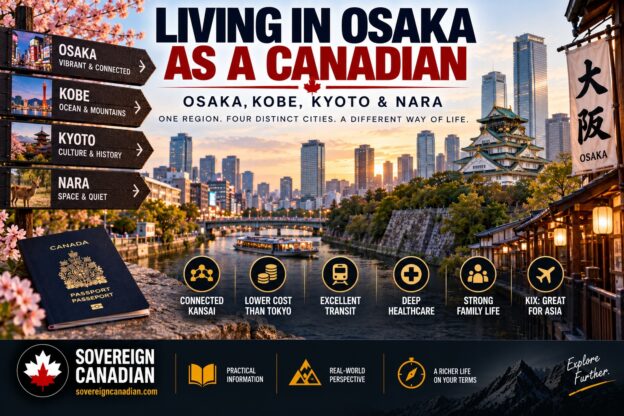
Here is why. Someone can live in Kobe and be standing on the platform at Osaka Station about twenty minutes later. Someone can live in Nara and reach Namba in well under forty. Kyoto and Osaka are connected by a train fast enough that a Canadian used to commuting across the Greater Toronto Area would barely register the distance as remarkable. Osaka, Kobe, Kyoto and Nara are not four cities that happen to be near each other. They function, for a lot of daily life, as one interconnected region with several downtowns.
That reframes the useful question. It is no longer just “Osaka or Tokyo.” It becomes: where do you need to be every morning, where do your kids go to school, which station do you actually live beside, do you need a hospital with English-speaking staff nearby or can you manage more Japanese-language friction for specialist care, do you fly home to Canada often enough that a seasonal airline route matters to your life, and do you want Osaka outside your front door or is twenty-five minutes away close enough.
That is the article: a regional living deep dive, not a repeat of the national guide and not a real estate pitch. Property gets its own detailed treatment in Japan Real Estate for Canadians, and a future piece will likely look at buying in Kansai specifically. Here I care about one question only: what is it actually like to build a life somewhere in this region, and does that life beat the equivalent one in Tokyo.
The Kansai Picture, at a Glance
Before the detail, here is the orientation I wish I had going in. These are qualitative judgments, not scores out of ten, and the rest of the article explains why the table looks the way it does.
| Factor | Osaka | Kobe | Kyoto | Nara |
|---|---|---|---|---|
| Housing cost | Moderate | Lower | Similar to Osaka | Lowest |
| Housing space | Moderate | Moderate to high | Moderate | Highest |
| Transit | Densest in the region | Very good | Good, strained by tourism | Good to Osaka and Kyoto, thinner locally |
| Airport access | Best, direct express | Good, same corridor | Good, direct express | Weakest, requires a transfer |
| Healthcare | Deepest bench, most English density | Full specialist depth, more language friction | Full specialist depth, more friction | Weakest, leans on Osaka and Kyoto |
| International schools | Strong | Strong | Limited; DISK is winding down toward 2029 closure | Limited depth, but one full Grade 1–12 option plus a public IB high school |
| English accessibility | Strongest | Strong, old international community | Moderate, university-linked | Weakest |
| Family life | Strong | Strong | Mixed, tourism pressure | Strong for space, weak for services |
| Career opportunities | Strongest in the region | Moderate, port and life-sciences linked | Weak outside academia | Weakest |
| Business opportunities | Strongest | Strong | Weak outside academia | Weakest |
| Food and urban life | Strongest, most variety | Strong, distinct character | Strong but crowded at the core | Quiet, limited |
| Nature access | Moderate | Strong, sea and mountains | Moderate | Strong |
| Tourism pressure | Moderate | Low | Highest by far | Low to moderate |
| Summer climate | Hot | Some coastal moderation | Hot, humid, basin-trapped | Hot, basin-trapped |
| Car-free living | Easiest | Easy centrally, harder on the hillside | Workable with friction | Workable in the city, harder outside it |
| Retirement at 65 | Strong | Strong, especially centrally | Moderate, tourism a daily friction | Weakest |
| Aging at 80 plus | Strongest | Weaker on the hillside, strong centrally | Moderate | Weakest |
| Overall pace | Busiest | Calmer | Calm outside the core, chaotic inside it | Quietest |
Nobody wins across the board. That is the point.
Kansai as One Region, and Where That Idea Breaks
Start with the geography, the single most underappreciated fact in this whole decision. Kansai is not really Osaka plus three day trips. It is a single, overlapping rail network that happens to pass through four historically distinct cities.
The numbers are worth sitting with. From Osaka’s Umeda station, the JR Special Rapid reaches Kobe’s Sannomiya station in about 21 to 22 minutes, and the same service reaches Kyoto in about 24 to 29 minutes. It is, in fact, the same line: JR West’s Special Rapid runs continuously from Kyoto through Osaka to Sannomiya and on to Himeji, timetabled roughly every 15 minutes through the day. From Namba, a Kintetsu Rapid Express reaches Kintetsu Nara in roughly 34 to 40 minutes, and Kobe to Kyoto, on that same JR corridor, runs about 50 minutes, one seat, no change. Layer on Hankyu, Hanshin, Keihan and the Osaka Metro network, and you get a genuinely redundant system: there is rarely only one way to get somewhere, and the alternatives are frequently competitive on both time and price.
The practical upshot is that choosing Kobe, Kyoto or Nara over Osaka proper does not mean giving up Osaka. It means trading a few minutes of travel time for a different housing budget, climate, pace, or school, a genuinely different proposition than the equivalent choice in most metro areas.
Now the part that keeps this from becoming an unqualified sales pitch for regional thinking. A 21-minute express train is not a 21-minute door-to-door commute, and that gap is exactly where the elegant version of this thesis needs a caveat. Add the walk to the station, the wait, and a possible transfer at the other end, and the actual daily trip from a home in hillside Kobe to a school or office near Namba can run considerably longer each way than the headline express time suggests. Rush-hour crowding is real, not theoretical, and a stroller or a bag of groceries changes the experience of it considerably. Last trains matter too: this network effectively stops running around midnight, give or take by line, which means an evening in central Osaka has a fixed endpoint if you live in Kobe or Nara, in a way that driving home at any hour in Canada simply does not.
So the honest formulation is this. Kansai is genuinely one region for the flexible, occasional parts of life: weekends, a specialist doctor’s appointment, a school open day, a business trip into the city. It is a looser, more qualified region for the rigid, daily parts of life: the school run, a fixed office start time, getting home after a late dinner. City boundaries matter less here than a Canadian would expect. Station access and daily destination still matter quite a lot.
What Osaka Itself Is Actually Like to Live In
Osaka proper is the biggest, densest, and most convenient single option in the region, and it is worth describing on its own terms before comparing it to anything else.
Umeda is the commercial and transit core: department stores, office towers, and the busiest station complex in western Japan, where the JR, Hankyu, Hanshin and Osaka Metro lines converge within a few minutes’ walk of each other. Namba and Shinsaibashi, to the south, form Osaka’s entertainment and shopping spine, dense, loud and extremely walkable, with the highest concentration of restaurants and nightlife. Honmachi sits between the two, more of a business district with a quieter edge. North of Umeda, the city thins into the Yodogawa corridor and Shin-Osaka, and from there into the northern suburbs that matter enormously for the family section below.
Day to day, Osaka retains most of what makes Japan feel remarkable to a Canadian without charging the full Tokyo premium for it. Transit is excellent and genuinely comprehensive. Everyday safety sits at the same level the national article already documented for Japan broadly. Food, at every price point from a standing noodle counter to a proper izakaya, is a real strength, not just tourism marketing. Healthcare, covered in detail below, is deep at the top end and unusually accessible in English by Kansai standards, concentrated particularly around the city’s major commercial districts.
What Osaka does not do is out-Tokyo Tokyo, and it should not be sold as though it does. Tokyo still has a deeper professional job market across more industries, more international-school capacity, more English-language service depth spread across more neighbourhoods, and a materially better year-round air-connectivity picture to Canada, a point I return to in detail below.
Osaka’s advantage is not that it replicates Tokyo at a discount. It keeps most of what a foreign-income Canadian actually wants from Japan — transit, safety, healthcare, food and cleanliness — at a lower cost and smaller scale, while giving up some career depth and connectivity to get there.
Osaka Versus Tokyo: What Do You Actually Give Up?
Housing is the clearest and most consistent finding, even without leaning on precise figures that would not survive close scrutiny. Osaka runs materially cheaper than Tokyo across the comparisons I found, and the difference becomes especially relevant once a household needs more than a small apartment. The proposition Canadians hear repeated online, that a Tokyo one-bedroom budget can sometimes stretch into a larger Osaka apartment, is directionally supported by the available evidence, though I would not attach an exact multiplier to it without better primary rental data.
Career opportunity is where Tokyo pulls ahead cleanly, and I do not think Kansai boosters should pretend otherwise. Tokyo is deeper for finance, multinational headquarters functions, consulting, and the broad category of generalist white-collar work most relocating professionals actually do. Kansai’s economy is real but narrower: manufacturing, industrial automation, machinery, maritime and logistics, chemicals, pharmaceuticals, and a genuinely current life-sciences and deep-tech cluster tied to the region’s universities. I return to that economy properly later, because it deserves more than a one-line dismissal, but the honest framing for a generalist is that Tokyo still has the deeper bench.
International schooling follows the same pattern. Tokyo has more schools, more capacity and more curricula on offer; Kansai has good schools but far fewer of them, which narrows the housing map far more aggressively here, a finding I treat properly in the family section below. Healthcare quality at the top end does not meaningfully favour Tokyo; what favours it is the density of everyday, English-accessible care. Air connectivity gets a section of its own too, because it is the single sharpest and most underreported difference between the two cities for a Canadian, and it is not really about cost at all.
None of this should collapse into a single number. A Canadian who cares most about cost and lifestyle has a real case for Osaka. A Canadian who needs the deepest job market, the most international-school options, or reliable year-round flights home has a real case for staying in Tokyo. The honest comparison respects both.
Kobe: The Alternative I Would Take Seriously
If Osaka is the obvious answer, Kobe is the one I think most Canadians researching this decision are underrating.
Kobe has a genuinely distinct identity, not a diluted version of Osaka’s. It was one of Japan’s first ports opened to foreign trade in the nineteenth century, and that history is still visible in Kitano, the old foreign-settlement district above Sannomiya, full of preserved Western-style houses and a long-established international community. Sannomiya and Chuo-ku form the commercial and transit core, dense and walkable in the way Osaka’s centre is, just calmer. Rokko Island, an artificial island a short train ride away, is home to Canadian Academy and functions as something close to a self-contained international community within the city.
Kobe’s geography is its own selling point: mountains directly behind a working port, the sea in front, and a coastal position that can moderate the feel of summer somewhat compared with the more enclosed, basin-trapped conditions inland. All four cities share hot, humid Japanese summers, and Kobe still gets genuinely hot. The sea changes the character of the city more than it changes the season.
The city’s economy is also real, not decorative. Kobe and Osaka jointly operate what is formally called Hanshin Port through the Kobe-Osaka International Port Corporation, and Kobe remains one of Japan’s major container ports, historically ranking as high as sixth in the world before the 1995 earthquake changed its trajectory. That port economy anchors a long-standing base in steel, shipbuilding and machinery, and has grown a newer life-sciences and biomedical cluster on the city’s artificial islands, connecting directly to the healthcare strength described below.
Healthcare in Kobe is genuinely strong, not a compromise. Kobe University Hospital and Kobe City Medical Center General Hospital provide serious specialist and tertiary care, and Kobe University Hospital operates an International Medical Communication Center for international patients.
There is an important distinction here, though. A foreign patient travelling to Japan specifically for treatment goes through the hospital’s international-patient pathway, which involves medical coordination and can involve formal interpreter requirements. A foreign resident of Japan covered by Japanese public health insurance is instead directed through the hospital’s normal domestic-patient system. Language can still create real friction, and paid medical interpretation is available, but I would not treat living in Kobe as automatically meaning that every foreign resident must arrive at every specialist appointment with a paid interpreter. The practical disadvantage versus Osaka is more about the thinner density of easy English-language everyday care than a difference in the underlying quality of the hospitals.
Between Kobe and Osaka sits a corridor most Canadians researching this decision have never heard of, and it deserves treatment as a genuine third option rather than a footnote to either city. Nishinomiya, Ashiya and Shukugawa run along the rail lines linking the two cities, and living there means treating both downtowns as accessible rather than choosing one.
Ashiya specifically has a long-established reputation as one of the region’s affluent residential enclaves, with low-rise housing, detached homes and some extremely expensive properties. Nishinomiya and Shukugawa offer variations on the same Osaka-Kobe corridor idea without requiring someone to live in either downtown.
The one honest caveat on Kobe is topography. The hillside neighbourhoods that make it so appealing, with the sea and mountain views and the closest connection to that old international character, involve genuine elevation change, charming at fifty-five and a real mobility problem at eighty. I come back to this in the retirement discussion below. Central, flat Kobe — Sannomiya and Chuo-ku specifically — does not carry the same trade-off.
Kyoto: Wonderful Place to Visit, Should You Live There?
Kyoto deserves a more skeptical treatment than almost anything written about it in English, because the tourist experience and the resident experience have genuinely diverged.
Overtourism is not an abstract complaint if you live there. The pressure falls disproportionately on the historic core and on parts of the transport system residents use for ordinary life. A bus that works perfectly well on an ordinary weekday can become a very different proposition when the same route is carrying thousands of visitors toward Kyoto’s best-known sites.
Kyoto’s summer is also genuinely difficult, for reasons that have nothing to do with tourism. The city sits in a basin surrounded by mountains, which contributes to hot, humid and relatively stagnant summer conditions. Nara shares much of this basin effect; Kobe’s coastal geography gives it a different feel, though every one of these cities has a real Japanese summer to plan around.
None of that means Kyoto has nothing to offer a resident. It has a real, non-tourist identity built around Kyoto University and a substantial academic community, and residential neighbourhoods away from Gion, Arashiyama and the heaviest visitor corridors function like ordinary Japanese neighbourhoods rather than theme parks.
The schooling picture, however, has become less attractive for a family planning several years ahead. Doshisha International School Kyoto, in Kizugawa within the Kansai Science City corridor, has confirmed that the school will close in 2029 once its remaining students have left. Its admissions have already been progressively restricted as the school winds down. It may still matter to an existing family already tied to the school, but I would not build a new long-term Kyoto relocation plan around DISK today.
The honest question is whether Kyoto is a city you want to live inside every day or one you would rather keep twenty-five minutes away. An academic, a remote worker whose daily geography avoids the tourist corridors, or a culture-focused retiree drawn specifically to Kyoto’s temples and seasonal rhythms has a real case for choosing it. A family whose daily life runs through the same streets tourists have discovered has a harder case, and Kyoto is not, on current evidence, a place I would default a family toward without a specific reason pulling them there.
Nara: The Space and Quiet Option That Actually Works
Nara is the thinnest-covered of the four cities in most English-language material about living in Japan, and it deserves better, because the case for it is real rather than a consolation prize for people priced out of the other three.
The transit numbers make Nara’s real position clear. Kintetsu Nara to Namba runs roughly 35 to 40 minutes on faster services, JR Nara to Osaka Station closer to 50 minutes, and Kintetsu links Nara and Kyoto in roughly the same broad range. Nara can therefore treat much of Kansai as its wider catchment rather than functioning as an isolated prefecture.
Housing follows directly. Nara is consistently the least expensive of the four broad choices in the comparisons I found, with more opportunity to trade central-city amenity density for larger units and detached housing.
Schools are where Nara’s case is stronger than most people assume. Kansai Christian School, near Heguri Station, is a genuine Grades 1 through 12 English-medium school, not a partial one, and is one of the more affordable full-time international options in the region. Its model is deliberately small and explicitly Christian, which will be a feature for some families and a reason to look elsewhere for others. Nara Prefectural Kokusai High School adds a distinctive public international option for older students.
That said, one full Grades 1–12 school plus a small number of alternatives is still a much shorter list than Tokyo, Osaka or Kobe can offer. Nara’s schooling depth should therefore be read as “workable and specific,” not as parity with the larger cities.
Healthcare is Nara’s real weak point, more so than for Kobe or Kyoto. Nara Medical University Hospital, the prefecture’s genuine tertiary academic centre, sits in Kashihara, south of Nara City itself, and English-language medical infrastructure is thinner than in Osaka. The realistic pattern for an international resident may be routine care handled locally where possible and more complex or English-mediated specialist care handled either there or elsewhere in the wider Kansai medical system.
That catchment framing works cleanly for the flexible parts of life: an occasional specialist appointment, a weekend, a remote-work schedule with no fixed hours. It works far less elegantly for the rigid parts: a daily commute with a fixed start time, complex healthcare that cannot wait for a convenient travel day, or frequent trips through Kansai International Airport, which Nara does not reach as directly as the other three cities.
Even on schooling, having one obvious full-continuum international option rather than several means a family has less fallback if Kansai Christian School’s small, Christian-affiliated model is not the right fit for a particular child.
Put plainly, Nara is strongest for a family willing to trade service depth for space, or for a financially independent household or remote worker with real schedule flexibility. It is weaker for an internationally oriented professional needing to be somewhere specific every morning, and weaker still for an elderly retiree who may eventually depend on nearby, English-accessible specialist care more than a larger house.
Where Would a Family Actually Live?
For a Canadian family planning around an international school, the school will very often choose the neighbourhood, not the other way around, and Kansai’s school map is small and specific enough that this decision resolves faster here than it would in Tokyo.
Osaka International School, with its sister school Senri, sits in Minoh, north of central Osaka, and is one of Kansai’s major international-school anchors. A family tied to the school realistically starts its housing search in Minoh, Toyonaka, Suita and the surrounding northern-Osaka corridor rather than in Namba.
Osaka YMCA International School provides another central-Osaka option and anchors a family much more toward Kita-ku and the urban core.
Canadian Academy, on Rokko Island in Kobe, is one of the region’s major international schools and anchors a family toward Kobe and the Osaka-Kobe corridor. Rokko Island itself is a planned, family-oriented community connected to the JR and Hanshin systems through the Rokko Liner, and Canadian Academy describes central Kobe as roughly twenty minutes away and Osaka as roughly thirty-seven minutes away from the island.
Kansai Christian School, in Nara’s Heguri, is the fourth real anchor rather than a footnote: a full Grades 1 through 12 school and the clearest reason an international-school family could deliberately choose Nara rather than simply settling there for cheaper housing.
Doshisha International School Kyoto belongs in a different category now. It has confirmed that it will close in 2029, and admissions are already being wound down. For an existing student it can still be relevant; for a Canadian family beginning a fresh long-term relocation plan, it should no longer be treated as one of Kansai’s durable school anchors.
Other schools can expand the map for particular ages and families, but that does not change the underlying point. Kansai has good international education. It does not have Tokyo’s depth. When one school fits a child particularly well, the school can end up choosing the rail line and therefore the neighbourhood for the entire family.
At six, that constraint matters much less because local Japanese elementary school remains a realistic option for families willing to make the immersion trade-off described in the national Japan article. At fourteen or seventeen, the number of realistic English-medium alternatives becomes far more consequential.
For how a child’s age and temperament interact with a move like this, see The Expat Year with Kids.
Housing: What Does the Money Actually Buy?
This section is about living somewhere, not investing in it. For the ownership rules, the minpaku regulatory picture, and the investment mechanics, see Japan Real Estate for Canadians; none of that is repeated here.
The core conceptual point is one I have not seen made clearly elsewhere. In Tokyo, housing cost mostly dictates how much space you can afford. In Kansai, geography hands you a second lever: move twenty to forty minutes along the rail network and you can materially change the housing proposition without leaving the region at all.
A budget that produces a small apartment in the centre of Osaka can stretch further in northern Osaka or parts of Kobe. Move along the Osaka-Kobe corridor and the housing mix changes again. Move toward Nara and larger units and detached housing become more realistic. The exact rents change too quickly, and vary too much by station, building age and walking distance, for me to pretend there is a single useful multiplier. The broader pattern is much more robust: Osaka generally costs less than Tokyo, and the wider Kansai region gives a household more ways to trade commuting time for space.
Expect the same broad rental customs across the region as the national article already described nationally: deposits, move-in fees, and the guarantor-company system many foreigners encounter. I have not found strong enough sourcing to say whether Osaka’s key-money culture runs meaningfully lighter than Tokyo’s, so I would not build a relocation budget around that assumption.
Buying a personal residence eventually, rather than renting indefinitely, is a real question for anyone planning to stay five years or more, and the same logic applies: the rail network means the choice of where to buy is a choice among several genuinely different housing markets inside one connected region. The ownership mechanics themselves, financing, seismic-era building codes, and cross-border tax treatment, are covered properly in the real estate article rather than here.
Healthcare: Osaka’s Advantage Gets Bigger With Age
Kansai does not meaningfully lag Tokyo in medical quality at the top end. What it lags in is the density of everyday, English-accessible care, and that gap is not evenly spread across the four cities.
Osaka University Hospital is one of the country’s major academic tertiary centres, and Osaka more broadly combines substantial specialist depth with a larger selection of clinics accustomed to international residents. That combination — top-end specialist medicine plus relatively accessible everyday care — is one of Osaka’s strongest practical advantages within Kansai.
Kobe’s major hospitals provide serious specialist care as well. As discussed earlier, the hospital process for a foreign resident enrolled in Japanese public health insurance is not the same as the international medical-tourism pathway for someone flying into Japan specifically for treatment. Language remains a practical consideration, but the distinction matters.
Kyoto likewise has genuine tertiary medical depth through institutions such as Kyoto University Hospital, alongside more accessible hospitals and clinics serving ordinary residents.
Nara Medical University Hospital is a genuine tertiary centre but sits outside Nara City and exists within a thinner English-language medical environment.
Here is where the age question matters more than almost anything else in this article. At forty-five, this may barely register; routine care with some Japanese, translation technology and patience can be manageable across the region. At sixty-five, it starts to matter more, particularly for anyone managing a condition requiring regular specialist visits. At eighty, it can outweigh almost every other factor here, including a bigger house or a quieter street.
Osaka’s healthcare advantage is real at every age, and it gets proportionally larger as the person asking the question gets older.
KIX: The Canadian-Specific Weakness
This is the sharpest and most underreported finding in the whole research process, and it deserves treatment as one of this article’s central contributions rather than a footnote.
Start with what Kansai International Airport actually is, because the common assumption that it is internationally thin compared with Tokyo is wrong for most of the world.
KIX is a substantial international airport with particularly strong connectivity across Asia. Korea is exceptionally well served, and the airport has extensive links across Southeast Asia, Taiwan, Hong Kong and mainland China. Europe is thinner but not absent, and Australia is reachable directly as well. For a Canadian using Japan as a base for wider travel around Asia, Kansai’s location can be a genuine advantage rather than a compromise.
The real, specific gap is North America, and Canada within that.
Air Canada is the key Canadian carrier serving Osaka, but KIX does not offer the same broad, dependable year-round Canadian nonstop network that Tokyo does. Vancouver and Toronto service has been seasonal, and there is no comparable nonstop Montreal route. Airline schedules change frequently enough that I would check the actual season for the year of travel rather than rely on an article like this for precise start and end dates.
That distinction matters because airline booking pages can show an Osaka-to-Canada itinerary in winter without that itinerary being a nonstop Osaka-to-Canada flight. A connection through Tokyo, Vancouver, Seoul or another hub still gets you home; it just is not the same proposition as living beside an airport with year-round direct Canadian service.
Compare that with Tokyo, where Air Canada’s Canadian network is materially deeper. That is the real, sharp difference. Kansai is not internationally isolated. Its excellent Asia connectivity simply does not translate into equally strong Canada connectivity.
Whether that matters depends entirely on your own life. A Canadian flying home once every year or two on a flexible schedule can plan around seasonal service or accept a connection and treat KIX’s Asia access as a genuine upside. A Canadian with aging parents, children studying back home, or regular Canadian business travel should weigh the difference much more heavily.
It is exactly the kind of thing that only becomes visible once you try to live somewhere rather than visit it.
Do You Need a Car?
Keep this practical rather than turning it into a driving guide; the national article already covers the country-level rules.
| Location | Car necessity |
|---|---|
| Central Osaka | Unnecessary |
| Central Kobe | Unnecessary |
| Hanshin corridor, Nishinomiya and Ashiya | Usually unnecessary |
| Northern Osaka suburbs | Useful but optional |
| Kyoto, residential wards | Optional, with real trade-offs |
| Nara City | Increasingly useful |
| Hillside Kobe | Meaningfully useful |
| Outer Nara | Useful for many family routines |
The pattern behind the table is straightforward. Anywhere flat and dense with two or three overlapping rail lines — central Osaka, central Kobe, the Hanshin corridor — works comfortably without a car. Kyoto is workable but adds friction, since the bus network that would normally substitute for a car is also carrying substantial visitor traffic. Nara City is genuinely workable without one but feels more like a choice than a given, and once you move to outer commuter areas, the calculation starts tipping toward ownership, particularly for family errands and trips that do not follow a rail line.
Hillside Kobe belongs in its own category for the reason already covered: elevation, not distance, decides it there.
Osaka’s Personality: Fact or Cliche?
This deserves care, because it is easy to slide from something real into something the evidence does not support.
The real part first. Osaka-ben, part of the broader Kansai-ben dialect family, has documented vocabulary, grammar and intonation differences from the standard, Tokyo-based Japanese most learners study. Osaka also has a long cultural identity tied to commerce and merchant life rather than being the country’s political capital. The perception within Japan of Osaka speech and social interaction as more direct and informal therefore has a real cultural basis rather than being purely an invention of English-language travel writing.
It is tempting to take the next step and conclude that this automatically makes Osaka easier for a foreigner to integrate into. I do not think the evidence supports going that far.
It is plausible that a more casual social register makes some everyday interactions feel easier for someone working with imperfect Japanese. But pleasant surface interaction is not the same thing as deeper belonging. The national article’s core finding still stands: real integration correlates with language investment, time, relationships and participation in ordinary Japanese life, not with simply choosing the “friendlier” city.
Osaka may make the social surface of daily life feel easier and more conversational. That is a different claim from making it easier to actually belong, and the two should not be blurred together.
The Weekend Map
Part of what makes a place livable is what an ordinary Friday evening or Saturday morning can turn into, and this is not a section about tourism. It is a section about what a resident’s actual weekend radius looks like.
The easy tier, a spontaneous same-day outing from central Osaka, includes Kobe, Kyoto, Nara and Himeji. That is a genuinely unusual cluster for one metropolitan region: several major historical or cultural cities, each distinct, all within casual day-trip range of each other.
A step further out, Lake Biwa, Wakayama, and the mountain temple complex at Koyasan all fit comfortably into the full-day category. Further still, and better treated as an overnight trip, sit Kinosaki Onsen in northern Hyogo; Awaji Island, across the strait from Kobe; and the Setouchi art-island region toward Shikoku.
Tokyo’s own weekend radius is also excellent, and I would not claim Kansai simply wins this comparison. Hakone, Nikko, Kamakura and the ski country of Nagano and Niigata are all accessible from the capital.
What is genuinely distinctive about Kansai’s version is the mix rather than the raw distance: historical capitals, another major city with its own mountains and coastline, a preserved castle town, onsen, beaches, an inland sea and rural Japan all stacked unusually close together.
Tokyo’s radius and Kansai’s radius are different kinds of good.
The Business Case for Kansai
It is worth explaining the Kansai economy properly rather than reducing it to the shorthand that Osaka simply has jobs.
Kobe and Osaka jointly form the Hanshin Port complex, anchoring one of Japan’s major industrial and logistics regions. Steel, shipbuilding, heavy machinery, manufacturing and port-related activity have deep roots here, an economy that predates the tourism and technology stories dominating most casual coverage of the region.
Layered on top is a more modern deep-tech and life-sciences story. Osaka University, Kyoto University and Kobe University anchor substantial research ecosystems, while the wider region has strengths in biotechnology, robotics, advanced manufacturing, pharmaceuticals, electronics and related fields. Kobe specifically has built a significant biomedical cluster on its artificial islands.
The Canadians with a genuine, defensible economic reason to choose Kansai over Tokyo therefore form a fairly specific group: manufacturing and industrial-automation professionals, maritime and logistics specialists with a real reason to be near a working port complex, life-sciences researchers and founders, and academics with ties to one of the region’s major universities.
A generalist finance, consulting or platform-technology professional still has a materially deeper opportunity set in Tokyo, and I would not stretch the Kansai case to cover that group just to make the argument tidier.
This is a different economic specialization, not a cheaper version of the same one.
Natural Hazards: Where in Kansai Matters
The national article already covers Japan’s earthquake and typhoon exposure at the country level, so I will not repeat that here. What is worth adding is the regional insight: within Kansai, micro-location matters more than a simple ranking of the four cities against each other.
Osaka Bay’s low-lying and reclaimed areas sit in a materially different risk category from the city’s higher, older ground. Elevation, flood exposure and whether a site sits on reclaimed land matter enough that I would check any specific address against the relevant municipal hazard map rather than rely on a general impression of the neighbourhood.
Northern Osaka carries a separate exposure: the 2018 Osaka earthquake was an inland, shallow event, a reminder that Osaka’s hazard picture is not simply the Nankai Trough and nothing else.
Kobe’s defining disaster, the 1995 Great Hanshin earthquake, was likewise an inland, shallow earthquake, and the disaster demonstrated dramatically why building age and seismic standards matter. I would be cautious about assuming newer waterfront stock on Kobe’s reclaimed islands is automatically safe purely because it is newer; construction date matters, but site conditions and the individual building still matter too. Kobe’s hillside districts carry a different risk again: landslide exposure from steep terrain, distinct from waterfront liquefaction concerns.
Kyoto and Nara share an inland profile: no direct tsunami exposure, but real earthquake risk and local flood or ground-condition risks that vary by neighbourhood.
None of this is a reason to avoid the region. Japan’s building standards, disaster planning and warning systems are among the reasons living there remains viable despite the underlying geology. The point is simply that choosing a specific part of Kansai changes your risk profile in real, nameable ways, worth knowing before you sign a lease rather than after.
Where I Would Actually Live
This is not a ranking, and I want to resist the temptation to turn it into one, because the honest answer keeps changing depending on which version of a life you are actually planning.
If I were thirty-five, building a business or working remotely without children yet, I would default to central Osaka, for the density, the career depth, and the sheer convenience of everything within a short walk or train ride. I would seriously consider Kobe if my specific work pointed there, something in the port, logistics or life-sciences economy that made its professional network genuinely useful rather than merely pleasant.
If I had school-aged children, the school would decide the neighbourhood before I did, and I would follow without much resistance: Minoh, Toyonaka or Suita if anchored to Osaka International School; central or Hanshin-corridor Kobe if anchored to Canadian Academy; Nara’s Heguri corridor if Kansai Christian School’s smaller, Christian-affiliated model genuinely fit our family. I would not build a new long-term family strategy around DISK given its scheduled 2029 closure.
I would not treat any of those choices as final, either. Children’s needs change, and Kansai’s network at least makes switching schools without switching regions a genuine option, which is not nothing.
At fifty to sixty-five, still working or managing a business, I would stay in Osaka or Kobe depending on which one my work and desired pace actually pointed toward, and I would be honest with myself about which mattered more that decade.
At sixty-five, healthy, with immigration status already settled, this is the genuinely split decision the research kept returning. Central Kobe appeals on pace, international character and its sea-and-mountain geography. Central Osaka wins on healthcare depth, flatness and sheer convenience. I do not think there is a universally correct answer here, and I would want to spend real time in both before committing, exactly the advice the national article already gives about testing Japan before moving permanently.
At eighty and beyond, the evidence pulls toward central Osaka more firmly than at any earlier stage: flat streets, the region’s deepest hospital bench, better odds of finding English-accessible care, and dense, walkable services all matter more at that age than a bigger house in Nara or a quieter street above Kobe.
That is not a comfortable thing to plan around at fifty-five, when Kobe’s hillside charm might feel like exactly the right trade for a slower life. It is worth planning around anyway.
The Flag Theory View
I have written before about how Flag Theory breaks a country decision into separate, independently optimizable pieces — residence, tax, business, property, and so on — rather than expecting one country to win on every dimension at once.
The Kansai question is not about planting every flag in Osaka specifically. It is narrower: if Japan is already your lifestyle or residence flag, does choosing Kansai over Tokyo actually improve that specific flag’s proposition?
On lifestyle, the case is strong: lower housing costs relative to Tokyo, serious healthcare, genuinely excellent transport, and a weekend radius most Canadians would find remarkable.
On connectivity, it depends on direction: excellent for Asia, weaker specifically for Canada and North America, which matters enormously if frequent trips home are part of the plan and barely at all if they are not.
On business, it is a real but narrower proposition than Tokyo’s, strong for the specific industrial, maritime and life-sciences profiles described earlier, and weaker for a generalist.
On education, it is a real constraint that concentrates rather than eliminates your housing choices.
How much any of this matters depends on the role Japan is playing in your life. A one-year family experiment, covered in more depth in my Expat Living pillar piece, can absorb Kansai’s Canada-connectivity gap relatively easily. A multi-year base for someone who needs frequent Canadian business travel should weigh that gap much more heavily. A posting tied to Kansai’s actual industrial economy may make the career logic more important than the flight network. A retirement base, immigration status already solved, should weight healthcare, mobility and daily convenience increasingly heavily with age.
Conclusion: The Wrong Question Is “Osaka or Tokyo?”
Return to where this started. The research simply does not support declaring Osaka better than Tokyo, and I am not going to force that conclusion just because it would make a tidier ending.
Tokyo is the deeper global city. It has greater career breadth, more international-school capacity, more English-language service depth, and materially better year-round Canadian air connectivity. None of that changes because Osaka is cheaper or because Kobe has the sea outside the window.
Osaka is the centre of a different proposition entirely.
Living there, or in Kobe, the Hanshin corridor, Kyoto or Nara, gives access not just to whichever city you happen to have chosen but to an unusually well-connected region where all of those places, plus northern Osaka’s suburbs and everything between, combine through one genuinely capable transport system.
That system is real. It is also not magic.
School runs remain school runs regardless of how elegant the rail map looks on paper. Fixed commutes remain fixed commutes. Last trains run on a schedule, not on your convenience. Kansai International Airport still makes Canada harder to reach than Tokyo’s airports do. English-language services remain thinner than in Tokyo, unevenly so across the four cities. A family with a teenager has a shorter list of serious international-schooling options here than in the capital, and an eighty-year-old will likely care far more about being close to excellent medical care than about an extra bedroom in Nara.
What Kansai actually offers, once all of that is priced in honestly, is optionality rather than a single, clean advantage.
A Canadian moving here does not have to choose as starkly as they might expect between a dense global city, a quiet family suburb, a historical culture town, an international port city, and a lower-cost commuter base. Much of that range exists inside one connected region, reachable from a single home base with real, if imperfect, ease.
So the right question is not Osaka or Tokyo.
It is narrower and, I think, more useful: given what you actually need on an ordinary Tuesday morning, and what you actually need at three in the morning if something goes wrong, where in Kansai does the life you want genuinely work?
That is a harder question to answer in one paragraph than “which city is better,” and it is the only honest one this research actually supports.
This article is general information, not legal, immigration, tax, financial, medical or real-estate advice. Rules, prices, school admissions, flight schedules and healthcare procedures change; verify anything material to your own decision with the relevant primary source or qualified professional.