Category Archives: Financial

Topics involved with financial sovereignty

Smith Maneuver diagram showing the readvanceable mortgage conversion loop for Canadian homeowners

The Smith Maneuver: A Deep Dive for Canadians Who’ve Already Read the Hype

The Smith Maneuver might be the most over-marketed strategy in Canadian personal finance. Search for it and you’ll find an ecosystem of certified specialists, courses, and books all selling the same dream: turn your mortgage into a tax deduction and retire rich on the spread. The pitch is seductive because the mechanics are real — this is a legitimate, CRA-recognized structure, not a loophole. But “legitimate” and “right for you” are different questions, and almost nobody selling the Smith Maneuver is incentivized to tell you when the answer is no.

Continue reading →

Whole life insurance in Canada guide with book, analysis notebook, and before-you-buy checklist on a desk

Whole Life Insurance in Canada: When It Actually Works (and When You’re Being Sold)

Whole life insurance in Canada is the most aggressively sold financial product I know of — and also the most reflexively dismissed. The insurance industry treats it like a miracle. The personal finance internet treats it like a scam. Both camps are being lazy, and if you’re a Canadian professional with real assets, you deserve better than a slogan.

Here’s my position up front, so you can decide whether to keep reading: for most Canadians, whole life insurance is the wrong product. Term insurance plus disciplined investing wins the math for the majority of households, most of the time. But “most people, most of the time” is not “everyone, always” — and there are three or four specific situations where whole life is not just defensible but genuinely the best tool available. If you own a cottage, run a corporation, or have maxed your registered accounts, one of those situations might be yours.

This post is the deep dive. What whole life actually is, why the default answer is still term, where the product earns its keep, and where the sales pitch falls apart under a calculator.

Continue reading →
The playgrounds flag — a Canadian's guide to where you spend your time, showing a field guide, checklist and tablet covering how presence creates tax residency, day-counting both ways, Schengen limits, and designing a year that doesn't backfire.

The Playgrounds Flag: Where You Spend Your Time

This is the fifth deep dive in my flag theory series, and it’s the one people assume is just the fun part. Where you vacation. Where you enjoy the money. And it is that — but there’s a hook buried in it that can quietly undo the residency flag you worked so hard to plant. So we’re going to enjoy the beach.

New to the series? Read the Flag Theory introduction first — it lays out the full six-flag framework.

Continue reading →
The asset haven flag — a Canadian's guide to banking abroad, showing a field guide, T1135 reporting document and tablet covering stability over secrecy, currency diversification, a second banking system, and why to plant this flag first.

The Asset Haven Flag: Banking and Investing Across Borders

This is the fourth deep dive in my flag theory series, and it’s the one I’d tell most people to plant first. Not because it’s the most powerful flag, but because it’s the cheapest, the most reversible, and the best teacher. If you’re going to learn the discipline flag theory requires, offshore banking done right is where you learn it. 

New to the series? Read the Flag Theory introduction first — it lays out the full six-flag framework.

Continue reading →
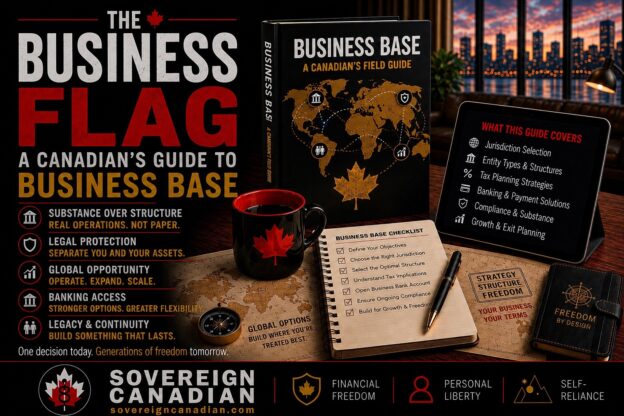
The business flag — a Canadian's guide to business base, showing a field guide, checklist and tablet covering jurisdiction selection, entity structures, tax planning, banking, compliance and substance, and growth and exit planning.

The Business Base Flag: Where Your Income Is Legally Earned

This is the third deep dive in my flag theory series. We’ve covered citizenship (the foundation) and residency (the lever). Now we get to where your money is actually made — the business base flag.

This is also the flag where good intentions turn into bad structures fastest. So I’m going to spend as much time on the tripwires as on the opportunity.

New to the series? Read the Flag Theory introduction first — it lays out the full six-flag framework.

Continue reading →
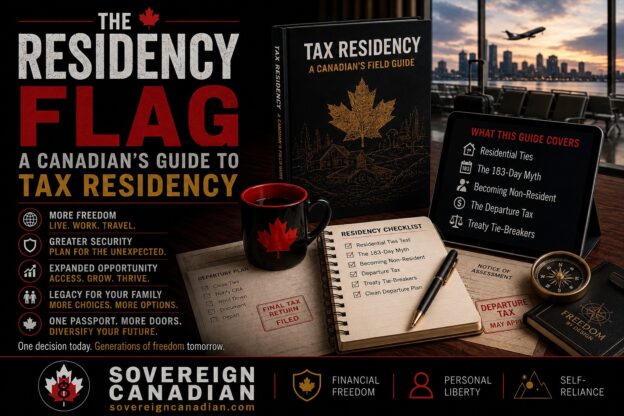
The residency flag — a Canadian's guide to tax residency, showing a field guide, departure plan and tablet covering residential ties, the 183-day myth, becoming non-resident, the departure tax and treaty tie-breakers.

The Residency Flag: How Canadian Tax Residency Actually Works

This is the second deep dive in my flag theory series, and it’s the one that matters most. If citizenship is the foundation, Canadian tax residency is the lever. It’s the flag that decides whether the whole framework saves you anything or does nothing at all. New to the series? Read the Flag Theory introduction first — it lays out the full six-flag framework.

I’m going to spend real time here, because this is also the flag people get catastrophically wrong. They assume moving is a vibe. It isn’t. It’s a documented legal act with a bill attached.

Continue reading →
The citizenship flag — a Canadian's guide to a second citizenship, showing a Canadian passport, globe, travel journal and tablet listing why a second citizenship matters.

The Citizenship Flag: A Canadian’s Guide to a Second Citizenship

This is the first deep dive in my flag theory series. If you haven’t read the overview yet, start there — it explains what planting flags means and why our residency-based tax system gives Canadians an edge Americans have to fight for. New to the series? Read the Flag Theory introduction first — it lays out the full six-flag framework.

Here we’re taking apart flag one: citizenship. And I’ll be honest up front, because most content on second citizenship is written by people selling one. A second citizenship is the slowest, least urgent flag on the board. It’s also the one I’d start positioning for earliest — and those two things aren’t a contradiction.

Continue reading →
Flag Theory for Canadians introduction — a Canadian passport, globe, travel journal and tablet listing the six flags: citizenship, residency, business base, asset haven, playgrounds, and digital.

Flag Theory for Canadians: An Introduction to Planting Flags

I first ran into flag theory the way most people do: buried in an offshore forum, wrapped in enough tinfoil that I almost closed the tab. The pitch sounded like a fugitive’s escape plan. Second passports. Numbered bank accounts. A guy on a beach who technically lives nowhere.

Then I actually read the idea instead of the caricature. And flag theory turned out to be something much more boring, much more useful, and — for a Canadian specifically — much more legal than the internet lets on.

Continue reading →

RESP Deep Dive: The Registered Education Savings Plan for Canadians Who Plan in Decades

Most personal finance accounts in Canada ask you to trust the government with your money and take the tax benefit on faith. The RESP is one of the few where the government just hands you cash. Contribute, and Ottawa deposits a 20% match into the account — no clawback, no means test for the basic grant, no strings beyond “the kid eventually enrols in something.” I’m generally skeptical of anything marketed as “free money.” This is the rare case where the label is accurate.

The Registered Education Savings Plan is also one of the most misunderstood accounts in the country. People over-contribute and get penalized. They front-load and quietly forfeit thousands in grants. They panic when a kid takes a gap year, or moves abroad, or decides university isn’t the plan — and they make expensive withdrawal decisions because nobody explained the three buckets of money inside the account. And for the readers of this site — incorporated, mobile, thinking about jurisdiction — there’s a whole layer that the mainstream RESP guides never touch: what happens to this account when you or your child stop being a Canadian resident.

Continue reading →