
Category Archives: Financial

Topics involved with financial sovereignty

RRSP versus TFSA in Canada comparing tax deferral, tax-free growth and different life stages

RRSP vs TFSA: The Decision Changes as Your Income Rises

RRSP versus TFSA is one of those Canadian personal-finance questions that seems to have acquired a standard answer: use the RRSP when your income is high and the TFSA when your income is low. That is basically correct, but it is not especially useful until we define what high and low actually mean.

I have thought about this more as my own income has risen. The RRSP contribution I made earlier in my career is fundamentally the same product as the RRSP contribution I make today, but the tax value of the deduction can be dramatically different. That immediately raises another question. If someone earns $80,000 today and reasonably expects to earn $160,000 five years from now, should they use all of their available RRSP room now simply because they have it? What about someone already earning $250,000? What changes if there is a pension waiting in retirement, or if the plan is to retire at 55 and deliberately spend down the RRSP before CPP and OAS arrive?

Continue reading →

Mortgage prepayment versus TFSA investing in Canada, comparing debt reduction with tax-free investment growth

Mortgage Prepayment vs TFSA: Where Should a Canadian Put Their Extra Money?

I have faced a version of this decision myself. There is some extra money available, unused TFSA room waiting to be filled, and a mortgage balance that could be knocked down. The money has to go somewhere. Do I put another $25,000 into investments, or send it against the house?

At first, this looks like one of the simpler decisions in personal finance. Compare the mortgage rate to the expected investment return. If the investments should earn more, invest. If the mortgage costs more, pay it down. It is an attractive rule because it fits in one sentence, but the more I thought about the decision, the less useful that sentence became.

Continue reading →

Homesteading or Digital Nomadism: Which Path Actually Buys You Sovereignty?

One movement tells you to buy land, grow food, keep chickens, cut wood, and become harder to disrupt. The other tells you to sell everything, work from a laptop, cross borders at will, and never let a single place, employer, or currency own you. On the surface, these are opposites. One roots down. The other floats free. One measures freedom in acres and root cellars; the other measures it in visas and time zones.

And yet listen to the people building each life and you hear the same word over and over. Freedom. Optionality. Not being trapped. A refusal to let a landlord, a boss, a bank, or a bureaucracy hold the only set of keys.

Continue reading →
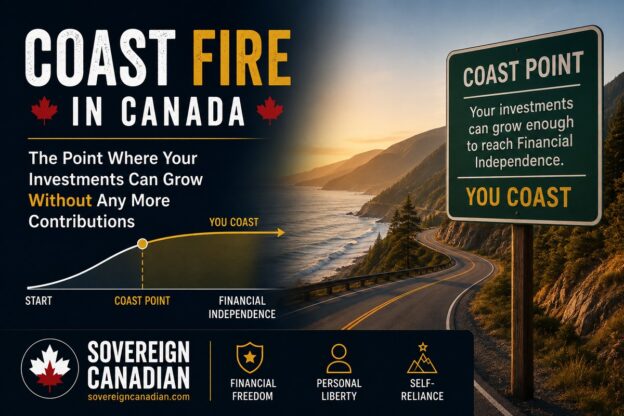
Coast FIRE for Canadians showing retirement savings growing toward financial independence without further contributions

Coast FIRE for Canadians: The Math, the Myths, and Whether It Holds Up Here

I want to start with a confession, because it frames everything that follows. The first time I ran my own Coast FIRE number, I felt something close to relief. A single formula told me I could stop saving aggressively, keep a job I mildly enjoyed, and still retire on schedule. Then I changed one input, the assumed rate of return, from 7 percent to 5 percent, and the number I needed nearly doubled. That is the whole story of Coast FIRE in one sentence: a real, useful idea sitting on top of assumptions most people never stress test.

This is not a piece designed to sell you on Coast FIRE. It is designed to help you understand exactly what it is, where the math is solid, where it quietly cheats, and whether it survives contact with Canadian taxes, Canadian accounts, and a Canadian cost of living. If you finish this and decide Coast FIRE is not for you, I will consider that a good outcome. Clarity is the product here, not enthusiasm.

Continue reading →

Wills, Executors, and Tax at Death: Getting Your Parent’s Affairs in Order Before It Matters

This is part eleven of the series on moving an elderly parent into your home. By now you have the multigenerational household running, the power of attorney signed, and maybe home care sorted. The one thing most families never get to is the will – because talking about a parent’s death while they are sitting at your kitchen table feels ghoulish. But the will, the executor you will probably become, and the tax at death are exactly what fall on you when the time comes.

Continue reading →

Moving Money to a Low-Income Parent Without Wrecking Their GIS

Once your parent moves in, the money conversation stops being abstract. You are the higher earner. They are a low-income parent living on Old Age Security, maybe a thin CPP cheque, and the Guaranteed Income Supplement that tops it up. You want to help – cover a dental bill, hand them a cushion, put something in their name. And somewhere in the back of your mind is a warning you half-remember: don’t give them too much or you’ll wreck their benefits.

That warning is half right and half backwards. The part almost everyone gets wrong is the part that matters most.

Continue reading →

Selling the Parent’s Home to Fund Care: The GIS Trap Nobody Warns You About

When a parent needs care that their monthly income can’t cover — private home care, a retirement home, the preferred room in long-term care — the family home is the obvious place to find the money. It’s usually their largest asset, and selling it is often the right call. But it’s also where a well-meaning family quietly destroys a low-income parent’s government benefits, because almost nobody understands what selling actually does.

Here’s the trap in one sentence: your parent’s house is invisible to their GIS, but the moment you sell it and invest the proceeds, you make that money visible — and their Guaranteed Income Supplement drops fifty cents on the dollar while their long-term care co-payment climbs. You can turn a benefit-neutral asset into a benefit-destroying income stream with a single well-intentioned transaction. This post is about unlocking the house without doing that.

Continue reading →

Powers of Attorney and Planning for Incapacity: The Documents That Let You Actually Help

Every other post in this series quietly assumes something that isn’t automatically true: that you can act for your parent — pay their bills, manage their money, decide on their care, sign them into a long-term care home. You can’t, not legally, unless they’ve signed two specific documents while they were still mentally capable. Without them, the moment a parent loses capacity, you have zero legal authority over their finances or their care — no matter that you’re their child, no matter how close you are — and you’re forced into a slow, expensive court process to get it.

Continue reading →
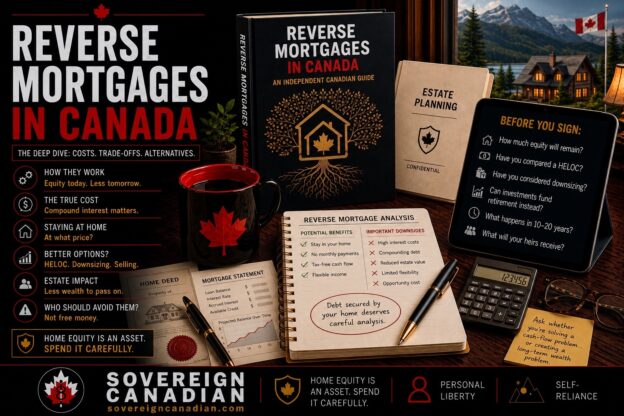
Reverse mortgages in Canada: costs, compounding debt, estate impact, and alternatives like a HELOC, downsizing, or selling the home

Reverse Mortgages in Canada: The Honest Case Against (and the Narrow Case For)

I’ll tell you where I stand before we start, because you’d figure it out by paragraph three anyway: I think a reverse mortgage in Canada is the wrong product for almost everyone who reads this site, and a genuinely useful one for a small handful of people I can describe precisely.

That’s not the same as saying it’s a scam. It isn’t. It’s a regulated loan from a federally regulated bank, with real consumer protections built in. But it’s an expensive loan wearing the costume of a retirement solution, sold with soft-focus advertising and a celebrity spokesperson, to people who are frightened of running out of money and reassured to hear they can “unlock” their home without selling it.

So let’s do what the brochure won’t. Let’s put the actual mechanics, the actual 2026 rates, and the actual compounding math in daylight, and then figure out the small number of situations where I’d tell a friend to seriously consider one. Educated criticism, not reflexive dismissal.

Continue reading →
Three colour-coded doors labelled FIRE, FIRE Light and Coast FIRE opening onto Canadian sunset scenes — three paths to financial independence in Canada.

FIRE, FIRE Light, and Coast FIRE: Three Doors Out of the 40-Year Grind

Most people hear “FIRE” and picture a 34-year-old in a hammock who will never touch a spreadsheet again. That version exists. But it’s one door out of three, and for a lot of higher-earning Canadians it’s the wrong one to walk through first. Financial independence isn’t a single finish line — it’s a spectrum of how much freedom you’re willing to buy now versus how much you’re willing to defer.

Continue reading →