
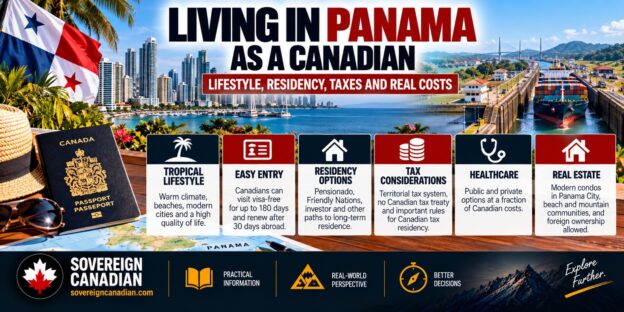
Panama can be remarkably good at receiving wealth. It is much less obviously good at creating tax-free active income, and your age on arrival decides how much of the healthcare advantage is still available to you.
A Canadian retiree living in Panama on a portfolio built abroad may find that Panama barely taxes the income paying for the lifestyle. His 35-year-old daughter can move into the same building, work remotely for Canadian clients, and face a very different tax question.
Same country. Same territorial tax system. Very different result.
That gap is the real subject of this article.
Panama does have meaningful advantages for a Canadian: a US dollar economy, one of the busiest air and shipping hubs in the Americas, residence programmes with paths to permanent status, private hospitals with international affiliations, and a tropical location outside the main Caribbean hurricane belt.
But “territorial taxation” is repeated so often, and so loosely, that it now misleads more people than it helps. Whether Panama’s tax system works in your favour depends heavily on whether you arrive with capital or still need to earn active income.
Age matters almost as much.
Someone who establishes private health insurance at 55 has a materially different set of options from someone arriving for the first time at 75 with chronic conditions.
Two other points frame everything that follows.
Panama’s offshore reputation was built in a different era, and what remains today is closer to infrastructure and optionality than secrecy. And moving there does not remove the Canadian side of the equation. Departure tax, Canadian withholding tax on pensions and similar payments, OAS recovery tax and the rules governing Canadian corporations can all continue to matter after the plane lands at Tocumen.
This article tests Panama as a place to live, retire, work, invest and keep a second base. It is part of the broader Sovereign Canadian Expat Living research.
Where I could verify something from a Panamanian or Canadian primary source, I have used it. Where the evidence comes from brokers, law firms or secondary reporting, I say so. Where I could not establish something reliably, I leave it unresolved rather than smoothing it over.
All Canadian-dollar conversions use the Bank of Canada’s October 2, 2026 rate of US$1 = CAD 1.4246. The Panamanian balboa is fixed at par with the US dollar, and the IMF describes Panama as a fully dollarised economy without a central bank.
The Panama proposition
Strip away the marketing and the case for Panama rests on a handful of real features.
The currency is effectively the US dollar. For a Canadian, that means living costs move with USD/CAD rather than with an independent local currency. That can provide currency diversification if much of your wealth is in Canadian dollars, but it can just as easily be a headwind when the Canadian dollar is weak.
Panama is also a genuine transport and logistics hub.
The Panama Canal Authority reported 10,726 transits in the first nine months of fiscal 2026, up 5.2% from the same period a year earlier. Revenue reached US$4.802 billion and net income US$3.614 billion. Tocumen airport is the base of Copa Airlines, which expects to serve roughly 88 destinations in 32 countries in 2026. Copa currently sells Panama City flights from both Toronto and Montreal.
Panama has a territorial income-tax system, established residence routes and a substantial private healthcare sector. It sits outside the main Atlantic hurricane track, although “outside the main track” is not the same thing as hurricane-proof.
Each advantage carries conditions.
For a Canadian, the Panama proposition depends heavily on the source of your income, whether you actually cease Canadian tax residence, your age and health when you apply for insurance, whether you are single or bringing a family, and whether you intend merely to live in Panama or also to work there.
That last distinction turns out to matter far more than the usual Panama pitch suggests.
Can a Canadian actually live in Panama?
Global Affairs Canada’s Panama travel advice says Canadian citizens do not need a tourist visa for stays of up to 180 days. Staying longer requires a change in residence status.
The same guidance says a business visa is required for business activity and that renewing tourist status requires leaving Panama for at least 30 days. It also warns that immigration authorities can refuse re-entry to people attempting to perpetually renew tourist status through short trips abroad.
Tourist status is permission to visit. It should not be treated as permission to work.
For someone actually relocating, Panama has several residence routes.
Pensionado
The Pensionado route is the best known.
According to the Panama Digital procedure administered by the Servicio Nacional de Migración, it is available to foreigners receiving a pension from a foreign government, international organization or private company who intend to settle in Panama and have enough resources to support themselves and their dependants.
The pension must be at least B/.1,000 per month, about CAD 1,425 at the exchange rate used in this article, and it must be granted for life.
The requirement falls to B/.750 per month, about CAD 1,068, if the applicant personally owns Panamanian property worth more than B/.100,000, about CAD 142,500.
Unlike many retirement visas elsewhere, this is a route to permanent residence, not merely a renewable temporary permit.
There are still questions a Canadian should resolve before relying on it.
CPP and a defined-benefit employer pension appear conceptually consistent with a lifetime-pension requirement. Whether a particular RRIF withdrawal programme, purchased annuity or other Canadian retirement-income arrangement satisfies SNM’s definition should be confirmed before moving.
The often-repeated claim that a Pensionado must demonstrate another US$250 per month of pension income for every dependant also deserves caution. The text of Executive Decree 320 of 2008 instead refers to B/.250 in favour of the Servicio Nacional de Migración for each dependant. I would confirm the current dependant requirements directly with SNM or a Panamanian immigration lawyer rather than building a plan around either internet version.
I also did not establish general work rights for Pensionado residents. Do not assume that obtaining retirement residence automatically gives you unrestricted permission to take employment in Panama.
The Pensionado discounts are real
The famous discounts attached to retirement in Panama are not merely an expat-blog invention.
Panama’s consolidated Law 6 of 1987, published by the consumer regulator ACODECO, expressly applies to Panamanians and foreign residents aged at least 55 for women or 60 for men, as well as pensioners and retirees more generally.
Among the statutory benefits are 25% off airfare, hotel discounts of 50% from Monday through Thursday and 30% on weekends, 25% off restaurant meals, 20% off medications, 15% off private hospital and clinic services and discounts on various professional services and utilities.
There are conditions. Discounts generally apply to regular prices and are not stacked on top of another promotion. ACODECO’s own 2026 enforcement reports show that businesses continue to be investigated and fined for failing to provide benefits required under the law.
That makes the discounts real enough to include in a retirement budget.
I still would not move to Panama because of them.
Friendly Nations
This programme is where Panama’s reputation is particularly out of date.
Older internet guides describe Friendly Nations as a cheap route to permanent residence: open a bank account, demonstrate an economic connection and obtain residence.
That is not the current programme.
SNM’s current Friendly Nations requirements, issued under Executive Decree 226 of July 20, 2021, provide for a two-year provisional residence followed by an application for permanent residence.
The main qualifying routes are employment, real estate or a fixed deposit.
For employment, the applicant needs documentation from a Panamanian employer together with the corresponding work-permit process.
For real estate, the minimum investment is US$200,000, about CAD 284,900. The property can be owned personally, through a company in which the applicant is the beneficial owner, or through a private-interest foundation in which the applicant is founder and beneficial owner. The purchase can be financed.
The fixed-deposit route requires US$200,000 in an unencumbered three-year deposit at a general-licence Panamanian bank.
The programme therefore bears little resemblance to the low-capital Friendly Nations route still described in older articles.
For a Canadian using the investment route, this is now effectively a US$200,000 residence programme with a two-year provisional period before permanent status.
Remote Worker
Panama’s Remote Worker visa is the route most relevant to younger Canadians, and it needs particularly careful reading.
Executive Decree 198 of May 7, 2021 created a short-stay remote-worker visa within Panama’s non-residentimmigration category. The Servicio Nacional de Migración’s 2021 decree archive confirms the decree and its purpose.
Law-firm summaries of the decree, including Kraemer & Kraemer and Castro & Castro, describe the main requirements as nine months of status, renewable once for another nine months; at least US$36,000 of annual foreign income, equivalent to US$3,000 per month; foreign employment or self-employment whose functions produce effects abroad; health insurance; and no local employment or Panamanian clients.
The visa permits the holder to perform the qualifying remote work without obtaining a separate Panamanian work permit.
What it does not appear to do is create a tax exemption.
That distinction matters.
The Remote Worker decree is an immigration instrument. Nothing I found indicates that it overrides Panama’s Código Fiscal or changes the rules determining whether income is Panamanian-source.
The practical conclusion is therefore:
The Remote Worker visa gives you permission to perform the work. It does not establish that the resulting income is tax-free.
Permanent residence, absence and citizenship
Another Panama myth concerns how often permanent residents must return.
Internet summaries commonly say you need to visit once a year or once every two years. The migration law itself is more specific.
Decree-Law 3 of 2008 lists absence from Panama for more than two years as a ground for loss of permanent residence unless the absence is justified and authorized by the immigration authority.
That is an absence limit, not an annual visit rule.
Someone who spends 23 months abroad has not breached a “visit every year” requirement simply because such a requirement is repeated online. Equally, briefly entering Panama during a longer absence should not be assumed to reset every legal issue automatically.
Anyone intending to hold Panamanian permanent residence while living mainly elsewhere should confirm the current rule with SNM before relying on it.
Citizenship is a different question.
Article 10 of Panama’s constitution provides a general naturalisation route after five years of continuous residence, with shorter periods in certain family situations, together with Spanish-language and civic requirements. The constitutional text also contains express renunciation language regarding the applicant’s existing nationality.
At the same time, Canadian government guidance says dual citizenship is legally recognized in Panama.
I could not reconcile those two propositions sufficiently to treat Panamanian citizenship as a simple dual-passport strategy. Anyone seriously considering naturalisation should obtain current Panamanian advice.
For most Canadians considering Panama, permanent residence is the more relevant objective anyway.
Panama’s territorial tax system: the part people get wrong
Panama taxes income produced within Panama regardless of where it is received.
That is the foundation of its territorial tax system.
Genuinely foreign-source passive income — for example, income from foreign investments — can therefore sit outside Panama’s income-tax base. That is the legitimate core behind the statement that Panama does not tax foreign income.
The problem begins when that statement is applied to active work.
A great deal of relocation content assumes that the location of the payer determines the source of income.
Canadian client equals Canadian-source income.
US employer equals US-source income.
Panama’s legislation does not support such a simple rule for personal services.
What Article 694 actually says
Law 6 of 2005 amended Article 694 of Panama’s Código Fiscal.
The legislation says income from professions, trades and all kinds of services performed by natural persons within Panama is considered produced within Panama.
It also addresses people performing the same services partly inside and partly outside the country.
Where the work occurs in both places, the legislation treats all of the service income as Panamanian-source when the individual spends at least 70% of the calendar year’s days in Panama in producing that income.
Where someone performs most of the work outside Panama and comes into the country only occasionally, the legislation contemplates the income produced outside Panama remaining foreign-source.
Later amendments, including Law 27 of 2015, do not appear to repeal that services rule.
Another part of Article 694 excludes certain income from directing, from an office in Panama, transactions that are perfected, consumed or take effect abroad.
That provision is sometimes used to support very broad claims about foreign-client work. It should not be casually substituted for the much more explicit provision dealing with personal services physically performed by individuals in Panama.
What the tax authority says
I did not find a directly applicable DGI ruling dealing with an ordinary Canadian remote worker sitting in Panama and serving Canadian clients.
That uncertainty matters.
It means I cannot say the DGI has expressly ruled that the income is taxable.
But it also means there is no administrative ruling supporting the much more common internet claim that it is exempt.
The DGI’s own foreigner tax-registration material identifies salaried foreigners, independent foreigners and foreigners providing professional services in Panama as potential taxpayers.
The stronger reading of the legislation is therefore:
A Canadian employee physically working from Panama for a Canadian employer is likely earning Panamanian-source employment income.
A Canadian consultant physically performing services from Panama for Canadian or other foreign clients is likely earning Panamanian-source professional income.
A Canadian receiving genuinely foreign passive investment income or foreign pension income is in a much stronger position to treat that income as outside Panama’s territorial tax base.
A Canadian business owner managing a corporation from Panama presents a more complicated case involving the individual’s salary, corporate residence, management and control and potentially Panama’s foreign-transaction provisions.
These are interpretations of the legislation, not individualized tax rulings.
But they are enough to make one warning clear:
Do not move to Panama assuming that foreign clients automatically make your remote-work income tax-free.
What the numbers could look like: a CAD 100,000 remote worker
Suppose a Canadian earns CAD 100,000, approximately US$70,196 at the exchange rate used in this article, while physically working from Panama City.
Panama’s DGI currently publishes the following individual income-tax rates: 0% on net taxable income up to B/.11,000, 15% on the amount from B/.11,000 to B/.50,000, and B/.5,850 plus 25% of the amount above B/.50,000.
If the entire CAD 100,000 were treated as Panamanian-source and we ignore deductions and social-security contributions, the illustrative calculation is:
| Band | Income in band | Tax |
|---|---|---|
| First B/.11,000 | US$11,000 | US$0 |
| B/.11,000 to B/.50,000 at 15% | US$39,000 | US$5,850 |
| Above B/.50,000 at 25% | US$20,196 | US$5,049 |
| Total | about US$10,899 / CAD 15,527 |
That arithmetic is straightforward. The difficult part is determining exactly what income is taxable and what deductions or contributions apply.
If you remain a Canadian factual resident, Canada continues taxing your worldwide income. Canadian domestic law provides a foreign tax credit for qualifying foreign income or profit taxes paid on foreign income reported in Canada, calculated federally on Form T2209.
The credit is not created by a Canada-Panama tax treaty. There is no such income-tax treaty.
Depending on the facts, the practical result can therefore be closer to paying the higher overall Canadian burden with credit for qualifying Panamanian tax than simply stacking the two countries’ full tax bills on top of one another.
But foreign-tax-credit limits and classifications matter. Do not assume every dollar of Panamanian tax will necessarily produce an equal Canadian reduction.
If you genuinely become a Canadian non-resident, the picture changes. The CRA says that after departure a non-resident generally pays Canadian income tax only on Canadian-source income. Foreign employment or business income earned after genuine emigration does not remain subject to Canadian worldwide-income taxation merely because the person used to live in Canada.
In that case, Panama may become the principal income-tax jurisdiction for active work performed there.
That is a very different proposition from “Panama is tax-free.”
Leaving Canada is a separate tax event
Everything above concerns Panama.
Leaving Canada is its own transaction.
Residence
Getting a Panamanian residence card does not end Canadian tax residence.
Canadian residence is primarily a factual question about the life you retain in Canada. The CRA focuses heavily on significant residential ties such as a Canadian home, spouse or common-law partner and dependants, alongside a wider collection of secondary ties.
The CRA’s emigrant guidance says that someone who leaves Canada while retaining residential ties is usually still a factual resident.
Our separate guide to the Canadian Residency Flag goes much deeper into how that test actually works.
Canada and Panama have no comprehensive income-tax treaty.
They do have a Tax Information Exchange Agreement, which entered into force on December 6, 2013.
Those are very different instruments.
An income-tax treaty normally contains rules for resolving cases where both countries consider the same person resident. Canada has no such treaty tie-breaker with Panama.
The CRA also states that when someone leaves Canada to settle in another country, they usually become non-resident on the latest of three dates: the date they leave Canada, the date their spouse or common-law partner and dependants leave Canada, and the date they become resident in the country where they settle.
That makes the timing more complicated than simply writing down the date of your flight.
Departure tax
When you emigrate, Canada generally treats certain property as though it had been sold at fair market value and immediately reacquired.
That deemed disposition can trigger capital gains even though nothing has actually been sold.
The CRA’s departure-tax guidance requires the deemed dispositions to be reported on Form T1243. If the total fair market value of the property you owned when leaving exceeds CAD 25,000, Form T1161 may also be required even when no tax return would otherwise be necessary.
The current capital-gains inclusion rate is 50%. The proposed increase announced in 2024 was ultimately cancelled.
The deemed-disposition rules generally capture assets such as non-registered shares, ETFs and mutual funds, private-company shares, cryptocurrency and foreign real estate.
Important exclusions include Canadian real property and registered arrangements including RRSPs, RRIFs, pension plans and TFSAs, although those assets can have their own tax consequences later.
The CRA also permits an emigrant to elect to defer departure-tax payment by filing Form T1244 by April 30 of the year after emigration.
The deferred amount is paid later, without interest, when the relevant property is actually disposed of.
If the federal tax owing on the deemed disposition exceeds CAD 16,500 — CAD 13,777.50 for former Quebec residents — adequate security is required.
That can make departure tax primarily a liquidity and planning issue rather than an immediate forced sale, but it does not make the liability disappear.
The scale depends entirely on what you own.
Someone leaving Canada at 25 with a modest portfolio may have very little accrued gain. Someone leaving with CAD 2 million of investments and a valuable private company can face a substantial deemed gain without receiving a dollar of sale proceeds.
Our departure tax in Canada guide deals with that problem separately.
Canadian income after you leave
Canadian-source income does not stop being Canadian-source because you move to Panama.
Service Canada’s guidance for pension recipients living abroad states that CPP and OAS paid to non-residents are generally subject to 25% Canadian non-resident tax unless a treaty reduces or eliminates the rate.
Panama has no such income-tax treaty.
That contrasts with destinations such as Mexico and Portugal, where treaty provisions can change Canadian withholding.
Canada and Panama also have no social-security agreement. Panama does not appear on the CRA’s current list of countries with which Canada has an international social-security agreement.
That means periods of Panamanian coverage are not coordinated with CPP or OAS in the way they can be under some of Canada’s bilateral agreements.
For CPP, OAS and many Canadian pension or registered-plan payments, 25% is therefore the conservative starting point for Canadian non-resident withholding unless a specific domestic rule changes the treatment.
The form of the payment matters. A periodic pension, a large RRSP withdrawal, a RRIF payment and a lump-sum employer benefit are not necessarily treated identically.
That distinction is part of the problem examined in our article on RRSPs and RRIFs as the golden handcuffs of Canadian retirement.
Section 217 and Form NR5
The 25% withholding rate is the starting point, not always the final Canadian tax bill.
Section 217 of the Income Tax Act allows non-residents receiving certain types of Canadian income to elect to file a Canadian return and calculate tax using the special section 217 rules.
The CRA’s section 217 guidance lists eligible income including OAS, CPP and QPP, most pension benefits, most RRSP payments and most RRIF payments.
When the election produces less Canadian tax than the amount withheld, the taxpayer can receive a refund.
Form NR5 allows an eligible non-resident who intends to use section 217 to apply in advance for reduced withholding rather than waiting to recover excess withholding later.
An approved NR5 generally covers five tax years. A section 217 return must then be filed for each covered year, and any shortfall between the reduced withholding and actual tax owing must be paid.
That makes NR5 a cash-flow mechanism, not an automatic tax discount.
Whether section 217 helps depends on the person’s Canadian-source income, world income, deductions, credits and family circumstances.
OAS recovery tax
Panama receives no special exemption from Canada’s OAS recovery tax.
The Government of Canada’s current OAS recovery-tax table puts the minimum threshold for 2026 income at CAD 95,323, governing the recovery period from July 2027 through June 2028.
For comparison, the threshold for 2025 income is CAD 93,454 and applies from July 2026 through June 2027.
The recovery tax is generally 15% of net world income above the applicable threshold. For a non-resident, the combined non-resident tax and OAS recovery tax cannot exceed the OAS benefit itself.
Because Panama has no Canadian income-tax treaty exempting residents from the recovery tax, a Panamanian resident receiving OAS generally remains within this system and must comply with the OAS Return of Income rules.
Receiving OAS while living abroad also generally requires at least 20 years of Canadian residence after age 18.
TFSA
A Canadian can keep an existing TFSA after becoming non-resident.
The CRA’s non-resident TFSA guidance confirms that the account continues to be exempt from Canadian tax, but new contributions made while non-resident are subject to a 1% monthly tax until the non-resident contribution is fully withdrawn or Canadian residence resumes.
A non-resident does not receive the annual TFSA dollar limit for a full year of non-residence.
Withdrawals made while non-resident can still eventually create contribution room, but that room cannot be used tax-free until Canadian residence is re-established.
Panama does not need to recognize the TFSA as a special Canadian account for foreign investment income to potentially remain outside its tax base. If the underlying income is genuinely foreign-source, the territorial system itself is what matters.
That is an inference from Panama’s source rules, not a Panamanian ruling specifically blessing TFSAs.
The retired-couple example
Consider a couple receiving:
| Source | Annual amount | 25% withholding |
|---|---|---|
| CPP | CAD 30,000 | CAD 7,500 |
| OAS | CAD 18,000 | CAD 4,500 |
| RRIF | CAD 50,000 | CAD 12,500 |
| Employer pension | CAD 20,000 | CAD 5,000 |
| Total | CAD 118,000 | CAD 29,500 |
At a simple 25% default withholding rate, Canada would withhold CAD 29,500, roughly US$20,700.
That is not a prediction of their final Canadian tax.
A section 217 election, potentially combined with an approved NR5 to reduce withholding in advance, could produce a materially lower result.
If the income were divided approximately equally between the spouses, each would have roughly CAD 59,000 of income, comfortably below the current OAS recovery threshold. If most of the income belonged to one spouse, the result would change.
A proper calculation would need the ownership of each income stream, world income, deductions, credits and other facts.
Panama, meanwhile, would generally be expected not to tax genuinely foreign pension and RRIF income that is not produced within Panama.
That captures the central Panama retirement proposition.
Panama may add little or no income tax to foreign retirement income. That does not mean Canadian tax disappears.
The Canadian withholding happens before Panama enters the equation.
Our broader snowbird versus full relocation analysis looks at why that distinction matters over an entire retirement rather than in a single tax year.
What if you own a Canadian corporation?
The business-owner case is where “move to Panama and stop paying Canadian tax” becomes particularly dangerous.
Imagine a Canadian-incorporated company earning CAD 500,000 whose owner moves to Panama.
The company does not simply stop being Canadian.
The CRA states that a corporation incorporated in Canada after April 26, 1965 is generally deemed resident in Canada. Corporate residence can also involve common-law management-and-control principles, and cross-border management can create additional issues rather than magically relocating the company.
If control of a Canadian-controlled private corporation shifts to a non-resident, CCPC status can also be lost, changing the corporation’s tax treatment.
Canadian dividends paid to a non-resident shareholder are generally subject to Part XIII withholding at a domestic rate of 25% unless treaty relief applies.
There is no Canada-Panama income-tax treaty to reduce that rate.
At the same time, salary paid to an owner for work physically performed from Panama may be Panamanian-source under Article 694.
And the shares of the Canadian private company can themselves be caught by Canada’s departure-tax rules when the shareholder emigrates.
The Business Base Flag goes deeper into why incorporation, management, ownership and the location where the work is actually performed need to be separated.
Putting a Panamanian corporation or private-interest foundation above the structure does not automatically solve any of this.
For Canadian residents, foreign-affiliate, foreign-trust and foreign-property reporting regimes include forms such as T1134, T1135, T1141 and T1142 depending on the structure and facts. The classification of a Panamanian private-interest foundation for Canadian tax purposes can itself depend on its legal characteristics and control arrangements.
I found no basis for telling a Canadian that a Panamanian foundation automatically creates Canadian tax deferral, creditor protection or secrecy.
The useful distinction is simpler.
Panama can be attractive to someone who has already accumulated capital abroad.
It is much more complicated for someone who is still building wealth through a Canadian operating company.
Offshore Panama: what is actually left?
Panama’s offshore reputation is older than the regulatory system that exists today.
The old image was based on corporate secrecy, discreet banking and a jurisdiction willing to accept foreign money with relatively few questions.
That is no longer an accurate description.
Panama implemented the OECD Common Reporting Standard, and the CRA’s list of participating jurisdictions lists Panama with a 2018 implementation date for exchanges with Canada.
Canada and Panama have also had their bilateral Tax Information Exchange Agreement in force since 2013.
The Financial Action Task Force placed Panama under increased monitoring in June 2019 and removed it in October 2023 after concluding that Panama had made sufficient progress on its action plan.
That does not mean every international concern disappeared.
Panama remained on the European Union’s list of non-cooperative jurisdictions for tax purposes after the Council’s February 17, 2026 revision. As of this publication check, that remains the latest Council revision published. The next scheduled review is in October 2026, so this status should be checked again whenever the Council publishes that update.
The EU tax list is also separate from both the FATF grey list and the EU’s anti-money-laundering list. They measure different things and should not be casually substituted for one another.
Panama also lacks the banking safety net Canadians are used to.
The IMF’s 2024 financial-sector assessment describes Panama as a fully dollarised economy with no central bank, no general deposit-insurance system and no lender of last resort. The two state-owned banks benefit from explicit state guarantees, but ordinary deposits at private banks do not have a CDIC-style government insurance scheme behind them.
None of this makes Panama useless as an international financial jurisdiction.
It changes what its usefulness is.
For a Canadian in 2026, Panama’s offshore value is better understood as infrastructure and optionality: dollar banking, international connectivity, residence options, legal entities, geographic diversification and a commercial ecosystem built around international trade.
It is not invisibility.
The broader Sovereign Canadian Flag Theory framework makes the same distinction. Geographic diversification can be legitimate and useful without depending on secrecy.
Banking
The numbered-account stereotype is a poor guide to modern Panamanian banking.
Law-firm and relocation sources consistently describe account opening as a conventional know-your-customer process involving a passport or residence card, proof of address, evidence of income and source of funds and, frequently, bank-reference letters and an in-person meeting.
Requirements vary by institution and customer, so I would not treat any single minimum deposit quoted online as universal.
A Canadian also no longer has the familiar Scotiabank shortcut.
Scotiabank and Davivienda completed the transfer of Scotiabank’s banking operations in Panama, Colombia and Costa Rica in December 2025. Scotiabank received an approximately 20% interest in Davivienda Group as part of the wider transaction, while the former Panamanian operations became part of the Davivienda structure.
The second difference from Canada is more important.
There is no general deposit insurance.
That does not establish that Panamanian banks are unsafe. The IMF notes that banks have historically maintained substantial liquidity and capital buffers partly because Panama lacks a conventional financial safety net.
It does mean I would not treat a large Panamanian bank balance exactly as I would a CDIC-insured Canadian deposit.
Healthcare: good private hospitals are not the whole question
Panama’s healthcare proposition has two different parts.
Global Affairs Canada says good medical care is available in private hospitals and clinics in Panama City, while public-hospital quality varies considerably and services are more limited outside the capital.
That distinction is important.
Public healthcare
The Caja de Seguro Social is not a universal system automatically opened to everyone holding Panamanian residence.
Workers, including foreign workers, can enter CSS through employment or other covered work. Panama also has a voluntary affiliation procedure, but it includes eligibility requirements and medical assessment.
I found reporting that appointments for some foreign voluntary applicants had at one point been suspended, but I could not establish that as a permanent current rule.
The practical lesson is therefore conservative:
Do not move to Panama assuming permanent residence automatically gives you comprehensive public health insurance.
Private healthcare
Private hospitals are the stronger side of the proposition.
Pacífica Salud, which operates Hospital Punta Pacífica and a second campus in Costa del Este, has a long-running Johns Hopkins Medicine International affiliation and has reported Joint Commission International accreditation.
That is useful evidence about a major hospital group.
It is not evidence that every hospital in Panama provides the same standard of care.
Medical-tourism sources quote prices such as US$60 to US$150 for specialist consultations, US$300 to US$600 for an MRI, US$1,200 to US$2,000 per eye for cataract surgery and roughly US$10,000 to US$20,000 for a hip replacement.
I have not found sufficiently reliable hospital tariffs to treat those figures as anything more than indicative marketing ranges.
That is why I would not describe Panamanian healthcare as simply “world class at a fraction of Canadian prices.”
There are strong private hospitals. There can be substantial price differences. Neither fact proves the broad slogan.
For comparison, our analysis of whether Canadian healthcare is actually world class separates clinical quality from access, capacity and financial protection, while the Medical Tourism section looks specifically at buying care abroad.
The insurance cliff
If there is one practical issue in this article that deserves to change someone’s relocation timing, it is private health insurance.
Panama’s public system does not simply absorb every new foreign resident.
Private insurance therefore matters.
And private insurance has entry ages.
MAPFRE Panamá’s current Solución Silver brochure lists a maximum entry age of 64 years and 11 months.
The plan has an annual reinstatable limit of B/.350,000, roughly CAD 498,600, and coverage focused on Panama and the Central American region. It is not equivalent to a worldwide plan with comprehensive US coverage.
The same brochure publishes monthly premiums before its stated 5% charge of approximately:
| Age | Monthly premium | Approx. CAD |
|---|---|---|
| 55–59 | B/.239.72 | CAD 342 |
| 60–64 | B/.273.22 | CAD 389 |
| 65–69 | B/.401.79 | CAD 572 |
| 70+ | B/.625.10 | CAD 891 |
The older age bands are relevant to people who entered before the maximum admission age and remained insured. They do not mean a new 70-year-old can simply buy the policy.
MAPFRE’s general conditions also contain two provisions that matter enormously to Canadians imagining Panama as a part-year base.
The insured generally must reside in Panama for ten months of the calendar year, unless the particular policy conditions say otherwise.
The policy also provides for termination after the insured accumulates 60 calendar days outside Panama during the year, unless an endorsement removes that condition.
That makes this particular local policy a poor fit for a conventional Canadian snowbird who intends to spend only four or five months a year in Panama.
The conditions are also more nuanced on pre-existing medical conditions than the blanket claim that local insurance excludes everything forever. Declared pre-existing conditions can be subject to waiting periods and other restrictions, while serious conditions and undisclosed conditions can be treated differently. Anyone relying on this should obtain an actual underwriting decision rather than extrapolating from the general policy wording.
ASSA’s publicly available ASSA Care conditions are for a group policy, not a standard individual-retiree policy, so I would not use its age rules as though they automatically applied to every individual applicant.
Broker sources report other age limits for individual Panamanian and international plans, including options extending into the 70s. Those claims are useful leads, not evidence strong enough to base a relocation on.
For a first-time applicant at 75 with chronic conditions, I could not establish a mainstream local insurance option robust enough to call the problem solved.
That case remains unresolved.
Panama at 55 versus Panama at 75
This is why Panama looks different depending on when you arrive.
A Canadian moving at 55 still has access to mainstream local underwriting.
That person can establish insurance before the common entry limits close, build relationships with physicians and hospitals, obtain residence and banking while healthy and mobile, and plan any Canadian departure-tax event before retirement income is fully underway.
Someone arriving for the first time at 75 with hypertension, diabetes or other chronic conditions is in a different position.
MAPFRE’s mainstream entry window has already closed. Other local plans may have closed as well. International or senior products may still exist, but the evidence becomes increasingly broker-dependent and underwriting becomes more important.
CSS voluntary coverage is not a universal fallback that I would assume will solve the problem.
And the evidence for sophisticated elder care is much thinner than the evidence for private acute medical care.
That does not prove a healthy 75-year-old cannot relocate successfully.
It means Panama’s healthcare proposition is path-dependent.
Arriving earlier and maintaining coverage can be fundamentally different from arriving late and trying to buy it for the first time.
For someone who wants to test Panama without immediately emigrating, our snowbird versus full relocation analysis is the more appropriate starting point.
Elder care
The evidence on elder care is considerably weaker than the evidence on private hospitals.
Secondary relocation sources identify private assisted-living and memory-care options in Panama City, with quoted costs in the range of roughly US$2,500 to US$4,500 per month, or approximately CAD 3,560 to CAD 6,410.
Other secondary sources quote lower-cost residential care and home-health aides.
I could not verify enough provider-direct pricing, nursing ratios, dementia standards, physician coverage or English-language capability to turn those figures into a reliable national market assessment.
Panama therefore does not emerge from this research as having a clearly documented, mature elder-care continuum comparable with what you would want to understand before moving a frail parent internationally.
Panama City has the country’s deepest concentration of major hospitals and identified private elder-care services. Evidence outside the capital is thinner.
That distinction matters because healthcare and elder care are not the same thing.
A country can have an excellent private hospital and still be difficult for someone who needs help dressing, bathing, taking medication, managing dementia or navigating daily life with limited mobility.
Our Canadian Elder Care roadmap shows how broad that continuum becomes once someone needs more than medical treatment.
What does housing actually cost?
Housing varies enough that the phrase “Panama is cheap” is not particularly useful.
Broker and market summaries suggest approximate two-bedroom monthly rents around:
| Area | Approximate rent | Approx. CAD |
|---|---|---|
| San Francisco, Panama City | US$1,400 | CAD 1,994 |
| Costa del Este | US$2,400 | CAD 3,419 |
| Punta Pacífica | US$3,450 | CAD 4,915 |
| Boquete | US$700–1,400 | CAD 997–1,994 |
| Coronado | US$1,100–1,800 | CAD 1,567–2,564 |
These are market indications, not an official rental index, and the Boquete and Coronado evidence is weaker than the Panama City evidence.
The useful conclusion is not that Panama is expensive either.
It is that the internationally oriented version of Panama is not automatically cheap.
A modern high-rise apartment in Punta Pacífica can cost several thousand Canadian dollars a month. A smaller apartment in another part of Panama City or a home in the highlands can cost much less.
Which Panama you choose matters more than the national average.
Buying property
Foreigners can generally own titled Panamanian property, but the legal form of the property matters.
The first distinction is titled property versus right of possession, commonly called ROP.
A titled property appears in Panama’s Public Registry with registered ownership. ROP land does not provide the same title protection and can create substantial legal and financing complications.
A foreign buyer should not treat the two as substitutes.
Foreign ownership is also restricted in border areas. Property within 10 kilometres of Panama’s land borders requires particular care.
Beachfront property has its own public-domain issues as well. I found inconsistent secondary descriptions of the exact public strip and would not rely on a generic number without having the specific parcel checked.
Transaction-cost summaries generally describe a 2% property-transfer tax and a 3% capital-gains advance payment by the seller, with final capital-gains tax depending on the actual taxable gain and circumstances.
Legal fees are commonly quoted around 0.5% to 1%, but these are market conventions rather than a universal statutory tariff.
The larger lesson is familiar from almost every foreign property market.
Use a Panamanian lawyer acting for you, verify title through the Public Registry, establish whether the land is actually titled, check border and coastal restrictions, and do it before paying a meaningful deposit.
Our Foreign Real Estate section covers the Canadian side of buying and holding property abroad.
Families and schools
Panama becomes much less obviously inexpensive when a family chooses premium international education.
Published school-market databases for the 2026-27 school year put annual tuition roughly in these ranges:
| School | Approximate annual tuition |
|---|---|
| International School of Panama | US$10,200–18,900 |
| Metropolitan School of Panama | US$12,600–20,800 |
| Balboa Academy | US$9,400–16,500 |
| King’s College | US$8,400–24,900 |
Some schools also charge substantial application, registration or capital fees.
These figures come from school databases rather than audited school fee schedules, so they should be checked directly before enrolment.
But they are sufficient to establish the scale.
A family renting a three-bedroom home in Costa del Este for US$2,000 to US$3,500 a month spends US$24,000 to US$42,000 a year on housing.
Add two children at roughly US$14,000 to US$17,000 each and housing plus tuition alone reaches approximately US$52,000 to US$76,000 per year, or about CAD 74,000 to CAD 108,000.
Food, transport, utilities, insurance, air conditioning, activities and trips back to Canada are still missing.
That does not make Panama unaffordable for an affluent Canadian family.
It does mean a CAD 250,000 household should not assume the family version of Panama is automatically a low-cost lifestyle.
Panama City, Boquete and the beach
This research does not support a neighbourhood-by-neighbourhood lifestyle ranking, so I will not pretend it does.
Panama City is the country’s main financial, medical and international-transport centre. It has the deepest concentration of the hospitals, businesses and international schools discussed in this article.
Boquete is an established highland expatriate area with a cooler climate than the lowlands.
Pacific communities such as Coronado offer the coastal version of the Panama lifestyle.
Those are different propositions.
The city is the strongest fit for someone prioritizing international connectivity, specialist healthcare and business infrastructure. Boquete and the beach trade some of that concentration for a different daily lifestyle.
The right answer is personal enough that it deserves an actual visit rather than a spreadsheet.
Safety
Panama is neither simply safe nor simply unsafe.
The national homicide rate is meaningful, but the violence is geographically concentrated.
Reporting for 2025 puts the country at roughly 12 to 13 homicides per 100,000 people. Official Panamanian data show substantial differences between provinces, with much lower rates in areas such as Chiriquí than in Colón and parts of Panamá province.
Organized crime and gang disputes account for a significant part of the violence.
That matters because a national homicide rate does not translate directly into the risk faced by a foreign retiree living in a condominium in a different province.
Global Affairs Canada currently advises Canadians to take normal security precautions in Panama overall, while exercising a high degree of caution in Colón Province, San Miguelito, Veracruz City and specified parts of Panama City.
Canada advises against all travel to areas south of Metetí in Darién Province and to the Mosquito Gulf because of violent crime, smuggling and trafficking.
Its Panama travel advisory also warns about robbery, residential break-ins and express kidnappings.
The useful conclusion is geographic.
“Panama is safe” is too broad.
“Panama is dangerous” is too broad too.
Where you actually live matters.
Climate, hurricanes and water
Panama sits outside the main Atlantic hurricane belt, but it is not hurricane-proof.
The National Hurricane Center’s report on Hurricane Otto shows what the distinction means.
Otto made landfall much farther north, in Nicaragua, in November 2016. Its centre never crossed Panama, but heavy rainfall and associated weather were linked to eight deaths in Panama.
That is a better model of the country’s tropical-cyclone risk than imagining a direct Florida-style hurricane strike every few years.
Wind risk is relatively low.
Flooding, heavy rain and landslides are more realistic concerns.
Water is another issue.
The Panama Canal and a substantial share of Panama’s drinking-water system depend on the same watershed.
The Panama Canal Authority spent much of 2026 managing low water levels and adjusting vessel draft and transit capacity.
Shipping-industry reporting documented a series of draft restrictions during the summer.
Conditions improved later in the year. In a September 28 update, the ACP said near-average watershed rainfall and water-saving measures allowed it to raise the maximum Neopanamax draft to 14.94 metres, or 49 feet, and increase capacity to 33 daily transit slots from October 15.
But the same announcement said a water deficit remained in the watershed.
That makes the broader issue structural rather than merely a bad summer.
A weak rainy season can affect both the Canal and the population that depends on the same water system.
The Canal and Panama’s international hub
It is easy to treat the Canal as scenery.
Economically, it is anything but.
In the first nine months of fiscal 2026, from October 2025 through June 2026, the Canal handled 10,726 transits, up 5.2% year over year.
Revenue reached US$4.802 billion and net income US$3.614 billion.
For someone living in Panama, the Canal’s importance extends beyond toll revenue. It has helped create an economy built around ports, shipping, logistics, freight forwarding, finance and international business.
Tocumen airport reinforces the same geography.
Copa Airlines uses Panama City as its connecting hub and expects to serve roughly 88 destinations in 32 countries in 2026. Copa’s Canadian booking site currently sells Panama City service from Toronto and Montreal.
That connectivity is one of Panama’s most defensible lifestyle advantages for someone who expects to maintain ties throughout the Americas.
It is especially relevant to a Canadian who does not want an international move to mean becoming geographically isolated.
Panama versus Costa Rica
The neighbouring comparison is useful because both countries are routinely described as tropical, territorial-tax retirement destinations.
They are not the same proposition.
Our full Living in Costa Rica as a Canadian guide goes through Costa Rica separately.
| Issue | Panama | Costa Rica |
|---|---|---|
| Pensioner residence | B/.1,000 lifetime pension; B/.750 with qualifying property; permanent residence | US$1,000 stable pension; temporary residence |
| Investment residence | Friendly Nations: employment or US$200,000 property/deposit; two-year provisional period | Investor threshold legally less clear after the 2026 sunset issue |
| Remote-worker status | 9 + 9 months; permits remote work; no tax exemption found | One year renewable once; statutory tax exemption for qualifying nomad income |
| Permanent residence | Immediate through Pensionado; later through Friendly Nations | Generally after three years of qualifying temporary residence |
| Citizenship | General five-year route; nationality issue requires advice | Longer general route for Canadians |
| Canada income-tax treaty | None | None |
| Canada social-security agreement | None | None |
| Territorial taxation | Yes | Yes |
| Foreign-client work performed locally | Appears Panamanian-source under Article 694 | Source treatment is also more complicated than “foreign client = foreign income”; nomad exemption helps qualifying holders |
| Public healthcare | CSS tied to participation/eligibility; not universal simply because you are resident | Caja enrolment is central to the residence system |
| Private insurance ageing | MAPFRE entry limit 64 years 11 months | INS policy reviewed in the Costa Rica research admitted applicants through age 70 |
| Banking | Heavy KYC; no general deposit insurance | Different banking structure |
| CRS exchange with Canada | Since 2018 | Since 2017 |
| Property complication | Border restriction, ROP land, coastal public-domain issues | Maritime-zone concession system |
| Air connectivity | Major Copa hub; Toronto and Montreal service | Good Canadian access but not a comparable continental hub |
Neither country wins the table outright.
Panama’s strongest profile is the Canadian arriving with foreign capital who values dollar infrastructure, private healthcare and international connectivity and establishes insurance early.
Costa Rica’s proposition leans more heavily toward lifestyle, its public Caja system and a digital-nomad regime with an explicit tax exemption that Panama’s Remote Worker visa does not appear to provide.
The shared lesson may be more important than the differences.
Neither country has a comprehensive Canadian income-tax treaty.
Neither has a Canadian social-security agreement.
Both use territorial taxation.
And in both, the phrase “foreign income is tax-free” is too crude to plan a life around.
Who Panama works for
The evidence points toward a fairly clear pattern.
A 25-year-old remote worker earning CAD 90,000 can certainly find Panama interesting, but the tax story is weaker than the marketing. The immigration route exists; the assumption that foreign-client work performed in Panama is untaxed does not hold up nearly as well.
A 35-year-old consultant earning CAD 150,000 faces the same source question with more money at stake.
A family earning CAD 250,000 can make Panama work, but international-school tuition and premium Panama City housing can consume a surprisingly large part of the supposed cost advantage.
A Canadian owner-manager still building wealth through an operating Canadian corporation has one of the weakest tax cases. Canadian corporate residence, CCPC status, dividend withholding, departure tax and the Panamanian source of salary all need to be solved rather than assumed away.
A 55-year-old semi-retired investor with substantial foreign investments is much closer to Panama’s sweet spot. Foreign passive income fits the territorial system better, mainstream insurance remains available, and there is time to plan the Canadian exit properly.
A 65-year-old retired couple can also be a strong fit. Pensionado residence is straightforward on the evidence, Panama may add little tax to foreign pension income, and the retiree discounts are real. But Canada’s withholding rules remain, and some mainstream private-insurance entry windows have already closed.
A long-established 75-year-old resident who bought insurance years earlier is a different case from a first-time 75-year-old arriving with chronic conditions.
The first can be entirely workable.
The second remains one of the weakest cases in this research because the healthcare backstop becomes much less certain exactly when it matters most.
Myth audit
“Foreign income is tax-free.”
Half true. Genuinely foreign-source passive income fits Panama’s territorial system well. Personal services physically performed in Panama are a different matter.
“Panama is an offshore tax haven.”
Mostly outdated. Panama participates in CRS exchange with Canada, has a TIEA with Canada, was removed from FATF increased monitoring in 2023 and remains subject to modern beneficial-ownership and know-your-customer rules. It remains on the EU tax list as of the latest published 2026 revision.
“Panamanian bank accounts are private.”
Private is not the same thing as secret. Automatic exchange and KYC have fundamentally changed the proposition.
“Panama is hurricane-free.”
No. It is outside the main Atlantic hurricane belt and direct strikes are rare, but tropical systems can still produce dangerous rain, flooding and landslides.
“Pensionado discounts are just expat marketing.”
No. The discounts are statutory and ACODECO enforces them. Foreign residents meeting the statutory conditions are included.
“Panama is cheap.”
Sometimes. Premium Panama City housing, international schools and private insurance can make the internationally oriented version of Panama considerably more expensive than the national stereotype.
“Friendly Nations gives easy permanent residence.”
Not in its old form. The current programme generally involves employment or US$200,000 of qualifying property or fixed-deposit capital and a two-year provisional stage.
“My Canadian company becomes tax-free if I move.”
No. A Canadian-incorporated corporation generally remains Canadian-resident under Canadian law, and the shareholder can add new cross-border issues rather than eliminate the old ones.
“Healthcare is world class and cheap.”
Too broad. Panama City has serious private hospitals and potentially attractive private-pay pricing. That does not establish uniform quality across the country, and private insurance becomes harder to obtain with age.
“Panama is safe.”
Too broad. The national homicide rate is meaningful but highly concentrated geographically. Canada advises normal precautions nationally while identifying specific high-risk and no-travel areas.
“Foreigners can buy any beachfront property.”
No. Title, right-of-possession land, public coastal areas and border restrictions all require due diligence.
“Panama is ideal at any age.”
Definitely not. The healthcare proposition can change materially depending on whether you establish yourself at 55 or arrive for the first time at 75.
The verdict: conditional, not universal
Panama does not emerge from this analysis as simply good or bad.
It emerges as conditional.
The strongest case is a financially independent or semi-retired Canadian who has already accumulated substantial assets abroad, wants a US-dollar international base, values connectivity throughout the Americas, establishes private insurance while still insurable and is willing to properly address Canadian tax residence if the move becomes permanent.
For that person, several parts of Panama line up unusually well.
Foreign passive income fits the territorial tax system better than active labour. Pensionado can provide immediate permanent residence for a qualifying retiree. The retiree discounts are real. Panama City has substantial private medical infrastructure. Tocumen provides exceptional regional connectivity. And Panama’s modern international-financial system still provides diversification even though the secrecy era is largely gone.
The weaker case is a working-age Canadian who assumes foreign clients make remote work tax-free, leaves a tangle of Canadian residential ties behind or believes incorporating a Panamanian company somehow causes the Canadian tax system to disappear.
That person can end up with Panamanian tax on active work, continuing Canadian obligations and two countries’ compliance systems instead of none.
The most uncertain case is the first-time older newcomer who assumes healthcare and elder care can be solved after arrival.
Mainstream local private-insurance entry windows close. Pre-existing conditions become more important. The public system is not a universal foreign-resident fallback. And the evidence for a mature elder-care continuum is much weaker than the evidence for private acute medical care.
That leads back to the distinction that matters most.
Panama is unusually good at receiving wealth. It is much less obviously good at creating tax-free active income.
Its modern value is not secrecy.
It is optionality: permanent residence, dollar infrastructure, geographic connectivity, a territorial tax system that genuinely matters for the right kinds of income, international banking and the ability to establish a life outside Canada.
But Canada does not disappear at Tocumen airport.
Canadian tax residence has to be genuinely changed. Departure tax may arise. Canadian-source retirement income can remain taxable. OAS recovery tax can continue. A Canadian corporation does not simply become Panamanian because its shareholder moves.
For the right Canadian, those are manageable complications around a genuinely interesting jurisdiction.
For the wrong Canadian, they are the entire story.
Before turning the idea into a move, I would do three things: establish the Canadian departure-tax and residency position with a Canadian cross-border adviser, have the Panamanian treatment of your actual income confirmed by a Panamanian tax professional, and obtain written health-insurance underwriting before giving up the Canadian healthcare and insurance arrangements you already have.
That is a much less exciting Panama pitch than “move south and pay no tax.”
It is also much closer to what Panama actually offers in 2026.