
Category Archives: Financial

Topics involved with financial sovereignty

Lifetime capital gains exemption in Canada — business owners shaking hands over a share purchase agreement outside a fabrication shop

Lifetime Capital Gains Exemption

The $1.275M Question Most Canadians Never Get to Ask

There is exactly one place in the Canadian tax system where the government hands you a seven-figure gain and takes nothing.

Not defers. Not reduces. Takes nothing.

It isn’t your RRSP — that’s a deferral with a bill attached at the end. It isn’t your TFSA — the ceiling is too low to matter at this scale. It isn’t even your principal residence exemption, which is generous but pays out in a form most people immediately reinvest in a more expensive version of the same asset.

It’s the Lifetime Capital Gains Exemption. For 2026, it shelters up to $1,275,000 of capital gains on qualifying property, per person, once in a lifetime. At a 50% inclusion rate and Ontario’s top combined marginal rate of 53.53% — an effective 26.77% on a capital gain — that’s roughly $341,000 of tax that simply never happens.

Continue reading
Departure tax Canada explained: deemed disposition on leaving Canada

Departure Tax Canada

What Leaving Actually Costs (And What It Doesn’t)

Every time I mention leaving Canada in a conversation, someone says the words “departure tax” in the tone you’d use for a diagnosis.

It’s become the boogeyman of Canadian expat planning. A vague, enormous, unavoidable levy the government slaps on you at the border for the crime of moving somewhere warmer. I’ve read forum threads where people talk themselves out of a decade-long plan because of a number they never actually calculated.

So let’s calculate it.

Continue reading
Charity tax credits Canada: chart comparing the ~20% combined federal and Ontario credit rate on the first $200 of donations to the ~40% rate above $200.

Charity Tax Credits in Canada

How to Turn Giving Into a Deliberate Tax Strategy

Charitable giving is one of the very few places where Canadian tax policy and your personal values actually point in the same direction. The government wants you to fund the causes it doesn’t want to fund directly, so it hands you a credit for doing it. That’s the deal. And yet most Canadians either leave real money on the table — by giving cash when they should be giving stock, or by scattering small donations across years that never clear the threshold where the credit gets good — or they overcomplicate it chasing schemes that get their receipts denied.

So let’s do what we always do here: strip out the feel-good marketing, look at the actual mechanics, and figure out how a Canadian with real assets — a decent income, a brokerage account with some winners in it, maybe a business, maybe an estate to plan — should think about charity tax credits.

Continue reading
Dividend tax treatment in Canada: tax integration chain from corporate profits through gross-up to the dividend tax credit

Dividend Tax Treatment in Canada:

What You Actually Keep From Every Kind of Dividend

Dividends are the one form of investment income where the government has quietly built you a tax break — and where most Canadians never bother to find out how big it is, where it applies, and where it silently disappears. So you get people paying full freight on US dividends they should have sheltered, holding American stocks in the exact wrong account, and treating the T5 that lands in their inbox as a mystery number they just plug into the software and hope for the best.

Continue reading
Renting out your primary residence in Canada — checklist of tax risks with a For Rent sign, keys, and calculator

Renting Out Your Primary Residence: The Real Math

The kids are gone. The cottage covers the summers. Somewhere warm covers the winters. And the family home sits there, mostly or completely paid off, quietly worth more than anything else you own. Do you sell it and invest the proceeds — or keep it and turn it into a rental? Here’s what actually happens when you do the second thing, and why the tax consequences run deeper than the income line.


Continue reading
Spain real estate investing for Canadians — coastal town on the Costa Blanca with Spanish flag

Spain Real Estate Investing for Canadians: The Introduction

Spain comes up early whenever Canadians start pricing out a place in Europe. It has the sun, the beaches, a healthcare system that consistently outranks ours, an established Anglophone expat infrastructure on every major coast, and prices that still look reasonable next to Toronto or Vancouver. It is the second most popular destination in this series after Mexico for good reason. But “sunny, cheap, and full of Canadians already” is not a strategy, and Spain has spent the last eighteen months rewriting the rules around rental property, taxation, and foreign investment – which means the version of Spain your neighbour bought into in 2019 is not the one on offer now.

This post is the country introduction, not the regional guide. It will not make you an expert on any single coastline – Costa del Sol and Costa Blanca will each earn their own deep dive, and I will link them here as they publish. What this post does is give you the framework: where Canadians actually buy and why, how ownership legally works when there is no trust and no restricted zone to worry about, how financing really functions for a non-resident, what the short-term rental clampdown of the last two years means for a rental thesis, what the taxes look like on both the Spanish and Canadian sides, and how safe the place actually is. By the end you will know enough to ask the right questions instead of the obvious ones. Spain is one of the markets I keep circling back to when I think about a second real estate investment.

Continue reading
Italy real estate investing for Canadians - Amalfi Coast hillside village with colourful homes, tiled dome, and Italian flag overlooking the Mediterranean

Italy Real Estate Investing for Canadians

Every country I have written up in this series answers a question. Mexico‘s question was legal: is the scary-sounding restriction on foreigners owning coastal land actually a problem? (It isn’t.) Spain‘s question was regulatory: are the frightening headlines the real risk, or is the quiet tightening of short-term rental rules the thing that will actually cost you money? (The second one.) Italy asks a different question, and it is the one I find hardest to answer honestly as someone who spends most of his time thinking in spreadsheets.

Italy’s question is this: can quality of life itself be a legitimate investment return?

Continue reading
Portugal real estate investing for Canadians guide featuring Lisbon Alfama azulejo buildings overlooking the Tagus River

Portugal Real Estate Investing for Canadians

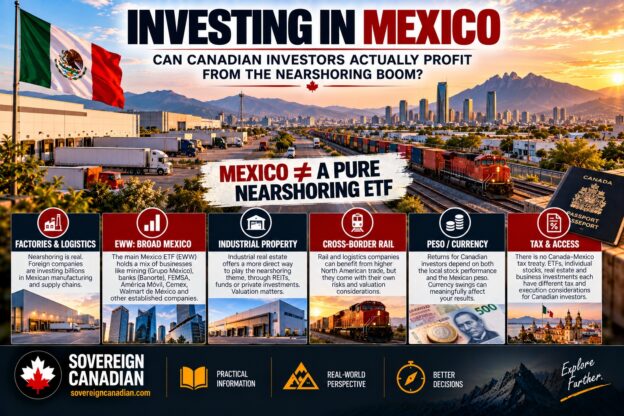
Mexico gets the phone calls. Portugal gets the long-term relationship.

Portugal real estate investing for Canadians is a fundamentally different proposition than the Mexico series I’ve been building out — and if I’m honest about my own shortlist, Portugal sits near the top of it, right alongside Mexico and Italy. Possibly ahead of both on one specific dimension: it’s the easiest of the three to actually execute. If you’ve read the Mexico introduction post, you know my bias toward proximity — a place you can reach for a long weekend gets used, and a place that requires nine hours in the air becomes a once-a-year commitment no matter how good the intentions were at purchase. Portugal breaks that rule and gets away with it. It’s not close. It’s not cheap relative to Mexico. And Canadians are still buying there in serious numbers, because Portugal isn’t selling proximity — it’s selling a legal system you recognize, a currency that isn’t going anywhere, EU market access, and a lifestyle case that Mexico, for all its yield, can’t quite match.

Continue reading
Puerto Vallarta real estate for Canadians guide, with Banderas Bay shoreline, the Church of Our Lady of Guadalupe, and an investor checklist

Puerto Vallarta Real Estate for Canadians

This is the post where the series changes states — literally. Everything we’ve covered so far in Mexico has been Quintana Roo: the Riviera Maya guide, the Playa del Carmen real estate deep dive, and the Tulum post all operate under the same state regulator, the same RETUR-Q registration regime, the same Caribbean demand engine. Puerto Vallarta real estate runs on different rails. It’s in Jalisco, on the Pacific, with its own tax rates, its own regulatory trajectory, and — as of February 2026 — its own headline risk that we need to talk about like adults.

Continue reading
Tulum real estate for Canadians guide cover with beachfront condos, investment highlights, and an investor checklist

Tulum Real Estate for Canadians

In the Riviera Maya guide, I filed Tulum under “appreciation but submarket-dependent” and flagged La Veleta and Region 15 as oversupply risk before moving on. That’s a fair one-line summary, but it’s not a buying decision. Tulum is the most polarizing market in this series so far — it’s the one where the Instagram version and the spreadsheet version diverge the most — and it earns its own post.

If you haven’t read the earlier pieces, start with the Mexico introduction post for fideicomiso and T776 basics, then the Riviera Maya post for how Tulum stacks up against Playa del Carmen and Puerto Morelos. This post assumes you’re past that and specifically weighing a Tulum purchase.

Continue reading