Tag Archives: Rental Income

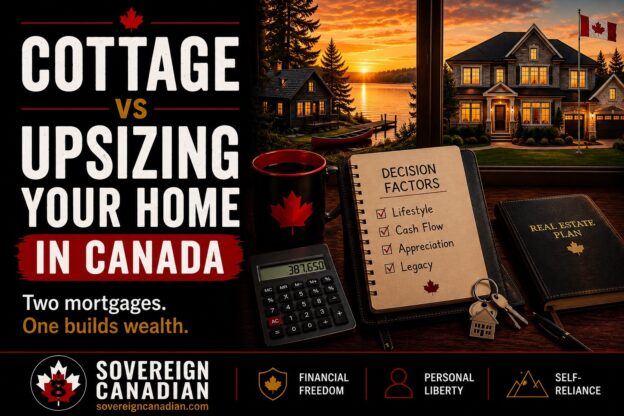
Cottage vs. Upsizing Your Home: Which Mortgage Decision Actually Builds Wealth?

Many people with a growing family and some equity hits the same fork in the road.

Do you upgrade and buy a bigger, better house? Or do you buy a cottage?

Both moves can cost roughly the same. Both put you ~$500k deeper in debt. But they are definitely not the same decision.


First — the upgrade is not nothing

Let’s be honest about what a $500k addition to your primary residence actually buys you.

A bigger yard. Space for the kids to actually play outside instead of turning your living room into a jungle gym. Maybe A three-car garage, or a proper workshop if that’s your thing. Usually a better kitchen, with more space, storage and actually room for your coffee machines. A basement rec room that earns its square footage and your living room sanity back. A main floor office that isn’t a closet with a monitor in it. A pool. Or a hot tub. Or both. And more storage. Sweet, sweet storage.

These are real quality-of-life upgrades. Don’t let anyone tell you otherwise.

And here’s the part that matters: it all happens under one roof, one mortgage, one address. Lower complexity. Easier to manage. Your family lives in it every single day. Enjoying.

If your goal is to optimize the experience of your daily life, the upsize is a legitimate answer.

But it is only one thing. It is a lifestyle purchase. A very good one — but a purchase, not a play.


The mortgage question nobody frames correctly

You’re not choosing between spending $500k. You’re choosing between two mortgages.

A $500k increase on your primary residence gives you everything listed above. Real value. Real enjoyment. And zero return on investment beyond the hope that real estate keeps going up.

A $500k cottage mortgage gives you a second title. A property that earns while you’re back in the city. Something you can sell independently, without touching the roof over your head. Something that appreciates in its own market, on its own merits.

Same debt load. Completely different financial architecture.

The upsize is consumption with a mortgage attached — excellent consumption, but consumption. The cottage is an asset with optionality built into the deed.

Second property mortgage rules in Canada


What STR income actually does to the math

You mortgage a cottage. Your family uses it. When you’re not there, you rent it.

A well-located Canadian cottage — good water access, reasonable drive from a major city — can gross $25,000 to $50,000 a year on Airbnb. Fifty to eighty nights at $300 to $600 a night. Adjust for your market. The numbers vary, but the model holds.

Get honest about costs. Platform fees, insurance riders, cleaning, maintenance, the furnishings that don’t survive year two, the occasional guest who redefines your understanding of the word “tidy.” After all of it, you’re netting somewhere around 40–55 cents on the dollar.

Call it $12,000–$25,000 net annually. On a $500k mortgage, your carrying costs are real. That rental income isn’t eliminating them. But it’s absorbing a substantial chunk — while the property appreciates and your family is actually using it through the season.

Your upgraded kitchen is doing none of that. Beautiful kitchen, though. And thank heavens for the full-size mudroom.

Airbnb hosting in Canada


The retirement move hiding in plain sight

Here’s what nobody mentions when they’re weighing the two options.

The cottage isn’t just a summer property. It’s a retirement vehicle.

You spend your working years building equity in both places. Then you retire. Summer goes to the cottage — Perhaps full season, no guests, entirely yours (or you crank up the price and go somewhere else for a week or two). Winter, you head south and become a proper Snowbird. The city house becomes your base, or you downsize it, or you leverage it while you’re gone. Or you sell and take those tax-free capital gains.

You’ve built a three-mode retirement almost by accident: cottage summers, snowbird winters, city as needed. All from one mortgage decision made when the kids were young.

The upgraded primary residence ages with you differently. You’re maintaining more square footage you eventually stop using. The pool becomes a chore. The workshop sits quiet. The extra bathroom cleans itself in your dreams. These are first-world problems, but they’re real ones — and they don’t come with an exit strategy.

Canadian real estate market data


The honest part — because the cottage isn’t all upside either

A cottage is not passive income. Be direct with yourself about that. It’s more work than your primary residence.

The early years cost more than you expect. You buy something, you fix it, you furnish it, you figure out what guests actually need versus what you assumed. There’s a gap between owning a cottage and running a profitable short-term rental — and that gap costs time, money, and weekends you’d rather have back. Most of your weekends.

Managing a short-term rental means managing people. Guest communication, cleaning coordination, maintenance calls that don’t respect your schedule. You can hire a property manager at roughly 20–25% (don’t do that!) of gross revenue and reclaim most of your time. Factor that in before you build your pro forma.

And the carrying costs in year one, before the rental flywheel is turning? You’re funding two mortgages with no offset yet. Make sure the cash flow supports that without drama.

But there are some sweet Rental Property Tax Benefits!


What the numbers don’t capture

Your kids will not remember the rec room.

They will remember the beach. The summers. The traditions that build because there’s a place worth returning to, year after year. That’s generational capital — the kind that actually transfers.

You own a piece of land your family controls. Not a place you book and hope is available. Yours. The week you want it is your week – or you just fill in the booking gaps and keep the rental availability close to 100%.

That’s sovereignty over your summers. Eventually, over your retirement.


The honest comparison

The upsize gives your family a better daily life. That’s worth real money and don’t let anyone dismiss it.

The cottage gives your family a better life — and builds an asset while it does it.

Both are good decisions for the right person. The question is whether you want to optimize for today’s comfort, or whether you want to build something that keeps paying dividends long after the kids have left the dock and started bringing their own families back.


Who the cottage isn’t for

Hate maintenance? Don’t buy one. There is a lot!

Family has no interest in the same place every summer? Don’t buy one.

Want passive income with no operational effort? Buy a REIT. The cottage is not that.

But if you want an asset that earns, appreciates, builds family legacy, and hands you a retirement lifestyle most people are still sketching on napkins at 65 — the math points in one direction.

Two mortgages isn’t reckless. It’s a strategy.


Not financial advice. Run your numbers with someone who knows your situation — especially around principal residence exemption planning when you eventually sell.