Merida Real Estate Investing: What Canadians Should Know Before They Buy

Merida real estate has become the quiet contrarian trade of the Mexican property market. While Canadian money chased beachfront condos up the Caribbean coast, a colonial capital 300 kilometres inland was compounding at 8 to 12 percent a year without the boom-and-bust drama. No cruise ships. No sargassum. No presale towers marketed at Toronto investor seminars.

I have spent the last several months working through the Mexican coast for this site. Cancun’s shadow, Playa’s presale machine, Tulum’s regulatory mess, Puerto Vallarta’s mature expat economy. Merida real estate is the last major market I wanted to cover, and it behaves least like the others.

That is exactly why it deserves a hard look — and exactly why the marketing around it needs a filter.

Continue reading


Los Cabos Real Estate Investing for Canadians: The Honest 2026 Breakdown

Los Cabos real estate is the most expensive, most American, and most water-constrained market in this entire Mexico series. It is also the one where Canadians currently have the most negotiating leverage they have had in years. Those two facts are related, and understanding why is the whole point of this post.

I have spent the last several months working through Mexico real estate market by market — the Riviera Maya, Playa del Carmen, Tulum, Puerto Vallarta. Each one has its own pathology. Tulum has an oversupply problem. Playa has a management problem. Puerto Vallarta has a seasonality problem. Los Cabos has a cost problem and a water problem, wrapped inside the strongest luxury brand in the country. If you are earlier in the decision than a specific country, the foreign real estate investing pillar is the map that sits above all of these.

Continue reading

Panama Real Estate Investing for Canadians

Mexico sells proximity. Portugal sells a legal system you recognize and an EU passport at the end of the road. Panama sells something different again: a currency you don’t have to think about, a government that has spent a century building its economy around foreigners moving money through it, and a property registry that treats a Canadian buyer almost exactly like a Panamanian one. That last part is not marketing copy — it’s closer to the truth than most “foreigner-friendly” claims you’ll read about other countries in this series.

Continue reading

Montenegro Real Estate Investing for Canadians

Portugal is the safe, well-lit room in this series. Mexico is the yield play with the tax paperwork to prove it. Montenegro is the one I keep coming back to because the numbers still look like 2015-Portugal — and almost nobody in Canada is looking at it yet.

Here’s the pitch in one line: a euro-denominated Adriatic coastline, zero foreign-ownership restrictions, a frontrunner spot in the EU accession queue, and price-per-square-metre figures that are still a third to a half of comparable Croatian or Italian coastline twenty minutes away by car. That combination doesn’t last forever. It’s exactly the kind of window this series exists to flag.

Continue reading

Belize Real Estate Investing for Canadians

Every country in this series has asked you to give something up. Mexico asks you to work through a fideicomiso if you want the coast. Portugal asks you to accept EU bureaucracy in exchange for a legal system you half-trust. Greece asks you to be early to a market that’s still catching up. Belize doesn’t ask you to give anything up on the ownership side — and that’s precisely why it belongs in this series, and precisely why you should still read the fine print before you wire a deposit.

If you’ve read the pillar post for this series or the Mexico introduction, you know my starting filter: I want a clean path to title, a legal system I can actually read, and a government that isn’t going to rewrite the rules three years after I close. Belize checks the first two boxes better than almost anywhere else in Latin America or the Caribbean. The third box is where this post earns its keep.

This is the primer for the Belize arm of the series — the country-level view before we go deep on Ambergris Caye, Placencia, and the inland Cayo district in later posts.

Continue reading
Spain real estate investing for Canadians — coastal town on the Costa Blanca with Spanish flag

Spain Real Estate Investing for Canadians: The Introduction

Spain comes up early whenever Canadians start pricing out a place in Europe. It has the sun, the beaches, a healthcare system that consistently outranks ours, an established Anglophone expat infrastructure on every major coast, and prices that still look reasonable next to Toronto or Vancouver. It is the second most popular destination in this series after Mexico for good reason. But “sunny, cheap, and full of Canadians already” is not a strategy, and Spain has spent the last eighteen months rewriting the rules around rental property, taxation, and foreign investment – which means the version of Spain your neighbour bought into in 2019 is not the one on offer now.

This post is the country introduction, not the regional guide. It will not make you an expert on any single coastline – Costa del Sol and Costa Blanca will each earn their own deep dive, and I will link them here as they publish. What this post does is give you the framework: where Canadians actually buy and why, how ownership legally works when there is no trust and no restricted zone to worry about, how financing really functions for a non-resident, what the short-term rental clampdown of the last two years means for a rental thesis, what the taxes look like on both the Spanish and Canadian sides, and how safe the place actually is. By the end you will know enough to ask the right questions instead of the obvious ones. Spain is one of the markets I keep circling back to when I think about a second real estate investment.

Continue reading
Costa Rica real estate investing for Canadians - sunset over a Pacific hillside villa with infinity pool and the Costa Rican flag

Costa Rica Real Estate Investing for Canadians

Mexico sells proximity. Portugal sells a legal system you half-recognize. Croatia sells full EU integration. Costa Rica sells something none of them can match cleanly: you can hold titled property in your own name, with the exact same rights as a citizen, no trust structure, no corporate workaround, no five-figure annual fee just to keep your ownership legal. If you’ve read the Mexico introduction and dealt with the fideicomiso, this is the part where you exhale. Costa Rica doesn’t make you rent a bank’s permission to own your own house.

That ease is also why Costa Rica isn’t a secret. It’s the most mature foreign-buyer market in Central America, prices in the established zones have already priced in decades of expat demand, and the “wild frontier, ground-floor opportunity” pitch that works for Albania or parts of Mexico doesn’t really apply here. What you’re buying in Costa Rica is stability and simplicity, not a discount. This is the primer for a new arm of the foreign real estate investing for Canadians series — the 30,000-foot view before we go deep on Guanacaste, the Central Valley, and the Southern Zone in later posts.

Continue reading

Isla Mujeres Real Estate Investing for Canadians

In the Cancun deep dive, I said Isla Mujeres was a different animal from the Costa Mujeres and Playa Mujeres corridor on the mainland — scarcer land, a heavier luxury skew, and its own municipal rulebook — and that it deserved its own write-up rather than a footnote. This is that write-up. It rounds out the Mexican Caribbean cluster in this series, and of every market I’ve covered, Isla Mujeres real estate is the one where the thesis is least about yield and most about scarcity.

Isla Mujeres real estate is a fundamentally different proposition than a Cancún condo or a Playa del Carmen investment unit, and the reason is geography. This is a seven-kilometre island of roughly 750 hectares, a twenty-minute ferry from the mainland, where the amount of land that can ever be built on is fixed and small. If you’ve read the Mexico introduction for the fideicomiso and T776 basics, and the Riviera Maya overview for how the region’s markets stack up, this post is the island-specific layer: where the money actually goes, and why the island’s constraints are the whole story.

Continue reading

Cancun Real Estate Investing for Canadians

I like Cancun. I like it the way I like an airport lounge with a good view – it is where a trip starts, not usually where it ends. Land a plane there, rent a car, and within two hours you can be almost anywhere on the Mexican Caribbean. That accessibility is the single most important fact about Cancun, and it colours everything else, including whether the place makes sense as somewhere to park capital.

This post is me doing my own homework out loud. I am not sold on Cancun as an investment or a retirement base – I lean toward Playa del Carmen if I am being honest – but “I have a hunch” is not a thesis, so I went and pulled the numbers, the ownership rules, the tax layers, and the current safety picture. What follows is what I would want to know before wiring a deposit. If you are earlier in the funnel, start with my broader pieces on investing in Mexican real estate as a Canadian and the Riviera Maya overview, and the pillar on foreign real estate investing for Canadians for the structural stuff that applies everywhere abroad.

Continue reading
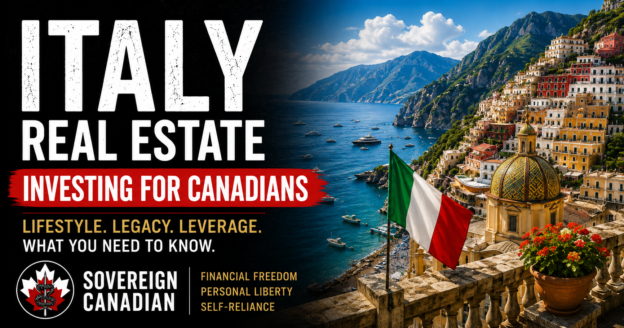
Italy real estate investing for Canadians - Amalfi Coast hillside village with colourful homes, tiled dome, and Italian flag overlooking the Mediterranean

Italy Real Estate Investing for Canadians

Every country I have written up in this series answers a question. Mexico‘s question was legal: is the scary-sounding restriction on foreigners owning coastal land actually a problem? (It isn’t.) Spain‘s question was regulatory: are the frightening headlines the real risk, or is the quiet tightening of short-term rental rules the thing that will actually cost you money? (The second one.) Italy asks a different question, and it is the one I find hardest to answer honestly as someone who spends most of his time thinking in spreadsheets.

Italy’s question is this: can quality of life itself be a legitimate investment return?

Continue reading