
Author Archives: Andrew

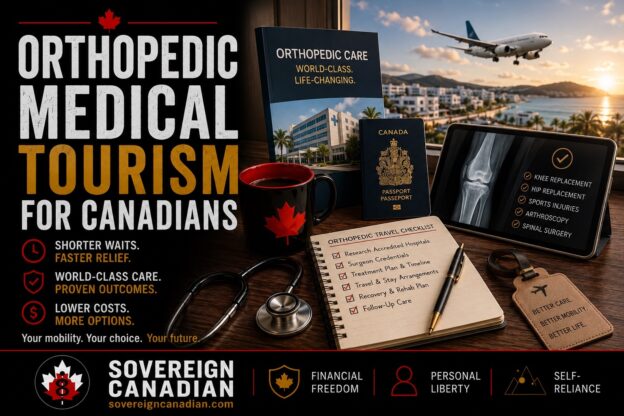
Orthopedic medical tourism for Canadians: a Canadian passport, stethoscope, knee X-ray on a tablet listing knee and hip replacement, and an orthopedic travel checklist on a desk overlooking a tropical coastline at sunset

Orthopedic Medical Tourism for Canadians: What a Hip, Knee, or Spine Really Costs Abroad

This is a deep dive in our medical tourism series, and it covers the procedure that pushes more Canadians onto a plane than almost any other. Orthopedic medical tourism is the queue-jumper’s category — the one where you already qualify for the surgery at home, the system agrees you need it, and the only thing standing between you and a working joint is a waitlist measured in seasons rather than weeks.

The math here is unusual. Unlike dental or cosmetic work, a hip or knee replacement is covered by your provincial plan. So the arbitrage isn’t really about money — it’s about time, and about the mobility you quietly lose while you wait for your name to come up. That changes how you should think about the whole decision. Let’s get into the numbers.

Continue reading

Genetic Testing for Cancer: What Canadians Should Actually Test For, and Where

Genetic testing for cancer is the one corner of the whole medical tourism conversation where my honest advice is: you probably don’t need to get on a plane. Your DNA is the same in Bangkok as it is in your kitchen. It’s a mail-in saliva sample either way. So this sub-post to the diagnostic medical tourism deep dive is less about geography and more about knowing what to test for, what it actually tells you, and what a result costs you back home.

Continue reading
Diagnostic medical tourism for Canadians: a Canadian passport, stethoscope, and medical travel checklists on a desk overlooking a sunset airport.

Diagnostic Medical Tourism: Why Canadians Are Buying Their Scans Abroad

Diagnostic medical tourism is the quietest, highest-value corner of the whole medical travel market, and almost nobody plans for it. Everyone pictures the dental trip or the knee replacement. Far fewer people think about the test that comes before any of that – the scan that tells you whether the knee needs replacing at all, or whether the fatigue you’ve been ignoring is nothing or something.

In Canada, that test is a queue. Abroad, it’s a product. This deep dive is the third stop in our medical tourism series, and it covers what executive health screening actually is, what it costs, where to get it, and the one risk the brochures never mention. I’m not a doctor, and none of this is medical advice. It’s a framework.

Continue reading
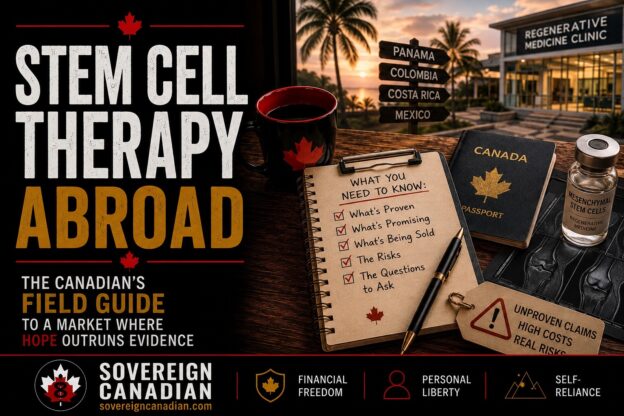
Stem cell therapy for Canadians field guide: Canada passport, mesenchymal stem cell vial, knee MRI, and a signpost to Panama, Colombia, Costa Rica and Mexico.

Stem Cell Therapy Abroad: The Canadian’s Field Guide to a Market Where Hope Outruns Evidence

Of every procedure in the medical tourism playbook, stem cell therapy for Canadians is the one where the marketing has travelled furthest ahead of the science. Dental implants in Los Algodones do exactly what the brochure says. A hip resurfacing in India is the same operation you’d get in Toronto, three years sooner. But when a clinic in Panama or Colombia tells you that an intravenous drip of umbilical cord cells will reverse your MS, rebuild your knees, calm your child’s autism, and knock a decade off your biological age — all from the same bag — you are no longer looking at a healthcare transaction. You are looking at a sales funnel.

Continue reading
Medical tourism for Canadians: a Canadian passport, Toronto-to-Cancún boarding pass, paid medical invoice and stethoscope on a desk overlooking an airport departures gate at sunset

Medical Tourism for Canadians: Why 105,000 of Us Left the Country for Care Last Year

Medical tourism for Canadians is no longer a fringe topic. In 2025, an estimated 105,529 Canadians travelled outside the country for non-emergency medical treatment — a 66% jump from a decade earlier. That’s not a statistic about desperate people making bad decisions. That’s a market signal. When six figures’ worth of your fellow citizens quietly pay out of pocket — after already paying taxes into a universal system — to get a hip, a scan, or a mouth full of implants somewhere else, the rational response isn’t outrage. It’s research.

This post kicks off a new series on Sovereign Canadian, running parallel to our real estate investing series. Same approach: country by country, procedure by procedure, with real numbers, honest risk assessments, and none of the brochure language. This introduction covers the landscape – why Canadians leave, the procedures that make the most sense to get abroad, the ten destinations that matter, and how to think about the whole thing like an adult managing a portfolio rather than a patient hoping for the best.

Continue reading
Three colour-coded doors labelled FIRE, FIRE Light and Coast FIRE opening onto Canadian sunset scenes — three paths to financial independence in Canada.

FIRE, FIRE Light, and Coast FIRE: Three Doors Out of the 40-Year Grind

Most people hear “FIRE” and picture a 34-year-old in a hammock who will never touch a spreadsheet again. That version exists. But it’s one door out of three, and for a lot of higher-earning Canadians it’s the wrong one to walk through first. Financial independence isn’t a single finish line — it’s a spectrum of how much freedom you’re willing to buy now versus how much you’re willing to defer.

Continue reading
Smith Maneuver diagram showing the readvanceable mortgage conversion loop for Canadian homeowners

The Smith Maneuver: A Deep Dive for Canadians Who’ve Already Read the Hype

The Smith Maneuver might be the most over-marketed strategy in Canadian personal finance. Search for it and you’ll find an ecosystem of certified specialists, courses, and books all selling the same dream: turn your mortgage into a tax deduction and retire rich on the spread. The pitch is seductive because the mechanics are real — this is a legitimate, CRA-recognized structure, not a loophole. But “legitimate” and “right for you” are different questions, and almost nobody selling the Smith Maneuver is incentivized to tell you when the answer is no.

Continue reading
Whole life insurance in Canada guide with book, analysis notebook, and before-you-buy checklist on a desk

Whole Life Insurance in Canada: When It Actually Works (and When You’re Being Sold)

Whole life insurance in Canada is the most aggressively sold financial product I know of — and also the most reflexively dismissed. The insurance industry treats it like a miracle. The personal finance internet treats it like a scam. Both camps are being lazy, and if you’re a Canadian professional with real assets, you deserve better than a slogan.

Here’s my position up front, so you can decide whether to keep reading: for most Canadians, whole life insurance is the wrong product. Term insurance plus disciplined investing wins the math for the majority of households, most of the time. But “most people, most of the time” is not “everyone, always” — and there are three or four specific situations where whole life is not just defensible but genuinely the best tool available. If you own a cottage, run a corporation, or have maxed your registered accounts, one of those situations might be yours.

This post is the deep dive. What whole life actually is, why the default answer is still term, where the product earns its keep, and where the sales pitch falls apart under a calculator.

Continue reading
The playgrounds flag — a Canadian's guide to where you spend your time, showing a field guide, checklist and tablet covering how presence creates tax residency, day-counting both ways, Schengen limits, and designing a year that doesn't backfire.

The Playgrounds Flag: Where You Spend Your Time

This is the fifth deep dive in my flag theory series, and it’s the one people assume is just the fun part. Where you vacation. Where you enjoy the money. And it is that — but there’s a hook buried in it that can quietly undo the residency flag you worked so hard to plant. So we’re going to enjoy the beach.

New to the series? Read the Flag Theory introduction first — it lays out the full six-flag framework.

Continue reading