Tag Archives: Financial

Sovereign Wealth – My Online Financial Advisors

The Three Online Financial Advisors I Actually Pay For — And Why

If you’ve spent any time trying to figure out how to grow real wealth outside of a Bay Street mutual fund, you’ve probably stumbled across the world of online financial advisors and independent financial research. Newsletter guys. Paid advisors. Contrarian investors who write multi-thousand-word breakdowns of junior mining stocks and macro geopolitics from their homes in Argentina and Vancouver.

There’s a lot of noise in that world. A lot of hype. And honestly, a lot of outright garbage.

But over the years, I’ve found three online financial advisors who I think are the real deal — worth your attention and worth the subscription cost. I pay for all three. I read all three. And I’ve learned a lot from all three.

This isn’t a puff piece. I’m going to tell you who they are, what they’re good at, what they produce, and who each one is best suited for. Think of it as my honest take after years of reading the newsletter space.

Let’s get into it.

Continue reading →

Cottage Airbnb — My Experience After 1 Month Hosting

If you own a recreational property in Canada and you’ve been sitting on the fence about Airbnb, this is for you. Not the glossy version. The real one — with the actual dollar amounts, the mild anxiety of handing over your keys to strangers, and the moment your first guests left thoughtful items for the next family and a five-star review and you thought: okay, maybe this works.

One month in. Here’s what I know.

Continue reading →
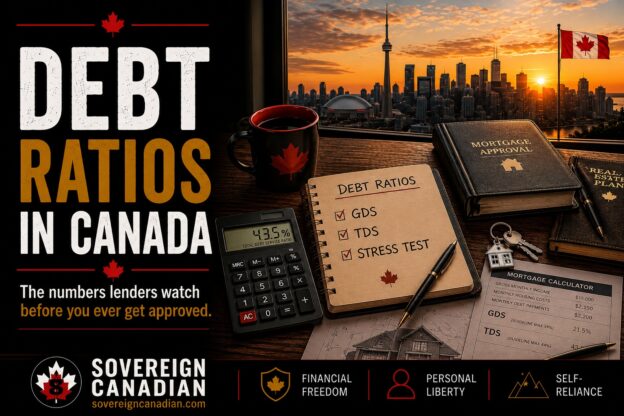
Debt ratios in Canada — GDS, TDS and stress test checklist with mortgage calculator and Toronto skyline

DEBT RATIOS IN CANADA: Front-end & Back-end


Debt ratios in Canada: GDS, TDS, And what rental property does to the math.

Most Canadians have no idea what their debt ratios actually are. They walk into a mortgage appointment, hand over their documents, and let the banker decide whether they qualify. That’s not sovereignty. That’s abdication.

Debt ratios in Canada are the gatekeepers to every major real estate move you’ll make. Understand them and you control the game. Ignore them and the bank controls you.

Here’s the breakdown — what each ratio means, what the lenders want to see, and how owning rental property changes the entire equation.

Continue reading →
Digital side hustles acquisition playbook — laptop showing online business for sale listing with revenue metrics

Digital Side Hustles: The Acquisition Playbook

You Don’t Build From Zero Anymore

Most people still think a side hustle means grinding from scratch — posting content into the void, cold-emailing strangers, hoping the algorithm notices you. That’s the old model. And it’s inefficient.

Acquiring a digital side hustle means buying something that already works. Revenue already flowing. Audience already built. Process already proven. You’re not gambling on an idea. You’re buying a small, operating business — and plugging it into your life as a professional. This is where I am at the moment – professional career is going well, but wanting more. An asset that first pays itself off, then can grow to either pay my wife, or even myself a replacement salary. Something that can grow and give a healthy cashflow, but also increasing its asset value (2-3x net profit).

This guide breaks down every major digital business model you can acquire: FBA, ecommerce, affiliate, digital services, SaaS, YouTube, online education, and KDP. For each one you get the full picture — pros, cons, effort level, AI’s role, and a SWOT you can actually use. Then we’ll talk about where to find them.

Let’s get into it.

Continue reading →
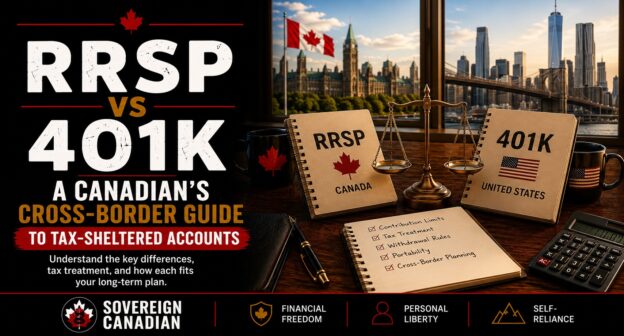
RRSP vs 401k cross-border comparison — Canadian and US tax-sheltered accounts guide by Sovereign Canadian

RRSP vs 401k: A Canadian’s Cross-Border Guide to Tax-Sheltered Accounts

You consume a lot of American financial content. So do I. The podcasts, the YouTube channels, the Reddit threads — most of it is US-centric. And most Canadians absorb it without ever asking: does this actually apply to me?

It often doesn’t.

The tax-sheltered account structures in Canada and the US rhyme. But they don’t match. The rules differ. The limits differ. The tax treatment at the border differs. If you’re optimizing your financial life based on American advice without running it through a Canadian filter, you’re leaving money on the table — or worse, making avoidable mistakes.

Here’s the full cross-border breakdown. No fluff.

Continue reading →
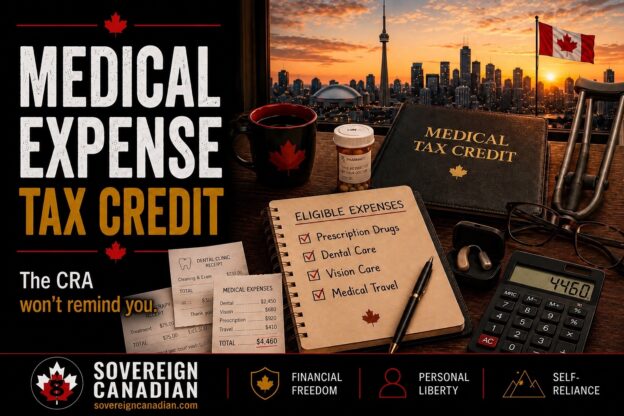
Medical Expense Tax Credit Canada – eligible expenses checklist with dental, prescription, and vision receipts against Toronto skyline

The Canada Medical Expense Tax Credit – How to claim

The CRA Is Letting You Leave Money on the Table — Here’s How to Stop It with the Canada Medical Expense Tax Credit.

Most Canadians file their taxes, take the standard deductions they know about, and move on. They assume if it mattered, their accountant would have caught it. They’re wrong — and the Canada Medical Expense Tax Credit is one of the most consistently overlooked credits in the entire Income Tax Act.

This isn’t a loophole. It’s not complicated. The CRA publishes the rules in plain language. But because it requires a bit of organization and strategic thinking, most people either skip it or massively underuse it. That’s money you’ve already spent — sitting unclaimed.

Here’s how to get it back.

Continue reading →

Tax Reduction: Donate to a Charity

You reduce your taxes If you donate to a charity

Previously I discussed how you can reduce your taxes by making a political contribution.

Well, most of us aren’t exactly enamoured by Canadian politics and political parties, so we need another way to reduce our taxes.

The most noble way of reducing your taxes is by donating to a charity.  This could be something for helping the poor, medical research, or another form of approved charity.

Charitable donations are considered a non-refundable tax credit.

Some helpful links:

Continue reading →

Components of Personal Sovereignty

There are many components of personal sovereignty that lead toward greater freedom and independence.

To me, they can be grouped into four pillars.

Thought Sovereignty

You have to think for yourself.

Almost everything you read contains a hidden agenda, marketing spin, or outright misdirection. The ability to research an issue, analyze the facts, and reach your own conclusions is one of the most valuable skills you can develop.

As Canadians, we like to assume people generally have good intentions. That’s a good quality, but it doesn’t mean we should stop asking questions. Always consider what someone’s agenda might be and what’s in it for them.

People without thought sovereignty are often called sheeple. They simply think and do whatever the television networks, advertisers, fashion retailers, politicians, or governments tell them to do.

Food Sovereignty

Nothing makes us more dependent on others than our food supply.

The average Canadian buys nearly 100% of their food from a grocery store. Unfortunately, I have to include myself in that category.

Growing a garden is one of the best steps you can take toward greater independence. From there, the possibilities are endless. Raise chickens. Plant fruit trees. Learn to preserve food. Produce what you can.

Food sovereignty isn’t just about saving money.

It’s about knowing where your food came from, improving its nutritional value, and becoming a little less dependent on the modern food system.

The food you eat also affects every other pillar. Better food improves your health, reduces medical costs, and often requires you to think more critically about what you’re consuming.

Financial Sovereignty

Debt is financial cancer.

It destroys marriages. It traps people in jobs they hate. It quietly replaces freedom with monthly payments.

When it comes to debt, just say no.

Maintain control of your finances.

Don’t automatically put every dollar into an RRSP simply because your bank tells you to. There are certainly times when RRSPs make sense—especially if your employer matches contributions—but they aren’t the only way to build wealth.

Resist the movement toward a cashless society where every dollar can be monitored, controlled, or switched off.

Hold some cash.

Own silver and gold.

Invest in assets that produce long-term value, whether that’s efficient equipment, farmland, houses, productive land, or your own business.

Most importantly, think for yourself financially instead of blindly following the talking heads on television, the salespeople at your bank, or the bureaucrats in Ottawa.

If you’re interested in building more financial independence, you’ll probably also enjoy my article on Foreign Real Estate Investing for Canadians.

Health Sovereignty

Being Canadians, most of us have never known anything other than government-run health care.

I’m neither a lover nor a critic of the Canadian system.

It’s adequate.

By that I mean it’s generally very good at testing, diagnosing, and treating illness.

Where I believe it falls short is prevention.

The medical industry doesn’t make money from healthy people. Pharmaceutical companies don’t promote healthy living—they promote treating illness after it appears.

I believe your health is ultimately your own responsibility.

Eat well.

Exercise.

Stay active.

Learn about nutrition.

Prevent disease wherever possible instead of simply assuming medicine will solve every problem later.

Canadians should also understand that healthcare options exist outside our borders. Sometimes looking elsewhere is the best decision for your own situation, which is why I’ve written about Medical Tourism for Canadians.

Final Thoughts

These four pillars are the foundation of personal sovereignty.

I’m nowhere near perfect myself. I work on all four every day, and I expect I always will.

Personal sovereignty isn’t something you achieve overnight.

It’s a direction.

Every skill you learn, every debt you eliminate, every tomato you grow, every dollar you save, and every independent decision you make moves you one step closer.


After writing much of this article I listened to an excellent discussion by Jack Spirko on The Survival Podcast (Episode 985: From Pawn to Personal Sovereignty). I found it extremely inspiring, and if these ideas interest you, it’s well worth a listen.

Do you agree or disagree with these recommendations?

Are you working toward greater personal sovereignty yourself?

I’d love to hear your thoughts.

The sign is basically a speed limit sign with a strike through; much like a no smoking sign

Speed Kills Your Pocketbook

How speed kills your pocket book

I live in the Vancouver area and recently viewed the video that takes a deep look at vehicle speeds, road safety, police ticketing, and how the media puts a spin on a story.

A major conclusion that is reached is that people drive with a speed that is reasonable for the road’s design, the weather and light conditions, and the capability of themselves and their vehicle.  The only reason that the white speed limit signs play a role at all is because they are afraid of being ticketed.  I have always been of the opinion that people are better off concentrating on the people and traffic around them, and having to watch their speed while looking out for the cops is dangerously distracting.  While reading this you will notice that I also agree that speed kills your pocketbook.


A case for speed limits

As pointed out in the video, there are times where some of the speed limits make sense.

School zones, tight urban streets, narrow residential streets with children nearby, and downtown access routes with heavy rush hour congestion.  Speed bumps are effective at this as well though.

It also makes sense that the speed limit could be higher for a dry road in day time, and then changed for nighttime, fog, rain, or other dangerous conditions.  Say a speed limit of 130, 140, or 150 km/h on the freeway during a dry day, but dropping to 120 at night, 110 when wet, or 80 when it is foggy.  You don’t have to have fancy digital signs to accomplish this – all it takes is some static signs and education.


Different roads need different limits

The example in the video is a perfect one.  Marine Drive is a well engineered and constructed road.  Three lanes in each direction, smooth surface, and wide curves – sounds like a 70 or 80 road right?  Nope its speed limit is 50 km/h in Vancouver, exactly the same as many narrow, crowded routes heading to and from downtown.  There is no comparison between the speeds I drive and my safety on the tow roads.  I don’t remember driving under 70 on Marine, unless weather and traffic dictate that it would be smart to do so.  But Main St is a different story, with cross roads, traffic lights, cross walks, merging busses, right turners, left turners, parallel parkers, pedestrians, and probably a dozen other road hazards.  My speeds on this street vary from 30 to 60 for the most part – hitting 80 on here would be reckless unless it was closed off to the public as part of a movie set.


Perhaps different speeds for different vehicles is a part of the answer

I have worked hard in my life and am blessed to have purchased a nice car.  I have also owned old pickup trucks, rented cheaper cars, and driven heavier shop vehicles.

There is no comparison between these vehicles when it comes to brakes and stopping distance, handling, tire quality, weight distribution, or all around effect on the safety of myself, my passengers, or drivers and pedestrians around me.

Why then, should I drive them at the same speed or have the same speed limit enforced.  My sports sedan can stop in 1/2 or 1/3 of the distance that my old pickup or shop trucks can.  Conversely I could probably drive 40km/h faster in my car than in the truck, and still stop in the same distance.

Some roads do have different speed limits for cars and transport trucks, and I applaud this.  But these are typically on freeways where stopping distance is less of a worry than on city streets, biways, or highways.  The practicality of different speeds for different vehicles is, admittedly, difficult to enact – but in this day of traffic police knowing everything about us from their laptops anyways, this is certainly worth discussing.


Are speeding fines just revenue generation for the police?

I can’t be the only one who thinks that some speed limits are enforced to help fill the gaps in police budgets.  A sort of involuntary user funding.  This is the most likely reason I can think of for the continued existence of the Marine Drive 50km/h zone.  In fact, in the video you will see how the Vancouver Police Department brags about the number of people it catches on Marine Drive during speed blitzes.  During the creator’s research, not a single car was going 50, in fact I believe that the average speed was around 70.  So when then does it seem that the speed is more intensely enforced on Marine than on Main?  Is it to dissuade speeders or is it to generate revenue?  A police car sitting by the road is just as effective at slowing down cars if traffic safety is their real desire.


My opinions on speed and safe driving

I have lived and driven in Germany and other parts of the world.  Travelling at 180 on the AutoBahn is not a big deal there.  The cars are made for it, the drivers are trained and experienced with it, and the roads are properly designed and constructed.  Oh and 180 is just a suggestion, some will drive at 150, some at 200.  People drive within their ability, their car’s capability, the traffic, and the weather conditions.  Signs slow people down when necessary, and this condition-induced limit is enforced.  Did I mention that the accident and fatalilty rate is much lower there than here?  The video presents the specifics figures – and they are significant.  My personal experience is that I feel much safer on a two lane Autobahn at 170 than I don on the #1 or 401 at 120 – because I am paying attention to my driving, as are others, and none of us are bored out of our minds and daydreaming due to the artificially low speed for the driving conditions.  In fact, I find that the only thing I am looking out for on those highways is a police car, because I really don’t feel like contributing to their slush fund.

Read the engineers’ speed recommendations, they are unilaterally more capable at setting them than politicians, civil servants, and others who just happen to find themselves in that position.  The recommendation that I saw was to set the speed at the 85th percentile speed of a large sample group.  Well I think that’s a reasonable place to start.  Just try it and watch the results, debating and predicting does little compared to real world results.  If the traffic is going to drive that speed anyways, then this is the prudent thing to do.  If this equates to 70 on Marine, then so be it.  In fact, removing the 50 signs and changing to 70 would increase the safety on the road, since it would limit the possibility of people driving 20km/h below the flow of traffic in fear of the police enforced driving tax.  Irrationally slow traffic is one of the most dangerous obstacles that I encounter on the road – especially when they stay in the left lane.  This causes other drivers to step on their brakes, pass on the right “undertake”, tailgate, or perform a number of other driving maneuvers that are much, much more dangerous that ‘speeding’

The sign is basically a speed limit sign with a strike through; much like a no smoking sign

Germany’s “No Speed Limit” Sign


You can view the “Speed Kills You Pocketbook” video right here:


Interested in more?

In support of the movement to raise speed limits on some roads, there are education & petition websites for BC and Ontario – please visit them if you want to learn more or to let this voice be heard.

Sign the BC Petition

Sign the Ontario Petition

Do you have an opinion on speed limits?  Have you received a ticket due to an unreasonable speed limit?  Are police in your area hiding to try and catch ‘speeders’ just in the name of revenue generation?  Or is your opinion different – I’d like to hear it as well.  Please comment below.

 
Google+