Tag Archives: Investing

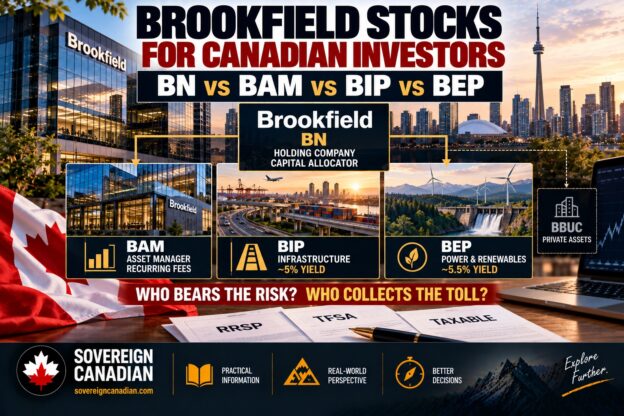
Brookfield stocks for Canadian investors comparing BN, BAM, BIP and BEP across asset management, infrastructure and renewable power

Brookfield Stocks for Canadian Investors: BN vs BAM vs BIP vs BEP

A Canadian investor who likes Brookfield can buy Brookfield Corporation, Brookfield Asset Management, Brookfield Infrastructure, Brookfield Renewable or Brookfield Business Corporation. On a brokerage screen that looks like a choice between five companies.

It isn’t.

It’s a choice about where you want to sit inside one capital-allocation system, and who gets paid first.

Here’s the short version. Brookfield Corporation (BN) owns about 74% of Brookfield Asset Management (BAM), the manager. BAM collects fees for running capital, including capital invested through Brookfield’s listed vehicles. Brookfield Infrastructure (BIP), Brookfield Renewable (BEP) and Brookfield Business Corporation (BBUC) own operating assets and carry much more of the financing, construction and operating risk.

Continue reading →
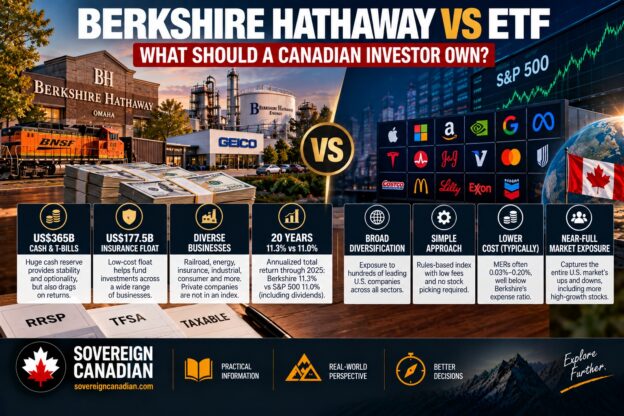
Berkshire Hathaway versus an ETF for Canadian investors comparing cash, insurance float, operating businesses, diversification and market exposure

Berkshire Hathaway for Canadian Investors: Is It Better Than Just Buying an ETF?

Berkshire Hathaway is the largest individual stock in my RRSP.

That makes this an important article to write. It would be easy to explain why Berkshire is a wonderful company, because it is. The harder question is whether I would make the same bet today with fresh money.

If I had the cash sitting in my account right now, would I buy Berkshire, or would I buy an S&P 500 or total-market ETF and be done?

Continue reading →
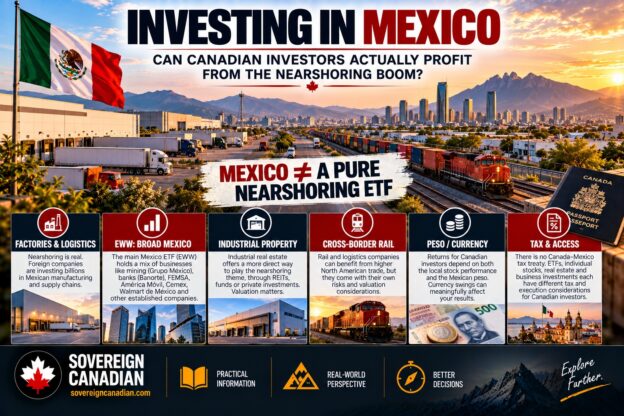
Investing in Mexico for Canadian investors with factories, logistics, cross-border rail, industrial property and Mexico ETF exposure

Investing in Mexico: Can Canadian Investors Actually Profit From the Nearshoring Boom?

Mexico’s factories are real. I’m not going to argue otherwise. Foreign companies put a record USD 40.9 billion of direct investment into Mexico in 2025, and another USD 35.0 billion in the first half of 2026. Trucks, rail cars and containers cross the border every hour carrying cars, servers and appliances that were assembled in Mexico and sold to Americans.

The question I care about is different. If Mexico wins the nearshoring race, who gets paid, and can a Canadian investor own any of it at a sensible price?

I went looking for the answer the way I did with Vietnam. In that article, an economy growing at roughly 8% a year had delivered about 3% a year to the foreign investor who bought the obvious ETF. Mexico looked like it might be the same story with a different flag.

It isn’t.

It’s closer to the reverse: a slow-growing economy, a stock market that has paid foreign investors respectably, and an investable market that looks surprisingly different from the factories everyone associates with Mexico.

Continue reading →
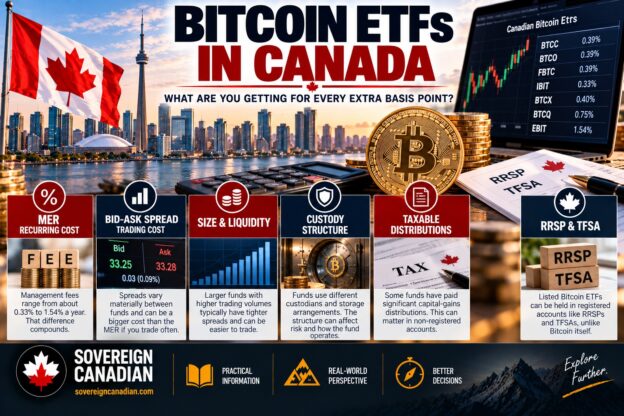
Bitcoin ETFs in Canada comparing MERs, bid-ask spreads, liquidity, custody, taxable distributions and registered accounts

Bitcoin ETFs in Canada: Which One Should You Actually Buy?

A Canadian can buy a Bitcoin ETF that costs about 0.33% a year, or one that costs more than 1.5%. Either way, the investor ends up with exposure to the same Bitcoin. On CAD 100,000, that is roughly CAD 330 a year versus CAD 1,540 a year, before any compounding.

So what is the more expensive fund doing for the extra money?

The answer is more nuanced than “buy the cheapest one.” The annual fee recurs, but bid-ask spreads are paid when you trade. Custody structures differ. In a taxable account, some of these funds have paid out large capital-gains distributions. And Canadians are not limited to Canadian-listed funds, even inside an RRSP or TFSA.

This article assumes you have already decided you want Bitcoin through an ETF. It does not argue for or against owning Bitcoin. Figures are dated throughout because they come from different measurement periods and are not simultaneous quotes.

Continue reading →
Snowbird versus full relocation for Canadian retirees comparing tax residence, RRSP and RRIF treatment, pension splitting, OAS, healthcare and foreign taxes

Snowbird vs Full Relocation: Should Canadian Retirees Actually Leave Canada?

A CAD 400,000 gap in how Canada taxes a RRIF at death looks like the whole answer, until you ask how much of that RRIF you will actually have left, and where you will genuinely be living when it matters.

Picture two Ontario retirees who started in nearly identical positions. Both retired at 55 with a RRSP worth about CAD 1.5 million. Both are now in their late eighties, widowed, with no spouse left to roll a RRIF over to. One still lives in Ontario. The other genuinely moved away years ago and has been a non-resident of Canada ever since.

If each of them dies this year with a CAD 1.5 million RRIF still sitting there, the Canadian tax difference between them can be roughly CAD 400,000. The resident’s RRIF is generally included in income on the final return, pushing much of a large balance into Canada’s highest marginal tax brackets. For a genuinely non-resident annuitant, the best-supported Canadian treatment is instead a deemed RRIF payment subject to Part XIII withholding, normally at 25 percent.

Continue reading →
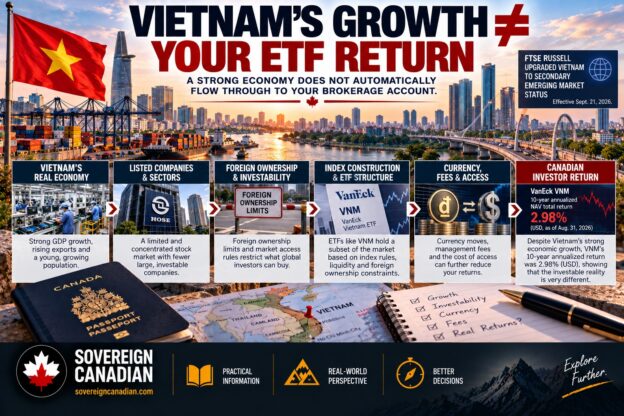
Investing in Vietnam for Canadian investors showing economic growth, foreign ownership limits, ETF structure and investor returns

Investing in Vietnam: Can Canadian Investors Actually Capture Vietnam’s Growth?

Vietnam is the country that gets waved around at every “de-risk from China” panel discussion. Samsung builds phones there. Apple’s suppliers have been moving assembly lines there for years. The population is young. The middle class is expanding. GDP has been growing at rates that would make most finance ministers weep with envy. And in September 2026, FTSE Russell finally did what index watchers had been expecting for years: it moved Vietnam out of frontier-market status and into Secondary Emerging Market status, alongside China, India, Indonesia and the Philippines. FTSE Russell’s Vietnam reclassification

On paper, this is exactly the kind of story that should have made patient foreign investors rich.

Continue reading →
Private REITs and real estate syndicates in Canada comparing illiquid private investments with publicly traded REITs

Private REITs and Real Estate Syndicates in Canada: Are the Higher Yields Worth Giving Up Liquidity?

Say you have $100,000 to invest.

Option one: you buy $100,000 of a Canadian REIT ETF. Tomorrow morning you can check what it is worth. If the bond market has a bad week, you might open your account and see $85,000. You will not like that number, but you will know it, and you can hit sell before lunch if you want to.

Option two: you put the same $100,000 into a private apartment REIT or a five-year real estate syndication. Your statement barely moves. The marketing materials talk about a 7 percent preferred return, a 5 percent cash distribution, institutional-quality buildings and “low historical volatility.” It feels calmer. Nothing is flashing red on a screen.

Continue reading →
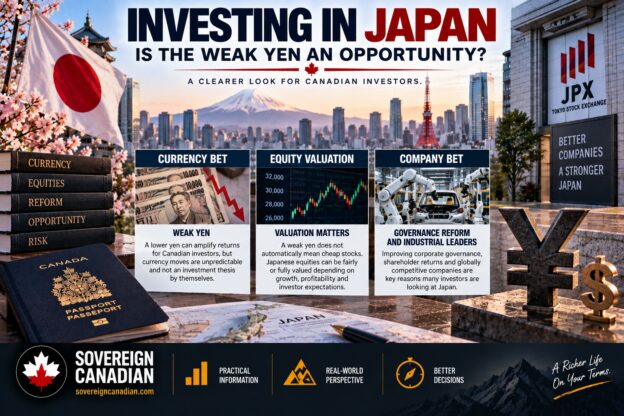
Investing in Japan for Canadian investors with Tokyo skyline, weak yen, Japanese equities and corporate reform

Investing in Japan: Is the Weak Yen Creating an Opportunity for Canadian Investors?

I am writing this from Japan. My family and I are here for a few weeks, moving between Osaka, Kyoto and Nara, and the weak yen is impossible to ignore. I was here more than a decade ago, and the difference this time shows up within the first day. Meals that would feel properly expensive back in Ontario come out costing a fraction of that once I convert. Local trains barely register as an expense. Even convenience store snacks, the onigiri and canned coffee that quietly add up on any trip, feel almost free.

I have already looked at Japan from the other direction in Living in Japan as a Canadian: what it costs to live here, how residency works, and where the country fits as an expat destination. This is a different question entirely.

Anyone who has glanced at CAD/JPY over the last couple of years already knows the yen has been weak. But standing in a train station doing currency math in my head, a different question kept nagging at me. If my Canadian dollar buys an unusual amount of Japan at the restaurant, the convenience store and the ticket machine, does it also buy an unusual amount of value on the Tokyo Stock Exchange?

The answer, after spending real time on this, is not necessarily.

Continue reading →
HOOPP pension deep dive showing defined benefit income, early retirement, bridge benefits, CPP, OAS and retirement investments

HOOPP Pension Deep Dive: What Is It Actually Worth, and How Should It Change Your Financial Plan?

Picture two households, both 55, both about to retire.

Household one has $1 million sitting in RRSPs and non-registered accounts. No pension. They look at their net worth statement and feel good about it. A million dollars is a million dollars.

Household two has $600,000 in investments and a HOOPP pension that will pay roughly $45,000 a year for the rest of their life, starting now. Their net worth statement, the conventional kind, says they have $600,000. Six hundred thousand dollars looks a lot smaller than a million.

So which household is actually in the stronger position?

Continue reading →
Canada's $50 billion Maple Fund showing CPP Investments and Brookfield funding Canadian infrastructure and strategic industries

Brookfield’s $50 Billion Maple Fund: Can Individual Canadians Invest Alongside It?

One of the announcements that caught my attention coming out of this week’s Canada Investment Summit was the creation of something called the Maple Fund.

The headline number is enormous: $50 billion.

CPP Investments and Brookfield Asset Management have created a new framework to pursue some of the largest infrastructure and strategic investments in Canada. Each organization could put as much as $25 billion into it over the next five years.

Continue reading →