
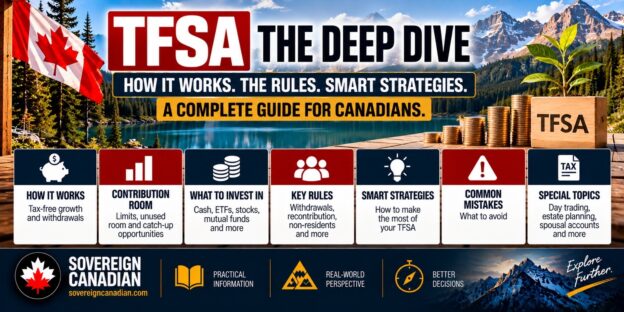
The Tax-Free Savings Account is the most quietly powerful account most Canadians own, and also the most misunderstood. Its name undersells it. People hear “savings account” and picture a place to park an emergency fund at 2% interest, when in fact it is one of the few tools in the Canadian system capable of sheltering a lifetime of investment growth from tax entirely.
This is a working guide to using it well. We will cover what the account actually is, how contribution room is built and rebuilt, where people get into trouble with the Canada Revenue Agency, and the strategic questions that matter most: TFSA versus RRSP, asset location, early retirement withdrawals, estate planning, and what happens if you leave the country. The goal is not to celebrate the account, but to help you treat it as what it is — a long-term pool of independently controlled, tax-free capital.
A note before we start: this is educational analysis, not personalized financial or tax advice. The rules below are current as of October 2026, but your own situation will have wrinkles these pages cannot anticipate. Confirm the specifics with a qualified advisor or accountant before acting.
What a TFSA actually is
The TFSA was introduced in 2009. Despite the name, it is not a savings product but a registered structure that can hold most of the same investments as a brokerage account: cash, guaranteed investment certificates, bonds, publicly listed stocks, mutual funds, and exchange-traded funds. What makes it distinct is the tax treatment. Interest, dividends, and capital gains earned inside the account are not taxed, and withdrawals are not taxed either. There is no deduction when money goes in, and no inclusion in income when it comes out.
To open one, you need to be a Canadian resident with a valid Social Insurance Number and have reached the age of majority in your province. That last point has a subtlety worth flagging, which we return to below.
The practical consequence of the tax treatment is that a TFSA removes the annual drag that a taxable account carries. In a non-registered account, the CRA takes a share of your interest and realized gains every year, and that lost amount can no longer compound. Over a long horizon, eliminating that drag is worth more than most people expect, which is where any honest discussion of the account should begin.
The value of tax-free compounding
Consider an investor who contributes the current annual maximum of $7,000 at the end of each year and earns a steady 6% annual return, with no fees and no withdrawals. The figures below are illustrative — real returns are neither steady nor guaranteed, and the annual limit will rise over time with inflation — but they make the mechanism concrete.
| Years contributing | Total contributed | Approx. account value at 6% |
|---|---|---|
| 25 years | $175,000 | ~$384,000 |
| 30 years | $210,000 | ~$553,000 |
After 30 years, roughly $343,000 of that balance is investment growth, and every dollar of it is spendable without further tax.
Now compare a taxable account running the same contributions and the same 6% gross return, but losing roughly one percentage point a year to tax. The one-point figure is an illustrative modelling assumption, not a universal or representative rate: the actual drag depends on the type of investment, portfolio turnover, how much of the return arrives as distributions versus unrealized gains, when gains are realized, and the investor’s own marginal rate. Using it, at a 5% net return the taxable account reaches about $465,000 after 30 years, compared with the TFSA’s $553,000 — a gap of roughly $88,000. And the comparison still flatters the taxable account, because its balance carries an embedded tax liability on unrealized gains, while the TFSA’s balance is yours outright.
The point is not that the difference is dramatic in any single year. It is that a small annual advantage, compounded across decades, becomes a large one. That is the core case for prioritizing the account and for holding it over long horizons rather than treating it as a chequing overflow.
The TFSA millionaire
The cumulative contribution limit — $109,000 in 2026 — caps what you can put in, not what the account can grow to. Because gains inside the account are never taxed and are not themselves contributions, a TFSA’s value can rise well above the total ever contributed. Seven-figure TFSAs exist, and they are the product of one of a few very different paths: decades of disciplined contributions compounding at reasonable returns; unusually strong investment performance; a concentrated position that happened to work; or outright speculation carrying substantial downside risk. The first is repeatable and sensible. The last is how a handful of people built enormous accounts — and how many others permanently lost sheltered capital they could never replace. Reaching a million dollars in a TFSA is neither typical nor easily achieved, and the strategies that occasionally produce it quickly are the same ones that more often end in loss.
One distinction is worth carrying into the rest of this guide: a $1 million TFSA and a $1 million RRSP are not worth the same. The TFSA balance can generally be withdrawn with no Canadian income tax at all. The RRSP balance is pre-tax money that carries a deferred tax liability — withdraw it, and a meaningful share goes to the CRA as income tax. This does not make the RRSP inferior; the deduction you received on the way in is real, and for many people the RRSP is the better account. It simply means that comparing raw balances across the two accounts, without adjusting for the tax embedded in the RRSP, overstates the RRSP.
Contribution room: how it is built
Every year the federal government sets an annual TFSA dollar limit. For 2026 it is $7,000, the same figure as 2024 and 2025. The limit is indexed to inflation and rounded to the nearest $500, so it rises in steps rather than every year.
Unused room never expires. It carries forward indefinitely. More importantly, room begins accumulating in the year you turn 18, whether or not you have opened an account. A Canadian who was 18 or older in 2009, has been resident throughout, and has never contributed therefore has a cumulative limit of $109,000 in 2026. That cumulative figure assumes eligibility across the entire period — residency every year and age 18 by 2009. Years spent as a non-resident, or years before you turned 18, do not generate room.
The full history, which is how the $109,000 is built, looks like this:
| Years | Annual limit |
|---|---|
| 2009–2012 | $5,000 |
| 2013–2014 | $5,500 |
| 2015 | $10,000 |
| 2016–2018 | $5,500 |
| 2019–2022 | $6,000 |
| 2023 | $6,500 |
| 2024–2026 | $7,000 |
The age subtlety mentioned earlier: contribution room starts accruing at 18 everywhere, but in provinces and territories where the age of majority is 19 — British Columbia, New Brunswick, Newfoundland and Labrador, Nova Scotia, the Northwest Territories, Nunavut, and Yukon — you cannot open an account until you are 19. The room from your 18th year is not lost, though; it carries forward and is available once you can open the account.
One feature sets TFSA room apart from RRSP room: it has nothing to do with earned income. RRSP room is generated as a percentage of the prior year’s employment or business income, so no income means no new RRSP room. TFSA room is granted to every eligible resident equally, whether or not they worked. That makes the account especially useful for retirees drawing down savings, students, stay-at-home parents, anyone temporarily out of the workforce, and the lower-earning partner in a couple with uneven incomes — all of whom keep accumulating room they can use whenever they have money to contribute. Residency and age eligibility still apply; income does not.
You can confirm your own number through the CRA’s My Account portal and contribution-room calculator, though with one caveat covered in the next section.
Withdrawals, recontributions, and room as a strategic asset
Here is where the account rewards understanding and punishes carelessness. When you withdraw from a TFSA, the amount withdrawn is added back to your contribution room — but only on January 1 of the following year. Within the same calendar year, a withdrawal does nothing to free up new room.
This is the single most common way people go offside. Suppose you have maxed out your account and then withdraw $10,000 in July to cover an expense. If you redeposit that $10,000 in October of the same year, the CRA treats it as an over-contribution, because your room does not refresh until the following January. The withdrawn amount comes back to you, but on the CRA’s schedule, not yours.
The more interesting feature is how room interacts with gains and losses, and here the mechanics need to be stated precisely, because the economic effect is real but the legal rule is specific. Contribution room is not affected by what your investments do inside the account: growth does not create new room, and a loss does not erase room you already have. Room changes only when you withdraw, and a withdrawal adds the amount withdrawn to your room on January 1 of the following year.
That rule has two consequences that are easy to miss. Consider an investor who has contributed $50,000 over the years, sees the portfolio grow to $150,000, and withdraws the entire balance. The following January, $150,000 of room is created — the full amount withdrawn, not the original $50,000 contributed. The growth was never taxed, and because it was withdrawn it enlarges the room available for future contributions. Over time, gains that are realized and withdrawn can expand your sheltered capacity well beyond the limits the government ever granted you.
The reverse is where people get hurt. Suppose that same $50,000 falls to $20,000 and you withdraw it. Your unused room and future annual allocations are untouched by the loss — the loss does not directly destroy any contribution room. But the amount you can add back the following January is only the $20,000 you actually withdrew, not the $50,000 you put in. The economic consequence is that the lost $30,000 is gone twice: once as money, and once as sheltered capacity you cannot rebuild. Compounding the problem, a loss realized inside a TFSA generally cannot be claimed as a capital loss against gains elsewhere, the way the same loss in a taxable account could. This is a real argument against holding speculative, high-downside positions inside a TFSA — a point we return to under asset location.
Two practical mechanics round this out. First, if you want to move a TFSA from one institution to another, do it as a direct transfer — a “qualifying transfer” that the institutions handle between themselves — rather than withdrawing the money and redepositing it. A withdrawal followed by a redeposit is treated as a fresh contribution against your current room, and if you are near your limit it can trigger an over-contribution. Second, the CRA’s online contribution-room figure is not real-time. It is generally accurate only up to the end of the prior tax year, because issuers report annually. If you have been active this year, the number you see may be stale, so keep your own records.
Excess contributions and the 1% tax
If you contribute more than your available room, the CRA levies a tax of 1% per month on the excess. The tax is calculated on the highest excess amount in each month, not an average, and it continues every month until the excess is withdrawn or absorbed by new room the following January. The CRA sets out the mechanics and examples in its guidance on tax owing on excess TFSA amounts.
Relief is possible but not automatic. Under subsection 207.06(1) of the Income Tax Act, the CRA has discretion to waive or cancel the tax where the over-contribution arose from a reasonable error and is withdrawn without delay. The request is made in writing, typically using Form RC4288, with supporting documentation: the date the excess was removed, the relevant assessment, and a factual explanation of how the error happened. Relief is far more likely when the excess came from something like incorrect advice or a confusing transfer form than from deliberate over-contribution, and it is unlikely to be granted if the excess is left sitting in the account. The lesson is simple: if you discover an over-contribution, withdraw it immediately and document the timeline.
Day trading inside a TFSA: the business-income problem
The TFSA is built for investing, not for running a trading business inside the wrapper. That distinction is not rhetorical. It is the difference between tax-free growth and a full tax bill, and the courts have now settled the question.
The governing case is Canadian Western Trust Company (as trustee of the Fareed Ahamed TFSA) v. The King. A professional investment advisor grew a self-directed TFSA from roughly $15,000 in contributions to over $600,000 in a few years through frequent, speculative trading, much of it in penny stocks. The CRA took the position that the account was carrying on a business, and that its profits were therefore taxable despite sitting inside a TFSA. The Tax Court of Canada agreed in 2023 (2023 TCC 17), and the Federal Court of Appeal upheld that decision in 2024 (2024 FCA 108). The reasoning turned on the plain text of the Income Tax Act: under subsection 146.2(6), a TFSA is generally exempt from tax on its income, but not on income from carrying on a business. An RRSP has a specific statutory exemption, in subsection 146(4)(b), from tax on business income earned by trading qualified investments; Parliament did not extend the same exemption to the TFSA, and the courts declined to read one in. That RRSP exemption is narrower than it sounds — it covers business income from qualified investments, not a blanket shield — so it should not be overstated.
What triggers this treatment is not a fixed number of trades. The CRA and the courts look at the totality of the circumstances, weighing factors such as the frequency of transactions, how long positions are held, the taxpayer’s knowledge and experience, the time devoted to the activity, and whether the intention was to earn quick trading income rather than to invest. No single factor is decisive, and there is no safe-harbour trade count.
For the ordinary investor, this is not a cause for anxiety. Buying and holding a diversified portfolio, rebalancing periodically, and even making the occasional concentrated bet does not amount to carrying on a business. The investors who have been reassessed were engaged in something that looked, on the evidence, like a full-time trading operation. If your trading activity genuinely resembles a business — high volume, short holding periods, sophisticated strategies, and significant time devoted to trading — you should understand the tax implications before conducting that activity inside a TFSA. A non-registered account generally provides more predictable treatment for business-like trading activity, although the deductibility and character of losses depend on the facts.
TFSA versus RRSP: getting the comparison right
The familiar rule of thumb is that an RRSP wins when your tax rate today is higher than it will be in retirement, and a TFSA wins when the reverse is true. That is directionally correct, but it glosses over the step that actually makes the comparison fair. For the full treatment, see our companion piece on how the RRSP versus TFSA decision changes as your income rises; the essentials are worth laying out here.
The key insight is that a dollar in an RRSP and a dollar in a TFSA are not economically equivalent, because the RRSP dollar is pre-tax and the TFSA dollar is after-tax. A proper comparison equalizes the after-tax cost of the contribution.
There are two equivalent ways to set this up, and mixing them is what confuses people. In the pre-tax method, you compare a sum of pre-tax income contributed to an RRSP against what remains of that same sum to fund a TFSA after paying tax. The deduction is already captured by the fact that the whole pre-tax amount went into the RRSP, so there is no separate refund to add. In the after-tax method, you start with an equal out-of-pocket contribution to each account and then account for the RRSP deduction by investing the resulting refund as well. Done properly, both give the same answer. The error to avoid is double-counting the deduction — contributing the full pre-tax amount to the RRSP and then also adding the refund on top.
Take the pre-tax method. Start with $10,000 of pre-tax income and a 40% marginal rate today. Contributing to a TFSA means paying tax first: $6,000 goes into the account. Contributing to an RRSP means the full $10,000 goes in, and because this is the pre-tax method the deduction is already reflected in that full contribution — we do not add the refund separately. Assume both grow at 6% for 20 years, which multiplies the balance roughly 3.2 times.
| TFSA | RRSP | |
|---|---|---|
| Amount invested | $6,000 (after 40% tax) | $10,000 (pre-tax) |
| Value after 20 years at 6% | ~$19,200 | ~$32,100 |
| Tax on withdrawal | none | depends on retirement rate |
| After-tax result at a 40% retirement rate | ~$19,200 | ~$19,200 |
| After-tax result at a 30% retirement rate | ~$19,200 | ~$22,500 |
| After-tax result at a 50% retirement rate | ~$19,200 | ~$16,000 |
When the marginal rate is the same in both periods, the two accounts produce an identical after-tax result. The RRSP pulls ahead only when your retirement rate is lower than your contribution rate, and the TFSA pulls ahead when your retirement rate is higher.
Two conditions sit underneath this. First, in the after-tax method the RRSP’s advantage in the low-retirement-rate case depends on actually reinvesting the refund. If you spend it, the RRSP contribution was effectively smaller than it looked, and much of the edge disappears. Second, “retirement rate” should account for more than the posted tax brackets. RRSP and RRIF withdrawals are taxable income, so they can reduce income-tested benefits such as Old Age Security and the Guaranteed Income Supplement. A retiree whose RRIF withdrawals push them into an OAS clawback faces an effective rate well above their nominal bracket. TFSA withdrawals, by contrast, are invisible to those tests — they are not income — which can make the TFSA more valuable than a bracket-only comparison suggests.
For most people the realistic answer is not either-or. A sensible plan uses the RRSP for high-income working years, captures any employer match first because that is an immediate return, and uses the TFSA for flexibility and for sheltering growth that would otherwise be taxed.
The TFSA in early retirement
For Canadians pursuing financial independence and early retirement, the TFSA solves a specific problem: how to fund the years before CPP and OAS begin without generating a large taxable income or locking capital away.
Because withdrawals are tax-free and do not count as income, the TFSA is a flexible source of spending that can be turned on and off without tax consequences. But that flexibility is most valuable when it is used deliberately alongside the other accounts, not simply drained first.
A thoughtful early-retirement drawdown usually coordinates three sources. The low-income years between leaving work and starting government benefits are an opportunity to withdraw from an RRSP at a low tax rate — sometimes low enough that little or no tax is payable. Realizing some taxable income in those years, rather than deferring all of it, can prevent a larger tax problem later when RRIF withdrawals become mandatory. The TFSA then serves as the top-up: it can cover the portion of spending that would otherwise push taxable income into a higher bracket or into benefit-clawback territory, and it can absorb lumpy expenses without distorting your income for the year. Non-registered accounts fit alongside, with their more favourable capital-gains treatment used where it helps.
The implication is that TFSA withdrawals should not automatically be prioritized over RRSP withdrawals. Draining the TFSA first can leave a large RRSP to be withdrawn later at higher rates, which is often the opposite of what you want. The right sequence depends on the size of each account, your other income, and the benefit thresholds you are trying to manage.
RRSP meltdown strategies
An RRSP meltdown is a deliberate plan to draw down a large RRSP or RRIF earlier than required, during lower-income years, to avoid a worse tax outcome later. It is one of the more advanced plays in retirement planning, and it is covered in depth in our advanced RRSP strategy playbook. The TFSA has a natural role within it.
The problem a meltdown addresses is real. A large RRSP does not stay sheltered forever. It must be converted to a RRIF by the end of the year you turn 71, after which minimum withdrawals are mandatory and fully taxable. For someone with a seven-figure RRSP, those forced withdrawals can arrive on top of CPP, OAS, and pension income, pushing them into a high bracket and into OAS clawback — the tax friction that makes a big RRSP a mixed blessing.
A meltdown chips away at the balance during the window when your other income is low — often the gap years between retiring and starting government benefits. It is important to be clear-eyed about the mechanism: this is a taxable withdrawal, not a tax-free transfer. You are choosing to pay some tax now, at a low rate, to avoid paying more later at a high one. Whether that trade is worthwhile depends on the spread between the two rates and on how the withdrawals interact with benefits.
The TFSA enters as the destination for the money you do not need to spend. If you withdraw from the RRSP and have TFSA room available, you can move the after-tax proceeds into the TFSA, where they resume growing tax-free and can later be withdrawn with no income consequence. This only works to the extent you have contribution room, which is why coordinating a meltdown with available TFSA space matters.
More aggressive versions pair the meltdown with an investment loan whose interest is tax-deductible, using the deduction to offset the taxable withdrawal. This adds leverage and real risk, and it is not something to undertake without careful, individualized advice. For most people, the straightforward version — measured withdrawals in low-income years, landing in the TFSA — captures most of the benefit without the added danger.
Asset location: what belongs where
Because TFSA room is finite and permanent, the question of which investments to hold inside it is as important as how much you contribute. The organizing principle is asset location: placing each type of investment in the account where its tax treatment is most favourable, across your TFSA, RRSP, and non-registered accounts together.
Three considerations drive the decision. The first is the headline principle — shelter the income that would otherwise be taxed most heavily. The second is a counterweight the first often ignores: the permanent-loss problem discussed earlier. The third is foreign withholding tax, which is real but frequently overstated.
Start with the asset types.
| Asset | Tax character | Natural home |
|---|---|---|
| Canadian equities / broad-market ETFs | Eligible dividends, capital gains; no foreign withholding | TFSA or non-registered; efficient anywhere |
| High-growth equities | Large expected gains | TFSA, to shelter the growth — within reason |
| US equities held directly | 15% US withholding on dividends | RRSP (0% withholding); see below |
| International equities | Foreign withholding, sometimes layered | RRSP or non-registered, depending |
| Bonds, GICs, high-interest savings | Fully taxable interest | RRSP or TFSA, to shelter the interest |
A few points need drawing out. Interest income is taxed at your full marginal rate in a non-registered account, so fixed income and cash are strong candidates for sheltering — though in a long-horizon TFSA, using scarce room on low-return cash carries an opportunity cost worth weighing. High-growth equities are the classic best use of a TFSA, because sheltering a large expected gain delivers the most tax value. But “maximize expected growth” is not the same as “maximize speculation.” The permanent-loss problem means a blown-up position inside a TFSA destroys sheltered room you cannot rebuild, so the case is for growth-oriented quality holdings, not lottery tickets. If you are still working out the building blocks of a portfolio, our comparison of ETFs, mutual funds, and individual stocks is a useful companion.
Foreign withholding tax, in proportion
US-source dividends are subject to a 15% US withholding tax when paid into a TFSA, and that tax cannot be recovered. The reason is the Canada–US tax treaty: under Article XXI, the treaty recognizes the RRSP, RRIF, and similar retirement plans as exempt, so US dividends paid into an RRSP on directly held US securities face 0% withholding. The TFSA — along with the FHSA and the RESP — is not recognized as a retirement plan under the treaty, so the 15% applies. In a non-registered account the same 15% is withheld, but there it can usually be recovered through the foreign tax credit, because you have Canadian tax on that income to credit it against. Inside a TFSA there is no Canadian tax to offset, so the withholding is simply lost.
Two refinements matter. First, the RRSP’s 0% rate applies only to US securities held directly. A Canadian-listed ETF that holds US stocks suffers the 15% withholding at the fund level, which cannot be recovered even inside an RRSP; the treaty benefit attaches to the direct holder, not the fund. Second, a US-listed ETF that in turn holds international stocks can produce two layers of withholding — the foreign country withholds first, then the US — which is why the wrapper you choose can matter as much as the account.
It helps to size the cost. A $10,000 US equity holding paying a 1.5% dividend throws off $150 a year; the 15% withholding on that is $22.50, an effective drag of about 0.225% of the investment’s value per year. That is a genuine cost, and across a large balance it accumulates, but it is small beside the decisions that actually drive outcomes. None of this should be mistaken for a reason to abandon US or international exposure. Geographic diversification is a first-order decision about risk and return; withholding tax is a second-order cost measured in fractions of a percent on the dividend yield. The sensible response is to locate assets thoughtfully where you can — US dividend payers in the RRSP, Canadian holdings and growth in the TFSA — not to tilt an entire portfolio toward Canada to save a small amount of withholding. Overall asset allocation and diversification will drive your results far more than withholding efficiency will. If you want the detail on how each kind of payout is taxed, see our breakdown of dividend tax treatment in Canada.
TFSA planning for couples
Spouses and common-law partners each have their own contribution room, and that creates a legitimate income-splitting opportunity that the usual attribution rules do not block.
Normally, if you give money to your spouse and they invest it, the income and gains are attributed back to you and taxed in your hands. The TFSA is a specific exception. You cannot contribute directly to your spouse’s account — only the holder can contribute to their own — but you can give your spouse money to contribute to their TFSA, and under subsection 74.5(12)(c) of the Income Tax Act, while those funds stay inside the TFSA the attribution rules do not apply. Income and growth earned inside the account belong to your spouse and are tax-free, regardless of whose money funded the contribution. This lets a higher-earning spouse effectively double the household’s tax-free sheltering by funding a lower-earning spouse’s unused room.
The exception has a boundary. Under subsection 74.5(12)(c) of the Income Tax Act, the spousal attribution exemption generally applies while the transferred property, or property substituted for it, remains inside the receiving spouse’s TFSA, provided the contribution is within their available room. If your spouse subsequently withdraws gifted funds and reinvests them in a non-registered account, the attribution rules can apply again. Income and taxable capital gains arising from the withdrawn property, or property substituted for it, may be attributed to the spouse who originally provided the money. The CRA confirmed this treatment in technical interpretation 2010-0354491E5. The rules can become more complicated when withdrawn funds, investment earnings, and personal savings are mixed, so maintaining clear records of gifted contributions and subsequent withdrawals is sensible. Couples seeking simplicity may prefer to keep gifted contributions in a separate TFSA. Coordinating both spouses’ accounts — who holds what, and who is named on each — is also part of good estate planning, which is the next piece.
Estate planning: successor holders and beneficiaries
What happens to a TFSA on death depends almost entirely on one decision: whether you name a successor holder or a designated beneficiary. The two are often confused, and the difference can be worth a great deal. A second, finer variable is how the TFSA itself is structured — as a deposit, a trust, or an annuity arrangement; most self-directed investment TFSAs are trusts, and the fine post-death mechanics can vary by type, but the successor-versus-beneficiary choice is what matters most for the majority of holders.
A successor holder can only be a spouse or common-law partner. When you name your spouse as successor holder, they become the holder of the account on your death. The account simply continues, with its full value and all future growth remaining sheltered, and it does not consume any of the survivor’s own contribution room. This is the cleanest outcome available, and for married and common-law couples it is almost always the right choice.
A designated beneficiary can be anyone — a child, a sibling, a friend — but the treatment is different. The fair market value of the TFSA at the date of death can generally pass to the beneficiary without Canadian income tax. What happens to subsequent investment growth depends on the account’s legal structure. A deposit or annuity TFSA generally ceases to be a TFSA on the holder’s death, with subsequent earnings subject to the applicable tax rules. A TFSA structured as a trust — the common arrangement for self-directed investment accounts — can remain tax-exempt during a limited period, generally ending no later than December 31 of the year following death. Amounts distributed to beneficiaries that represent post-death investment income or gains are generally taxable to them, while distributions attributable to the account’s date-of-death value remain tax-free. If the trust continues beyond the exempt period, it becomes subject to the applicable trust taxation rules.
Where the beneficiary is a surviving spouse who was named as beneficiary rather than successor holder, there is a mechanism to preserve the shelter: the survivor can make an eligible “exempt contribution” into their own TFSA without using their existing contribution room. The contribution must generally be completed by December 31 of the year following death, and Form RC240 must be filed within 30 days of making it. The amount eligible for this treatment is subject to statutory limits, including the deceased holder’s date-of-death TFSA value. Naming the spouse as successor holder, where permitted, is generally simpler because it allows the account to continue without requiring this separate contribution process.
Two cautions. First, Quebec generally does not recognize successor holder or beneficiary designations made in the TFSA contract itself, except where the TFSA is an annuity or insurance arrangement such as a segregated fund; otherwise, in Quebec these designations must be handled through the will. Second, naming a beneficiary is not a cure-all. It keeps the date-of-death value tax-free and lets the money pass outside the estate, but it does not eliminate post-death growth from taxation, and it interacts with the rest of your estate plan in ways that deserve a proper review rather than a form filled out at account opening.
Leaving Canada: the TFSA for non-residents
The TFSA is a creature of Canadian tax law, and its advantages do not travel well. If you become a non-resident of Canada, the rules change in ways that catch people off guard, which makes this a relevant consideration for anyone thinking about mobility or retirement abroad.
You can keep an existing TFSA as a non-resident, and the income inside it remains untaxed in Canada. But under the CRA’s non-resident rules, no new annual contribution room accrues for any year in which you are a non-resident throughout. More importantly, contributions made while non-resident generally attract a 1% monthly tax, even if you have unused contribution room. A non-resident sitting on $50,000 of unused room who contributes $5,000 can therefore face a monthly tax of $50 until the relevant conditions for ending that tax are met. Withdrawals remain permitted and are not taxed in Canada. Amounts withdrawn while non-resident are added back to contribution room on January 1 of the following year, but that room generally cannot be used for ordinary contributions without the non-resident penalty until Canadian tax residency is re-established. The distinction matters: your contribution room can increase while you are abroad, even though you cannot freely use it.
The larger issue is what happens in your new country. The TFSA’s tax-free status is a Canadian designation that other countries are under no obligation to honour, and many do not. The United States, in particular, does not recognize the TFSA as a tax-sheltered account, so a US person is generally taxable on the account’s income and may face additional reporting obligations. Other jurisdictions have their own treatment. The result is that an account that is perfectly tax-free in Canada can become an ordinary, taxable — and sometimes administratively burdensome — account the moment you land somewhere else. Anyone planning a move should get advice in both countries before assuming the shelter survives the border.
Common mistakes
A handful of errors account for most of the trouble people get into:
- Recontributing a withdrawal in the same calendar year, before the room refreshes on January 1.
- Moving an account between institutions by withdrawing and redepositing, rather than using a direct transfer, and creating an over-contribution in the process.
- Trading frequently enough that the account risks being treated as a business.
- Holding directly owned US dividend stocks in the TFSA when they would sit more efficiently in an RRSP.
- Naming a beneficiary, or the estate, where naming a spouse as successor holder would have kept the account intact and sheltered.
- Contributing while a non-resident and incurring the 1% monthly tax.
None of these is exotic. They are the predictable consequence of treating a tax-sheltered investment account like an ordinary bank account, and each is avoidable with a little attention to the rules.
Conclusion
A TFSA is not a savings account in any meaningful sense. Managed well, it is a permanent and growing pool of tax-free investment capital — one that offers retirement flexibility, shelters decades of compounding, and leaves income-tested benefits untouched because its withdrawals are not income. Those are substantial advantages, and they compound over a lifetime.
But the advantages are conditional. They depend on understanding how room is built and rebuilt, on staying clear of the business-income line, on holding investments suited to the account rather than against it, and on coordinating the TFSA with your RRSP, your spouse’s accounts, your estate plan, and your residency. The account does not do this work for you. What it offers is a rare opportunity within the Canadian tax system to compound investment returns without Canadian income tax on the resulting growth or withdrawals — which is reason enough to make those decisions carefully.
Frequently asked questions
What is the TFSA contribution limit for 2026?
The annual limit for 2026 is $7,000. A Canadian who was at least 18 in 2009 and resident throughout, and who has never contributed, has cumulative room of $109,000 in 2026.
Are TFSA withdrawals taxed?
No. Withdrawals are tax-free and are not counted as income, so they do not affect income-tested benefits such as Old Age Security or the Guaranteed Income Supplement. Withdrawn amounts are added back to your contribution room on January 1 of the following year.
Can I day trade in my TFSA?
You can trade, but if the activity amounts to carrying on a business — judged on the full pattern of frequency, holding periods, expertise, and intent — the profits can be taxed as business income, as confirmed in the Ahamed case and upheld on appeal in 2024. There is no safe number of trades. Investors whose trading activity resembles a business should carefully consider the tax implications before using a TFSA.
Should I use a TFSA or an RRSP?
Compared on an equal after-tax-cost basis, the two are identical when your tax rate is the same now and in retirement. The RRSP wins when your retirement rate will be lower, provided you reinvest the refund; the TFSA wins when your retirement rate will be higher, or when you want to avoid affecting income-tested benefits. Most households use both.
What happens to my TFSA when I die?
If you name your spouse or common-law partner as successor holder, the account generally continues in their name, fully sheltered, without using their own contribution room. A designated beneficiary can generally receive the date-of-death value tax-free, but the treatment of post-death income depends on whether the TFSA is structured as a trust, deposit, or annuity. Quebec generally requires these designations to be made through a will unless the TFSA is an eligible annuity or insurance arrangement.
Educational information only — not personalized financial or tax advice. Confirm your specifics with a licensed advisor or accountant.