
The guides and roadmap pages are the foundation of Sovereign Canadian. This page is where I publish new articles, research, commentary, and updates as they’re released. If you’re looking for the latest additions to the site, you’ll find them here.
-

Bigger House or Finish the Basement? How I’m Actually Thinking About It
I’ve noticed something over the last few years as I’ve written more for Sovereign Canadian. Almost every major financial decision eventually disguises itself as something much smaller. Buying a cottage isn’t really about buying a cottage. Buying offshore real estate isn’t really about buying another property. Even deciding whether to acquire a business or continue investing in…
-

FIRE, FIRE Light, and Coast FIRE: Three Doors Out of the 40-Year Grind
Most people hear “FIRE” and picture a 34-year-old in a hammock who will never touch a spreadsheet again. That version exists. But it’s one door out of three, and for a lot of higher-earning Canadians it’s the wrong one to walk through first. Financial independence isn’t a single finish line — it’s a spectrum of…
-

The Smith Maneuver: A Deep Dive for Canadians Who’ve Already Read the Hype
The Smith Maneuver might be the most over-marketed strategy in Canadian personal finance. Search for it and you’ll find an ecosystem of certified specialists, courses, and books all selling the same dream: turn your mortgage into a tax deduction and retire rich on the spread. The pitch is seductive because the mechanics are real —…
-
Canada Pension Plan: The 2026 Owner’s Manual
Most Canadians treat the Canada Pension Plan the way they treat the furnace in the basement — they assume it works, they resent the bill, and they never once read the manual. That’s a mistake. The CPP is one of the few pieces of your retirement that is inflation-indexed for life, backed by an $800-billion…
-

Second Real Estate Investment: What Comes After the Cottage?
The cottage decision is behind me. If you followed along, you know how that analysis went — cottage vs. upsizing the primary residence, two mortgages vs. one, lifestyle purchase vs. an asset with optionality. The cottage won. And after one month of Airbnb hosting on Lake Huron, the numbers are pointing in the right direction — not cash-flow…
-

Cottage vs. Upsizing Your Home: Which Mortgage Decision Actually Builds Wealth?
Many people with a growing family and some equity hits the same fork in the road. Do you upgrade and buy a bigger, better house? Or do you buy a cottage? Both moves can cost roughly the same. Both put you ~$500k deeper in debt. But they are definitely not the same decision.
-
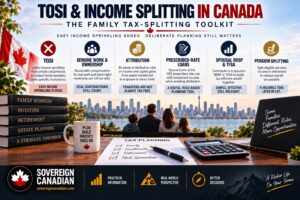
TOSI and Income Splitting: The Family Tax-Splitting Toolkit
Ask any Canadian business owner what happened to income splitting and you will get the same answer: TOSI killed it. Before 2018, a private corporation could pay dividends to a spouse who did nothing, to adult children away at school, to whoever in the family sat in the lowest tax bracket that year. Then the…
-

Multi-Generational Wealth in Canada: How Do You Actually Build Wealth That Survives Generations?
CIBC has cited estimates that roughly a trillion CAD will change hands between Canadian generations from 2024 through 2026, the largest transfer of its kind in the country’s history. Statistics Canada reports that the average size of a monetary gift to first-time home buyers rose 73% to $115,000 between 2019 and 2024. Nearly a third of first-time…
-
Canada’s $1 Trillion Investment Boom: What the Investment Summit Actually Means for Canadians
Canada just held its first national investment summit, and if you read the headlines coming out of Toronto, the numbers are extraordinary. Nearly $500 billion in new investment commitments. More than $100 trillion of assets represented in the room. A $50 billion Canadian infrastructure fund. A $52.5 billion AI infrastructure project in Saskatchewan. Hundreds of…
-
Canada and the European Union: What Would a Much Closer Relationship Actually Mean for Canadians?
For a few days in September 2026, Canada joining the European Union became a surprisingly serious-sounding idea. The Wall Street Journal reported that Canada was exploring some form of “associate membership” in the EU. Prime Minister Mark Carney was preparing to address the European Parliament in Strasbourg. Canada had become the first non-European country to…
-
Living in Cambodia as a Canadian
Cambodia has never been on my radar. I have looked seriously at Thailand, Malaysia, Vietnam, Indonesia, the Philippines, and Singapore. Cambodia never made the list, and I never asked myself why not. That omission is the actual starting point for this piece, because an omission that goes unexamined for years is either a very good…
-

Mortgages in Canada: The Deep Dive
I want to start with the sentence this entire article is built around. The mortgage with the lowest rate is not necessarily the cheapest mortgage. Most Canadians shop for a mortgage the way they shop for a toaster. They compare a number on a rate sheet, pick the smaller one, and sign. Then, three years later,…
-
Mortgage Prepayment vs Corporate Investing: Should a Business Owner Leave Money in the Company or Pay Down the House?
The previous articles in this series compared mortgage prepayment with a TFSA, RRSP, non-registered investing and an RESP. Corporate investing is a different problem because the money may not start on the personal side of the balance sheet at all. Suppose I own a profitable Canadian corporation. The company earns more than I currently need to fund its operations or…
-

HoldCo, OpCo & Multiple Corporations: When Does a Canadian Business Need More Than One Company?
I do not own an incorporated business yet. That is actually one of the reasons I have been thinking about corporate structure now rather than after the fact. If I acquire a business, the first question is relatively straightforward: what corporation buys and operates it? The more interesting question comes next. What happens if that…
-

Mortgage Prepayment vs RESP: Should You Pay Down the Mortgage or Save for Your Kids?
The previous articles in this series compared mortgage prepayment with investing inside a TFSA, an RRSP, and a non-registered investment account. The RESP creates a different decision because there are really two RESP comparisons hiding inside the same account. The first is whether I should contribute enough to receive the available Canada Education Savings Grant or put that…
-

Mortgage Prepayment vs Non-Registered Investing: Where Should a Canadian Put Their Extra Money?
The first two articles in this series compared mortgage prepayment with investing inside a TFSA and an RRSP. The TFSA comparison was relatively clean because both sides could be considered largely on an after-tax basis: paying down a non-deductible mortgage avoids an after-tax borrowing cost, while investment growth inside a TFSA is generally tax-free. The RRSP complicated the…
-
Living in Singapore as a Canadian: Excellence Without Access
Every country in this series so far has sold some version of the same trade. You get access, and you give up certainty. Thailand lets you stay for years on a chain of visas that never quite becomes permanence. Vietnam gives you presence without the paperwork to make it stick. Malaysia formalizes the temporariness so…
-
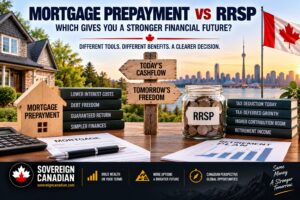
Mortgage Prepayment vs RRSP: Where Should a Canadian Put Their Extra Money?
The mortgage-versus-TFSA decision is relatively clean. If I have $25,000 available, I can use it to reduce a non-deductible mortgage or invest it inside an account where future growth is generally tax-free. The mortgage gives me something economically close to a guaranteed after-tax return equal to the interest I avoid. The TFSA gives me an uncertain investment…
-

RRSP vs TFSA: The Decision Changes as Your Income Rises
RRSP versus TFSA is one of those Canadian personal-finance questions that seems to have acquired a standard answer: use the RRSP when your income is high and the TFSA when your income is low. That is basically correct, but it is not especially useful until we define what high and low actually mean. I have…
-

Mortgage Prepayment vs TFSA: Where Should a Canadian Put Their Extra Money?
I have faced a version of this decision myself. There is some extra money available, unused TFSA room waiting to be filled, and a mortgage balance that could be knocked down. The money has to go somewhere. Do I put another $25,000 into investments, or send it against the house? At first, this looks like…
-
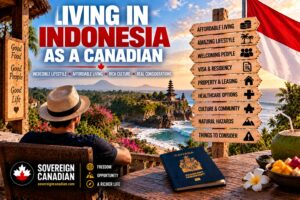
Living in Indonesia as a Canadian: Attachment Without Tenure
Every country in this series eventually reveals a single sentence that explains it. Thailand offers dependability without belonging. Vietnam offers presence without permanence. Malaysia offers a formalized temporariness that is honest about what it is. The Philippines, to my surprise, turned out to offer durable legal permission over a life whose dependability you have to…
-
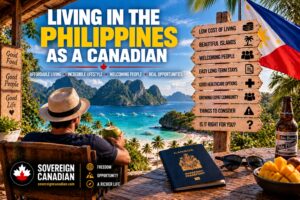
Living in the Philippines as a Canadian
Durable permission, conditional dependability. I went into the Philippines expecting to write the easy one. After Japan, Thailand, Vietnam, and Malaysia, here was the country everyone told me was the soft landing: English everywhere, a retirement visa that lasts forever, prices that make Ontario look insane, and a culture that treats older foreigners with something…
-
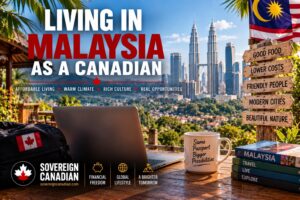
Living in Malaysia as a Canadian: A Second Base That Doesn’t Need to Become Home
This is the fourth stop in the Asian run of this series, and by now a pattern has set in. Japan gave us functionality without integration, a country that works flawlessly and still holds you at arm’s length. Thailand gave us dependability without belonging. Vietnam gave us presence without permanence, a place easier to afford…
-
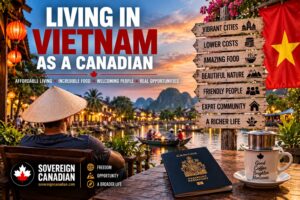
Living in Vietnam as a Canadian: Why a Country This Easy to Live In Is So Hard to Formalize
Vietnam is the easiest country in this series to fall for and one of the hardest to build a permanent life inside. That is the whole story, and it is worth saying plainly before the enthusiasm sets in. You can land in Da Nang with a portfolio, a warm-weather plan and a genuine love of…
-
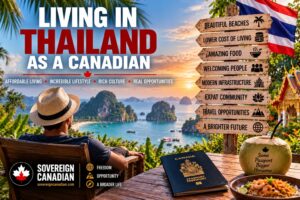
Living in Thailand as a Canadian: Families, Retirement, Sabbaticals and the Reality of Thai Expat Life
Thailand has spent five decades proving that a foreigner with money can live extraordinarily well there. The private hospitals are genuinely world class. The condominiums have infinity pools and gyms and BTS stations at the door. There are international schools running the full International Baccalaureate, English-speaking lawyers and accountants, drivers, cooks, and a mature expatriate…
-
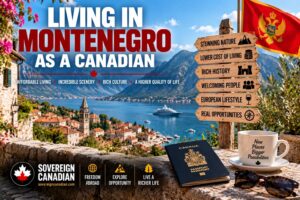
Living in Montenegro as a Canadian: Convergence Without Completion
Montenegro is the most European-feeling country in Europe that is not yet in Europe. You pay for your coffee in euros the country adopted unilaterally in 2002. You sit under a NATO umbrella it joined in 2017. And you live in the clear frontrunner of the European Union’s enlargement queue, a country that has opened…