
Medical tourism for Canadians: a Canadian passport, Toronto-to-Cancún boarding pass, paid medical invoice and stethoscope on a desk overlooking an airport departures gate at sunset

Medical Tourism for Canadians: Why 105,000 of Us Left the Country for Care Last Year

Medical tourism for Canadians is no longer a fringe topic. In 2025, an estimated 105,529 Canadians travelled outside the country for non-emergency medical treatment — a 66% jump from a decade earlier. That’s not a statistic about desperate people making bad decisions. That’s a market signal. When six figures’ worth of your fellow citizens quietly pay out of pocket — after already paying taxes into a universal system — to get a hip, a scan, or a mouth full of implants somewhere else, the rational response isn’t outrage. It’s research.

This post kicks off a new series on Sovereign Canadian, running parallel to our real estate investing series. Same approach: country by country, procedure by procedure, with real numbers, honest risk assessments, and none of the brochure language. This introduction covers the landscape – why Canadians leave, the procedures that make the most sense to get abroad, the ten destinations that matter, and how to think about the whole thing like an adult managing a portfolio rather than a patient hoping for the best.

Continue reading


Three colour-coded doors labelled FIRE, FIRE Light and Coast FIRE opening onto Canadian sunset scenes — three paths to financial independence in Canada.

FIRE, FIRE Light, and Coast FIRE: Three Doors Out of the 40-Year Grind

Most people hear “FIRE” and picture a 34-year-old in a hammock who will never touch a spreadsheet again. That version exists. But it’s one door out of three, and for a lot of higher-earning Canadians it’s the wrong one to walk through first. Financial independence isn’t a single finish line — it’s a spectrum of how much freedom you’re willing to buy now versus how much you’re willing to defer.

Continue reading
Smith Maneuver diagram showing the readvanceable mortgage conversion loop for Canadian homeowners

The Smith Maneuver: A Deep Dive for Canadians Who’ve Already Read the Hype

The Smith Maneuver might be the most over-marketed strategy in Canadian personal finance. Search for it and you’ll find an ecosystem of certified specialists, courses, and books all selling the same dream: turn your mortgage into a tax deduction and retire rich on the spread. The pitch is seductive because the mechanics are real — this is a legitimate, CRA-recognized structure, not a loophole. But “legitimate” and “right for you” are different questions, and almost nobody selling the Smith Maneuver is incentivized to tell you when the answer is no.

Continue reading
Whole life insurance in Canada guide with book, analysis notebook, and before-you-buy checklist on a desk

Whole Life Insurance in Canada: When It Actually Works (and When You’re Being Sold)

Whole life insurance in Canada is the most aggressively sold financial product I know of — and also the most reflexively dismissed. The insurance industry treats it like a miracle. The personal finance internet treats it like a scam. Both camps are being lazy, and if you’re a Canadian professional with real assets, you deserve better than a slogan.

Here’s my position up front, so you can decide whether to keep reading: for most Canadians, whole life insurance is the wrong product. Term insurance plus disciplined investing wins the math for the majority of households, most of the time. But “most people, most of the time” is not “everyone, always” — and there are three or four specific situations where whole life is not just defensible but genuinely the best tool available. If you own a cottage, run a corporation, or have maxed your registered accounts, one of those situations might be yours.

This post is the deep dive. What whole life actually is, why the default answer is still term, where the product earns its keep, and where the sales pitch falls apart under a calculator.

Continue reading
The playgrounds flag — a Canadian's guide to where you spend your time, showing a field guide, checklist and tablet covering how presence creates tax residency, day-counting both ways, Schengen limits, and designing a year that doesn't backfire.

The Playgrounds Flag: Where You Spend Your Time

This is the fifth deep dive in my flag theory series, and it’s the one people assume is just the fun part. Where you vacation. Where you enjoy the money. And it is that — but there’s a hook buried in it that can quietly undo the residency flag you worked so hard to plant. So we’re going to enjoy the beach.

New to the series? Read the Flag Theory introduction first — it lays out the full six-flag framework.

Continue reading
The asset haven flag — a Canadian's guide to banking abroad, showing a field guide, T1135 reporting document and tablet covering stability over secrecy, currency diversification, a second banking system, and why to plant this flag first.

The Asset Haven Flag: Banking and Investing Across Borders

This is the fourth deep dive in my flag theory series, and it’s the one I’d tell most people to plant first. Not because it’s the most powerful flag, but because it’s the cheapest, the most reversible, and the best teacher. If you’re going to learn the discipline flag theory requires, offshore banking done right is where you learn it. 

New to the series? Read the Flag Theory introduction first — it lays out the full six-flag framework.

Continue reading
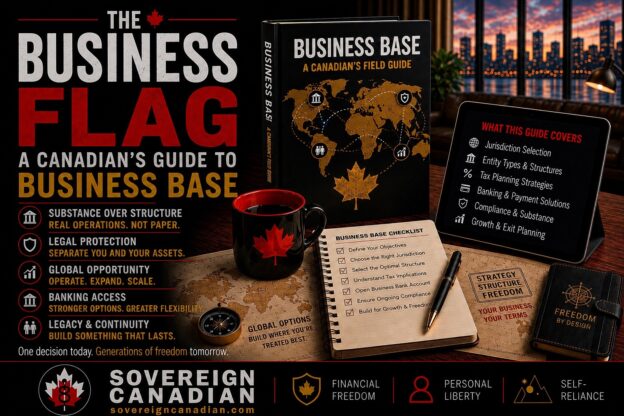
The business flag — a Canadian's guide to business base, showing a field guide, checklist and tablet covering jurisdiction selection, entity structures, tax planning, banking, compliance and substance, and growth and exit planning.

The Business Base Flag: Where Your Income Is Legally Earned

This is the third deep dive in my flag theory series. We’ve covered citizenship (the foundation) and residency (the lever). Now we get to where your money is actually made — the business base flag.

This is also the flag where good intentions turn into bad structures fastest. So I’m going to spend as much time on the tripwires as on the opportunity.

New to the series? Read the Flag Theory introduction first — it lays out the full six-flag framework.

Continue reading
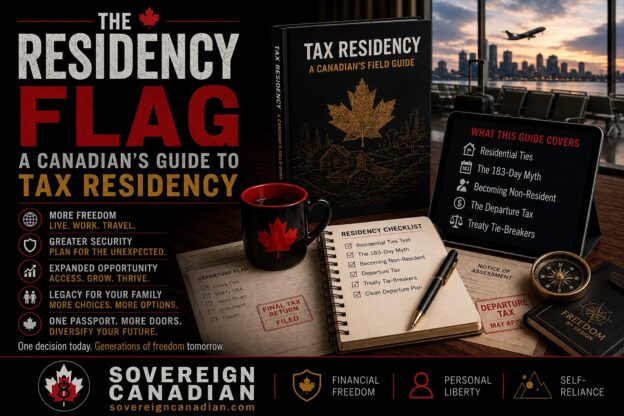
The residency flag — a Canadian's guide to tax residency, showing a field guide, departure plan and tablet covering residential ties, the 183-day myth, becoming non-resident, the departure tax and treaty tie-breakers.

The Residency Flag: How Canadian Tax Residency Actually Works

This is the second deep dive in my flag theory series, and it’s the one that matters most. If citizenship is the foundation, Canadian tax residency is the lever. It’s the flag that decides whether the whole framework saves you anything or does nothing at all. New to the series? Read the Flag Theory introduction first — it lays out the full six-flag framework.

I’m going to spend real time here, because this is also the flag people get catastrophically wrong. They assume moving is a vibe. It isn’t. It’s a documented legal act with a bill attached.

Continue reading
The citizenship flag — a Canadian's guide to a second citizenship, showing a Canadian passport, globe, travel journal and tablet listing why a second citizenship matters.

The Citizenship Flag: A Canadian’s Guide to a Second Citizenship

This is the first deep dive in my flag theory series. If you haven’t read the overview yet, start there — it explains what planting flags means and why our residency-based tax system gives Canadians an edge Americans have to fight for. New to the series? Read the Flag Theory introduction first — it lays out the full six-flag framework.

Here we’re taking apart flag one: citizenship. And I’ll be honest up front, because most content on second citizenship is written by people selling one. A second citizenship is the slowest, least urgent flag on the board. It’s also the one I’d start positioning for earliest — and those two things aren’t a contradiction.

Continue reading