Build a Secondary Unit vs. Buy a Bigger House: The Real Math for Housing Your Parents

When a parent needs to move in, the housing question usually gets framed as a feelings problem — where will everyone be comfortable, who gets which floor, will it feel like an intrusion. Those matter. But underneath them sits a six-figure capital-allocation decision that most families make on gut instinct and regret later.

There are really only two serious paths: build a self-contained unit into the home you already own, or sell and buy something bigger with a suite already in it. This post is the cold-eyed math on both — the build costs, the two federal tax credits that quietly tilt the whole thing, the friction costs of trading up that nobody budgets for, and the optionality one path gives you that the other doesn’t.

Continue reading

Elderly Parents Moving In: A Canadian’s Playbook for Housing, Money, and Family

There’s a moment a lot of us hit somewhere in our forties or fifties that nobody really sits you down and prepares you for. A parent’s health slips. A spouse dies and the survivor is suddenly rattling around a house that’s too big and too far away. The stairs stop being a good idea. And the question of elderly parents moving in with you goes from something you’d vaguely assumed you’d “figure out someday” to a decision you have to make this year.

Here’s the thing most Canadians get wrong about it: they treat it as a purely emotional decision, make the housing and money choices on autopilot, and then discover eighteen months later that they triggered a benefits clawback, botched the tax treatment on the “rent” they charge, or spent $180,000 on a bigger house when a $60,000 basement build would have done the job better — and come with a federal cheque attached.

Continue reading
Reverse mortgages in Canada: costs, compounding debt, estate impact, and alternatives like a HELOC, downsizing, or selling the home

Reverse Mortgages in Canada: The Honest Case Against (and the Narrow Case For)

I’ll tell you where I stand before we start, because you’d figure it out by paragraph three anyway: I think a reverse mortgage in Canada is the wrong product for almost everyone who reads this site, and a genuinely useful one for a small handful of people I can describe precisely.

That’s not the same as saying it’s a scam. It isn’t. It’s a regulated loan from a federally regulated bank, with real consumer protections built in. But it’s an expensive loan wearing the costume of a retirement solution, sold with soft-focus advertising and a celebrity spokesperson, to people who are frightened of running out of money and reassured to hear they can “unlock” their home without selling it.

So let’s do what the brochure won’t. Let’s put the actual mechanics, the actual 2026 rates, and the actual compounding math in daylight, and then figure out the small number of situations where I’d tell a friend to seriously consider one. Educated criticism, not reflexive dismissal.

Continue reading
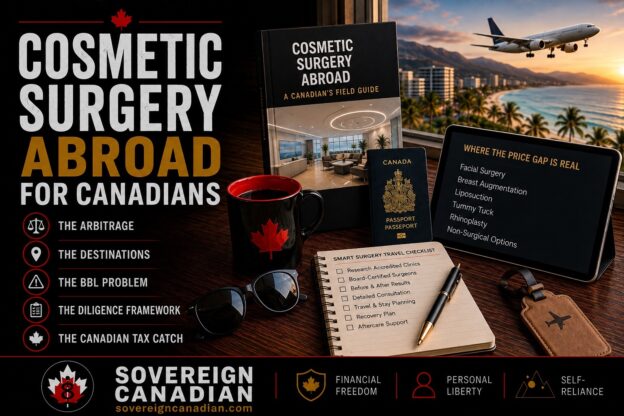
Cosmetic surgery abroad for Canadians featured image with passport, diligence checklist and coastal resort backdrop

Cosmetic Surgery Abroad for Canadians: The Quarter of the Market Nobody Insures

Cosmetic surgery abroad is where medical tourism stops being about a broken queue and starts being about pure economics. Nothing in this category was ever covered by your provincial plan. There’s no 28.6-week wait to jump, no Health Canada approval to sit through — just a price in Toronto and a much smaller price somewhere warmer. Every Canadian who wants this work is already a private-pay patient. The only open question is which currency the invoice is printed in.

Continue reading
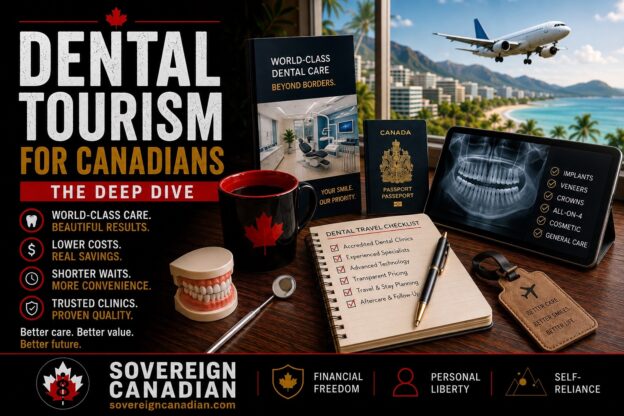
Dental tourism for Canadians: a Canadian passport, dental X-ray on a tablet, and a dental travel checklist on a desk with a tropical clinic view

Dental Tourism for Canadians: The Deep Dive on the Easiest Way to Leave the Country for Care

Dental tourism for Canadians is the natural place to start this series, and not by accident. In the medical tourism overview that kicked things off, I called dental work “the workhorse of medical tourism” and “the easiest entry point” for Canadians. This post is where I back that up with real 2026 numbers, the destinations that actually work, and the traps that quietly eat your savings if you don’t see them coming.

Here’s the thesis in one line: for most Canadians, a mouth full of implants was never covered anyway, so you are already a private-pay patient. The only real question is whether you pay Toronto prices or Los Algodones prices. Let’s do the math like adults.

Continue reading
Canadian passport, coffee mug, and tablet showing LASIK eye scan on a desk overlooking a coastal sunset — vision correction abroad for Canadians

Vision Correction Abroad: A Canadian’s Guide to LASIK, Lens Replacement, and Cataract Surgery

Part of the Sovereign Canadian Medical Tourism series

Vision correction abroad is the procedure the rest of this series has been building toward — the one where the case is almost too clean. It’s cheap at home relative to a knee or a mouth of implants, so the dollar savings look smaller on paper. But the recovery is measured in days, not weeks, which means it fits into a trip you were half-planning anyway. That combination — real savings, near-zero downtime — makes eye surgery the single most travel-compatible procedure on our list. If you’ve been reading this series wondering where to start, this is arguably the shallow end of the pool.

Continue reading
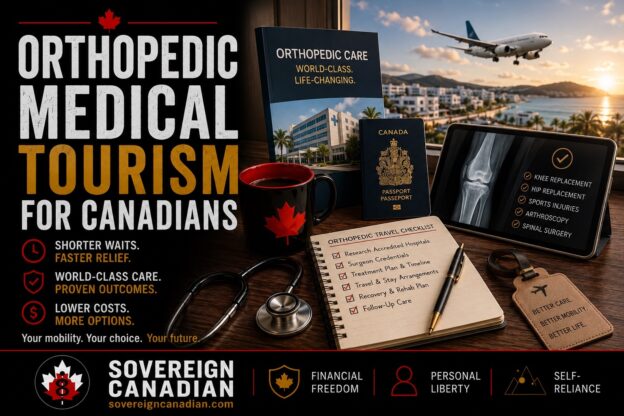
Orthopedic medical tourism for Canadians: a Canadian passport, stethoscope, knee X-ray on a tablet listing knee and hip replacement, and an orthopedic travel checklist on a desk overlooking a tropical coastline at sunset

Orthopedic Medical Tourism for Canadians: What a Hip, Knee, or Spine Really Costs Abroad

This is a deep dive in our medical tourism series, and it covers the procedure that pushes more Canadians onto a plane than almost any other. Orthopedic medical tourism is the queue-jumper’s category — the one where you already qualify for the surgery at home, the system agrees you need it, and the only thing standing between you and a working joint is a waitlist measured in seasons rather than weeks.

The math here is unusual. Unlike dental or cosmetic work, a hip or knee replacement is covered by your provincial plan. So the arbitrage isn’t really about money — it’s about time, and about the mobility you quietly lose while you wait for your name to come up. That changes how you should think about the whole decision. Let’s get into the numbers.

Continue reading

Genetic Testing for Cancer: What Canadians Should Actually Test For, and Where

Genetic testing for cancer is the one corner of the whole medical tourism conversation where my honest advice is: you probably don’t need to get on a plane. Your DNA is the same in Bangkok as it is in your kitchen. It’s a mail-in saliva sample either way. So this sub-post to the diagnostic medical tourism deep dive is less about geography and more about knowing what to test for, what it actually tells you, and what a result costs you back home.

Continue reading
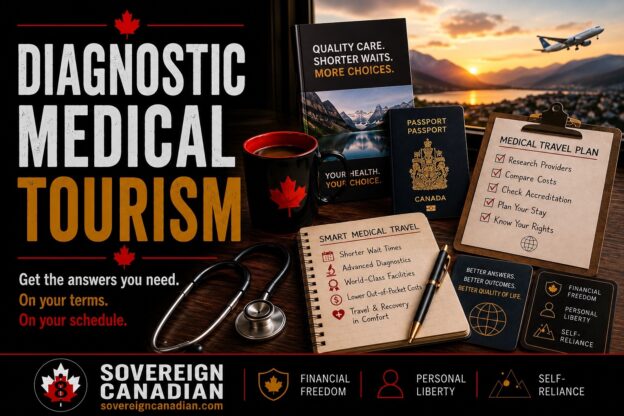
Diagnostic medical tourism for Canadians: a Canadian passport, stethoscope, and medical travel checklists on a desk overlooking a sunset airport.

Diagnostic Medical Tourism: Why Canadians Are Buying Their Scans Abroad

Diagnostic medical tourism is the quietest, highest-value corner of the whole medical travel market, and almost nobody plans for it. Everyone pictures the dental trip or the knee replacement. Far fewer people think about the test that comes before any of that – the scan that tells you whether the knee needs replacing at all, or whether the fatigue you’ve been ignoring is nothing or something.

In Canada, that test is a queue. Abroad, it’s a product. This deep dive is the third stop in our medical tourism series, and it covers what executive health screening actually is, what it costs, where to get it, and the one risk the brochures never mention. I’m not a doctor, and none of this is medical advice. It’s a framework.

Continue reading
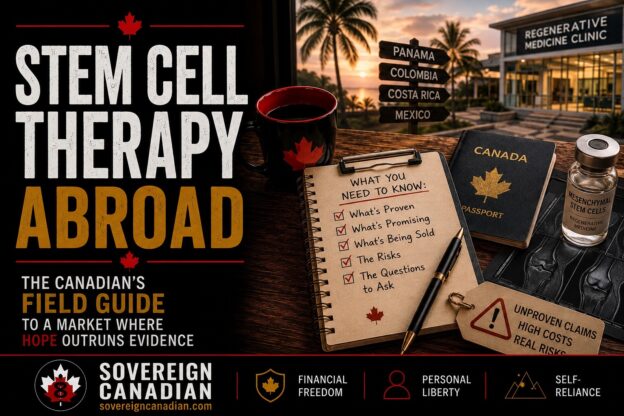
Stem cell therapy for Canadians field guide: Canada passport, mesenchymal stem cell vial, knee MRI, and a signpost to Panama, Colombia, Costa Rica and Mexico.

Stem Cell Therapy Abroad: The Canadian’s Field Guide to a Market Where Hope Outruns Evidence

Of every procedure in the medical tourism playbook, stem cell therapy for Canadians is the one where the marketing has travelled furthest ahead of the science. Dental implants in Los Algodones do exactly what the brochure says. A hip resurfacing in India is the same operation you’d get in Toronto, three years sooner. But when a clinic in Panama or Colombia tells you that an intravenous drip of umbilical cord cells will reverse your MS, rebuild your knees, calm your child’s autism, and knock a decade off your biological age — all from the same bag — you are no longer looking at a healthcare transaction. You are looking at a sales funnel.

Continue reading