
Author Archives: Andrew

Best electrification stocks for Canadian investors, featuring ABB, electrical grid infrastructure, renewable energy, EV charging, financial performance, growth opportunities and investment risks.

Electrification Stocks: 11 Companies Powering the Future – But Which Are Worth Buying?

The Electrification Investment Paradox

GE Vernova builds some of the most important machines in the electricity system. At the end of June 2026 its remaining performance obligations, the contracted work it has yet to deliver, stood at USD 176 billion, and second-quarter orders rose 88% on an organic basis, according to its second-quarter results filing. At its 15 October 2026 close of USD 926.44, it also trades at roughly 78 times my estimate of its normalized earnings, or roughly 61 times the consensus estimate I could retrieve.

I do not read that as a prediction that GE Vernova will stumble. It is arithmetic. To earn an 8% annualized return over ten years from that price, my model says GE Vernova’s earnings per share would have to grow about 21% a year, every year, for a decade. My own base case is already generous, with earnings per share growing 16.6% a year, and it still produces a return of only 4.0% a year, because the multiple I assume compresses from 78 times earnings to 24 times by 2036.

That gap between a superb operating business and a mediocre investment is the subject of this article. Electricity demand is growing, grids are being rebuilt and the equipment is being ordered. What is not obvious is how much of that is already in the price.

Continue reading →


Foreign real estate buyers in Canada guide featuring Canadian homes, foreign buyer restrictions, non-resident property taxes, provincial differences and international real estate ownership rules.

Foreign Real Estate Buyers in Canada: Who Can Still Buy, What It Costs, and How the Rules Follow Us Abroad

I’ve spent a lot of words on the idea of a second property somewhere warmer for the winter months. I’d use it myself, rent it when I’m not there, and get to know the community around it instead of treating it as a line on a spreadsheet. My second real estate investment post ranks that idea against the other places I could put the capital. Every time I bring it up, someone tells me speculation is what’s pushing real estate prices higher.

That’s partly true. Speculation does move markets, and I still don’t recognize my plan as such. Rather than defend myself again, I turned the question around and looked at the group Canadian policy treats as the speculators: foreign real estate buyers in Canada. Can a non-resident still buy here, and where? What does it cost to buy and to hold? When does the ban end? And what does our ban do to Canadians who want to buy abroad? The last answer surprised me most.

Continue reading →
New Ontario auto insurance rules explained, including changes to accident benefits, optional coverage, insurance premiums, implementation timelines and what Ontario drivers should do.

The New Ontario Auto Insurance Rules: What Went Optional (and What It Costs You)

Here’s the uncomfortable truth about the new Ontario auto insurance rules that took effect on July 1, 2026: the government didn’t simply make your coverage cheaper. It made much of your coverage optional – which is a very different thing, and the difference is where households could make expensive mistakes. For decades, a substantial package of accident benefits was bolted onto every Ontario policy whether you wanted it or not. Now most of it is an à la carte menu, and a cheaper policy may be a thinner policy that looks reassuringly familiar right up until someone gets hurt.

This is the companion to my broader cross-Canada auto insurance guide, which mapped how coverage works province by province – public versus private, no-fault versus tort, the mandatory minimums, and the endorsements worth buying. That one teed up the Ontario reform and promised a dedicated post. This is it. I’m going to go deep on exactly what changed, walk through the real financial value of each benefit that’s now optional, answer the question everyone actually wants answered – are rates going up for the same coverage? – and give you a framework for deciding what to keep and what you can rationally drop.

Continue reading →
Auto insurance in Canada guide featuring Canadian vehicles, provincial insurance differences, coverage options, premium costs, savings strategies, accident claims and electric vehicles.

Auto Insurance in Canada: The Provincial Patchwork Nobody Explains

Here’s a fact that should bother you more than it does: the same driver, in the same car, with the same clean record, can pay roughly $1,000 a year or well over $2,500 depending on nothing but which side of a provincial line they sleep on. Auto insurance in Canada isn’t one system. It’s effectively thirteen of them stapled together — ten provinces and three territories, each writing its own rules — and the seams are where all the money hides.

I write a lot on this blog about jurisdictional arbitrage: moving yourself, your business, or your assets to the jurisdiction that treats them best. Most people think of that as an international game — Panama, Portugal, the whole flag theory playbook. But you don’t need a passport to see arbitrage in action. You just need to compare a car insurance quote in Windsor to one in Winnipeg. Same country, same currency, same Charter — wildly different price, and genuinely different rules about what happens to you when you get hurt.

Continue reading →
Life insurance in Canada guide featuring a Canadian family, term and permanent life insurance, coverage costs, financial protection, tax treatment and estate planning.

Life Insurance in Canada: Term vs. Mortgage vs. Whole Life (And How Much You Actually Need)

Life insurance in Canada gets sold far more often than it gets explained. Most advisors work on commission, and commission structures can create a real conflict of interest between what pays best and what fits your household. That is not an argument that every advisor pushes an unsuitable product; plenty do careful work. It is a reason to understand the mechanics yourself before signing anything.

This piece works through three questions. What type of insurance should you buy. How much do you actually need. And when should you stop paying for it. That third question gets skipped constantly: a household with a paid-off mortgage, a seven-figure portfolio, and no dependants may need almost no ongoing income-replacement insurance, whatever a multiple-of-salary rule says. Insurance should be sized against your actual balance sheet, not a generic formula.

Continue reading →
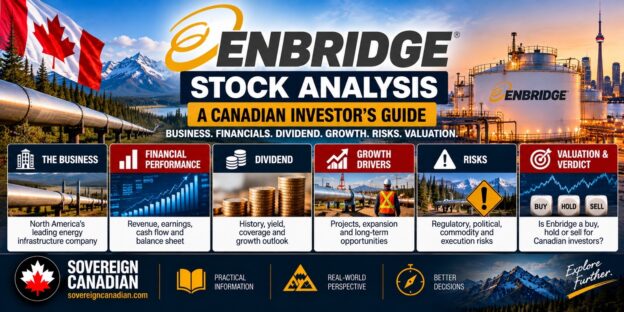
Enbridge stock analysis for Canadian investors featuring oil and gas pipelines, energy infrastructure, dividend income, financial performance, growth opportunities, risks and valuation.

Enbridge Stock: Is ENB a Good Value, Dividend, and Long-Term Investment?

Enbridge is one of the first names a Canadian dividend investor learns, and that familiarity is part of the problem. A long dividend record and a yield near 6% tell you the company is a reliable payer. They do not tell you whether the stock is cheap, or whether owning it will build wealth faster than the alternatives. Those are three different questions, and Enbridge answers them differently.

This analysis uses a research reference date of October 13, 2026, and a reference price of CAD 67.15 per share on the TSX (an intraday quote). All yields and multiples below are calculated from that price. If the stock has moved by the time you read this, the ratios move with it, and the conclusions about price matter more than the exact figures.

Continue reading →
Investing in global stock markets from Canada, featuring international markets in North America, Europe, Asia and emerging economies, with a Canadian flag and world map.

Investing Directly in Global Stock Markets: A Canadian Investor’s Guide

A Canadian investor can buy Royal Bank, Apple or an S&P 500 ETF in a few clicks. An online brokerage makes it feel as though every listed company is available. It isn’t. If the company you want trades mainly in Zurich, Tokyo, London or Frankfurt, you may find a US ADR, an OTC quotation, a secondary listing or no North American line at all. Direct access to the foreign exchange opens up more companies, along with a longer list of complications.

This is the last of four articles on how stock markets work. TSX vs NYSE vs Nasdaq covered where stocks trade, S&P 500 vs Nasdaq vs Dow Jones vs TSX covered what indices measure, and OTC Stocks, ADRs and Pink Sheets covered depositary receipts. This one covers buying ordinary shares on the foreign exchange itself.

Continue reading →
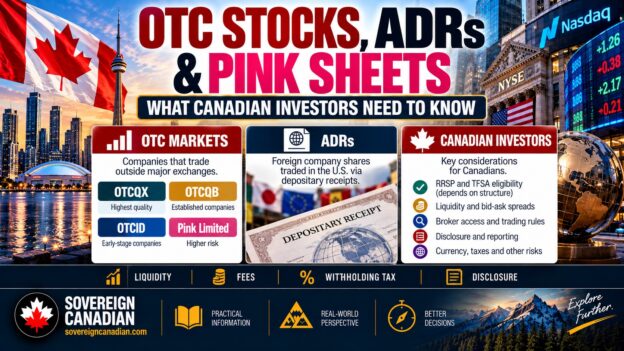
OTC stocks, ADRs and Pink Sheets guide for Canadian investors covering OTC market tiers, foreign depositary receipts, RRSP and TFSA eligibility, liquidity and trading risks.

OTC Stocks, ADRs and Pink Sheets: What Canadian Investors Need to Know

Most Canadians who own foreign stocks never think about where the shares actually trade. The ticker shows up in the app, the price looks fine and the order goes through. Then the spread is wider than expected, or a TFSA purchase gets flagged, or a dividend arrives smaller than announced. In each case the problem wasn’t the business. It was the security, and how it trades.

Not Every Stock Trades on a Major Exchange

Not every stock worth owning trades on the NYSE, Nasdaq or TSX. Nestlé, one of the world’s largest food companies, is listed in Switzerland, and its US line is quoted over the counter. Plenty of speculative microcaps trade in the same general market. Those are very different situations.

Continue reading →
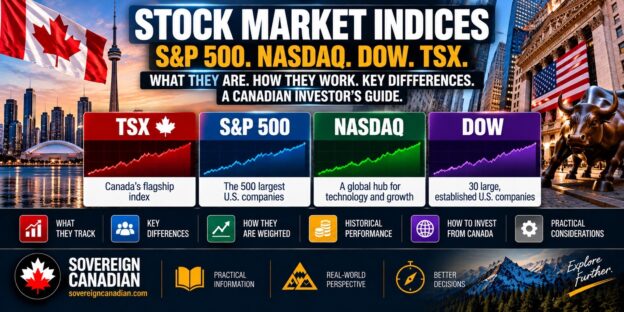
Stock market indices comparison for Canadian investors featuring the S&P 500, Nasdaq, Dow Jones and S&P/TSX Composite, with Canadian and American financial markets.

S&P 500 vs Nasdaq vs Dow Jones vs TSX: Understanding Stock Market Indices

Financial headlines tell you the Dow gained 300 points, the Nasdaq fell 2%, the S&P 500 hit another record and the TSX outperformed Wall Street. Each sentence describes a different group of companies, counted by different rules. A 300-point move in the Dow isn’t comparable with a 300-point move in the S&P 500. A rising Nasdaq-100 doesn’t mean the average American stock is doing well. A strong TSX doesn’t mean Canada’s economy is beating the United States.

Stock market indices are how we summarize markets, and index funds are how most of us own them. When you buy an index ETF, you’re buying a methodology: which companies, in what proportions, measured in which currency. This is the second article in the Understanding Stock Markets series. It covers what the major benchmarks measure, why they diverge and what that means for a Canadian portfolio.

Continue reading →
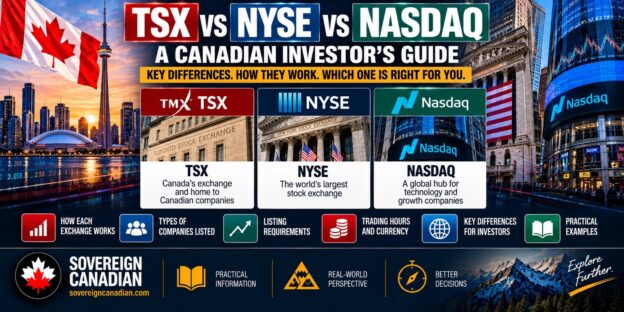
TSX vs NYSE vs Nasdaq comparison for Canadian investors, featuring the Toronto and New York stock exchanges, trading currencies and key differences.

TSX vs NYSE vs Nasdaq: A Canadian Investor’s Guide to Stock Exchanges

From a single self-directed brokerage account, a Canadian can buy Royal Bank, Berkshire Hathaway, Microsoft, Shopify or a small mining company in the same afternoon. Those securities sit on different exchanges, meet different listing standards and, in some cases, trade in different currencies. The investor sees a ticker and a buy button. Behind it sits a market structure most people never look at.

For the large, liquid companies that fill most portfolios, that structure matters less than most explainers imply. It isn’t irrelevant, though. Canadian stock exchanges and their American counterparts differ in which companies they list, how easily shares change hands, which currency a trade settles in and how much disclosure you can count on. This is the first article in a four-part series, Understanding Stock Markets. It covers where your stock is listed, what separates the major North American exchanges, and which differences deserve your attention.

Continue reading →