Author Archives: Andrew

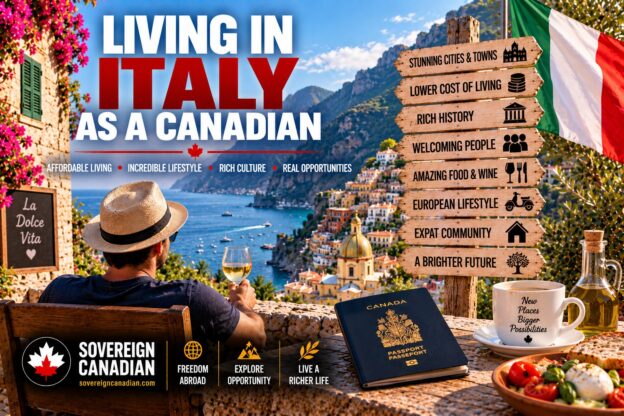
Living in Italy as a Canadian with an Italian coastal town, Mediterranean Sea, Italy flag and Canadian passport

Living in Italy as a Canadian: Families, Retirement, Sabbaticals and the Reality Behind the Dream

Italy is the easiest country in this series to want and one of the harder ones to think clearly about. Two weeks of trains, piazzas, markets and long lunches can leave a Canadian half-convinced they should sell the house and move, and the brochure version of that decision is everywhere: cheap stone cottages, la dolce vita, a slower and richer life. I am not immune to it. I find the Italian case genuinely compelling, which is exactly why I want to be careful with it. The useful question for this series is not whether Italy is wonderful, because it plainly can be. The question is whether the Italy you fall for on holiday survives an ordinary Tuesday: the bureaucracy, the taxes, the slower institutions, the language, the regional inequality, and the gap between visiting a place and being administered by it.

The short version, which the rest of this piece will earn, is that Italy rewards one kind of Canadian and quietly punishes another, and the dividing line is almost entirely about where your money comes from and how much of Italian life you are actually willing to join. Bring your income with you, choose one region with real intent, treat Italian as non-optional, and Italy offers one of the deepest lifestyle returns in Europe. Arrive needing to earn locally, expecting effortless paperwork, planning to live in English, or hoping for a simple tax return, and it becomes one of the weaker choices in Western Europe. Italy is unusually good at being lived in slowly. It is unusually bad at being treated as a frictionless international product.

Continue reading

Living in Portugal as a Canadian with Lisbon rooftops, Tagus River, Portugal flag and Canadian passport

Living in Portugal as a Canadian: Families, Retirement, Sabbaticals and the New Expat Reality

This is part of the Sovereign Canadian Expat Living series, where I work through what actually living in another country buys a Canadian – what it costs, and for which chapter of life it’s worth doing. This is personal documentation and analysis, not immigration, tax, legal or financial advice. Rules here change fast; verify current figures with primary sources before you act on anything.

There’s a version of Portugal that lives in expat YouTube videos and relocation-agency blog posts, and it goes roughly like this: cheap Lisbon apartments, ten years of near-zero tax under NHR, buy a place and get a Golden Visa, five years to an EU passport, everyone speaks English, the sun always shines, and healthcare is free. Move abroad, pay nothing, live like it’s a permanent vacation.

There was enough truth underneath that pitch to make it extraordinarily persuasive, somewhere between about 2015 and 2022.

Continue reading
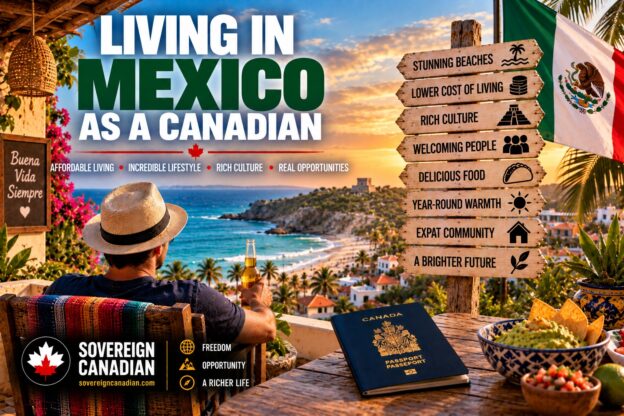
Living in Mexico as a Canadian with a tropical Mexican coastline, Mexico flag, Canadian passport and expat lifestyle

Living in Mexico as a Canadian: Snowbirds, Families, Sabbaticals and Retirement

Most articles about Mexico answer a question almost nobody serious is actually asking. They tell you whether Mexico is a nice place to visit. Of course it is. The harder and more useful question is whether a Canadian could build part of a life here, and the honest answer is that it depends entirely on which life you mean.

Mexico is one of the very few countries where a financially comfortable Canadian can plausibly imagine several completely different arrangements. Three winter months in Puerto Vallarta. A family year in Merida. Two years working remotely from Playa del Carmen. Raising children in Mexico City. Retiring near Lake Chapala. Keeping a house in Ontario while establishing a second base south of the border. Each of those is a different decision with different math, different risks, and a different verdict.

Continue reading
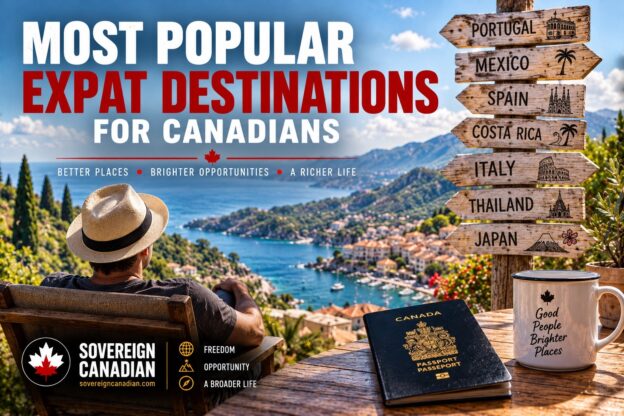
Most popular expat destinations for Canadians with signs pointing to Portugal, Mexico, Spain, Costa Rica, Italy, Thailand and Japan

Most Popular Expat Destinations for Canadians: Where Canadians Actually Go

Most people start with the wrong question. They ask “where should I move?” as if there were a single correct answer waiting to be found, a country that quietly outscores all the others once you run the numbers. There isn’t one. The reason is simple: Canadians who leave are not all trying to build the same life. A retired couple chasing a warm, cheap winter has almost nothing in common with a 34-year-old software engineer weighing a job offer in Dubai, and neither of them is solving the problem a young family faces when they want their kids to spend a year inside a different culture before high school swallows the chance.

So this article does not crown a winner. It surveys the map. It looks at where Canadians repeatedly end up when they decide to spend real time abroad, why those places keep pulling people in, and what kind of Canadian each one actually suits. Some of these destinations are popular because they are warm, cheap, and a direct flight from Toronto. Some are popular because that is where the careers are. Some are popular in a quieter way, the kind of place a certain type of person investigates once and never stops thinking about.

Popular is a useful signal. It tells you a destination solves a real problem for real people. It is not the same thing as best, and treating it that way is how Canadians end up buying a condo somewhere that suited someone else’s life.

Continue reading
Expat living for Canadians with a Canadian passport, laptop and coastal destination representing life abroad

Expat Living for Canadians: Why Live Abroad, and Should You?

Canada is a good country. That is worth stating plainly before anything else, because most writing about living abroad starts from the opposite premise, that the place you are leaving has somehow failed you. Millions of people spend years and fortunes trying to move here. Anyone fortunate enough to already hold a Canadian passport should begin any conversation about leaving from a position of gratitude rather than grievance.

So this is not an argument that you should go. It is an argument that you might have more choices than you have been treating as available.

The interesting question is not whether Canada is a good country. It obviously is. The more interesting question is whether one country has to supply every chapter of a life. The default Canadian script runs in a straight line: grow up, build a career, buy a house, raise children, retire, and perhaps escape the worst of a few winters somewhere warm near the end. That script is not wrong. It has just quietly been treated as the only one.

Continue reading
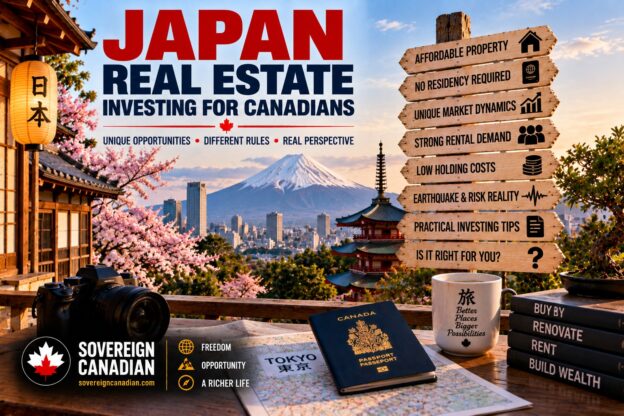
https://www.sovereigncanadian.com/real-estate/japan-real-estate-investing-for-canadians/

Japan Real Estate for Canadians: Cheap Property, a Weak Yen, and a Housing Market That Breaks the Rules

I started looking at Japanese property the way most Canadians probably do, which is by accident. I was reading about the weak yen, wandered onto a listing site, and found myself staring at a detached house an hour outside a major city priced at less than the annual property tax bill on some Toronto homes. Then I found an apartment in a real city, on a real train line, for the price of a parking space in Yorkville. My first reaction was the one the internet wants you to have: this has to be a mistake, or an opportunity, and either way I should keep scrolling.

The more I looked, the more I realized the cheap-property story was simultaneously true and misleading. Japan is not a poor country hiding a fire sale. It is one of the richest, safest, most functional places on earth. The trains run to the second. The rule of law is real. Foreigners can buy property with no residency or nationality requirement. Tourists arrive in record numbers. And yet large parts of the residential market behave in a way that would look like a malfunction to anyone raised on Canadian real estate, where the assumption that a house is a savings account that always goes up is baked so deep we forget it is an assumption at all.

Continue reading
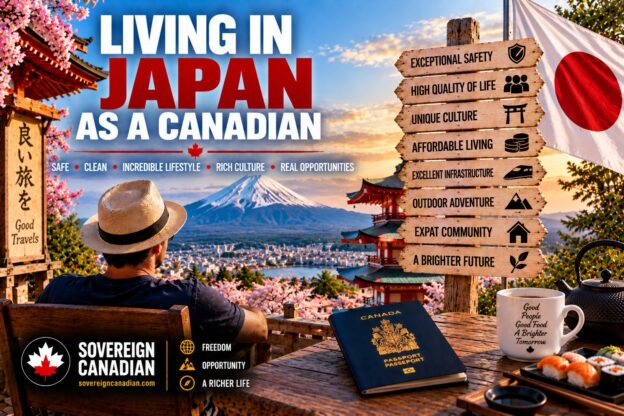
Living in Japan as a Canadian with Mount Fuji, Japanese pagoda, cherry blossoms, Japan flag and Canadian passport

Living in Japan as a Canadian: Is It Actually a Good Expat Destination?

Japan is one of the easiest countries in the world to visit. Whether it is one of the easiest to live in is a completely different question — and it’s the one this article is actually about.

Here’s the thesis I want to test, because I’ve been weighing it myself: Japan may be exceptionally easy to visit, remarkably functional to live in, and considerably harder to truly integrate into. That’s not a knock. It’s a distinction most travel content skips. A country can be extraordinary for three months and genuinely difficult for ten years, and the gap between those two experiences is where most expat regret lives.

Continue reading
Bosnia real estate for Canadians with Mostar's historic bridge, Bosnian property, mountains and Bosnia and Herzegovina flag

Bosnia Real Estate for Canadians: Cheap European Property – But Is It Actually Investable?

I started looking at Bosnia and Herzegovina the way most Canadians probably do: by accident, while researching somewhere else. I was deep into Croatia, running the numbers on the Adriatic coast, and they were not friendly. Croatia joined the EU, adopted the euro, and spent fifteen years being discovered by German, Austrian, and Scandinavian buyers; coastal scarcity did the rest. What used to be a value play is now priced like the mature European tourism market it is.

Then I looked one border inland, and the prices fell off a cliff.

That is the entire reason Bosnia gets a Canadian investor’s attention. It is European, sits directly against Croatia, and has a real capital in Sarajevo, an established tourism town in Mostar, mountains, rivers, skiing, and EU candidate status. And an apartment there can cost a third of the equivalent an hour’s drive away on the coast. The instinct is immediate: this is Croatia before Croatia became Croatia.

Continue reading

Digital Business vs Physical Business Acquisition: Which Is Better for a Canadian Buyer?

I am standing at this fork myself, so I will not pretend to be neutral about how interesting it is.

On one side is a digital business I could acquire mostly with my own capital and a seller note, keep running as a side project while I hold my current income, and grow patiently over a few years. On the other side is a larger, more conventional operating business – the kind with employees, equipment, a lease, real customers, and real problems – that would demand far more of me up front but could become genuinely substantial with the right effort. One path looks like buying an asset I can carry quietly. The other looks like buying a job that might turn into an empire.

Continue reading

Homesteading or Digital Nomadism: Which Path Actually Buys You Sovereignty?

One movement tells you to buy land, grow food, keep chickens, cut wood, and become harder to disrupt. The other tells you to sell everything, work from a laptop, cross borders at will, and never let a single place, employer, or currency own you. On the surface, these are opposites. One roots down. The other floats free. One measures freedom in acres and root cellars; the other measures it in visas and time zones.

And yet listen to the people building each life and you hear the same word over and over. Freedom. Optionality. Not being trapped. A refusal to let a landlord, a boss, a bank, or a bureaucracy hold the only set of keys.

Continue reading