Author Archives: Andrew

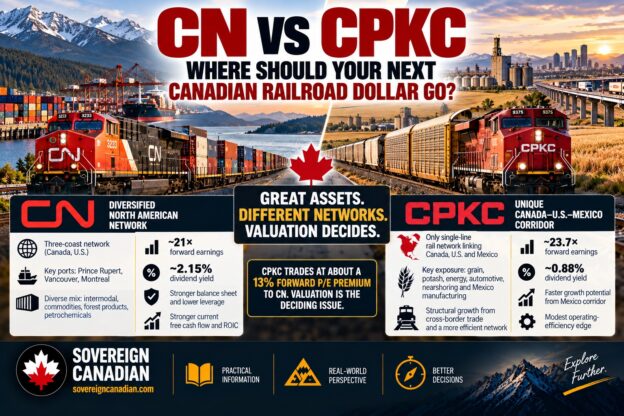
CN versus CPKC Canadian railroad stocks comparing their rail networks, valuation, dividend yields, balance sheets and growth potential

CN vs. CPKC: Where Should Your Next Canadian Railroad Dollar Go?

I own both CN and CPKC. I also own them a third way, through the Canadian index funds and mutual funds that hold both almost by default. So when I ask which railroad I would buy next, I am really asking about the margin: what an extra C$10,000 should do in a portfolio that already has a fair amount of both.

Part of what I like about railroads is that they are infrastructure whose physical replacement value is enormous. Canada is not going to wake up one morning and decide that railways are obsolete. The economic cycle will keep turning, commodity prices will swing, governments will change and trade routes will shift, but the country still has to move grain, potash, crude and chemicals, automobiles, containers, lumber, metals and consumer goods across a very large piece of geography, and trains are still the cheapest way to do much of it. Nobody is going to build another CN or another CPKC from scratch. The rights-of-way, the urban corridors, the bridges and tunnels, the yards and terminals, the port connections and the signalling systems took more than a century to assemble, and the political and environmental approvals required to repeat the exercise today would take longer than most investment horizons. Inflation makes the theoretical bill higher every year.

Continue reading →
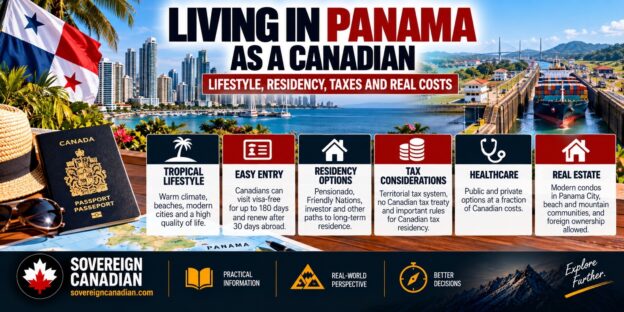
Living in Panama as a Canadian showing Panama City, the Panama Canal, Canadian passport, residency, taxes, healthcare and real estate

Living in Panama as a Canadian: Is Panama Actually a Good Place to Live?

Panama can be remarkably good at receiving wealth. It is much less obviously good at creating tax-free active income, and your age on arrival decides how much of the healthcare advantage is still available to you.

A Canadian retiree living in Panama on a portfolio built abroad may find that Panama barely taxes the income paying for the lifestyle. His 35-year-old daughter can move into the same building, work remotely for Canadian clients, and face a very different tax question.

Same country. Same territorial tax system. Very different result.

That gap is the real subject of this article.

Panama does have meaningful advantages for a Canadian: a US dollar economy, one of the busiest air and shipping hubs in the Americas, residence programmes with paths to permanent status, private hospitals with international affiliations, and a tropical location outside the main Caribbean hurricane belt.

Continue reading →
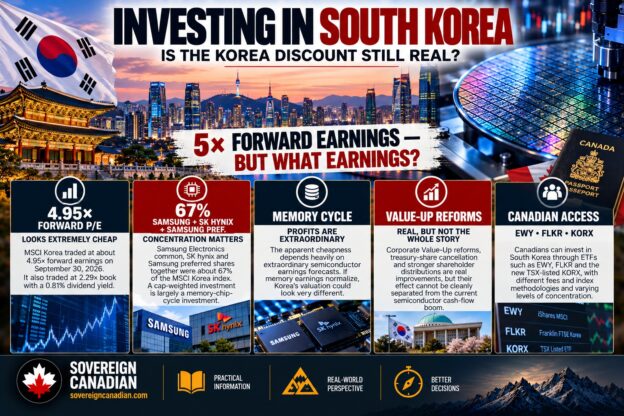
Investing in South Korea for Canadian investors showing Korea's low forward P/E, Samsung and SK hynix concentration, memory cycle and ETF options

Investing in South Korea: Is the Korea Discount Still Real?

South Korea looks like one of the cheapest major stock markets in the world.

MSCI Korea traded at about 4.95 times forward earnings on September 30, 2026. At the end of August, MSCI Japan was at 16.38 times, MSCI Emerging Markets at 10.07 times, and the broad global MSCI ACWI IMI at 16.76 times. On that number, Korea is priced at roughly half the emerging-market multiple and less than a third of Japan’s.

That looks absurdly cheap.

But the same MSCI data show Korea at 2.29 times book value. Japan was at 2.03 times at the end of August, and emerging markets at 2.40 times. At the end of 2023, according to Robeco’s analysis of Bloomberg data, MSCI Korea traded at about 1.1 times book.

So the Korea discount did not simply vanish, and it did not simply persist. The thing I’m measuring changed.

Continue reading →
Canadian grocery stocks comparing Loblaw, Metro, Empire, North West Company and George Weston, including Northern stores and Weston's Loblaw and Choice Properties holdings

Canadian Grocery Stocks: Can You Hedge Your Grocery Bill by Owning the Grocers?

If my family spends $15,000 a year on groceries and grocery prices rise 3% a year, the bill in twenty years is about $27,000. That is roughly $12,000 a year more than we pay now, and about $115,000 of extra grocery spending along the way.

Canadians have an obvious thing to say about this, and we say it constantly. Grocery prices are too high. The industry is concentrated. Loblaw, Sobeys and Metro make billions of dollars.

So here is a tidy Canadian idea. If Loblaw, Metro and Empire, the parent of Sobeys, really are earning more as grocery prices rise, why not own them? Collect the dividends, let the shares compound, and get a little of the money back from the checkout counter.

I wanted to know whether that actually works.

The answer is yes, but not for the reason I expected.

Continue reading →
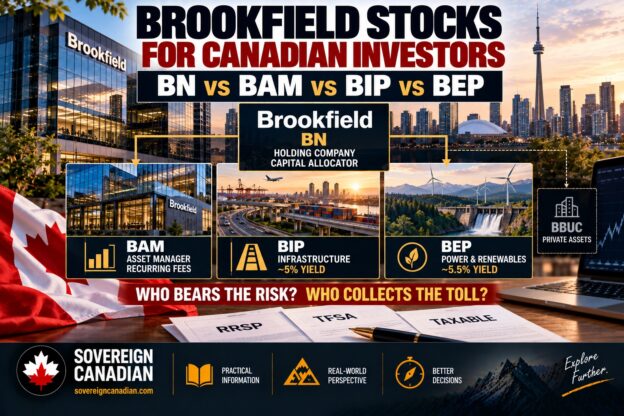
Brookfield stocks for Canadian investors comparing BN, BAM, BIP and BEP across asset management, infrastructure and renewable power

Brookfield Stocks for Canadian Investors: BN vs BAM vs BIP vs BEP

A Canadian investor who likes Brookfield can buy Brookfield Corporation, Brookfield Asset Management, Brookfield Infrastructure, Brookfield Renewable or Brookfield Business Corporation. On a brokerage screen that looks like a choice between five companies.

It isn’t.

It’s a choice about where you want to sit inside one capital-allocation system, and who gets paid first.

Here’s the short version. Brookfield Corporation (BN) owns about 74% of Brookfield Asset Management (BAM), the manager. BAM collects fees for running capital, including capital invested through Brookfield’s listed vehicles. Brookfield Infrastructure (BIP), Brookfield Renewable (BEP) and Brookfield Business Corporation (BBUC) own operating assets and carry much more of the financing, construction and operating risk.

Continue reading →
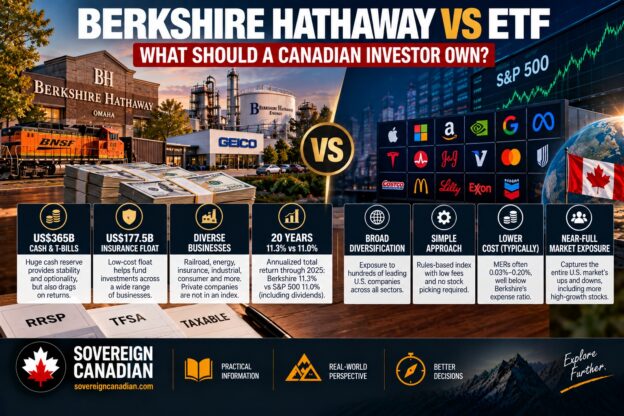
Berkshire Hathaway versus an ETF for Canadian investors comparing cash, insurance float, operating businesses, diversification and market exposure

Berkshire Hathaway for Canadian Investors: Is It Better Than Just Buying an ETF?

Berkshire Hathaway is the largest individual stock in my RRSP.

That makes this an important article to write. It would be easy to explain why Berkshire is a wonderful company, because it is. The harder question is whether I would make the same bet today with fresh money.

If I had the cash sitting in my account right now, would I buy Berkshire, or would I buy an S&P 500 or total-market ETF and be done?

Continue reading →
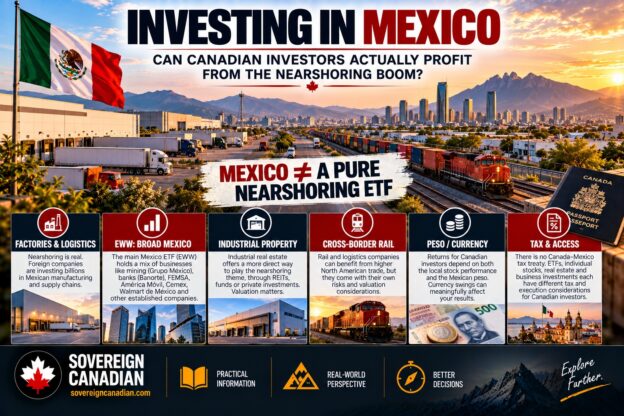
Investing in Mexico for Canadian investors with factories, logistics, cross-border rail, industrial property and Mexico ETF exposure

Investing in Mexico: Can Canadian Investors Actually Profit From the Nearshoring Boom?

Mexico’s factories are real. I’m not going to argue otherwise. Foreign companies put a record USD 40.9 billion of direct investment into Mexico in 2025, and another USD 35.0 billion in the first half of 2026. Trucks, rail cars and containers cross the border every hour carrying cars, servers and appliances that were assembled in Mexico and sold to Americans.

The question I care about is different. If Mexico wins the nearshoring race, who gets paid, and can a Canadian investor own any of it at a sensible price?

I went looking for the answer the way I did with Vietnam. In that article, an economy growing at roughly 8% a year had delivered about 3% a year to the foreign investor who bought the obvious ETF. Mexico looked like it might be the same story with a different flag.

It isn’t.

It’s closer to the reverse: a slow-growing economy, a stock market that has paid foreign investors respectably, and an investable market that looks surprisingly different from the factories everyone associates with Mexico.

Continue reading →
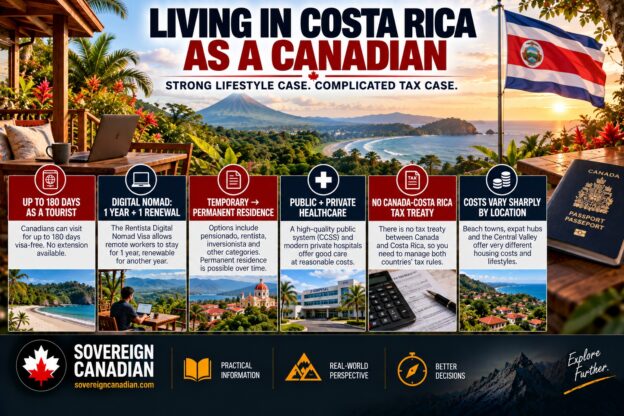
Living in Costa Rica as a Canadian with tropical coastline, Costa Rican flag and Canadian passport highlighting residency, healthcare and tax considerations

Living in Costa Rica as a Canadian: Is Costa Rica Actually a Good Place to Live?

Costa Rica has been sold to Canadians for a generation as a four-part package: tropical weather, cheap living, easy residency and a tax system that supposedly ignores foreign income. In 2026 each of those four parts needs a footnote, and the footnotes are not the same size. The weather is what it always was. The residency routes exist and are easier to understand than most. The “cheap” part now depends on where you live and what you buy. The tax part is the one that breaks down once you read it from a Canadian rather than an American or European point of view.

The reason is structural. Canada and Costa Rica have no income-tax treaty, no social-security agreement and no treaty rule for deciding which country gets to call you a resident. Costa Rica’s territorial tax system is real, but a Canadian who moves there is not entering a tax-free zone. They are entering a gap between two systems that were never negotiated against each other. CPP, OAS and RRIF payments default to a 25% Canadian withholding rate. Leaving Canada triggers its own tax event. The widely repeated claim that a remote worker can sit in Escazú, bill Canadian clients and owe nothing locally is, at best, unresolved. Costa Rica went to the trouble of writing a special exemption for digital nomads, which is a good clue that ordinary residents may not enjoy the same treatment.

Continue reading →
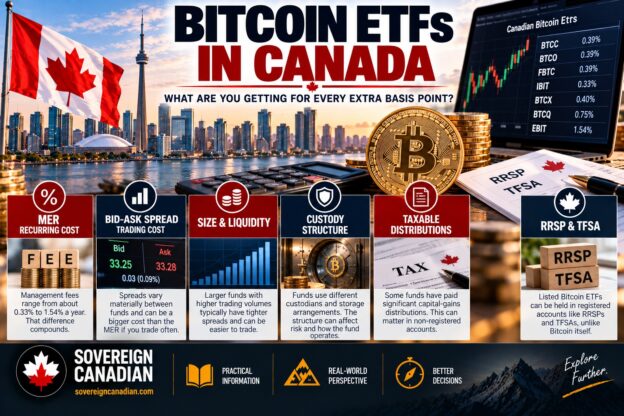
Bitcoin ETFs in Canada comparing MERs, bid-ask spreads, liquidity, custody, taxable distributions and registered accounts

Bitcoin ETFs in Canada: Which One Should You Actually Buy?

A Canadian can buy a Bitcoin ETF that costs about 0.33% a year, or one that costs more than 1.5%. Either way, the investor ends up with exposure to the same Bitcoin. On CAD 100,000, that is roughly CAD 330 a year versus CAD 1,540 a year, before any compounding.

So what is the more expensive fund doing for the extra money?

The answer is more nuanced than “buy the cheapest one.” The annual fee recurs, but bid-ask spreads are paid when you trade. Custody structures differ. In a taxable account, some of these funds have paid out large capital-gains distributions. And Canadians are not limited to Canadian-listed funds, even inside an RRSP or TFSA.

This article assumes you have already decided you want Bitcoin through an ETF. It does not argue for or against owning Bitcoin. Figures are dated throughout because they come from different measurement periods and are not simultaneous quotes.

Continue reading →
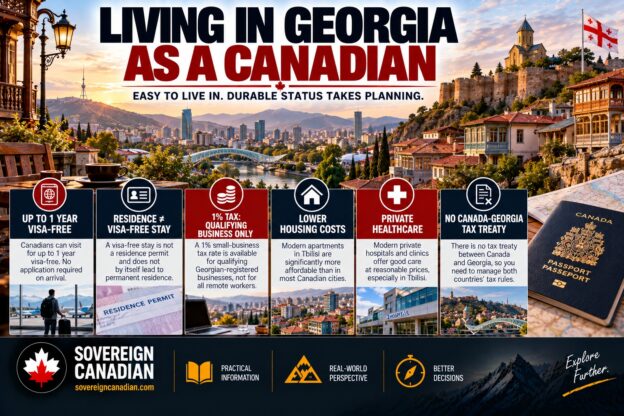
Living in Georgia as a Canadian with Tbilisi skyline, Georgian flag and Canadian passport highlighting visa-free stays, residence and taxes

Living in Georgia as a Canadian: Is Georgia Actually a Good Place to Live?

Picture a 35-year-old Canadian consultant who lands in Tbilisi with a laptop and a one-way ticket. Canadians can stay in Georgia visa-free for a year, so there is no application to file at the airport. The consultant rents a modern apartment in Saburtalo, signs up for fibre internet, learns the Metro and the Bolt app, and keeps working for Canadian and American clients exactly as before. Within a few weeks there is a favourite cafe, a gym, a bank card and a routine. By any ordinary measure, this person has moved to Georgia.

Legally, something quieter has happened. The visa-free stay is not a residence permit. Nothing about it starts the clock that eventually leads to permanent residence. The consultant’s Georgian life can look far more permanent than their Georgian status is, and, separately, nothing in that arrival has told the Canada Revenue Agency that this person stopped being a Canadian tax resident.

Continue reading →