Author Archives: Andrew

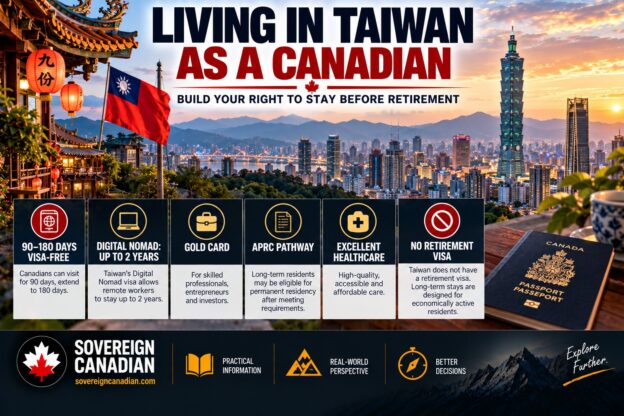
Living in Taiwan as a Canadian with Taipei skyline, Taiwan flag and Canadian passport highlighting Gold Card and permanent residency pathways

Living in Taiwan as a Canadian: Is Taiwan Actually a Good Place to Live?

Picture two Canadians who both decide, at different points in their lives, that they want to retire in Taiwan.

The first moves at 45. She’s a product manager clearing a strong salary, and Taiwan’s Employment Gold Card lets her get a resident permit without a Taiwanese employer sponsoring her. She spends the next several years actually living there — building a career, paying Taiwanese tax, learning the neighbourhoods — and eventually converts that residency into permanent status. By the time she’s ready to slow down, Taiwan isn’t a retirement plan. It’s just where she lives.

The second Canadian spends his career in Canada, retires comfortably at 65, and only then decides Taiwan looks like exactly the kind of place he’d like to spend his later years — safe, walkable, cheap food, excellent hospitals, a short flight from the rest of Asia. He has the same net worth as the first Canadian. Possibly more.

Taiwan’s immigration system treats these two people completely differently. The first one built her right to be there while she still had something Taiwan’s system was designed to reward: an income, a skill set, an employer relationship, a professional category. The second one shows up with money and time and discovers that neither, on its own, is a currency Taiwan’s immigration architecture accepts.

Continue reading →


Snowbird versus full relocation for Canadian retirees comparing tax residence, RRSP and RRIF treatment, pension splitting, OAS, healthcare and foreign taxes

Snowbird vs Full Relocation: Should Canadian Retirees Actually Leave Canada?

A CAD 400,000 gap in how Canada taxes a RRIF at death looks like the whole answer, until you ask how much of that RRIF you will actually have left, and where you will genuinely be living when it matters.

Picture two Ontario retirees who started in nearly identical positions. Both retired at 55 with a RRSP worth about CAD 1.5 million. Both are now in their late eighties, widowed, with no spouse left to roll a RRIF over to. One still lives in Ontario. The other genuinely moved away years ago and has been a non-resident of Canada ever since.

If each of them dies this year with a CAD 1.5 million RRIF still sitting there, the Canadian tax difference between them can be roughly CAD 400,000. The resident’s RRIF is generally included in income on the final return, pushing much of a large balance into Canada’s highest marginal tax brackets. For a genuinely non-resident annuitant, the best-supported Canadian treatment is instead a deemed RRIF payment subject to Part XIII withholding, normally at 25 percent.

Continue reading →
World-class health care comparison showing Canada, Switzerland, the Netherlands, Australia, Japan and Taiwan across access, outcomes and system design

What Does World-Class Health Care Actually Look Like?

Switzerland, the Netherlands, Australia, Japan and Taiwan each do something Canada doesn’t. Each also pays for it somewhere else.


Canada spends more per person on health care than the typical rich country. OECD figures for 2024 put it at about US$7,301 per capita, adjusted for purchasing power, against an OECD average of US$5,967. That is 11.3% of GDP versus 9.3%. Canadians also live a little longer than the OECD average (81.7 years versus 81.1), die less often from causes that medicine can prevent or treat, and survive heart attacks at better-than-average rates.

And yet only about half of Canadians say they are satisfied with the availability of quality health care where they live, versus 64% across the OECD. About 9% report going without medical care because of cost, distance or waiting, versus 3.4% on average. Ask a Canadian about this and you will hear about the family doctor they don’t have, the specialist they haven’t seen, or the MRI that comes after a long wait.

The comparative weakness is not the quality of Canadian medicine. It is the system’s ability to deliver that medicine when patients need it.

Continue reading →
Canadian healthcare system comparing universal coverage, health outcomes, primary care access, wait times, capacity and patient choice

Is Canadian Healthcare Actually World Class? Why Universal Coverage Is Not the Same Thing as a Great System

Canada spends roughly the same amount per person on healthcare as Australia, France and Denmark. On the OECD’s harmonized comparison, Canada comes in at USD 7,301 per person. Australia is at USD 7,469, France at USD 7,367 and Denmark at USD 7,071.

Here is what that money buys. Canada has 2.7 practising doctors per 1,000 people. Denmark has about 4.5 and Australia about 4.2. Canada has roughly 26 CT, MRI and PET scanners per million people, about half the OECD average of 51. Denmark has about 49, and the OECD ranks Australia second for CT scanners per capita. And when the OECD measured satisfaction with the availability of quality healthcare in its 2025 edition, about 50% of Canadians said they were satisfied. In Denmark, the figure was 86%.

Canada is on track to spend about CAD 399 billion on healthcare in 2025, according to the Canadian Institute for Health Information. So what, exactly, are Canadians getting for that money?

Continue reading →
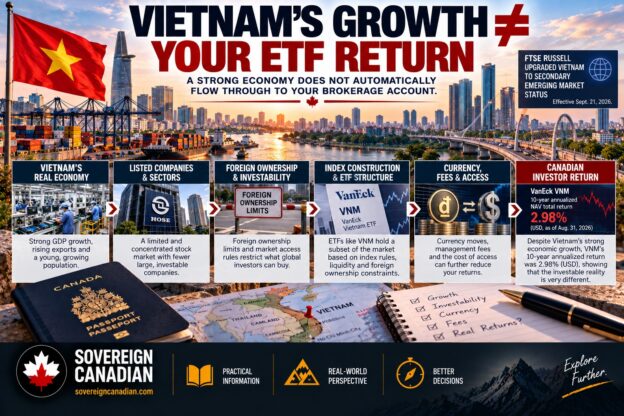
Investing in Vietnam for Canadian investors showing economic growth, foreign ownership limits, ETF structure and investor returns

Investing in Vietnam: Can Canadian Investors Actually Capture Vietnam’s Growth?

Vietnam is the country that gets waved around at every “de-risk from China” panel discussion. Samsung builds phones there. Apple’s suppliers have been moving assembly lines there for years. The population is young. The middle class is expanding. GDP has been growing at rates that would make most finance ministers weep with envy. And in September 2026, FTSE Russell finally did what index watchers had been expecting for years: it moved Vietnam out of frontier-market status and into Secondary Emerging Market status, alongside China, India, Indonesia and the Philippines. FTSE Russell’s Vietnam reclassification

On paper, this is exactly the kind of story that should have made patient foreign investors rich.

Continue reading →
Private REITs and real estate syndicates in Canada comparing illiquid private investments with publicly traded REITs

Private REITs and Real Estate Syndicates in Canada: Are the Higher Yields Worth Giving Up Liquidity?

Say you have $100,000 to invest.

Option one: you buy $100,000 of a Canadian REIT ETF. Tomorrow morning you can check what it is worth. If the bond market has a bad week, you might open your account and see $85,000. You will not like that number, but you will know it, and you can hit sell before lunch if you want to.

Option two: you put the same $100,000 into a private apartment REIT or a five-year real estate syndication. Your statement barely moves. The marketing materials talk about a 7 percent preferred return, a 5 percent cash distribution, institutional-quality buildings and “low historical volatility.” It feels calmer. Nothing is flashing red on a screen.

Continue reading →
Living in Bali as a Canadian with signs for Canggu, Sanur, Ubud, Denpasar and Uluwatu highlighting schools, healthcare and airport access

Living in Bali as a Canadian: Where on the Island Should You Actually Build Your Life?

Bali is not physically large. On a normal map, Canggu, Sanur, Ubud, Jimbaran and Denpasar look almost absurdly close together, a cluster of names you could imagine strolling between over a long weekend. Read the map that way and choosing a base becomes a lifestyle question: do I want the surf-and-café scene, the rice terraces, the calm beachfront, the cliffs?

That map is misleading. Twenty kilometres in Bali does not mean twenty minutes. A house that appears perfectly placed can put you on the wrong side of the island’s road network from the school, hospital or airport your life actually depends on. And the failure is rarely a steady, predictable slowness. It is variance: the same trip that takes a comfortable half hour on a good afternoon becomes an hour and a half on a bad one, and you find out on the day it matters.

So I want to start from a different question. Not “Where in Bali would I most like to live?” but “Which journey in my life cannot afford to fail?” The answer changes with your age, your work, whether you have children, and how your health is holding up. It determines which parts of Bali are options for you and which are traps that look like options.

Continue reading →
Home-buying process in Canada showing deposit, mortgage approval, lawyer trust account, title insurance, closing funds and registration

The Home-Buying Process in Canada: Title Insurance, Legal Steps, CMHC Mortgage Insurance, and What Actually Happens Before You Get the Keys

You have an accepted offer. You already sent a deposit to somebody. Your bank told you the mortgage is approved. Then your lawyer calls and asks you to send tens of thousands of dollars into something called a trust account, a few days before closing, for reasons nobody explained clearly. Somewhere in the background, your bank is preparing to send hundreds of thousands of dollars to a place you will never see. The seller still has their own mortgage registered against the house. And then, on closing day, the lawyer calls again and says the house has closed, and you can pick up the keys.

What actually happened in between?

Where did the deposit go. Why was pre-approval not the same thing as approval. Who paid off the seller’s bank, and how did your lawyer know that would actually happen. When did the house legally become yours. Why did you pay for title insurance on top of a lawyer who already searched the title. And if you put down less than 20 percent, why did you pay thousands of dollars for an insurance policy that mostly protects your bank and not you.

Continue reading →
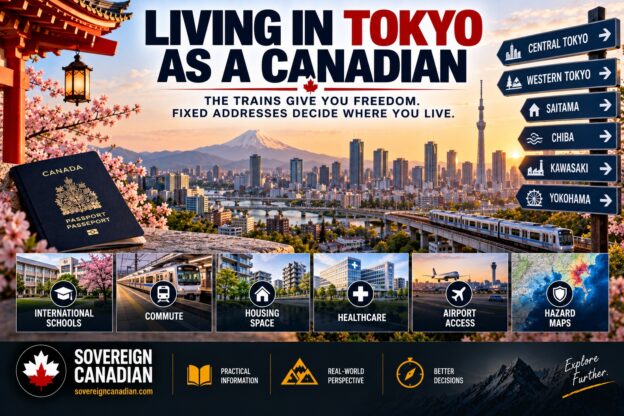
Living in Tokyo as a Canadian with Greater Tokyo trains, housing, schools and signs for Tokyo, Yokohama, Kawasaki, Saitama and Chiba

Living in Tokyo as a Canadian: Where in Greater Tokyo Should You Actually Build Your Life?

Tokyo has, by most honest measures, the most extraordinary urban railway system on earth. Someone living in a different prefecture, an hour’s drive from the Imperial Palace on a map, can step onto a platform and be standing in Marunouchi before a typical Torontonian has cleared the Don Valley Parkway. A Canadian moving to Greater Tokyo could, in principle, live in Kanagawa, Saitama or Chiba and still reach central Tokyo faster than they reached their own downtown back home.

That fact creates a seductive impression. If the trains are that good, does it even matter where you actually live?

Continue reading →
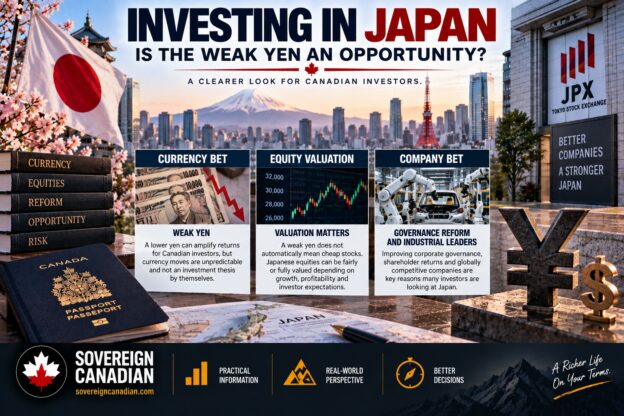
Investing in Japan for Canadian investors with Tokyo skyline, weak yen, Japanese equities and corporate reform

Investing in Japan: Is the Weak Yen Creating an Opportunity for Canadian Investors?

I am writing this from Japan. My family and I are here for a few weeks, moving between Osaka, Kyoto and Nara, and the weak yen is impossible to ignore. I was here more than a decade ago, and the difference this time shows up within the first day. Meals that would feel properly expensive back in Ontario come out costing a fraction of that once I convert. Local trains barely register as an expense. Even convenience store snacks, the onigiri and canned coffee that quietly add up on any trip, feel almost free.

I have already looked at Japan from the other direction in Living in Japan as a Canadian: what it costs to live here, how residency works, and where the country fits as an expat destination. This is a different question entirely.

Anyone who has glanced at CAD/JPY over the last couple of years already knows the yen has been weak. But standing in a train station doing currency math in my head, a different question kept nagging at me. If my Canadian dollar buys an unusual amount of Japan at the restaurant, the convenience store and the ticket machine, does it also buy an unusual amount of value on the Tokyo Stock Exchange?

The answer, after spending real time on this, is not necessarily.

Continue reading →