Tag Archives: Financial

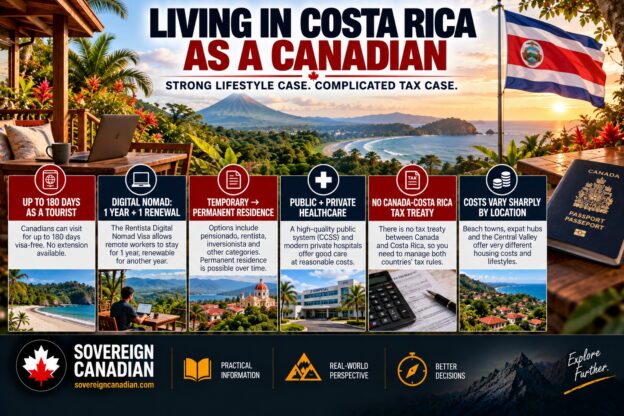
Expat Living for Canadians: Why Live Abroad, and Should You?

Canada is a good country. That is worth stating plainly before anything else, because most writing about living abroad starts from the opposite premise, that the place you are leaving has somehow failed you. Millions of people spend years and fortunes trying to move here. Anyone fortunate enough to already hold a Canadian passport should begin any conversation about leaving from a position of gratitude rather than grievance.

So this is not an argument that you should go. It is an argument that you might have more choices than you have been treating as available.

The interesting question is not whether Canada is a good country. It obviously is. The more interesting question is whether one country has to supply every chapter of a life. The default Canadian script runs in a straight line: grow up, build a career, buy a house, raise children, retire, and perhaps escape the worst of a few winters somewhere warm near the end. That script is not wrong. It has just quietly been treated as the only one.

Continue reading

Japan Real Estate for Canadians: Cheap Property, a Weak Yen, and a Housing Market That Breaks the Rules

I started looking at Japanese property the way most Canadians probably do, which is by accident. I was reading about the weak yen, wandered onto a listing site, and found myself staring at a detached house an hour outside a major city priced at less than the annual property tax bill on some Toronto homes. Then I found an apartment in a real city, on a real train line, for the price of a parking space in Yorkville. My first reaction was the one the internet wants you to have: this has to be a mistake, or an opportunity, and either way I should keep scrolling.

The more I looked, the more I realized the cheap-property story was simultaneously true and misleading. Japan is not a poor country hiding a fire sale. It is one of the richest, safest, most functional places on earth. The trains run to the second. The rule of law is real. Foreigners can buy property with no residency or nationality requirement. Tourists arrive in record numbers. And yet large parts of the residential market behave in a way that would look like a malfunction to anyone raised on Canadian real estate, where the assumption that a house is a savings account that always goes up is baked so deep we forget it is an assumption at all.

Continue reading

Bosnia Real Estate for Canadians: Cheap European Property – But Is It Actually Investable?

I started looking at Bosnia and Herzegovina the way most Canadians probably do: by accident, while researching somewhere else. I was deep into Croatia, running the numbers on the Adriatic coast, and they were not friendly. Croatia joined the EU, adopted the euro, and spent fifteen years being discovered by German, Austrian, and Scandinavian buyers; coastal scarcity did the rest. What used to be a value play is now priced like the mature European tourism market it is.

Then I looked one border inland, and the prices fell off a cliff.

That is the entire reason Bosnia gets a Canadian investor’s attention. It is European, sits directly against Croatia, and has a real capital in Sarajevo, an established tourism town in Mostar, mountains, rivers, skiing, and EU candidate status. And an apartment there can cost a third of the equivalent an hour’s drive away on the coast. The instinct is immediate: this is Croatia before Croatia became Croatia.

Continue reading

Digital Business vs Physical Business Acquisition: Which Is Better for a Canadian Buyer?

I am standing at this fork myself, so I will not pretend to be neutral about how interesting it is.

On one side is a digital business I could acquire mostly with my own capital and a seller note, keep running as a side project while I hold my current income, and grow patiently over a few years. On the other side is a larger, more conventional operating business – the kind with employees, equipment, a lease, real customers, and real problems – that would demand far more of me up front but could become genuinely substantial with the right effort. One path looks like buying an asset I can carry quietly. The other looks like buying a job that might turn into an empire.

Continue reading

Homesteading or Digital Nomadism: Which Path Actually Buys You Sovereignty?

One movement tells you to buy land, grow food, keep chickens, cut wood, and become harder to disrupt. The other tells you to sell everything, work from a laptop, cross borders at will, and never let a single place, employer, or currency own you. On the surface, these are opposites. One roots down. The other floats free. One measures freedom in acres and root cellars; the other measures it in visas and time zones.

And yet listen to the people building each life and you hear the same word over and over. Freedom. Optionality. Not being trapped. A refusal to let a landlord, a boss, a bank, or a bureaucracy hold the only set of keys.

Continue reading
Coast FIRE for Canadians showing retirement savings growing toward financial independence without further contributions

Coast FIRE for Canadians: The Math, the Myths, and Whether It Holds Up Here

I want to start with a confession, because it frames everything that follows. The first time I ran my own Coast FIRE number, I felt something close to relief. A single formula told me I could stop saving aggressively, keep a job I mildly enjoyed, and still retire on schedule. Then I changed one input, the assumed rate of return, from 7 percent to 5 percent, and the number I needed nearly doubled. That is the whole story of Coast FIRE in one sentence: a real, useful idea sitting on top of assumptions most people never stress test.

This is not a piece designed to sell you on Coast FIRE. It is designed to help you understand exactly what it is, where the math is solid, where it quietly cheats, and whether it survives contact with Canadian taxes, Canadian accounts, and a Canadian cost of living. If you finish this and decide Coast FIRE is not for you, I will consider that a good outcome. Clarity is the product here, not enthusiasm.

Continue reading

Faceless YouTube Channels: Should Canadians Build One, Buy One, or Avoid Them?

Every few years the internet falls in love with a new business.

Blogs. Dropshipping. Amazon FBA. Affiliate sites. Podcasts. AI SaaS.

Right now the infatuation is faceless YouTube.

The pitch is close to irresistible. Global customers, no inventory, no storefront, no lease, no payroll. Content that keeps earning while you sleep. Income that follows you to Lisbon, Chiang Mai, or a cottage two hours north of me. It sounds like the platonic ideal of a sovereign business: scalable, portable, and detached from any single geography. It sounds, in short, like location independence with a monetization engine bolted on.

Continue reading
House Rich in Canada – model house chained to Canadian dollar bills illustrating the financial risks of concentrating wealth in a principal residence, Sovereign Canadian.

The Hidden Risks of Being House-Rich in Canada

Canadians love watching the value of a home rise. Every increase feels like proof that things are working, that the plan is on track, that the family is quietly getting wealthier while it sleeps.

I feel it too. There is something deeply satisfying about a number on a real estate site climbing year after year, especially when you remember what you paid.

But there is an uncomfortable question sitting underneath all of it, and I have never been able to fully shake it.

If my house doubled in value while producing no additional cash flow, while demanding higher property taxes and insurance, while locking me into one city, and while quietly preventing me from buying almost anything else, did I actually become wealthier?

Or did I just become more concentrated?

Continue reading
France real estate investing for Canadians – Paris skyline with the Eiffel Tower, the Seine River, Haussmann architecture, and the French flag, Sovereign Canadian field guide

France Real Estate Investing for Canadians

This is a country deep-dive in the Sovereign Canadian international real estate series. Like everything here, it is personal documentation of how I am working through my own portfolio decisions, not financial, tax, or legal advice. The Canadian-side machinery that sits above every country in this series – the CRA reporting, the financing reality, the four reasons any of us do this – lives in the foreign real estate investing pillar post. France also turned up in my offshore real estate survey as one of the countries Canadians consistently buy in, which is what earned it its own post. France has some of the highest carrying taxes and the most bureaucratic buying process in this entire series, so I verify the numbers before I write them down and I flag the ones that are moving right now.

France is the country everyone in this series has an opinion about before they have a spreadsheet. Mexico sells proximity. Portugal sells the easy on-ramp to Europe. Italy sells romance you have to renovate. France sells something more complicated: the single most-visited country on earth, world-class healthcare and rail, a rule-of-law system that has protected private property through revolutions and republics, and a lifestyle so specific that people build entire retirements around a village they visited once. It is not a value play and not a yield play. And for the right Canadian, it can still be one of the best places on the planet to own a home.

Continue reading
REITs vs direct real estate investing for Canadians – comparison of publicly traded real estate investment trusts and owning investment property, Sovereign Canadian field guide

REITs vs Direct Real Estate Investing for Canadians

If I have $250,000 available for real estate, why would I buy a building at all?

That is the honest version of this question, and almost nobody asks it that way. The usual framing is “REITs vs rental property,” which quietly assumes the two are the same thing delivered through different pipes. They are not. One is a security I can buy before lunch and sell before dinner. The other is a business I operate, or an asset I hold in a country that is not mine to be pushed out of. Treating them as interchangeable is the first mistake.

Continue reading