
Tag Archives: Family

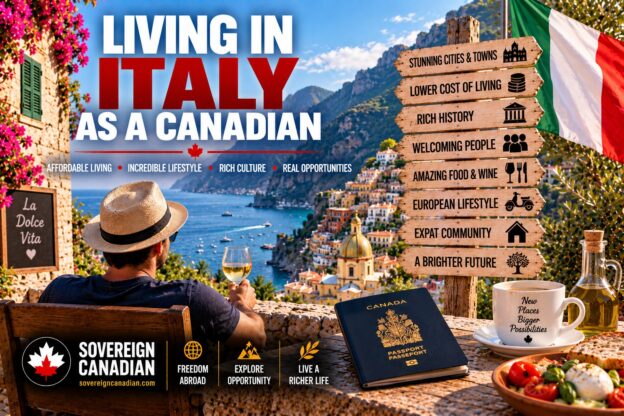
Living in Italy as a Canadian with an Italian coastal town, Mediterranean Sea, Italy flag and Canadian passport

Living in Italy as a Canadian: Families, Retirement, Sabbaticals and the Reality Behind the Dream

Italy is the easiest country in this series to want and one of the harder ones to think clearly about. Two weeks of trains, piazzas, markets and long lunches can leave a Canadian half-convinced they should sell the house and move, and the brochure version of that decision is everywhere: cheap stone cottages, la dolce vita, a slower and richer life. I am not immune to it. I find the Italian case genuinely compelling, which is exactly why I want to be careful with it. The useful question for this series is not whether Italy is wonderful, because it plainly can be. The question is whether the Italy you fall for on holiday survives an ordinary Tuesday: the bureaucracy, the taxes, the slower institutions, the language, the regional inequality, and the gap between visiting a place and being administered by it.

The short version, which the rest of this piece will earn, is that Italy rewards one kind of Canadian and quietly punishes another, and the dividing line is almost entirely about where your money comes from and how much of Italian life you are actually willing to join. Bring your income with you, choose one region with real intent, treat Italian as non-optional, and Italy offers one of the deepest lifestyle returns in Europe. Arrive needing to earn locally, expecting effortless paperwork, planning to live in English, or hoping for a simple tax return, and it becomes one of the weaker choices in Western Europe. Italy is unusually good at being lived in slowly. It is unusually bad at being treated as a frictionless international product.

Continue reading →


Living in Portugal as a Canadian with Lisbon rooftops, Tagus River, Portugal flag and Canadian passport

Living in Portugal as a Canadian: Families, Retirement, Sabbaticals and the New Expat Reality

This is part of the Sovereign Canadian Expat Living series, where I work through what actually living in another country buys a Canadian, what it costs, and which chapter of life it fits. This is personal documentation and analysis, not immigration, tax, legal, or investment advice. Rules here change fast; verify current figures with primary sources before you act on anything.

There is a version of Portugal that lives on in expat videos and relocation blogs: cheap Lisbon apartments, a decade of near zero tax under NHR, a Golden Visa you buy with an apartment, five years to an EU passport, and healthcare that is simply free. Almost every specific claim in that pitch has since been closed, narrowed, or repriced. The old NHR regime shut its doors to new applicants at the end of 2023. The Golden Visa has not touched real estate since October of that same year. Portuguese house prices recorded the largest annual increase anywhere in the European Union heading into 2026. And as of May 2026, the citizenship clock for a Canadian runs ten years, not five.

Continue reading →
Living in Mexico as a Canadian with a tropical Mexican coastline, Mexico flag, Canadian passport and expat lifestyle

Living in Mexico as a Canadian: Snowbirds, Families, Sabbaticals and Retirement

Most articles about Mexico answer a question almost nobody serious is actually asking. They tell you whether Mexico is a nice place to visit. Of course it is. The harder and more useful question is whether a Canadian could build part of a life here, and the honest answer is that it depends entirely on which life you mean.

Mexico is one of the very few countries where a financially comfortable Canadian can plausibly imagine several completely different arrangements. Three winter months in Puerto Vallarta. A family year in Merida. Two years working remotely from Playa del Carmen. Raising children in Mexico City. Retiring near Lake Chapala. Keeping a house in Ontario while establishing a second base south of the border. Each of those is a different decision with different math, different risks, and a different verdict.

Continue reading →
Most popular expat destinations for Canadians with signs pointing to Portugal, Mexico, Spain, Costa Rica, Italy, Thailand and Japan

Most Popular Expat Destinations for Canadians: Where Canadians Actually Go

Most people start with the wrong question. They ask “where should I move?” as if there were a single correct answer waiting to be found, a country that quietly outscores all the others once you run the numbers. There isn’t one. The reason is simple: Canadians who leave are not all trying to build the same life. A retired couple chasing a warm, cheap winter has almost nothing in common with a 34-year-old software engineer weighing a job offer in Dubai, and neither of them is solving the problem a young family faces when they want their kids to spend a year inside a different culture before high school swallows the chance.

So this article does not crown a winner. It surveys the map. It looks at where Canadians repeatedly end up when they decide to spend real time abroad, why those places keep pulling people in, and what kind of Canadian each one actually suits. Some of these destinations are popular because they are warm, cheap, and a direct flight from Toronto. Some are popular because that is where the careers are. Some are popular in a quieter way, the kind of place a certain type of person investigates once and never stops thinking about.

Popular is a useful signal. It tells you a destination solves a real problem for real people. It is not the same thing as best, and treating it that way is how Canadians end up buying a condo somewhere that suited someone else’s life.

Continue reading →
Bigger house or finish the basement: a two-storey home exterior at dusk beside a finished basement living room.

Bigger House or Finish the Basement? How I’m Actually Thinking About It

I’ve noticed something over the last few years as I’ve written more for Sovereign Canadian. Almost every major financial decision eventually disguises itself as something much smaller. Buying a cottage isn’t really about buying a cottage. Buying offshore real estate isn’t really about buying another property. Even deciding whether to acquire a business or continue investing in index funds isn’t fundamentally about the asset itself. They’re all capital allocation decisions. They’re simply different ways of answering the same question: where should the next chunk of our family’s wealth go?

That realization is why I’ve become less interested in questions like “Can I afford it?” and much more interested in “What am I giving up by saying yes?” Every major purchase closes off other possibilities. Every dollar committed to one decision is a dollar that isn’t available for another. Sometimes the answer is still obvious. Sometimes it isn’t.

This latest decision has been disguised as a basement renovation.

Continue reading →

If Your Job Is Thriving — Optimize, Acquire, or Build a Side Hustle?

If your job is thriving, most people do the same thing: relax. Others panic in the opposite direction and rush to buy a side hustle they haven’t thought through. Both are wrong — and both come from the same place: no framework.

They upgrade the car. They move into the bigger house. They tell themselves they’ve “made it.” Five years later they’re earning more than ever — and somehow still living paycheque to paycheque, completely dependent on a single employer, no closer to sovereignty than when they started.

Thriving at your job is not the destination. It’s fuel. The question is what you burn it on.

Continue reading →

Wills, Executors, and Tax at Death: Getting Your Parent’s Affairs in Order Before It Matters

This is part eleven of the series on moving an elderly parent into your home. By now you have the multigenerational household running, the power of attorney signed, and maybe home care sorted. The one thing most families never get to is the will – because talking about a parent’s death while they are sitting at your kitchen table feels ghoulish. But the will, the executor you will probably become, and the tax at death are exactly what fall on you when the time comes.

Continue reading →

Selling the Parent’s Home to Fund Care: The GIS Trap Nobody Warns You About

When a parent needs care that their monthly income can’t cover — private home care, a retirement home, the preferred room in long-term care — the family home is the obvious place to find the money. It’s usually their largest asset, and selling it is often the right call. But it’s also where a well-meaning family quietly destroys a low-income parent’s government benefits, because almost nobody understands what selling actually does.

Here’s the trap in one sentence: your parent’s house is invisible to their GIS, but the moment you sell it and invest the proceeds, you make that money visible — and their Guaranteed Income Supplement drops fifty cents on the dollar while their long-term care co-payment climbs. You can turn a benefit-neutral asset into a benefit-destroying income stream with a single well-intentioned transaction. This post is about unlocking the house without doing that.

Continue reading →

Powers of Attorney and Planning for Incapacity: The Documents That Let You Actually Help

Every other post in this series quietly assumes something that isn’t automatically true: that you can act for your parent — pay their bills, manage their money, decide on their care, sign them into a long-term care home. You can’t, not legally, unless they’ve signed two specific documents while they were still mentally capable. Without them, the moment a parent loses capacity, you have zero legal authority over their finances or their care — no matter that you’re their child, no matter how close you are — and you’re forced into a slow, expensive court process to get it.

Continue reading →

When Home Isn’t Enough: Long-Term Care and Placement in Ontario

This is the hardest post in the series to write, and probably the hardest one to read, because it’s about the moment the plan changes. Everything up to here has been about keeping a parent in your home — the suite, the benefits, the rent, the credits, the PSW hours brought in to stretch it as far as it goes. But home care, even maxed out, has a ceiling. Sometimes the safe, loving, honest answer is a long-term care home.

Reaching that point is not a failure of love or effort. It’s the responsible far end of a commitment you made with your eyes open — and handling it well, early, and without guilt is its own act of care. The families who suffer most are the ones who refuse to plan for it until a crisis forces a rushed, bad decision at the worst possible moment. This post is how you avoid that: the honest signals that you’ve hit the ceiling, how placement actually works in Ontario, what it costs, and how to make the tax system carry part of the load.

Continue reading →