Vietnam real estate investing for Canadians - Ho Chi Minh City skyline and Saigon River at sunset from a high-rise apartment terrace with a Vietnamese flag

Vietnam Real Estate Investing for Canadians

This is a country deep-dive in the Sovereign Canadian international real estate series. Like everything here, it is personal documentation of how I am working through my own portfolio decisions, not financial or legal advice. The mechanics that sit above every country – the CRA reporting, the financing reality, the four reasons anyone does this – live in the foreign real estate pillar post. And when I went looking for where Canadians are actually buying in my offshore real estate survey, Vietnam turned up as “an emerging low-entry option.” That is exactly the kind of line that earns a country its own post, so here it is.

Vietnam is the frontier bet of this series, and I want to be honest about that from the first paragraph. This is not Mexico, where a Canadian can fly down, buy near the beach through a routine bank trust, and be a snowbird by Christmas. It is not Spain, where a non-resident can get a mortgage and a clean freehold title. Vietnam is the most structurally different market I have looked at so far: you cannot own the land, and your ownership of the home itself is time-limited; local banks will not lend to you; and the short-term-rental rulebook has been rewritten twice in eighteen months. It is a genuine growth story wrapped around a real Canadian-reporting tail and a slow currency headwind.

Continue reading
hailand real estate investing for Canadians - condo balcony overlooking the Chao Phraya River at sunset with Wat Arun and a Thai flag

Thailand Real Estate Investing for Canadians

A country deep-dive in the Sovereign Canadian international real estate series, sitting under the foreign real estate investing pillar that covers the Canadian-side mechanics in full. This is personal documentation of how I’d approach the decision, not advice. Thailand’s rules are moving fast in 2026, so verify the live numbers the week you transact.

Here’s the decision that comes before every other decision in Thailand: you will never own the land, so buy the one thing you can actually hold in your own name – a condominium, in freehold, inside the 49% foreign quota.Everything else on offer – the beach villa, the pool house, the “company-owned” plot – is a workaround, and every workaround trades away control for lifestyle. If you internalize only one line from this post, make it that one. It disqualifies half the listings you’ll be shown and saves you from the single most common way Canadians get quietly fleeced here.

Continue reading

If Your Job Is Thriving — Optimize, Acquire, or Build a Side Hustle?

If your job is thriving, most people do the same thing: relax. Others panic in the opposite direction and rush to buy a side hustle they haven’t thought through. Both are wrong — and both come from the same place: no framework.

They upgrade the car. They move into the bigger house. They tell themselves they’ve “made it.” Five years later they’re earning more than ever — and somehow still living paycheque to paycheque, completely dependent on a single employer, no closer to sovereignty than when they started.

Thriving at your job is not the destination. It’s fuel. The question is what you burn it on.

Continue reading

The Most Popular Offshore Real Estate Locations for Canadians

A data-led ranking of the most popular offshore real estate for Canadians – where other Canadians are actually buying property abroad, not my shortlist but the market’s. This is a standalone survey in the Sovereign Canadian international real estate series; for the how-it-actually-works mechanics behind any of these markets, start with the foreign real estate investing pillar post. As always, this is personal documentation and research, not financial or legal advice.

Most “best places to buy abroad” lists are really just the writer’s own wish list with a ranking bolted on top. I’ve written a few posts that are exactly that. This one is different on purpose: I went looking for what other Canadians are actually buying, searching for, and retiring to – the objective popularity picture, independent of what happens to be on my personal radar. Some of it confirmed what I already assumed. Some of it sent me looking hard at countries I’d never seriously considered.

Continue reading

Slovenia Real Estate Investing for Canadians

Every country in this series has a pitch. Mexico’s is yield. Portugal’s is lifestyle-with-EU-access. Slovenia’s pitch is quieter, and it took me longer to take it seriously than it probably should have: this is a two-million-person country wedged between Italy, Austria, Croatia, and Hungary that keeps landing in the same top-ten lists as Iceland and Switzerland for safety, runs a full EU/Schengen/eurozone membership, and still lets Canadians buy property with the same rights as Slovenian citizens — no golden visa gimmick, no shell company requirement, no reciprocity application to file. That last point alone puts Slovenia in a smaller club than most of the countries we’ve covered so far.

Continue reading
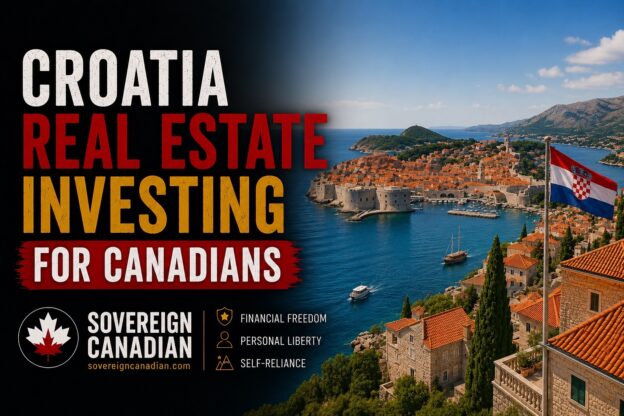
Croatia real estate investing for Canadians - Dubrovnik old town, Adriatic harbour, and Croatian flag

Croatia Real Estate Investing for Canadians

Mexico sells yield. Portugal sells lifestyle and a legal system you recognize. Croatia sells something neither of them can: full EU membership, the euro already in your wallet, and a coastline that’s still catching up to its own tourism numbers.

If you’ve read the Mexico intro post or the Portugal intro post, you know how I open these — with the honest version of “why here, and why not somewhere cheaper or closer.” For Croatia, the honest version is this: it’s the only market in this series where you’re buying into a country that finished its integration story. EU accession happened in 2013. It adopted the euro in January 2023. It joined the Schengen zone the same year. There’s no currency conversion drama, no “will this country still be in the EU in ten years” question, and no separate visa-free travel calculus once you’re in. You’re buying property in a fully normalized European jurisdiction that also happens to have 1,700+ islands and some of the clearest water in the Mediterranean.

Continue reading

Cyprus Real Estate Investing for Canadians

Mexico sells proximity. Portugal sells a legal system you already understand. Cyprus sells something neither of those two can: an EU passport-adjacent foothold at a price point that still looks like 2015 Lisbon.

If you’ve read the Mexico introduction post or the Portugal primer, you know how I open these — with the honest version of why anyone would put capital into this particular country instead of the dozen other places selling sun and yield. For Cyprus, the honest version is this: it’s the cheapest entry point into the European Union’s property and residency system that still comes with genuine rental demand, a common-law-influenced legal system, and a tax regime that rewards people who structure things properly. It is also an island with an unresolved territorial split sitting sixty kilometres from Syria and Lebanon, a foreign-ownership law that’s actively being rewritten as I write this, and a short-term rental compliance regime that has real teeth. None of that is a deal-breaker. All of it needs to be priced in before you wire a deposit.

Continue reading
Albania real estate investing for Canadians — sunset over the Albanian Riviera coastline with the Albanian flag and a hillside terrace

Albania Real Estate Investing for Canadians

Everyone in this series so far has been chasing something familiar. Mexico is proximity. Portugal is EU access and a legal system you half-recognize. Albania is neither of those things, and that’s exactly why it’s worth a post.

If you’ve read the foreign real estate pillar post, the Mexico introduction, or the Portugal guide, you know my bias: I want yield, I want a clear path to ownership, and I want a country that isn’t going to change the rules on me three years after I wire the deposit. Albania checks the first two boxes better than almost anywhere else in Europe right now — genuinely double-digit gross yields on the coast, land you can own outright as a foreigner in most cases, entry prices that make Portugal look expensive by comparison. The third box is the interesting one, because Albania is mid-transformation. It’s an EU candidate country with all 33 negotiation chapters open, a tourism sector that tripled in visitor numbers in a decade, and a property market still priced like nobody’s noticed. That combination — improving fundamentals plus a market that hasn’t repriced yet — is usually where the money gets made. It’s also usually where the due diligence has to work harder, because the legal and regulatory scaffolding is still being built while you’re standing on it.

Continue reading

Wills, Executors, and Tax at Death: Getting Your Parent’s Affairs in Order Before It Matters

This is part eleven of the series on moving an elderly parent into your home. By now you have the multigenerational household running, the power of attorney signed, and maybe home care sorted. The one thing most families never get to is the will – because talking about a parent’s death while they are sitting at your kitchen table feels ghoulish. But the will, the executor you will probably become, and the tax at death are exactly what fall on you when the time comes.

Continue reading

Moving Money to a Low-Income Parent Without Wrecking Their GIS

Once your parent moves in, the money conversation stops being abstract. You are the higher earner. They are a low-income parent living on Old Age Security, maybe a thin CPP cheque, and the Guaranteed Income Supplement that tops it up. You want to help – cover a dental bill, hand them a cushion, put something in their name. And somewhere in the back of your mind is a warning you half-remember: don’t give them too much or you’ll wreck their benefits.

That warning is half right and half backwards. The part almost everyone gets wrong is the part that matters most.

Continue reading