
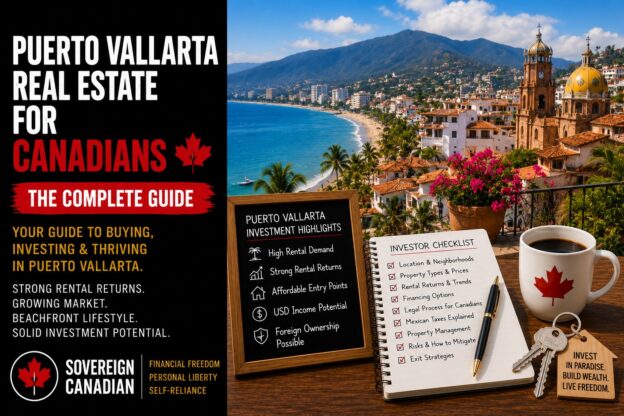
This is the post where the series changes states — literally. Everything we’ve covered so far in Mexico has been Quintana Roo: the Riviera Maya guide, the Playa del Carmen real estate deep dive, and the Tulum post all operate under the same state regulator, the same RETUR-Q registration regime, the same Caribbean demand engine. Puerto Vallarta real estate runs on different rails. It’s in Jalisco, on the Pacific, with its own tax rates, its own regulatory trajectory, and — as of February 2026 — its own headline risk that we need to talk about like adults.
Three things you should know before we get into neighbourhoods, because each one would be buried in the second half of a promotional post and each one changes the investment case:
First, the regulatory regime is different — and currently lighter. There is no RETUR-Q here. Jalisco has historically been one of the least regulated major STR markets in Mexico, but that’s ending: the state lodging tax rose to 5% in January 2026, the municipality is bringing platform rentals into its business licensing system under the 2026 income law, and there’s a bill in the Jalisco Congress proposing a Mexico City-style 180-night annual cap. You’d be buying into a market mid-transition from unregulated to regulated. That’s happened everywhere else in this series; Vallarta is just later to it.
Second, the occupancy math is worse than the sales decks say. Market-wide Airbnb occupancy in Puerto Vallarta is sitting around 38%. Not 70%. Thirty-eight. The averages include a long tail of mediocre listings — good operators in good buildings do meaningfully better — but if a developer’s pro forma assumes 65–75% occupancy at a US$227 average daily rate, they are describing the top decile and pricing you as if you’ll land in it.
Third, February 2026 happened. Mexican forces killed the CJNG’s founder in an operation in inland Jalisco, and the cartel’s retaliation — road blockades, burned vehicles, a brief shelter-in-place that reached Puerto Vallarta and closed the airport for about two days — played out across the state. The situation normalized within days, tourists weren’t targeted, and Canada returned Jalisco to its prior advisory level. But if you’re underwriting a rental property whose income depends on Canadian and American tourists feeling comfortable, you don’t get to pretend that week didn’t happen. We’ll deal with it properly in the safety section.
If you’re new to this series, start with the Mexico introduction post for the fideicomiso and Canadian tax basics — all of that applies identically here, because Puerto Vallarta sits squarely inside the restricted coastal zone. This post assumes you know that framework and want the Vallarta-specific version.
Why Puerto Vallarta at All
The honest case for Puerto Vallarta real estate is maturity, not momentum. This is not Tulum, where half the inventory didn’t exist five years ago. Vallarta has been a functioning international destination since the 1960s, has a metro population around 578,000 growing at roughly 1.9% a year, and has a foreign ownership ecosystem — notaries, property managers, rental platforms, an established MLS — that Quintana Roo markets are still building.
The demand base is also structurally different from the Caribbean coast, in three ways that matter to a Canadian owner:
The Canadian connection is real, not marketing. Nearly half a million Canadians fly into Puerto Vallarta annually, with direct routes from Toronto, Montreal, Calgary, and Vancouver, and carriers adding capacity. On the Riviera Maya you’re one nationality among many; in Vallarta, Canadians are a core demand pillar. That matters for your rental calendar (Canadian snowbird season is long and predictable) and for eventual resale (a large share of buyers for your unit will be people like you).
The infrastructure spend is front-loaded and visible. The airport’s 9.2-billion-peso Terminal 2 will roughly double capacity to 12 million passengers annually by 2027. The new “vía corta” highway has cut the Guadalajara drive dramatically, opening the city to Mexico’s second-largest metro for weekend demand. The Puente Amado Nervo bridge now ties the Jalisco and Nayarit sides of Banderas Bay together. These aren’t renderings; they’re built or building.
There’s a domestic buyer beneath you. Guadalajara money buys in Vallarta. That’s a price floor Tulum doesn’t have. When foreign demand softens — and February showed it can, abruptly — a market with Mexican middle- and upper-class buyers underneath it corrects rather than craters.
The honest case against: this market already had its boom. The COVID-era surge in pre-sales left a hangover of undercapitalized developers still trying to sell into a much more balanced market. Inventory has expanded 50–100% year over year depending on the segment, average days-on-market is around 255 — eight to nine months — and mid-market condos appreciated roughly 0–4% over the past year while luxury view properties did 20%+. This is a two-speed market where the average unit is going nowhere fast. You are not buying appreciation here; you’re buying a functioning rental market at a negotiable price. Buyers are routinely getting ~6% off asking, and more on stale listings. Use that.
The Neighbourhoods That Actually Matter
Prices below are asking-price ranges per square metre for condos as of mid-2026, converted at roughly 18 pesos to the US dollar. The market quotes in USD at the top end and pesos at the bottom, which tells you everything about who the sellers think their buyers are.
Zona Romántica (Emiliano Zapata): The Default, Priced Like It
This is the neighbourhood people mean when they say Puerto Vallarta: the walkable grid south of the Río Cuale, packed with restaurants, galleries, and the highest-density STR demand in the city. It’s also the centre of gravity of Vallarta’s standing as one of North America’s premier LGBTQ+ destinations — a demand segment that is loyal, repeat-visit, and less seasonal than families, which is genuinely valuable for a rental calendar.
Pricing runs roughly MXN 65,000–120,000 per m² (US$3,500–6,500), with prime blocks pushing past that. Entry-level studios start around US$150,000–160,000; realistic two-bedroom budgets are US$300,000–400,000. Gross STR yields here tend to land in the 4–6% range — the purchase price compresses the ratio, and you’re paying for occupancy reliability and resale liquidity rather than cash flow.
The contrarian note: parts of the Romántica case rest on “it’s the established area,” and established cuts both ways. Some of the building stock is aging, the neighbourhood has arguably peaked as a growth story, and you’re competing against thousands of nearly identical one- and two-bed condo listings. If you buy here, buy the building and the view, not the postal code.
Safety note: Romántica is among the safest districts in the city day and night — heavy foot traffic, tourist police, good lighting. The realistic risks are petty theft and bar-district pickpocketing, not violence.
Versalles: The Yield Play Everyone Now Knows About
Five years ago Versalles was a local residential grid inland from the Hotel Zone. Today it’s the most-cited gentrification story in Vallarta — restaurant row, mid-rise condo construction, and the US$320-million Distrito Versalles project anchoring institutional confidence in the area. Pricing is meaningfully below Romántica, and gross yields on well-run units in the value corridor (Versalles, 5 de Diciembre, parts of Centro) reach 6.5–8.5% — the best cash-flow math in the city.
The trade-offs are real: you’re a 15–20 minute walk from sand, guests are choosing you on price and restaurants rather than beach access, and the construction pipeline around you is heavy. New supply is the enemy of your occupancy. My read: Versalles is the right neighbourhood for a cash-flow-first buyer who will compete on operations, and the wrong one for someone who wants to set-and-forget a beach condo.
Safety note: gentrifying areas are transitional by definition — perfectly comfortable on the main corridors, rougher at the edges, and quieter at night than the tourist core. Walk it after dark before you buy.
5 de Diciembre and Centro: The Middle Path
Between the Malecón and the Hotel Zone, 5 de Diciembre offers something Romántica can’t: walkability to the boardwalk and beach at a discount, with a more Mexican street feel. It shows up alongside Versalles in every gentrification analysis, with price appreciation in the high single digits annually — at or slightly above the national SHF trend of 8–10%. This is where I’d look for the balance of yield and long-term appreciation, particularly on view units on the hillside streets.
Safety note: comparable to Romántica on the tourist-facing blocks; standard city awareness applies as you move uphill and inland.
Marina Vallarta: The Families-and-Golf Quadrant
Gated buildings, 24/7 security, the yacht harbour, the golf course, ten minutes from the airport. Marina is the most physically secure neighbourhood in the city and rents well to families and older travellers who want polish over nightlife. Pricing overlaps the upper Romántica band. Two flags: some of the building stock dates to the late ’80s and ’90s, so inspect for deferred maintenance and confirm HOA reserves — and note that HOA fees in amenity-heavy buildings here can run MXN 15,000–30,000 a month at the top end, which quietly eats a yield. The airport Terminal 2 expansion directly benefits this quadrant.
Safety note: the safest neighbourhood in the city by design. Your risk here is financial (HOA health, special assessments), not personal.
Conchas Chinas and Amapas: The Trophy Cliffs
South of Romántica, the hillside neighbourhoods hold the most expensive real estate in Vallarta — MXN 100,000–200,000 per m² (US$5,600–11,200) for cliffside view properties. This is also where the two-speed market is most visible: luxury view properties appreciated over 22% in a single recent year while the mid-market sat flat. If you have the capital, scarce view inventory here is the strongest appreciation story in the city. But be aware that hillside construction is exactly where municipal enforcement on permits and setbacks is most likely to tighten under the 2024–2027 municipal plan — do serious permit due diligence on anything new.
Safety note: quiet, residential, low crime; the practical risks are steep access roads and construction quality on slopes.
The Hotel Zone and Fluvial: The Supply Frontier
The high-rise corridor along the northern beaches plus the master-planned Fluvial district inland is where the cranes are. New builds command about a 12% premium per m² over comparable resale, pre-sale inventory is 25–35% of listings, and this is where the undercapitalized-developer risk from the COVID pre-sale boom is concentrated. If you buy pre-construction here, everything from the Riviera Maya guide about developer due diligence applies double: verify the land title, the permits, the construction financing, and the developer’s completed track record — not their renderings. The strong move in 2026’s balanced market is negotiating the resale unit two buildings over at 6%+ off asking instead.
A Note on the Other Side of the Bay
Nuevo Vallarta, Bucerías, and the Punta Mita corridor are twenty minutes north and constantly marketed alongside Puerto Vallarta — but they’re in Nayarit, a different state, with different lodging taxes, different registration rules, and a different (Tepic-based) bureaucracy. The new bridge makes the bay feel like one market; legally it is not. The Riviera Nayarit deserves its own analysis and I’m deliberately excluding it here. If an agent quotes you “Puerto Vallarta” compliance rules for a Bucerías condo, that’s your signal to find a better agent.
The Occupancy Reality Check
Same exercise as Playa and Tulum, harsher numbers. Across roughly 6,400–6,500 active listings, Puerto Vallarta’s market-wide short-term rental profile looks like this: about 38% average occupancy, a US$227 average daily rate, and average annual revenue in the low US$20,000s per listing. February is the peak month; September is the trough, and the summer shoulder is soft and last-minute (average booking lead time drops to ~34 days in August versus ~104 in January).
Run the honest math on a US$300,000 Romántica two-bed: at a 6.5% gross yield you’re at roughly US$19,500 in annual revenue. Take off 30–40% for management, platform fees, HOA (budget MXN 4,000–7,000/month for a typical mid-market building), utilities, and maintenance, and your net is US$11,700–13,650 — a 3.9–4.6% net yield before Mexican and Canadian income tax. Long-term rentals net closer to 3.5–4%. Those are the market-average outcomes. Beating them is possible — top-decile listings clear US$6,000+ per month — but that’s an operations business, not a passive investment, and supply is still growing at ~6% a year against demand that just took a headline shock.
The seasonality also matters for a Canadian owner specifically: the peak rental months (December–April) are exactly the months you’d want to use the place yourself. Every snowbird week you keep is your highest-revenue inventory. Decide which business you’re in before you buy.
STR Rules: Lighter Than Quintana Roo, Tightening Fast
Here’s the regime as it stands in mid-2026, and where it’s headed:
State lodging tax: 5% as of January 2026. Jalisco’s Impuesto Sobre Hospedaje rose from 4% to 5% effective January 2026 — the third consecutive annual increase. Airbnb collects and remits it automatically on Jalisco listings (calculated on the nightly price including cleaning fees). Guests pay it, but it’s part of your price competitiveness against hotels.
Municipal platform licensing: arriving via the 2026 income law. Puerto Vallarta’s municipal government moved to bring platform rentals into the same business-licence framework hotels operate under — registration with the city and an annual licence fee, with the measure incorporated into the 2026 municipal revenue plan. The era of the fully informal Vallarta Airbnb is closing. Confirm the current registration requirement with the municipality (or a local accountant) before you list, because enforcement regimes always start messy.
The 180-night cap proposal: not law, but on the table. A bill in the Jalisco Congress would cap platform rentals at 180 nights per year statewide, mirroring Mexico City’s 2024 framework, alongside taxes on vacant properties — framed explicitly as anti-gentrification policy. It hasn’t passed, and Vallarta’s tourism economy gives the city a strong lobby against it. But price the possibility: at 38% market occupancy, a 180-night cap (49% of the year) wouldn’t bind the average operator at all — it would specifically punish the top-decile operators whose pro formas justify today’s prices. Read that sentence again before you pay a premium for “proven rental income.”
The new visitor tax: noise, not signal. Starting January 2026 Puerto Vallarta charges foreign tourists a one-time per-stay municipal tourism fee, paid separately at kiosks rather than through platforms. It’s currently framed as effectively voluntary with no published penalty. It doesn’t change your math; it does confirm the direction of travel — this municipality intends to monetize tourism harder every year.
Federal tax mechanics: identical to Quintana Roo. SAT registration (RFC), 16% IVA on furnished short-term rentals, platform withholding for hosts, and for non-residents the choice between flat withholding on gross rents or electing to file on net income in Mexico. Nothing here differs from what we covered in the Mexico introduction post; get a Mexican accountant, it’s a few hundred dollars a year and it’s not optional.
Fideicomiso, Financing, and the Canadian Side
Short version, because this series has covered it in depth: Puerto Vallarta is inside the restricted zone (within 50 km of the coast), so as a Canadian you hold through a fideicomiso — a renewable 50-year bank trust — or, for genuinely commercial multi-unit operations, a Mexican corporation. Budget 5–7% of purchase price in closing costs and a US$500–700 annual trustee fee as a permanent carrying cost. Financing remains the same story as everywhere in Mexico: developer financing on pre-sales, expensive peso mortgages (Banxico’s benchmark rate has been cut into the 6.5–7% range, so local financing is slowly getting cheaper, but cross-border mortgages for Canadians remain rare and unattractive), or — the way most Canadians actually do this — Canadian home equity deployed as cash. The what-comes-after-the-cottage post covers that decision framework.
On the CRA side, nothing changes by state: rental income goes on a T776 (in Canadian dollars), the property and fideicomiso interest go on a T1135 if your total specified foreign property exceeds $100,000 in cost, Mexican tax paid generates a foreign tax credit via T2209 under the Canada–Mexico treaty, and the eventual sale is a taxable capital gain in Canada with Mexican ISR creditable against it. Keep every facture.
A Direct Note on Cartel Risk and February 2026
I’m not going to launder this through euphemism, because the whole value of this series is that we don’t.
On February 22, 2026, Mexican forces killed Nemesio “El Mencho” Oseguera Cervantes, founder of the Jalisco New Generation Cartel, in an operation in Tapalpa, inland Jalisco. The retaliation was statewide and immediate: road blockades, vehicle burnings, shelter-in-place advisories that explicitly included Puerto Vallarta, suspended taxis and rideshares, and a roughly two-day disruption at PVR airport. Within days, flights resumed, the shelter-in-place was lifted, economic activity restarted, and both the U.S. and Canadian advisories walked back to their prior levels. No tourists were targeted; the violence was directed at the state, not at visitors. Jalisco’s tourism authorities also had to publicly debunk AI-generated images of Vallarta supposedly in flames — a genuinely new category of headline risk for a rental market.
What should a Canadian investor actually take from this?
The baseline is better than the headlines. As of the Government of Canada’s current Mexico advisory, the only part of Jalisco under “avoid non-essential travel” is the strip within 50 km of the Michoacán border — deep inland, nowhere near the coast. Puerto Vallarta sits under the country-wide “exercise a high degree of caution” level, the same as Cancún and Mexico City, and even has its own Canadian consular agency in the Hotel Zone. Puerto Vallarta’s tourist zones are explicitly carved out of the broader Jalisco advisories precisely because the city’s crime profile — heavy on petty theft and public drunkenness, light on violence against visitors — doesn’t match the inland state’s. Day to day, Romántica, the Malecón, and Marina Vallarta are among the safer urban environments in Mexico. That’s consistent with everything we found in Playa del Carmen and Tulum: cartel conflict is overwhelmingly gang-on-gang, and tourists are the economy both sides depend on.
But the tail risk is fatter here than in Quintana Roo. CJNG is headquartered in this state. When the Mexican government escalates against it — and a leadership decapitation guarantees a succession struggle — the disruption happens here, on your access roads and at your airport, not in someone else’s state. February cost operators most of a week of peak-season revenue and an unknowable amount of forward bookings, and Jalisco tourism officials themselves acknowledged Vallarta was “still struggling a little” into the spring. If your investment only works at top-decile occupancy with no allowance for a lost week or a soft season every few years, it doesn’t work.
Practical underwriting response: haircut your revenue assumption 5–10% below whatever the pro forma says for headline-risk seasons, carry a cash reserve that covers six months of HOA and trustee fees without rental income, and make sure your insurance and your property manager both have a protocol for guest cancellations during security events. One more Vallarta-specific item flagged in embassy notices: a pattern of dating-app-facilitated extortion targeting visitors in the Vallarta/Nuevo Nayarit area. It’s a guest-safety point worth including in your house manual, not an investment factor — but you should know the local risk landscape better than your guests do.
The Verdict: What I’d Actually Do
Ranked, same as always, for a Canadian buying one property with rental intent:
1. A view unit in 5 de Diciembre or upper Romántica, bought at a discount off a stale listing. The 255-day average days-on-market is your leverage. Walkable-core view properties are the segment with both defensible occupancy and real appreciation (the only segment that did 20%+ last year). Offer 8–10% under asking on anything listed six months or more, and let the two-speed market work for you.
2. A Versalles cash-flow condo — if you’ll operate it seriously. Best gross yields in the city (6.5–8.5%), lowest entry prices in a gentrifying corridor, institutional money validating the area. The catch is you’re competing on operations against growing supply, and a future 180-night cap would hit high-performing operators hardest. Right buy for the wrong-personality investor is still a wrong buy.
3. Marina Vallarta resale for the security-first, family-renter strategy. Slower money, calmer ownership, airport-expansion tailwind. Inspect the building’s bones and the HOA’s books harder than the unit.
4. What I’d skip: pre-construction in the Hotel Zone/Fluvial pipeline. Buying new supply at a 12% premium, from a developer cohort with known capitalization problems, into a market with 50–100% more inventory than a year ago and flat mid-market pricing, is taking every risk in this post simultaneously. The resale unit next door is cheaper and exists.
And the meta-verdict, consistent with the whole Mexico arc: Puerto Vallarta is the most livable, most operationally mature market we’ve covered in this country — and in 2026 it’s a buyer’s market with a regulatory bill coming due and a fat geopolitical tail. If your plan includes actually spending winters in the unit, the lifestyle-adjusted math here beats Playa and crushes Tulum. If this is a pure spreadsheet investment, the 38% market occupancy number should make you slow down, negotiate hard, and underwrite like an adult. Better yet, rent here for a season first — the reconnaissance approach costs you one winter and can save you a mispriced quarter-million-dollar decision.
Next in the Mexico series: we cross the Ameca River to the Riviera Nayarit — Nuevo Vallarta, Bucerías, Sayulita, and Punta Mita — where the beaches are marketed as one bay with Puerto Vallarta but the legal and tax regime belongs to an entirely different state. That distinction is worth a full post.
See further reading:
– Government of Canada Mexico travel advisory (safety section)
– Jalisco Secretaría de la Hacienda Pública / SEFIN (lodging tax) — STR rules section
– SHF housing statistics (appreciation data)
– Grupo Aeroportuario del Pacífico (Terminal 2 expansion) — infrastructure section
Disclaimer: This post is for information and education only and is not legal, tax, or investment advice. Real estate rules, tax rates, and security conditions in Mexico change frequently and vary by state and municipality. Verify current requirements with a Mexican notario, a cross-border accountant, and official government sources before purchasing. All figures are estimates as of mid-2026 and will go stale.